On this page
What is SaaS SEO, and what actually makes it different
SaaS SEO is search engine optimization for software companies that sell subscriptions. That one word, subscriptions, changes almost everything about how you should do it.
The plain definition
SaaS SEO is the work of getting your software found in search by the people who would pay for it, and turning those searches into trials, demos, and signups. Some people call it SEO for SaaS. Same thing. In practice it covers four jobs that must run together: keyword strategy, the content that targets those keywords, the technical health that lets it all rank, and links that build trust. Miss one and the other three underperform.
The goal is not traffic. The goal is pipeline. A SaaS site with 3,000 visits a month from buyers will beat a site with 50,000 visits from students copying homework answers, every single time. Keep that sentence. Half of this guide is that sentence applied to different decisions.
The three things that are actually different
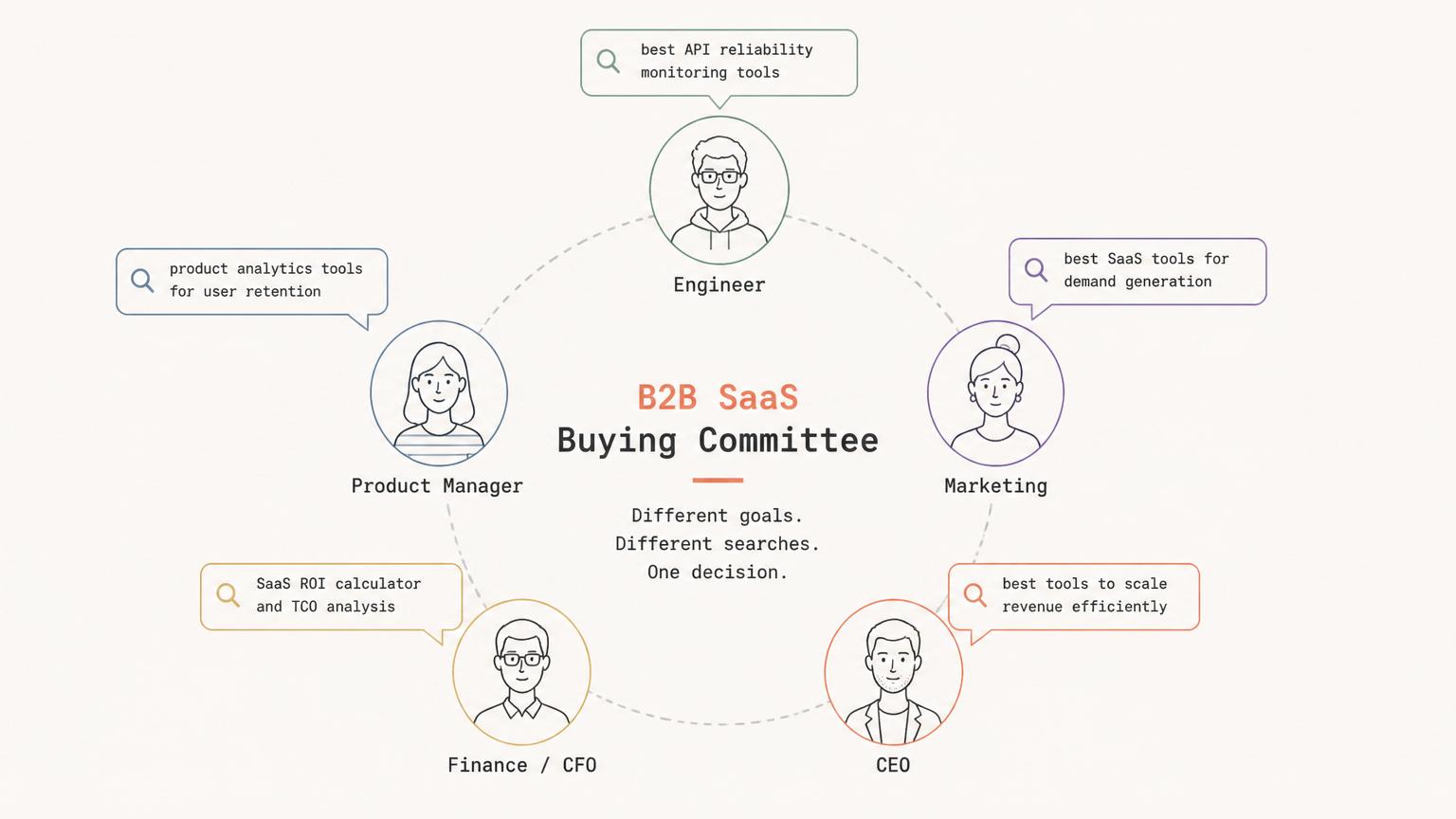
First, you sell to a committee. A B2B software purchase usually involves several people, and each one searches in their own way. The engineer reads your API docs. The manager searches your name against a competitor's. The finance lead searches your pricing and whether anyone serious uses you. One deal, many different searches, spread over weeks or months. Your SEO has to show up for all of them. That is why a SaaS keyword plan looks nothing like a blog calendar.
Second, the economics are upside down compared to most industries. One customer can be worth tens of thousands of dollars a year, for years. So a keyword with 90 searches a month can matter more than one with 9,000, if those 90 people are choosing a vendor this quarter. In e-commerce, volume wins. In SaaS, intent wins.
Third, your product is itself a search asset. Free tools, templates, integrations, and documentation can rank and bring in buyers directly. No other industry gets to do this the way software does, and the companies that use it grow on a different curve. Chapter 7 covers it in detail.
What does not change
Google still works the same way for everyone. Your pages must be crawlable, they must load fast, they must answer the search better than the other results, and they earn trust through links and mentions. One more constant that grows stronger every year: pages need identifiable humans behind them. Real authors with real experience, named and findable, outrank anonymous content more and more often, in classic search and in AI answers alike. SaaS SEO is not a different sport. It is the same sport with different scoring. If you want the version of this we run as a service, that is what our B2B SaaS SEO pillar covers.
Why SEO is the highest-ROI channel for SaaS: the math
Before the how, the why. SEO wins in SaaS for one reason that sits in your business model, not in Google. You sell a subscription, so a customer keeps paying. And a ranked page keeps producing customers. Two compounding lines, stacked.
Rented traffic against owned traffic
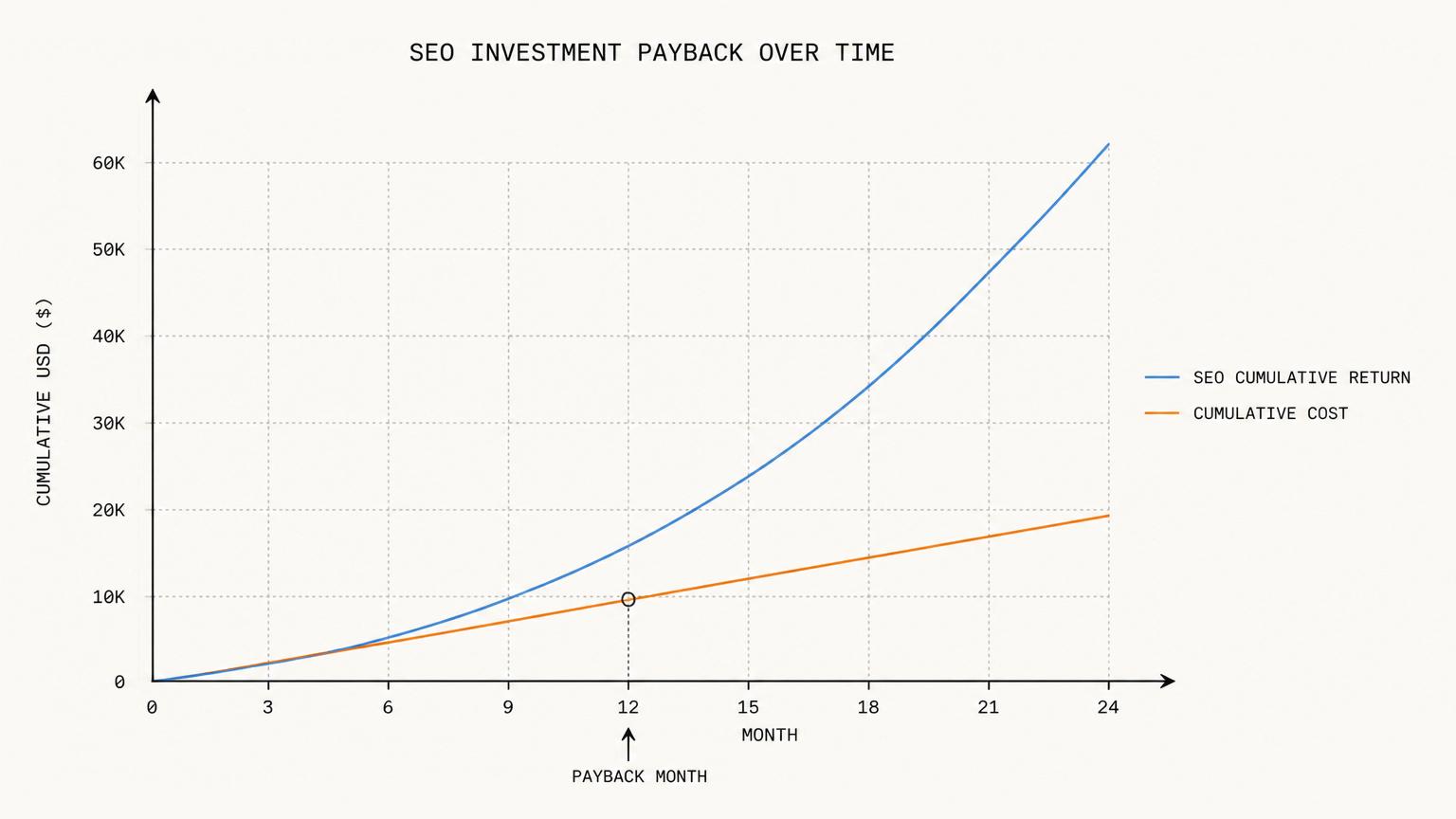
Paid search is rent. You pay, buyers arrive, you stop paying, they stop arriving. The cost per click also tends to rise every year, because more competitors keep bidding on the same terms. SEO is the opposite shape. You pay a lot up front, in months where little seems to happen. Then the pages you own keep sending buyers without new spend. There is a month where the cumulative return crosses the cumulative cost. We call it the payback month. After it, the channel gets cheaper every quarter while paid gets more expensive.
There is a second effect people miss. SEO traffic also compounds inside the funnel. A buyer who finds you through a useful page trusts you more than one who clicked an ad, converts better, and churns less. So the same visit is worth more. The whole argument for SaaS SEO lives in these two curves.
A worked example in real numbers
Take one comparison page. It targets a query your buyers run when they are choosing, something like "your product vs competitor". Say it ranks and brings 500 visits a month. At a 3 percent visitor-to-demo rate, that is 15 demos. Close 20 percent and you win 3 customers a month. At $15,000 in annual contract value each, that single page influences $45,000 in new ARR every month it keeps ranking. It cost you one good brief, one good writer, and a few weeks. It will keep doing this for years, and it does not care that you stopped paying attention to it.
Now multiply. A real program is not one page, it is a portfolio of 50 to 200 pages across every search your committee runs. Some produce demos directly, others feed authority to the ones that do. The portfolio is the asset. That is also why judging SEO in month two is like judging a subscription business on week one of revenue.
What the research says
The direction of the data is consistent. Google's own B2B research found that the large majority of B2B buying journeys start with a generic search, not a brand name. Multiple industry studies put organic customer acquisition cost meaningfully below paid for software companies, often by 40 percent or more. And our own books say the same thing: at Workwize, monthly organic pipeline grew from $360K to a $1.16M peak in month 19 of the program. If you want to test the math on your own funnel, our SEO ROI calculator does it in about a minute, free and ungated.
Where paid still wins
Honesty section. Paid is faster, and speed matters when you are testing messaging, launching in a new market, or filling this quarter's pipe. Paid also retargets, which SEO cannot. The mature answer is not either-or. Run paid for speed while SEO builds, then shift the mix toward organic as it compounds. We wrote a full comparison in SEO vs PPC for B2B SaaS.
What 22 months of SaaS SEO looks like: the Workwize numbers
Every guide should have to show its receipts. Here are ours, with the client named. They agreed, and unverifiable proof is not proof.
I was the client before I was the agency
In June 2024, Workwize, a B2B SaaS platform from the Netherlands, hired me as their in-house SEO specialist. I sat in the weekly marketing meetings. I saw what agencies charged them and what those invoices bought, and I saw how often a small, senior team could beat the output for a fraction of the cost. I also learned what a CMO actually worries about, because I was in the room when the worrying happened. In October 2024 I founded Technotize, and within a couple of months, Workwize became our first client. Very few agencies have run SEO from inside the client's building. It changes how you work.
What we did, in order
The order matters more than the tactics. First, we cleared the technical debt, because content published on a broken foundation is wasted money. Then we built pages against the searches Workwize's buyers actually run when they are choosing a vendor: comparisons, alternatives, integrations, use cases. High intent first, volume later. Only then did we go after links, a small number of real editorial ones, pointed at the pages built to convert them. And here is the honest part: the first three months looked almost flat. Impressions moved, revenue did not. That is what the start of compounding looks like. It is also exactly where most companies fire their agency and reset the clock to zero.
One more piece of honesty, on cost. This was a normal mid-market retainer, inside the range we publish on our pricing page, not a special deal for a friendly client. The return came from sequencing and quality, not from outspending anyone.
And not everything worked on the first try. A few early pages read the intent wrong and had to be rebuilt after the SERP made that obvious. At one point we tried batching content production to move faster, watched the quality slip, and went back to one page at a time. Both lessons are now rules in this guide, which is what a real engagement gives you that theory never will.
What 22 months produced
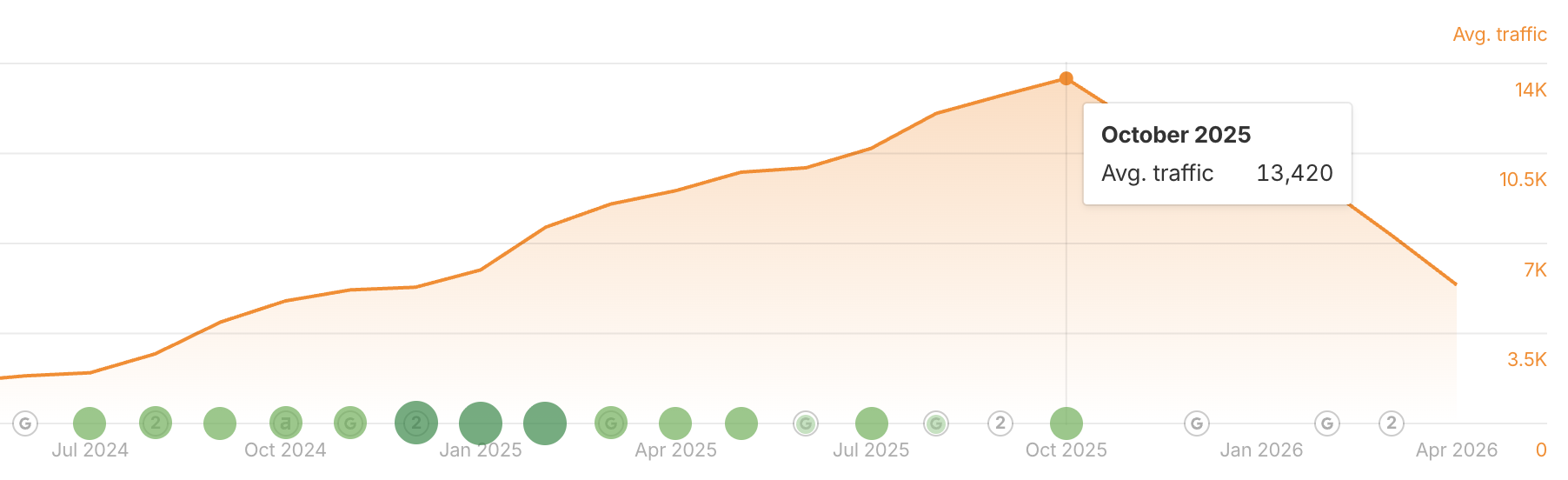
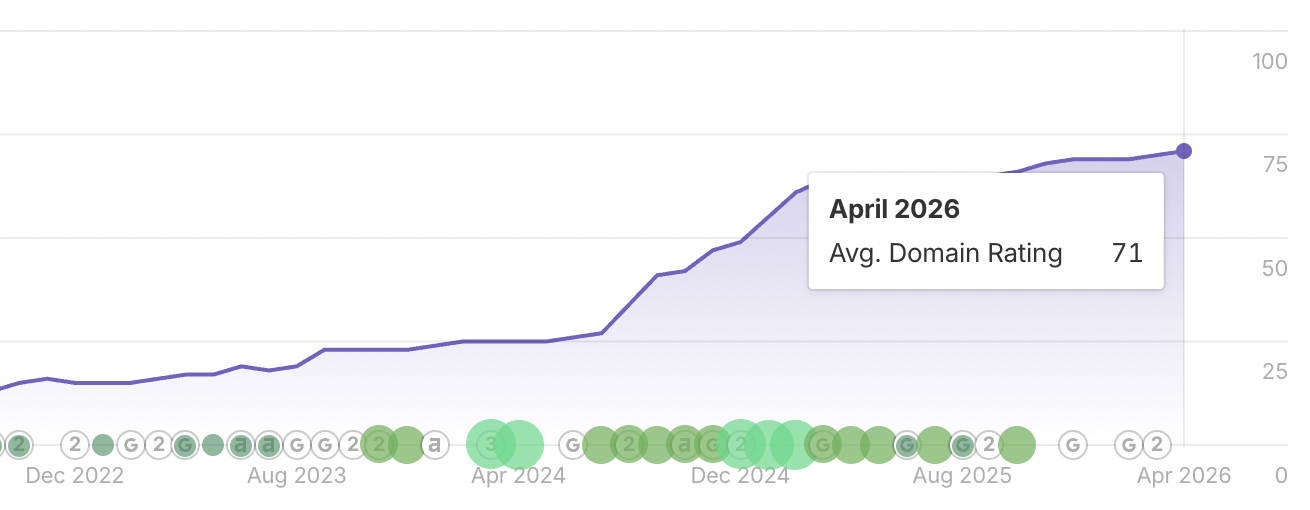
Domain rating went from 27 to 71. Monthly organic sessions went from 1,852 to 13,420. Organic search became the company's leading source of new pipeline, peaking at $1.16 million in a single month. Monthly marketing-qualified leads went from 28 to 111, and sales-qualified leads settled at 35 to 40 a month. Those numbers ran through April 2026, and every one of them traces to a source the client controls: Ahrefs for authority, their own analytics for sessions, their CRM for pipeline. The full story, including what went slower than planned, is in the Workwize case study.
The SaaS buyer journey and your keyword universe
Keywords are where SaaS SEO is won or lost, and most teams get them wrong for a simple reason. They map keywords to a funnel built for one buyer, when SaaS sells to a room.
How a buying committee actually searches
Picture a 60-person company buying expense software. The finance manager who feels the pain searches "automate expense reports" on a bad Tuesday. Two weeks later she searches "best expense management software" and reads three lists. Her ops lead searches "ramp vs brex" and "expensify alternatives". An engineer checks "ramp api docs" to see if the integration is real. Before signing, someone in leadership searches the brand name plus "pricing" and plus "reviews". One purchase, six different searches, four different people, spread across a month. If you only rank for the first search, you started the conversation and then left the room.
And some of those searches you will never see in a rank tracker. The ops lead asks an AI assistant for a shortlist instead of scrolling results. Someone pastes your pricing page into a chat and asks for a summary. These invisible searches are growing fast, and they reward the same things classic search does: clear pages, real proof, and a brand machines can identify. Chapter 10 covers how to win them.
The three levels of awareness
The old copywriting frame still holds, and credit where it is due: Eugene Schwartz laid it out in Breakthrough Advertising decades ago. We compress it to three levels, because committee buying blurs the rest. Problem aware people know the pain but not the category, and they search the pain: "automate expense reports". Solution aware people know the category and compare inside it: "best expense management software", "ramp vs brex". Product aware people know you and are checking for reasons to say no: "your brand pricing", "your brand reviews". Each level needs different pages. The biggest budget mistake in SaaS content is spending everything at the first level, where the traffic is big and the intent is thin.
The eight SaaS keyword categories
Every SaaS keyword worth having falls into one of eight buckets. Map your universe against this table and the gaps announce themselves.
| Category | Example | Who searches it | Funnel job |
|---|---|---|---|
| Category term | expense management software | Solution-aware manager | Get on the list |
| Comparison | ramp vs brex | The evaluator | Win the head-to-head |
| Alternatives | expensify alternatives | The switcher | Catch the churn |
| Integration | quickbooks expense integration | Engineer, ops | Prove the fit |
| Use case | expense reports for consultants | Niche buyer | Win the segment |
| Pricing and cost | ramp pricing | Finance, late stage | Remove the last doubt |
| Pain point | automate expense reports | Problem-aware searcher | Start the journey |
| Branded | [your brand] reviews | The whole committee | Protect the close |
Two notes on the table. The middle rows, comparison through pricing, are where the revenue lives, and they are usually the smallest keywords by volume. And branded search is not vanity. When a committee is deciding, the last searches are all your name plus a doubt, and you want to own every one of those results. We wrote a full process for mapping buyer intent in B2B SaaS if you want to go deeper.
Put the map together before you write anything
The output of this chapter is one document: every keyword you could target, tagged by category, awareness level, and who on the committee runs it. Not a list from a tool export. A map. For a typical B2B SaaS, that map holds 300 to 800 terms once you include every comparison, integration, and use case. You will not build all of them, and you should not try. A strong first-year plan usually commits to 100 to 150 of those terms, weighted hard toward the middle of the table above, where the intent is. The next two chapters turn the map into that prioritized plan, starting from the searches closest to money. That order is the whole idea behind the Pipeline-First Method.
SaaS keyword research: the operator process
Chapter 4 gave you the map. This chapter is how we fill it, check it, and cut it down to a plan you can actually run. It is the same process we use for clients, with nothing held back.
Start where the buyers talk, not in a tool
Keyword tools are averaging machines. They tell you what the whole internet searches, not what your buyers say. So we start with language, and the best source of buyer language is sales calls. Read ten transcripts and you will find the exact words prospects use for their problem, the competitors they bring up, and the objections that stall deals. Every one of those phrases is a keyword lead. At Workwize, real buyer terms kept showing up in calls long before any tool showed search volume for them. The pages built on that language converted far above the site average, because they answered the question in the buyer's own words.
After transcripts, work through the other places buyers talk: support tickets, the reviews people leave on your competitors, your own site search logs, and your sales team's list of questions they answer every week. Competitor reviews deserve a special mention. On G2 and Capterra, look for the sentences that start with "we switched from" and "the only thing missing is". Those sentences are keyword research nobody runs: they tell you which alternatives pages to build and which feature language buyers actually use. Only then open a keyword tool, and use it for what it is good at: expanding each seed phrase into its full cluster and attaching numbers. The complete transcript process is in our guide to mining sales calls for keywords.
Validate the SERP before you write a word
A keyword is not a target until you have looked at what ranks for it. This check takes two minutes and saves months. Look at four things. What type of page ranks: a guide, a product page, a list, a forum thread. How strong the ranking sites are, and whether any weak page is holding a spot, because a forum thread or a thin post in the top five is an open door. What sits above the results: ads, an AI answer, a featured snippet, each one taking clicks before position one gets any. And whether the intent matches your page idea at all, because Google has already decided what this query means, and it will not change its mind for you.
The page you are reading exists because of this check. We looked at the SERP for its main keyword and saw a DR 67 blog holding position one while a DR 92 giant sat at six. That told us credibility wins this query, not authority, and that a young site with a real operator guide had a lane. No SERP check, no brief. It is a hard rule for us, and it should be for you.
The check also catches the most expensive mistake in content: intent mismatch. A team decides a keyword deserves a product landing page, but every ranking result is a how-to guide. Google has voted. Build the landing page anyway and it will sit on page four forever, no matter how good it is. Match the page type the SERP already rewards, and put your product inside it.
Traffic potential beats volume, and difficulty depends on you
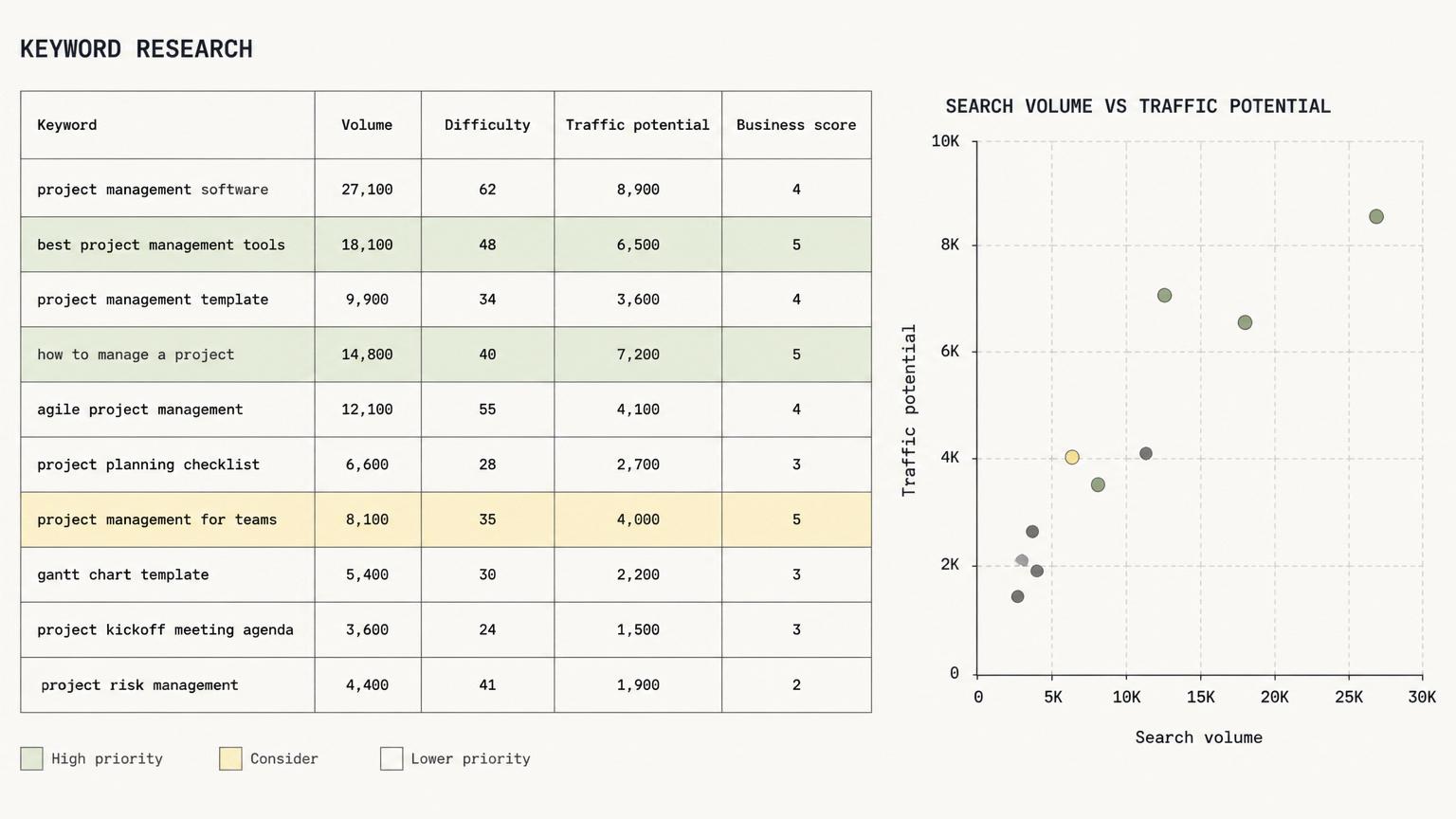
Two numbers mislead almost everyone at the start. The first is volume. Volume counts searches for one exact phrase, but a page that ranks number one collects traffic from hundreds of phrasings of the same question. So judge a keyword by what the current top page earns in total, usually shown as traffic potential, not by the phrase's own volume. A 150-search phrase whose top page pulls 2,600 visits a month is a better target than a 1,000-search phrase whose top page pulls 400.
The second is difficulty. Tools score difficulty mostly by counting links to the pages that rank, which makes the score a rough guide, not a verdict. At a low domain rating, filter hard: keep your first two quarters under a difficulty score of about 20. But read the SERP as well, because the score misses weak spots and overrates big domains that rank with thin pages. We watch small, focused sites hold top-ten spots on commercial SaaS terms every week, against domains many times their size. A precise page on a focused site beats a generic page on a big one more often than the scores predict.
Score by business potential, then commit
The last filter is money. For every keyword, ask one question: if someone searches this, can our product be the answer? Score it 3 if the product is the answer, 2 if the product helps, 1 if the searcher is not really a buyer at all. Kill most of the 1s, even the ones with pretty volume. A ranking that brings the wrong audience costs writing money and returns nothing.
Then commit. From a map of 300 to 800 terms, a first-year plan takes 100 to 150, weighted toward the 3s and 2s your site can win now. And inside that plan, sequence matters: the first 20 pages should almost all come from the money categories in Chapter 4's table, the comparisons, alternatives, integrations, and pricing terms, because those are the pages that turn rankings into demos while the rest of the program is still warming up. The next chapter explains that order in full.
The deliverable is one sheet: keyword, category, awareness level, business score, difficulty, traffic potential, owner, status. That sheet is the program. Everything else in this guide executes it. The deeper version of this process lives in our keyword research sub-pillar.
Content strategy: the Pipeline-First Method
Now you have a scored list. Order still decides everything, because two teams with the same list can publish in a different sequence and get opposite results. This chapter is our sequence, and it is the one idea in this guide we would defend against anyone.
The method, in one page
Most content plans run top-down. Build awareness content first, attract a big audience, then move that audience down the funnel. It looks logical and it dies slowly: nine months of rising traffic, flat revenue, and a budget review the program does not survive.
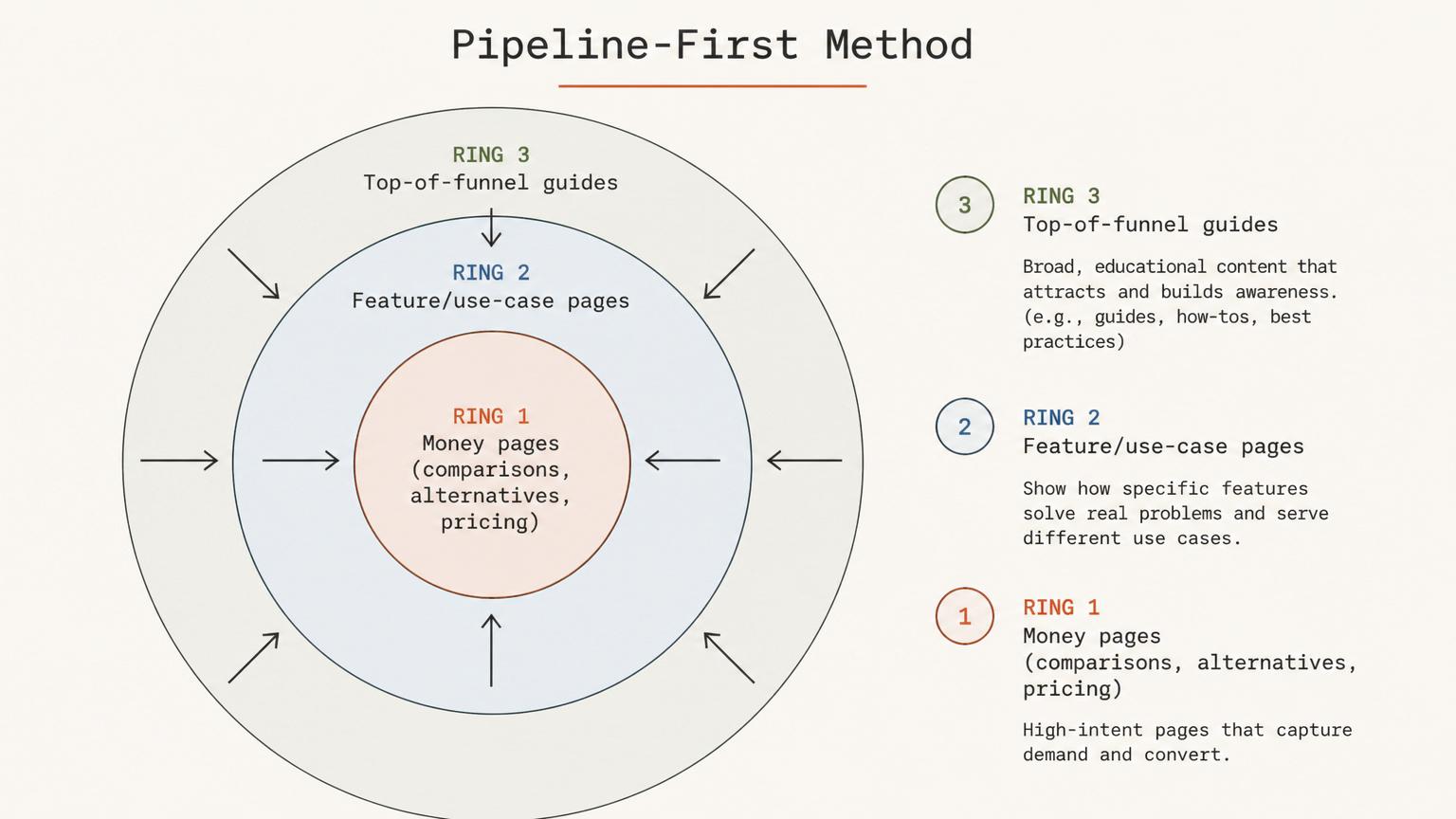
We run the reverse, and we call it the Pipeline-First Method. Picture three rings. Ring one is the money layer: comparison pages, alternatives pages, pricing and cost content, integration pages, use cases. These target the searches people run while choosing a vendor. They are small pages, low volume, high intent, and often surprisingly easy to win, because volume-chasing competitors ignore them. Build ring one first, and revenue signals show up in months, not years. Ring two is the support layer: solution content that answers the questions right before choosing, each piece linking into ring one. Ring three is the volume layer: problem-aware guides and authority content, built last, once there is a conversion layer for that traffic to land on.
The internal links always point inward, from ring three through ring two into ring one, so every new page pushes authority toward the pages that close. Pipeline first, traffic later. The traffic arrives anyway, and when it does, it lands on a site that already converts.
In practice, the mix shifts by quarter. The first quarter should be almost all ring one, roughly seven money pages for every three supporting ones. By the third quarter the ratio flips, because the conversion layer is built and the job becomes feeding it. Teams that fix the ratio at the start and never revisit it end up with either a site that converts but never grows, or one that grows and never converts.
The pillar-cluster architecture
The rings describe order. Architecture describes structure, and the structure that works is pillars and clusters. A pillar page covers a broad topic in full. Cluster posts each cover one specific question underneath it, and everything interlinks: clusters up to the pillar, pillar down to clusters, siblings across. Search engines read that structure as depth, and depth is how a small site earns trust on a topic without a big link profile.
You are inside one right now. This guide sits alongside our pillars for content marketing and link building, with fourteen sub-pillars and more than ninety posts beneath them, every one interlinked on purpose. Even the breadcrumbs follow the topic tree rather than the URL folders, so every page declares its parent subject to both readers and crawlers. That architecture is a large part of why a young site can compete on the keyword that brought you here. The linking rules that hold it together are a craft of their own, and we published them in full in our guide to internal linking for B2B SaaS.
The page types that drive pipeline
Ring one is made of a small set of page types, and each has its own rules. Comparison pages, your product versus a named competitor, work best when they are honest. Admit what the competitor does well, win on the differences that matter, and buyers trust the page enough to act on it. Alternatives pages catch switchers searching "[competitor] alternatives", and the strange-feeling rule is to list real options, yourself among them, because a page that only sells you gets ignored. Integration pages, one per integration, prove fit for the technical people on the committee. Use-case pages win segments: the same product, framed for consultants, for agencies, for finance teams. Pricing and cost guides answer "how much does [category] cost" while competitors hide their numbers. And a glossary, one clean page per industry term, is the quiet compounder: definition searches are low difficulty, they never stop, and each page earns links from writers who need something to cite. We keep a full playbook for the hardest of these in comparison content for B2B SaaS.
Briefs, and the one-at-a-time rule
Every page starts from a brief: the keyword and its intent, what the SERP told us, the outline, the proof and data the page must include, the internal links it gives and receives, and the meta. A page without a brief drifts, and drift is expensive at scale.
Then publish one page at a time. We tested batching, producing several pages in one push, and quality dropped in ways we only caught after publishing. Sections shrank, examples disappeared, and every page started sounding like the same page. One at a time, checked before the next, is slower per week and much faster per result. Our brief template is public if you want to steal it
Plan for maintenance from day one, because content is not a publish-and-forget asset. Rankings decay as SERPs shift and competitors update. A simple quarterly review, refresh what slipped, retire what never worked, protects the compounding you paid for. Our rule of thumb for that call is in when to refresh vs retire content.
Product-led SEO and free tools
Here is the advantage software companies have that no other industry gets: the product itself can rank. Not content about the product. The product, or small free pieces of it, sitting on pages that match searches.
What product-led SEO means
A product-led page gives the searcher real value before any signup. Free tools, templates, an integrations directory, public documentation. The searcher arrives with a job to do, the page does part of the job, and the product is the obvious next step. These pages convert differently from articles, because the visitor is not reading about a solution. They are already using one.
Documentation and templates count too, and most SaaS teams waste them. Public docs rank for the exact technical questions engineers on the committee search, so keep them indexable and structured, one question per page. Templates rank for "[job] template" searches and hand the searcher a working start that lives inside your product. Both are pages you mostly already have. The work is treating them as search assets instead of support files.
The free tool play, with receipts
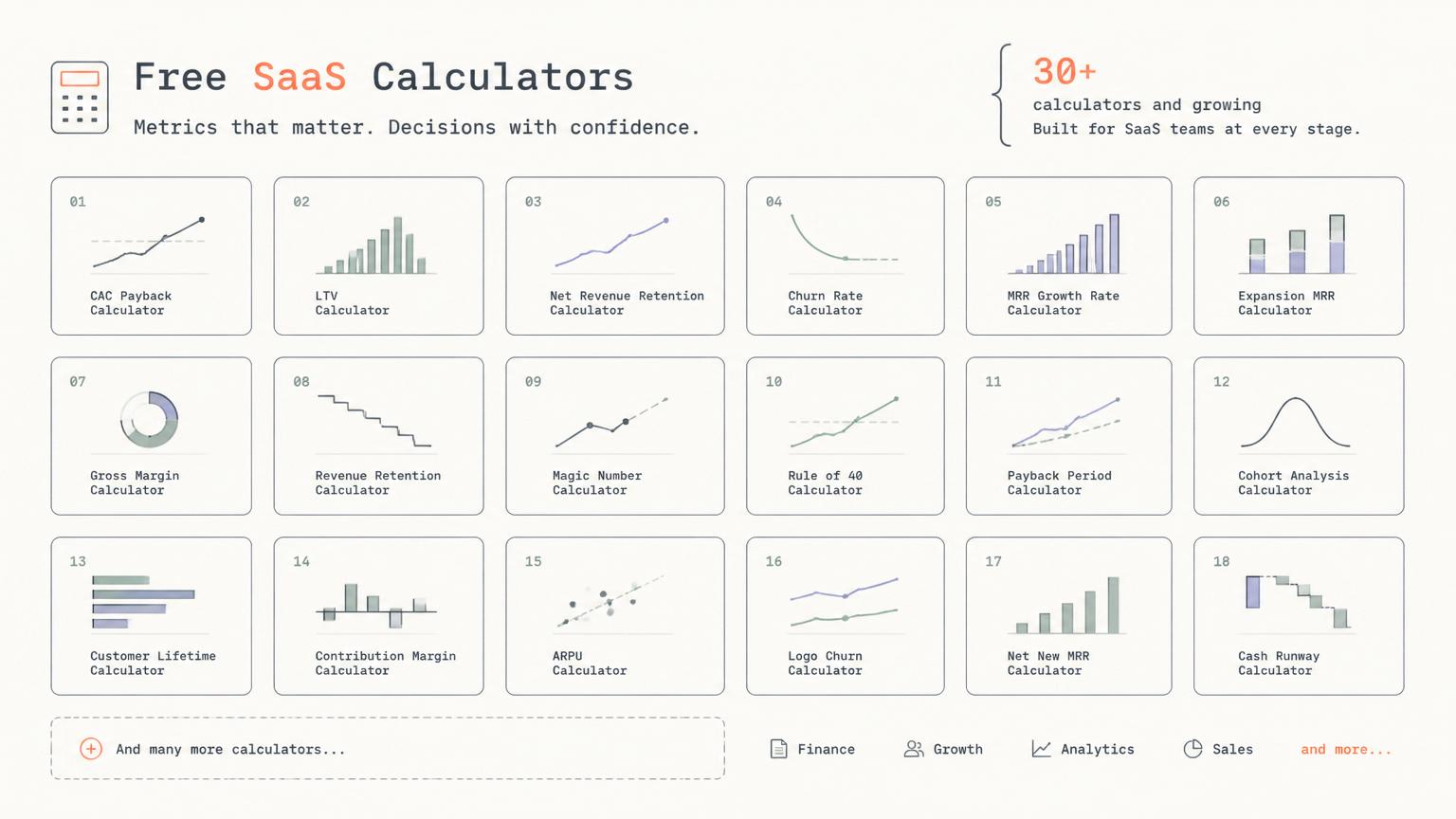
Tools are the strongest version of this, and calculators are the easiest tools to build. Each calculator targets its own search, usually "[metric] calculator", the difficulty is low because most companies never bother, and a working tool earns links on its own, because people cite tools far more readily than articles. The most-linked page on one of the best-known SaaS SEO agencies' sites is not an article. It is a calculator paired with a guide, with close to 4,000 referring domains pointing at it, data via Ahrefs. That is not luck. Tools are what the internet links to.
The pairing is the part most teams miss. A tool alone wins the "[metric] calculator" search. A guide alone wins the "what is [metric]" and "how to improve [metric]" searches. Put them on connected pages and each one feeds the other: the guide sends users to the tool, the tool gives the guide something worth linking to, and the pair covers the whole cluster instead of one query. Whenever we build a calculator now, the guide is part of the same brief.
We practice this at a scale most agencies would call excessive: 99 free calculators, one for every SaaS metric a finance or growth team touches, from CAC payback to net revenue retention. Each one targets its own query, each one links to the guide content around it, and together they work as a linkable-asset layer for the whole site. The economics of the play are in our piece on SaaS calculators as linkable assets.
Programmatic, done with judgment
Programmatic SEO means generating many pages from structured data: Zapier's thousands of integration pages, Notion's template gallery. It works when two things are true for every single page: there is real search demand for that exact page, and the page holds real, specific value, not a template with a swapped noun. When either is missing, you are publishing thin content at scale, and Google treats it exactly that way. The test we use before any programmatic build: would a human bookmark one of these pages on its own? If not, do not multiply it by a thousand. Our full framework, including when we talk clients out of it, is in programmatic SEO for B2B SaaS.
Technical SEO for SaaS sites
Technical SEO is the foundation everything above sits on, and on SaaS sites it breaks in specific, predictable places. This chapter is the short version of what we check first, written for people who do not want to become developers.
JavaScript and single-page apps
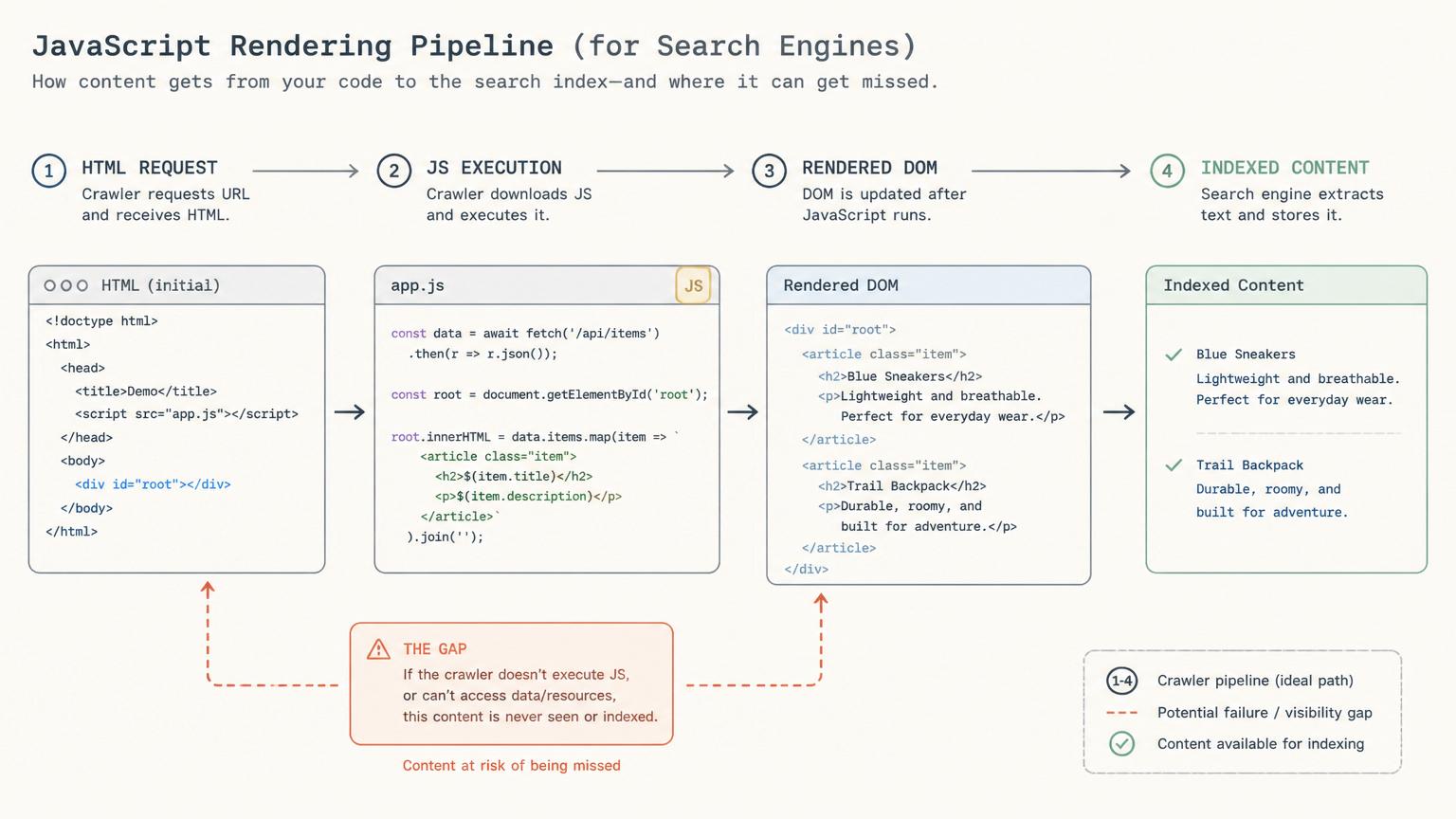
Most modern SaaS marketing sites run on React, Vue, or a similar framework, and many render their content in the browser instead of on the server. Google can handle that, but rendering happens in a second step that can lag behind crawling, and anything that only appears after that step, content, links, metadata, is at risk of being missed or delayed. The symptoms are quiet: pages indexed with no text, internal links that pass nothing, rankings that never quite arrive.
The fix is to serve real HTML. Server-side rendering or prerendering for every page that matters, then verify with the URL inspection tool that Google sees what users see. The five-minute test anyone can run: open a page, view the raw source, and search for a sentence from the middle of your content. If it is not in the source, you are depending on the render step, and you should confirm in Search Console that the rendered version is complete. We run our own site on a React stack, so this is not advice from a book. It is our own weekly checklist, and the full version is in JavaScript SEO for B2B SaaS.
Architecture and crawl
Where things live matters more than most teams think. Keep the marketing site and the blog on the main domain in subfolders, not on subdomains, so every page feeds authority to one domain instead of splitting it. Put the app on its own subdomain and keep it out of the index, but treat public documentation the opposite way: indexable, on the main domain where possible, structured one question per page, because docs are a ranking surface for the engineers on the committee. Our approach to that is in API documentation SEO.
Watch parameter and filter URLs, which can multiply one page into thousands of crawlable duplicates and waste crawl attention at scale. And keep the sitemap honest: only pages you want ranked, nothing broken, nothing redirected. The subdomain question alone has cost SaaS companies years of compounding, and we wrote the full argument in subdomain vs subfolder for SaaS.
Speed, schema, and the boring wins
Core Web Vitals are a tie-breaker, not a ranking hack. Fix the basics, a fast first load and a layout that does not jump, and then stop optimizing milliseconds nobody feels. Schema is the quieter win for SaaS: Organization and SoftwareApplication markup so machines know what you are, FAQ markup where you genuinely answer questions, and Article markup with a real named author on every post, because authorship is part of how both Google and AI systems judge trust. None of this is exciting. All of it compounds.
Migrations: the highest-risk moment in SaaS SEO
Rebrands, replatforms, and domain moves are where years of SEO die in a week. The rule that prevents it is simple and absolute: every old URL gets a 301 redirect to its exact new equivalent, mapped one to one before launch day, never to the homepage in bulk. Then crawl the old URLs after launch and fix everything that does not land cleanly. Two more launch-day checks, because we have seen both go wrong: make sure the noindex tag from the staging site did not ship to production, and make sure the new robots file is not blocking what the old one allowed. Either mistake can deindex a site quietly while everyone celebrates the launch. If your company is planning a move, read our website migration guide for B2B SaaS before anyone touches the DNS. The rest of our technical stack, including the checklist we run on every new client, lives in the technical SEO sub-pillar.
Link building for SaaS
Links are still how search engines break ties, and in SaaS they are bought badly at industrial scale. This chapter is the clean system: how to earn the links that move rankings, buy placements without poisoning your profile, and look natural while doing it.
Why links still decide close calls
Think of a link as a citation. When a real site references your page, it tells search engines that someone with a reputation vouches for you. Content quality decides whether you can compete. Links often decide who wins when several pages compete well. The good news for a young SaaS site is that you need far fewer than people think. A handful of relevant, editorial links from real industry sites moves a small domain more than a hundred junk links ever will. The Workwize program that took domain rating from 27 to 71 was not built on volume. It was built on a steady flow of real placements pointed at pages designed to use them.
Earn first: linkable assets and digital PR
The cheapest links long term are the ones you never ask for, and they go to assets. Original research is the strongest: survey your customers, publish the numbers, and writers will cite you for years, because writers always need numbers. The recipe is smaller than it sounds. Fifty to two hundred responses, ten clear findings, one simple chart per finding, and a short methodology note so the numbers can be trusted. That is one quarter of part-time work, and it can outperform a year of cold outreach. Free tools are next, as Chapter 7 showed with a competitor's calculator sitting on close to 4,000 referring domains. Definitive guides earn steadily if they genuinely settle a topic. Build two or three real assets a year and your link profile grows while you sleep. The full build order is in our linkable assets strategy.
Digital PR is the active version of the same idea. Journalists and industry newsletters need expert comment and fresh data every week. A SaaS company sits on both: your product data tells stories about how an industry behaves, and your founders have opinions reporters can quote. Package either one well and the links come from sites money cannot buy into. Our process for that is in digital PR for B2B SaaS SEO.
Placements done clean: guest posts and niche edits
Outreach placements, writing a guest article or adding your link to an existing relevant paragraph, are the workhorses of most SaaS link programs, including ours. They work when the standards stay high. The site must have real organic traffic and real editorial judgment, the page must be genuinely relevant, and the link must sit in a sentence that would make sense even if the link were removed. A simple test catches most bad placements before you pay: would this site's editor have published this exact paragraph anyway, without money involved? If the honest answer is no, the link is decoration on a billboard nobody reads.
Expect a legitimate placement to cost a few hundred dollars in fees or effort. When someone offers links for 30 dollars, you are buying a spot on a link farm, and farms get discounted by Google in bulk, taking your money with them. The warning signs are learnable in ten minutes: we listed them in how to spot a niche edit farm.
One more decision teams skip: where the links should point. The instinct is to aim everything at the homepage. Better is a natural mix, weighted toward the ring-one pages doing the selling, with supporting guides and the homepage taking the rest. A comparison page with three real editorial links can outrank competitors that have never earned one, and that ranking pays in demos, not sessions.
Velocity and anchors: look boring on purpose
Two quiet rules keep a link profile safe. First, pace. A steady monthly rhythm of new links reads as a growing brand. A spike of fifty links in one week reads as a purchase, because it usually is. Second, anchor text. Most of your anchors should be your brand name, your URL, or natural phrases from the sentence. Exact keyword anchors should be rare, because over-optimized anchors are the most common self-inflicted wound in SEO. The distribution we run, and the caps we hold per page and per site, are published in our anchor text strategy. Everything in this chapter, as a service and a system, lives under the link building pillar.
AI search: ranking when the answer is generated
A growing share of your buyers never sees a results page. They ask an AI assistant which tools to shortlist, or Google answers them inside an AI Overview before the first blue link. Chapter 4 called these the invisible searches. This chapter is how to win them, without the snake oil that has already grown around the topic.
How AI answers pick their sources
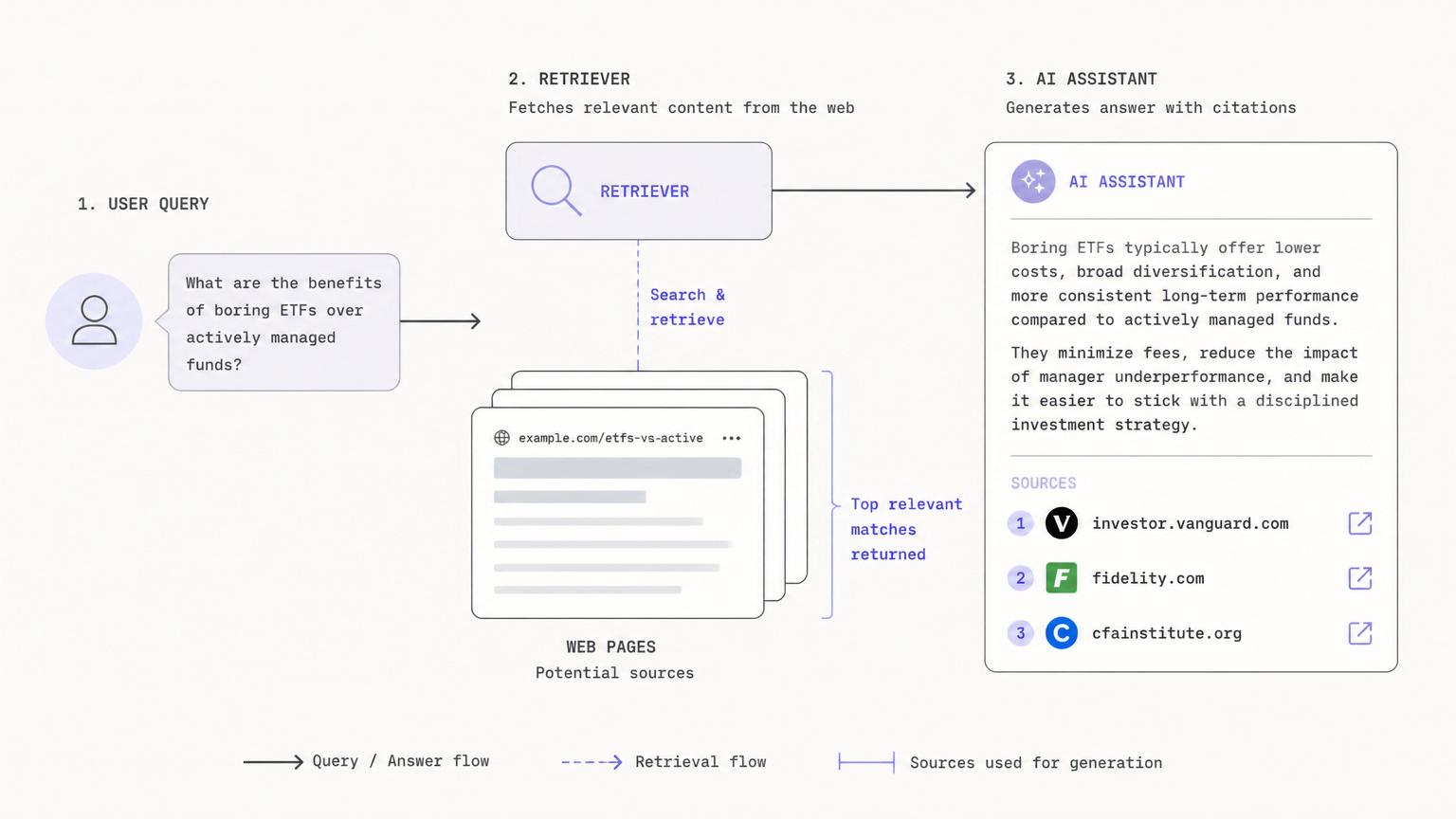
When an assistant or an AI Overview answers a question, it retrieves a set of pages first, then writes from them and cites some. The pages that get retrieved and cited share traits you can copy. They answer the question directly, near the top, in plain sentences a machine can lift cleanly. They make specific, factual claims with sources, because generated answers prefer material they can attribute. They come from identifiable entities, sites where it is obvious who is speaking and why they would know. And they agree with the broader consensus often enough to be safe to quote. None of this is magic. It is the mechanics we broke down in how AI search engines rank and cite content.
It also helps to know there are two different surfaces, because they reward slightly different work. AI Overviews sit on top of Google's own index, so classic rankings still feed them: if you rank on page one, you are in the candidate pool. Assistants with live web access retrieve more freely, and they lean harder on third-party sources, the lists, reviews, and industry sites they consider neutral. Which leads to the least obvious tactic in this chapter: getting your brand onto the credible third-party pages assistants already trust is often faster than waiting for your own page to be chosen. That is digital PR doing AI search work, and it is why Chapters 9 and 10 belong to the same program.
Make your pages quotable
The practical work overlaps heavily with good SEO, which is the honest part most AEO sellers skip. Put a direct answer in the first sentences under every heading. Keep one idea per section. State numbers with sources. Define your terms. Keep an FAQ that actually answers questions, marked up with schema. Then do the entity work: Organization schema, a real named author on every page, consistent company facts across your site and profiles, so machines can identify who is speaking. You may have noticed this guide follows its own advice: every heading here opens with the answer. That is deliberate, and it is the core of our AEO checklist for B2B SaaS.
Track citations like you track rankings
You cannot manage what you never measure, so citations become a KPI next to rankings. The method is simple to start: write down the fifteen to twenty questions your buyers actually ask assistants, from "best [category] software" to "[you] vs [competitor]", run them monthly across the major assistants, and log where you are mentioned, cited, or absent. Watch the trend, not any single answer, because answers vary run to run. We run this for clients as standard now, with the process in AI citation tracking for B2B SaaS. The rest of our AI search practice lives in its own sub-pillar.
Measurement: reporting SaaS SEO in revenue
This is the chapter that keeps programs alive. SEO does not usually die from bad tactics. It dies in a budget meeting, defending itself with traffic charts against people who think in pipeline. Measure in revenue from day one and that meeting goes differently.
The three numbers that matter
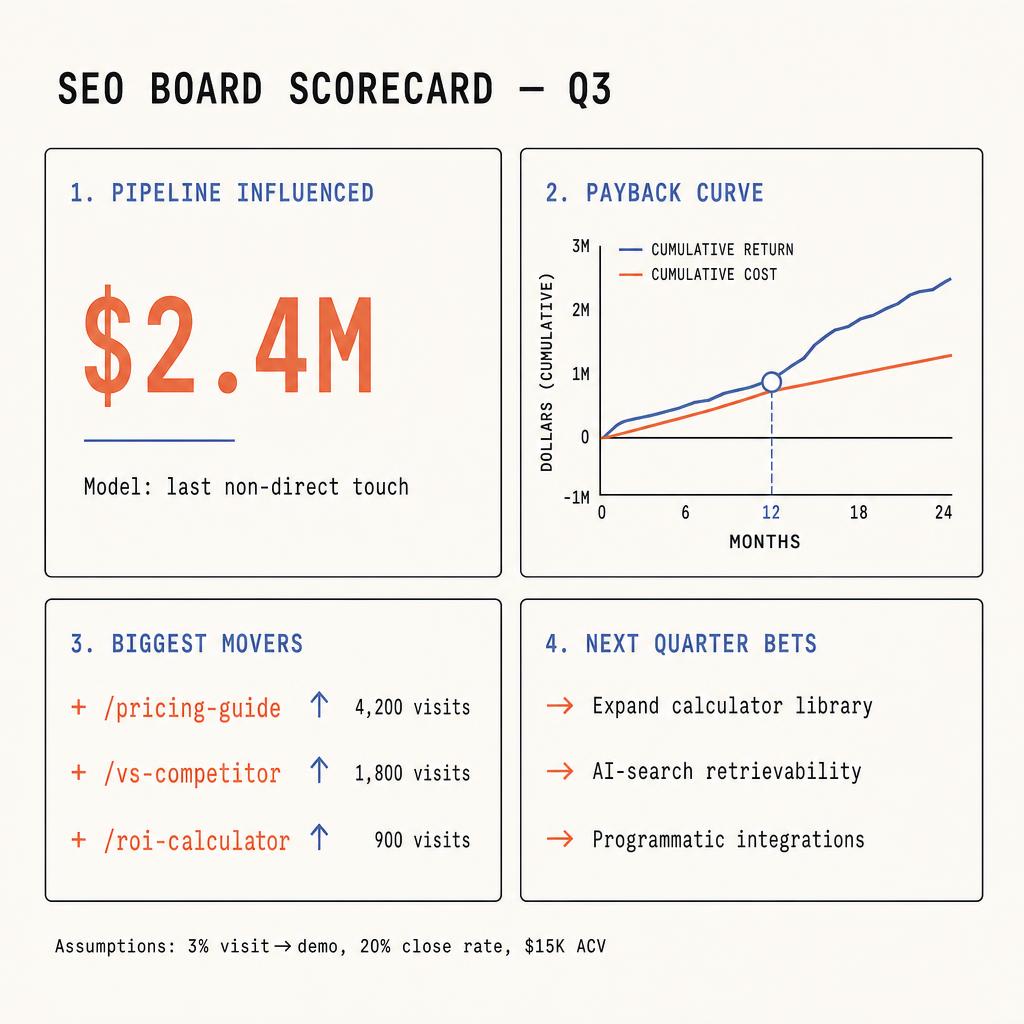
Every SaaS SEO report should lead with three numbers. Pipeline influenced: the value of deals where organic search played a part, pulled from your CRM. The payback month: when the program's cumulative return passes its cumulative cost, projected at first, then tracked against reality. And the ROI ratio: total return over total cost, the number that travels well in executive conversations. Underneath those, keep the leading indicators that predict them: impressions on money keywords, first-page entries in ring one, and the demo conversion rate of organic traffic. Leading indicators are for steering. Revenue numbers are for reporting. Confusing the two is how good programs end up defending sessions in a boardroom.
One timing rule saves a lot of arguments: report pipeline on a trailing window, not the calendar month. An organic-sourced deal often closes one or two quarters after the first visit, so this month's traffic pays in a later month's revenue. Compare cohorts, the deals started by each quarter's traffic, and the numbers stop looking random and start looking like a curve.
Attribution without lying to yourself
Long sales cycles make attribution the hardest part, and the common failure is undercounting. Last-click models hand the deal to whatever touched it last, usually direct traffic or a branded search, and erase the guide that started the journey two months earlier. Use an assisted or multi-touch view, make sure your CRM captures first source, and watch branded search volume next to organic sessions, because strong content lifts your brand searches and last-click hides it.
Add one low-tech field that catches what analytics never will: "How did you hear about us?" on the demo form, free text, read by a human monthly. Buyers name the guide they read, the tool they used, or the AI answer that mentioned you, and those answers surface the invisible searches from Chapter 10 that no tracker records. And label estimates as estimates. A slightly soft number with visible assumptions survives finance review. A precise number nobody can trace does not.
The board scorecard
Report on one page. The pipeline number with its attribution model named. The payback curve, cumulative return against cumulative cost, with the crossover marked. The quarter's biggest movers, three lines, and the next quarter's bets, three lines. Assumptions at the bottom. That format took us years of client meetings to reduce, and the long version is in SEO ROI for board reporting. If you are building the projection for the first time, project your payback month with the same calculator we use in those meetings. And for the fuller theory behind the numbers, our guide to SEO ROI in B2B SaaS goes deeper than this chapter can.
The honest timeline: month by month
How long does SaaS SEO take? Here is the answer with no sales spin, from programs we have run, including the one whose numbers open this guide.
The first 90 days
Months zero to one produce documents, not rankings: the audit, the keyword map, the fix list, plus the quick wins, usually pages already sitting on page two that respond fast to attention. Months two and three are production: content shipping weekly, technical fixes going live, the first outreach starting. The honest description of how this period feels is "busy but flat". Impressions climb, a few long-tail rankings appear, and revenue does not move. This is normal. I watched it from the client side at Workwize before I ever ran it from the agency side, and the flat feeling is identical in both seats.
Months 4 to 9
Around month four to six, ring one pages start reaching page one, and the first demos with an organic source show up in the CRM. Links begin landing on pages that can use them. Somewhere in the six to nine month window, the curve bends: traffic growth stops feeling linear and starts feeling compounding, because dozens of pages are gaining together instead of a few gaining alone. This is the window where the math from Chapter 2 turns real. It is also the window most companies never reach, because they quit in the flat months and reset the clock with a new vendor.
Months 9 to 18: the boring middle that pays
After the curve bends, the work changes character. Less invention, more maintenance and expansion: refreshing pages that slipped, widening winning clusters, pushing links at the pages one spot from the top. It feels less exciting than the build phase and it produces most of the money. Workwize hit its pipeline peak in month 19, which is typical: the biggest returns arrive in the stretch where an impatient team would already have moved on. Budget for this phase from the start, because a program funded for six months is a program funded to quit at the worst possible moment.
When to actually worry
Patience is not faith. Set checkpoints. If impressions on your target keywords show no growth by month four, something is wrong at the foundation: indexing, rendering, or intent. If no ring-one page has reached page one by month eight, the diagnosis is usually content quality or keyword selection, not time. A good partner will name the problem and change the plan, not ask for more patience. The full breakdown, with the curve drawn honestly, is in how long B2B SaaS SEO takes.
In-house, agency, or hybrid
Everything in this guide can be run by your own team, by a partner, or by a mix of both. Full disclosure before this chapter starts: we sell one of these options, so discount our view accordingly. Here is the honest version anyway.
What each model is good at
In-house wins on context. Nobody understands your product, your buyers, and your politics like your own people, and that context compounds. The costs are real, though: a senior SEO lead, a writer, and technical support add up to several salaries plus tools, and the ramp to full speed takes months. In-house makes the most sense at scale, when SEO is core to the growth model and there is enough work to keep specialists busy every week.
An agency wins on speed and pattern exposure. You get a full senior team from week one, and that team sees what works across dozens of SaaS companies at once, which no single in-house seat can. Serious agency programs run 4,000 to 25,000 dollars a month, with most mid-market companies landing between 8,000 and 15,000. Compare that with the loaded cost of even one senior hire and the math is closer than most founders expect. Our numbers are public on the pricing page if you want to run that comparison with real figures.
Hybrid is what most growing SaaS companies actually end up with, and often it is the right answer: one in-house owner who holds context and approves direction, with an agency carrying strategy, production, and links. The channel gets senior execution without a full department, and nobody duplicates anyone.
The split that makes hybrid work is clean ownership. The in-house owner brings what only an insider can: product truth, customer context, fast approvals, and internal buy-in. The partner owns the machine: the keyword map, briefs, production, technical work, links, and the revenue report. One weekly async update, one monthly strategy call, and neither side waits on the other. Hybrid fails when both sides half-own the same things, not when either side is weak.
How to decide, and how to choose
Three questions settle it. Do you already have a senior person who has built an SEO program before, not just managed one? Is there enough continuous work for a full team, or would specialists sit idle between projects? And how fast do you need the channel moving, given that in-house ramp time is measured in quarters? Answer those honestly and the model picks itself. We wrote the longer version, with the budget math, in outsource SEO vs in-house.
If the answer points to a partner, shop properly. We published an honest comparison of the best SaaS SEO agencies, including the competitors we lose deals to and who each one genuinely fits, because a buyer who compares well is the buyer we want.
The 12 mistakes that kill SaaS SEO programs
We have watched SEO programs fail from the client side and the agency side, and the causes repeat with boring reliability. Here are the twelve, each with the tell that gives it away and the fix. Count how many your current program is making.
Strategy mistakes
- 1. Chasing volume instead of intent. The tell: traffic grows every month and demos do not. The fix is the whole point of this guide: build the money layer first and let volume come later.
- 2. Skipping the SERP check. The tell: a genuinely good page stuck on page four forever. The intent was decided before you wrote, and your page type does not match it. Check first, write second.
- 3. Copying competitor blogs. The tell: your content calendar looks identical to three rivals'. Everyone is averaging everyone else. The fix is language from your own sales calls, which competitors cannot copy because they have never heard it.
- 4. Covering one persona in a committee sale. The tell: you rank for the manager's searches and nothing the engineer or the finance lead runs. Map all eight keyword categories and the gaps close.
Execution mistakes
- 5. Publishing on a broken foundation. The tell: pages indexed with missing text, or rankings that never arrive despite good content. Fix rendering, architecture, and crawl before scaling production, because content on broken ground is spend without return.
- 6. Volume from a content mill. The tell: many posts a month, all interchangeable with anyone's. Fewer pages, real briefs, one at a time. Quality is a process, not a hope.
- 7. Buying cheap links. The tell: offers at 30 dollars, and a link graph that spikes. Farms get discounted in bulk. Pay for editorial reality or earn links with assets, and keep the pace steady.
- 8. Publishing and forgetting. The tell: pages that ranked in quarter one slipping by quarter three while everyone builds new ones. Rankings decay. A quarterly refresh review protects what you already paid for.
Measurement and management mistakes
- 9. Judging the program in month two. The tell: panic during the flat months every program has. Replace vibes with the checkpoints from Chapter 12 and judge against those.
- 10. Reporting sessions to executives. The tell: every budget review turns into a fight about whether SEO works. Lead with pipeline, payback, and the ratio, and the fight usually ends.
- 11. Trusting last-click attribution. The tell: the CRM says organic never converts while branded search keeps climbing. Last-click erases the assist. Use a multi-touch view and ask buyers how they heard of you.
- 12. Quitting right before the curve bends. The tell: a vendor change at month seven or eight, then starting from zero. Most of the return arrives after the point where impatient teams leave. Fund the program through the bend or do not start it. The deeper autopsy of all twelve is in why B2B SaaS SEO programs fail.
Where to go from here
You now have the playbook we charge for, complete. Map the keyword universe, win the money layer first, keep the foundation clean, earn links that would exist without you asking, structure everything so machines can quote it, and report in revenue. Then hold your nerve through the flat months, because the curve bends for the teams still standing when it does.
The gap between reading this and getting the results is execution, week after week, for quarters. If you build it in-house, this guide and the deeper posts linked throughout are genuinely enough. If you would rather have it run for you, by the team that wrote this page and produced the numbers at the top of it, that is a 30-minute conversation.