On this page
Google AI Overviews now appear above the traditional search results for most B2B SaaS-related queries. The AI Overview cites three to seven sources by default; pages cited capture buyer attention before any blue link gets clicked.
Most B2B SaaS programs we audit have pages ranking on page one for their target keywords but never get cited in the AI Overview that sits above those rankings. This is the operator playbook for AI Overview optimization: the structural signals that make pages eligible for citation, the SaaS-specific page types that show up most often, and the measurement framework that proves the optimization is working.
01What AI Overviews are (and when Google triggers them)
Google AI Overviews are the AI-generated answer summaries that appear at the top of Google search results for many queries, pulling content from 3 to 7 cited sources. They are one chapter of our AI Search visibility services for B2B SaaS where the citation eligibility and the underlying ranking optimization are different disciplines.
The actionable definition
An AI Overview is Google's generative response to a search query, displayed above the traditional organic results, with inline citations to source pages. Each citation appears as a numbered reference linking back to a source URL. The Overview synthesizes the cited sources into a unified answer; clicking a citation opens the source page. From a B2B SaaS marketing perspective, AI Overview citations are the new "above the fold" of Google search.
When AI Overviews appear
Google's documentation indicates AI Overviews trigger for queries the system judges as complex, informational, or benefiting from synthesis across multiple sources. B2B SaaS queries hit those criteria frequently: comparison queries ("[Tool A] vs [Tool B]"), pricing queries ("[Tool] pricing 2026"), capability queries ("does [Tool] integrate with [Other tool]"), and definitional queries ("what is [Category]").
AI Overview triggering signals from Google's documentation
Three signals from Google's published guidance affect whether AI Overviews trigger and which sources get cited. First, query complexity: simple navigational queries rarely trigger Overviews; multi-aspect informational queries do. Second, query freshness: queries Google interprets as time-sensitive favor recent content. Third, citation worthiness of available sources: when no sources meet the bar, Google may suppress the Overview. The implication for B2B SaaS is that being a citation-worthy source is what determines whether your category's Overview shows your brand at all.
02How AI Overviews differ from featured snippets and AI Search
Three distinct surfaces serve generative answers. They share patterns but have meaningfully different measurement and optimization implications.
AI Overviews versus featured snippets
Featured snippets are a pre-AI Google feature that surfaces a single source's content at the top of search results. AI Overviews synthesize multiple sources into a generative answer with citations. The optimization patterns overlap: clear answer paragraphs, structured content, schema. The measurement patterns diverge: a page either holds the featured snippet or doesn't (binary), while AI Overview citation is a share-of-citations metric measured across multiple competing sources.
AI Overviews versus AI Search engines (ChatGPT, Perplexity)
AI Search engines (ChatGPT Search, Perplexity, Claude, Bing Copilot) operate independently of Google. Each runs its own retrieval and generation, cites its own sources. The structural signals that earn AI Overview citations correlate with the signals that earn AI Search citations, but not identically. Some content that ranks in Google's AI Overview never appears in Perplexity for the same query because the underlying retrieval differs.
Why the distinctions matter for measurement
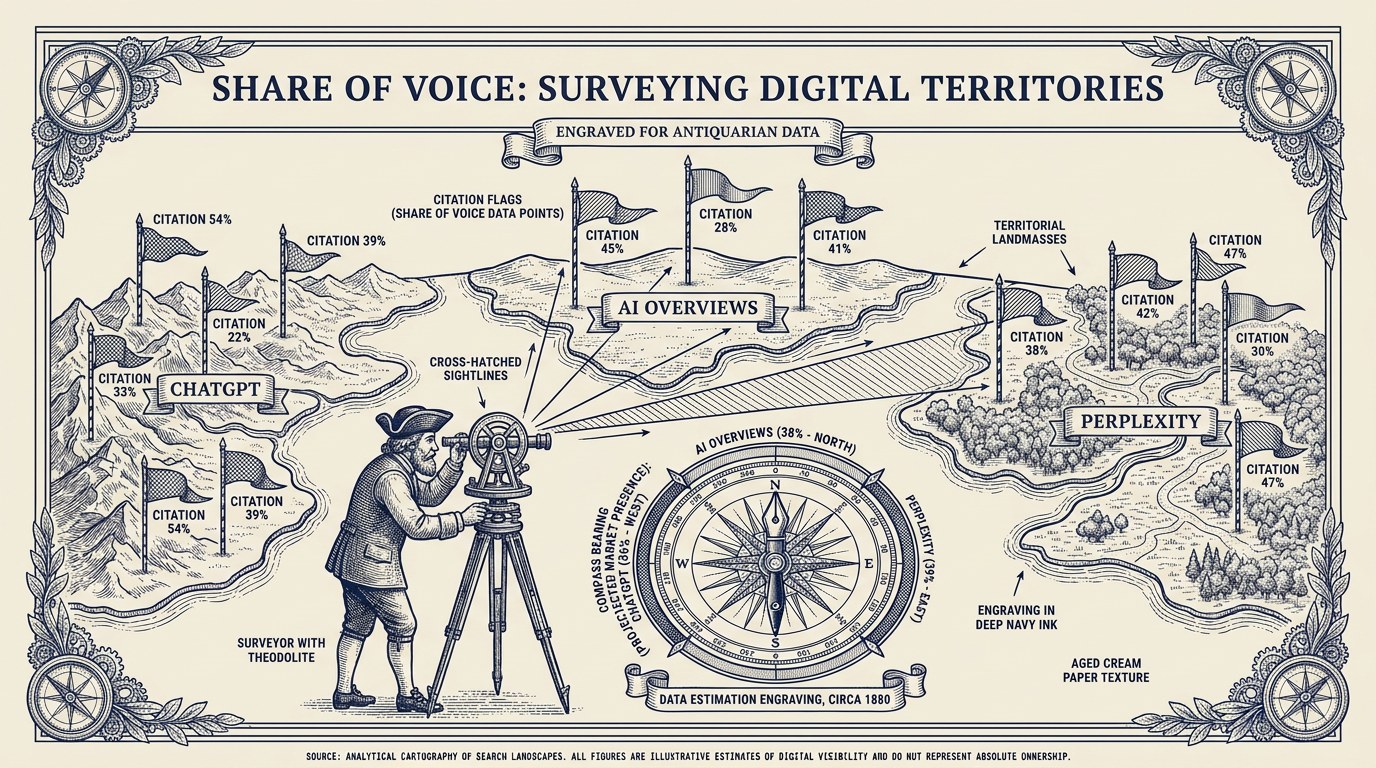
Programs measuring "AI visibility" as a single number lose signal. The discipline is to measure AI Overview citation share, ChatGPT citation share, and Perplexity citation share separately, then aggregate for executive reporting. The AI Search citation tracking framework we ship covers the per-engine measurement methodology in detail.
03The structural signals that make pages eligible
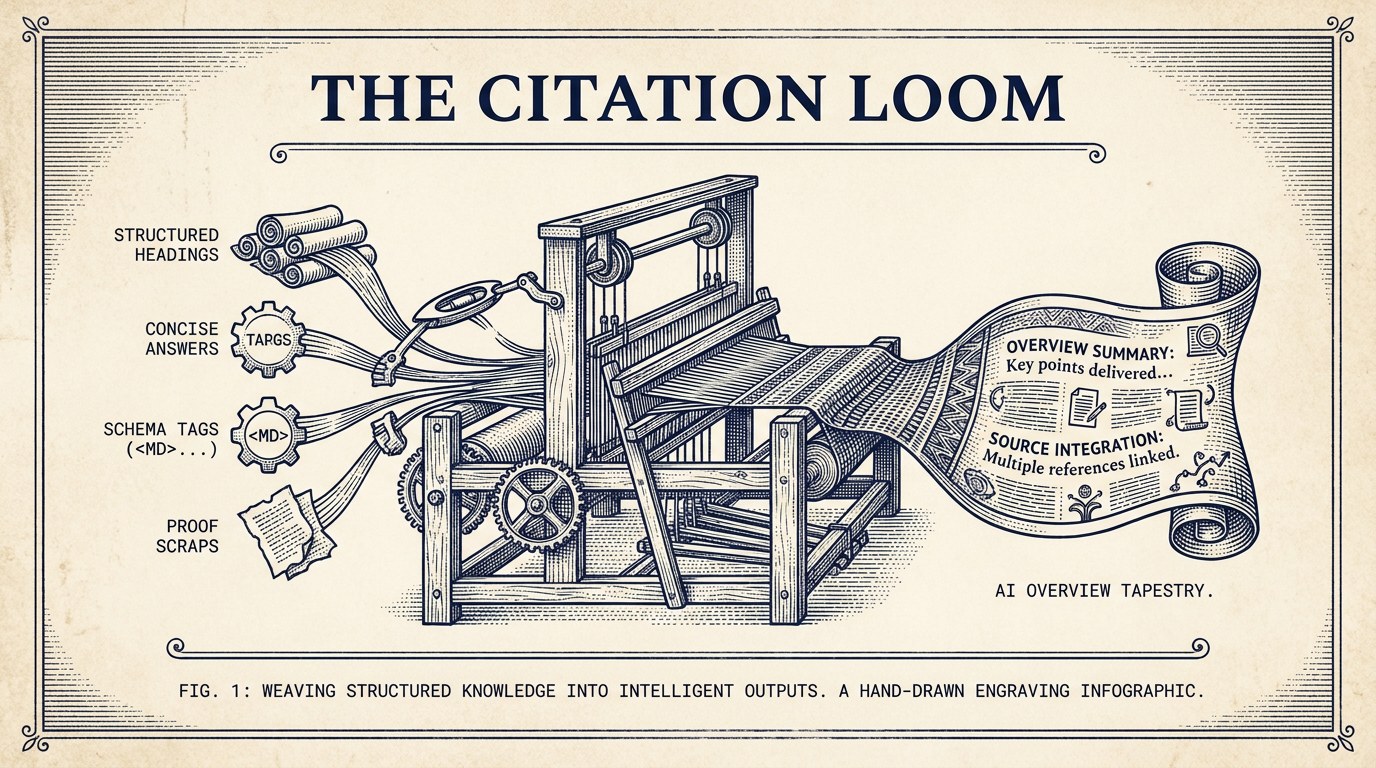
Four signal categories influence AI Overview citation eligibility. Pages that hit three or more are dramatically more likely to be cited than pages that hit one.
Structured content with clear answers
The single strongest signal is content structure that surfaces clear, complete answers near the top of the page. Pages with a 40 to 60 word direct-answer paragraph immediately under an H1 or H2 that matches the query intent get cited at materially higher rates than pages where the answer appears deep in the content. The "answer-first then explain" pattern beats the "build context then answer" pattern for AI Overview eligibility.
Schema markup signals
Article schema, FAQPage schema, HowTo schema, and BreadcrumbList schema all contribute to AI Overview eligibility. FAQPage in particular feeds direct-answer extraction; well-structured Q&A pairs with self-contained answers are favored citation sources. The schema markup JSON-LD implementation for B2B SaaS covers the specific schema patterns that compound across SEO and AI Overview eligibility.
E-E-A-T signals
Experience, Expertise, Authoritativeness, and Trustworthiness signals affect AI Overview citation selection. Author bylines with credentials, organization Person schema, About pages, and original research citations all signal source quality. Pages from sites Google's quality systems classify as authoritative for the category get cited more often than equivalent content from less-authoritative sources.
Topical authority
The cumulative depth of coverage on a topic across a site affects per-page citation eligibility. A B2B SaaS site with 15 well-structured pages on "integration patterns" earns AI Overview citations on integration queries more often than a site with one page on the topic. Topical authority compounds the structural signals above.
04Content patterns that get cited in AI Overviews
Specific content patterns appear in AI Overview citations at much higher frequency than general content. Four patterns dominate.
Direct-answer paragraph patterns
The most-cited pattern: a 40 to 60 word paragraph that answers the query directly in the first sentence, written immediately under a heading that matches the query phrasing. The paragraph stands alone semantically (doesn't require surrounding context to make sense), uses one or two specific facts, and avoids hedging language ("it depends," "generally," "in most cases").
List and table patterns
Numbered lists with self-contained items get cited frequently when the query asks for steps, factors, or a count of items ("5 ways to," "top 3," "what are the four"). Tables get cited when the query asks for comparisons or specifications. The structural clarity feeds AI Overview extraction directly.
Citation source patterns
Pages that themselves cite authoritative sources (Google's own docs, peer-reviewed research, original data) get cited at higher rates than pages that don't. The signal interpretation: pages that cite sources are themselves citation-worthy.
What doesn't get cited
Three patterns consistently fail to earn AI Overview citations. First, content written in marketing voice (heavy adjectives, customer testimonial language, sales-led framing). Second, content that buries the answer ("we'll explore [topic] in this guide, starting with the background"). Third, content without a clear semantic anchor (no heading that matches the query, no answer paragraph near the top).
05SaaS-specific page types that show up most often
Four page types dominate AI Overview citations for B2B SaaS queries. Most programs under-invest in producing these page types because they look like commodity content; they're actually the highest-leverage AI Overview real estate.
Comparison pages
"Tool A vs Tool B" comparison pages are the single most-cited B2B SaaS page type in AI Overviews. The query intent ("[Tool A] vs [Tool B]") triggers AI Overviews almost always; the Overview synthesizes 3 to 5 comparison sources. Programs with operator-quality comparison pages covering their direct competitors capture disproportionate citation share. The B2B SaaS comparison content playbook covers the page structure that earns citations.
Pricing and tier explanation pages
Pricing queries ("[Tool] pricing 2026," "[Category] pricing comparison") trigger AI Overviews consistently. The Overview pulls from pricing pages, pricing comparison articles, and tier explanation content. Pages with explicit pricing tables in machine-readable formats (HTML tables, not images) earn citation at much higher rates than pages with pricing communicated only through marketing copy or contact-for-quote callouts.
Integration pages
"[Tool A] with [Tool B] integration" queries trigger Overviews citing integration documentation pages. Programs operating programmatic SEO via integration directory pages (covered in the integration page SEO patterns post) earn substantial AI Overview citation share across hundreds of integration queries simultaneously.
Definitional content
"What is [Category]" and "What is [Specific concept]" queries trigger Overviews citing definitional content. Programs that produce category-level definitional content (under proper pillar architecture) earn citations for queries that bring buyers into the awareness stage of the funnel. The definitional content also compounds AI Search citation share across ChatGPT and Perplexity for the same queries.
06Measuring AI Overview citation share
AI Overview optimization without measurement produces unverifiable claims. Three measurement layers are required.
AI Overview citation tracking tools
Tools that track AI Overview citation share at scale include Otterly, BrightEdge, Conductor, Authoritas, and several emerging specialists. The choice depends on B2B SaaS-specific feature requirements: per-query tracking across a tracked keyword list, competitive citation share tracking, alerting on citation gain or loss. Tool selection isn't the discipline; the discipline is making the measurement repeatable and comparable across reporting periods.
The citation share metric
Citation share is the right primary metric: your brand's AI Overview citations divided by the total AI Overview citations across your tracked query set. The metric is share-based (not absolute count) because the absolute count fluctuates with how often Google triggers AI Overviews for a query, which changes over time and is outside operator control. Citation share is comparable quarter over quarter.
Per-page citation tracking
Beyond the aggregate citation share, per-page tracking surfaces which specific pages are earning AI Overview citations. The diagnostic value: a comparison page that ranks position 5 but earns AI Overview citation on every targeted query produces more visibility value than a position-2 page that never gets cited. Per-page tracking exposes the ranking-versus-citation mismatch covered in Chapter 02.
Quarterly AI Overview scorecard
The reporting format that survives scrutiny: a quarterly scorecard showing aggregate citation share, citation share trajectory across 4 prior quarters, top-cited pages with their citation share, and competitive citation share comparison. The framework mirrors the SEO ROI scorecard for B2B SaaS we ship for traditional SEO performance, with AI Overview-specific metrics added.
07Common failure modes and operational fixes
Four dominant failures.
The "rank but never cited" failure: pages ranking position 1 to 5 for target keywords but never appearing in the AI Overview for those queries. Fix: audit the answer-first paragraph pattern in Chapter 04; most pages with this failure mode lack a clean direct-answer paragraph in the first 100 words.
The "schema absence" failure: pages eligible by content quality but missing the structured data signals that make them machine-readable. Fix: ship Article, FAQPage, and BreadcrumbList schema as a minimum; HowTo and Product schemas where applicable.
The "marketing-voice-only" failure: pages written in customer-facing marketing voice (heavy adjectives, sales framing) without operator-grade direct answers. Fix: rewrite key paragraphs in operator voice. Customer-facing marketing voice can live elsewhere on the page; the answer paragraph stays operator-grade.
The "no measurement" failure: AI Overview optimization with no citation tracking, defenseless when budget reviews ask whether the investment produces results. Fix: ship citation tracking before optimization investment scales; the per-page tracking data drives the prioritization of what to optimize next.
08Building the AI Overview optimization workflow
The workflow that scales has three components: a weekly content optimization sprint, a monthly measurement review, and integration with broader AI Search and SEO work.
The weekly content optimization sprint
Weekly cadence: pick 3 to 5 priority pages from the citation tracking diagnostic, audit each against the four signal categories in Chapter 03, ship the optimization (typically rewriting the first paragraph, adding schema, tightening the heading-to-answer match). Track which optimizations move citation share over the following 30 days; the measurement loop compounds the operator intuition for what works.
The monthly measurement review
Monthly cadence: review aggregate citation share against trajectory, identify pages with gain or loss of citation share, investigate the underlying changes (Google AI Overview behavior shifts, competitor optimization activity, content changes on tracked pages). The monthly review feeds the next month's weekly sprints.
Integration with broader AI Search and SEO work
AI Overview optimization is one workstream within the broader B2B SaaS SEO program Technotize operates. The technical foundation, schema implementation, content production, and link building all compound the AI Overview citation share. Programs that operate AI Overview optimization in isolation from broader SEO and content disciplines underperform programs with integrated execution.
If you want this AI Overview optimization running on your program, book a 30-minute AI Overview audit with our team.
09FAQ
What is AI Overview optimization?
AI Overview optimization is the discipline of structuring content, schema, and authority signals so that pages get cited in Google AI Overviews above traditional search results. AI Overviews appear for many B2B SaaS-related queries and cite 3 to 7 sources per query. Optimization differs from traditional ranking optimization because eligibility is determined by structural signals (clear answer paragraphs, schema markup, E-E-A-T) rather than ranking position alone.
How are AI Overviews different from featured snippets?
Featured snippets surface a single source's content at the top of search results. AI Overviews synthesize multiple sources into a generative answer with inline citations. The optimization patterns overlap (clear answer paragraphs, structured content, schema), but the measurement diverges: featured snippet is binary (holding or not holding), while AI Overview is a share-of-citations metric measured across competing sources.
Why does my page rank position 1 but never get cited in the AI Overview?
The most common cause: the page ranks on content depth and link signals but lacks the structural signals AI Overviews use for citation selection. The fix is usually a content restructuring: a 40 to 60 word direct-answer paragraph in the first 100 words of the page under a heading that matches the query phrasing, plus FAQPage schema with self-contained Q&A pairs. Pages with this restructuring typically earn AI Overview citation within 4 to 8 weeks of optimization.
Which B2B SaaS page types get cited in AI Overviews most often?
Four page types dominate AI Overview citations: comparison pages ("Tool A vs Tool B"), pricing and tier explanation pages, integration pages ("Tool A with Tool B integration"), and definitional content ("What is [Category]"). Programs producing operator-quality versions of these page types capture disproportionate citation share. Most B2B SaaS programs under-invest in these page types because they look like commodity content; they're the highest-leverage AI Overview real estate.
How does AI Overview optimization fit with broader AI Search and SEO?
AI Overview optimization is one workstream within the broader AI Search visibility discipline (which also includes ChatGPT, Perplexity, and Bing Copilot citation optimization) and the broader B2B SaaS SEO program (which includes traditional ranking, technical SEO, content, and link building). The structural foundations compound across all three: pages optimized for AI Overview citation also tend to earn AI Search citations and rank well in traditional results.
Part of the AI Search playbook
This is the AI Overview optimization chapter of the AI Search sub-pillar.
The strategic framework covering AI Search visibility as a discipline, the citation tracking infrastructure, and how AI Search integrates with traditional SEO, lives on the parent sub-pillar.