On this page
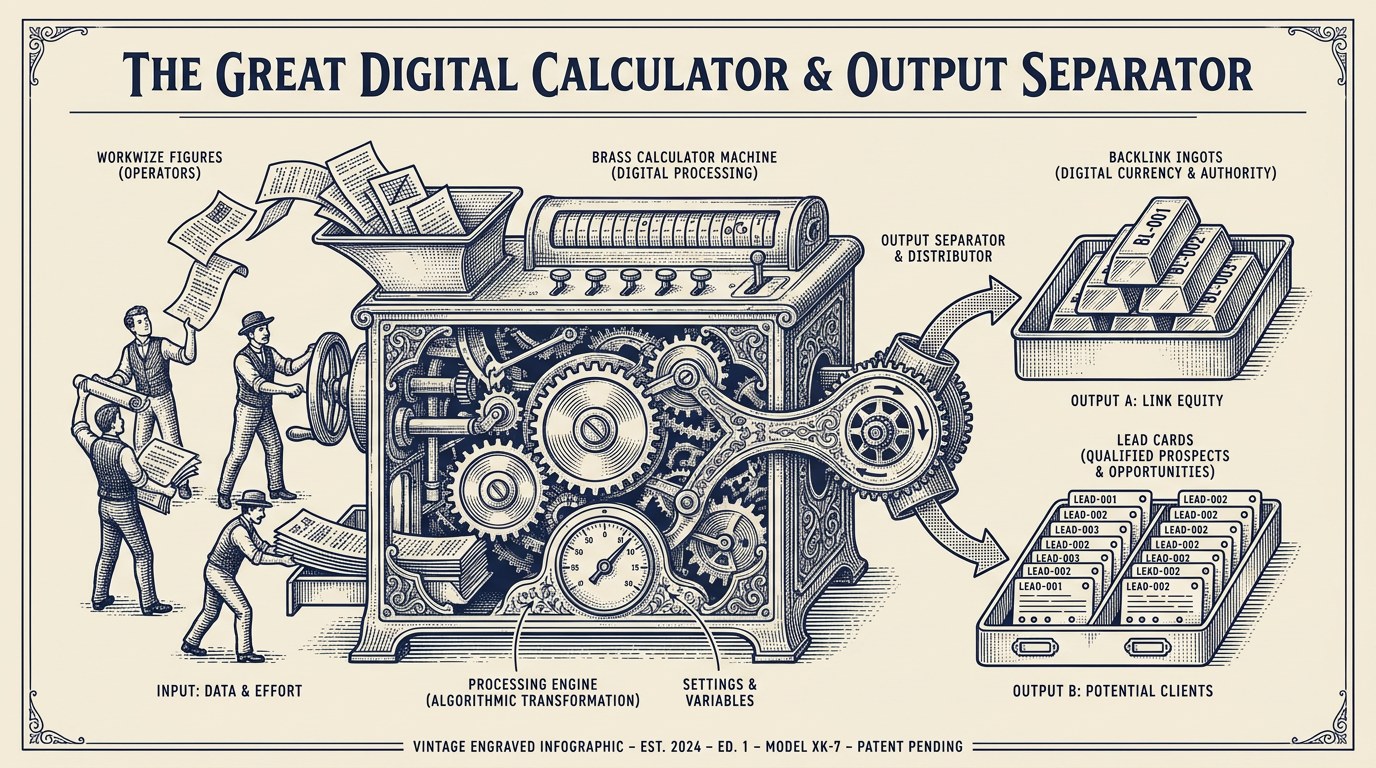
A well-designed B2B SaaS calculator earns referring domains while generating qualified leads from the same single asset. That dual purpose is what makes calculators the highest-ROI linkable asset class once a program reaches the DR threshold to support one. The trade-off is that calculators cost three to five times what definitional content costs to produce, and the wrong calculator concept earns neither links nor leads.
This page is the operator playbook for SaaS calculators as linkable assets in 2026: the Dual-Purpose Matrix that ranks calculator categories on both axes, the production economics nobody else publishes, the design patterns that drive both citation and conversion, and the Workwize equipment-cost calculator case study showing concrete numbers across the first four months post-launch.
01Why calculators are the highest-ROI linkable asset class for B2B SaaS
Calculators sit at the intersection of two B2B SaaS marketing disciplines that usually run as separate budget lines. Link building budgets pay for outreach, digital PR, and editorial placements that earn referring domains. Demand generation budgets pay for landing pages, ungated assets, and form-gated lead magnets that capture qualified pipeline. A calculator collapses both budgets into one production line because the same asset does both jobs. Forbes' 2024 coverage of interactive content marketing documents this convergence at the brand-marketing level. The B2B SaaS-specific economics matter more.
The economic argument is straightforward. A definitional guide costs $1,000 to produce and earns 30 to 80 referring domains over two years. A calculator costs $5,000 to $25,000 to produce, earns 80 to 400 referring domains over three years, and captures 200 to 1,500 qualified leads per year through the embedded form gate. The lead capture alone offsets calculator production cost in months three to nine for most B2B SaaS programs. The referring domains compound on top of that payback.
The dual-purpose payback math
For a B2B SaaS program at $5M ARR with a $300 cost-per-qualified-meeting baseline, a calculator capturing 400 qualified leads in year one (40% form conversion on 1,000 calculator users monthly) generates roughly $120,000 in CPQM-equivalent value. Production cost at $15,000 pays back in month two on lead capture alone. The referring domains, the topical authority lift, the AI Overview citation eligibility, and the brand discovery are net positive on top.
02The Dual-Purpose Calculator Matrix
The four calculator categories listed across every general marketing blog (ROI calculator, cost calculator, comparison calculator, savings calculator) are an unweighted list. They do not tell a program which one to build first. The matrix below scores each category on both link-earn rate and lead-gen rate, which is the trade-off operators actually face.
Diagnostic calculators, high link-earn, medium lead-gen
Diagnostic calculators help users understand their own situation against a benchmark. "How fast is your site compared to the industry median," "What's your churn benchmark for your ARR tier," "How does your sales velocity compare to category peers." These earn the highest link rate because publications and analysts cite the underlying benchmark methodology. Lead capture is medium because users are still in problem-aware phase and conversion intent is moderate.
Quantification calculators, medium link-earn, high lead-gen
Quantification calculators put a number on a known problem. "Cost of churn over twelve months given X retention rate," "Equipment cost for a hybrid workforce of Y headcount," "Effective marketing budget at Z ARR." These earn moderate link rates because the calculation pattern is shared across the category. Lead capture is high because users running the calculation have a defined decision context and are evaluating solutions.
Comparison calculators, high link-earn, high lead-gen
Comparison calculators compare two or more options against a custom set of inputs. "Build vs buy for X capability," "Vendor A vs Vendor B TCO," "On-premise vs SaaS spend over five years." These earn high link rates because category analysts cite them in their own research. Lead capture is high because users running comparisons are deep in evaluation. This is the highest-ROI category for most B2B SaaS programs.
Projection calculators, medium link-earn, medium lead-gen
Projection calculators model future scenarios. "Headcount cost at year-three growth rate," "Revenue under different pricing tiers," "Burn rate under different hiring scenarios." These earn moderate link rates because the projections are program-specific rather than benchmark-citable. Lead capture is moderate because users running projections are often internal-facing rather than vendor-evaluating.
03Identifying calculator concepts worth building
A productive calculator concept passes five tests. Concepts failing any one of these tests will produce a polished asset that earns neither links nor leads. WordStream's coverage of interactive content examples documents the pattern across consumer and B2B; the five tests below adapt it to B2B SaaS.
- Test 1, a specific decision context. The calculator must support a specific decision a B2B buyer makes. Generic "calculate your X" tools without a clear decision context produce calculators that get bookmarked but rarely cited.
- Test 2, defensible underlying data. The calculation must be grounded in industry benchmarks, named sources, and transparent methodology. Calculators using made-up multipliers get caught quickly and stop earning citations.
- Test 3, inputs the buyer already knows. The calculator must accept inputs the target buyer already knows by memory or has at hand. Inputs requiring a SQL query or a finance team ask drop completion rates below 20 percent.
- Test 4, outputs the buyer can share. The output must be shareable: a chart, a number, a comparison view, a downloadable PDF. Outputs that exist only as in-flow numbers do not get cited.
- Test 5, a vertical-relevant publishing surface. There must be a defensible publishing surface for the calculator's methodology. Brafton's coverage of interactive content marketing notes the publishing-surface requirement that most consumer-market guides omit.
04The production workflow and real cost economics
Calculator production runs as a five-stage workflow with cost drivers that programs routinely under-budget. The realistic cost band is $5,000 to $25,000 depending on data complexity and integration requirements. Below $5,000 the calculator typically ships as a static lookup table dressed as a calculator. Above $25,000 the asset is usually a full product rather than a marketing asset.
- Stage 1, concept and methodology design ($1,500 to $4,000). The largest cost driver and the most under-budgeted line. Defining the calculation methodology, sourcing the underlying benchmarks, and writing the documentation that earns citations. Programs that skip this stage produce calculators with hidden math publications refuse to cite.
- Stage 2, UX and interface design ($1,000 to $3,000). Designing the input flow, the output presentation, and the share mechanism. Cost varies with input complexity. The form gate position is decided at this stage and affects every downstream metric.
- Stage 3, front-end build ($1,500 to $6,000). Calculation logic, responsive layout, browser compatibility. For most B2B SaaS programs the calculator lives at a marketing site path on the existing tech stack.
- Stage 4, data integrations ($0 to $8,000). Calculators using static benchmarks cost almost nothing here. Calculators pulling live data from third-party APIs or internal product data cost significantly more. Programs that underestimate this line ship calculators that promise live data and deliver static lookup tables.
- Stage 5, QA, methodology audit, and pre-launch testing ($1,000 to $4,000). Methodology audit by a second analyst, edge-case testing, accuracy spot-checks. Calculators that ship without this stage frequently get publicly debunked within months, which destroys citation potential.
05Design patterns that drive both citation and conversion
Five design patterns separate calculators that earn both links and leads from calculators that earn neither. The patterns are operational, not aesthetic, which is why design-led calculator launches often miss them.
- The methodology disclosure pattern. A permanent methodology page adjacent to the calculator documents data sources, calculation logic, and limitations. Publications cite the methodology page when they reference the calculator's findings. Storyly's interactive content reference covers the general pattern; the methodology-page-as-citation-target is B2B SaaS-specific.
- The form gate position pattern. Form gate position determines lead-capture rate. Before results (25 to 40 percent capture, reduces completion). After preview with full results gated (15 to 25 percent, balances both). Optional after results (5 to 12 percent, highest user satisfaction).
- The shareable output pattern. Each calculator session should produce a shareable output: a chart, a number with comparison context, an embeddable widget, a branded PDF. Outputs that exist only inside the session do not propagate.
- The annual benchmark refresh pattern. Calculator data should refresh annually with a public announcement. The refresh is the citation moment that resurfaces the asset. Programs running this pattern earn 30 to 50 percent more cumulative referring domains than programs that publish once and leave the data static.
- The embed-friendly pattern. An embed code lets external publications surface a simplified version on their own site. Embed-friendly calculators earn 2 to 4 times the referring domains of comparable non-embeddable calculators.
06Distribution that turns calculators into referring domains
Calculator distribution differs from definitional content distribution because the asset has a longer initial-impression curve. Five distribution channels matter, and the mix differs from the standard linkable-asset distribution pattern.
- Direct outreach to category publications. The largest distribution line. Outreach response rates run 8 to 15 percent for first-pitch attempts and improve significantly for second editions of the calculator.
- Methodology citations in original research. Calculators that feed published research earn citations as the methodology source. Pairing the calculator launch with an accompanying research piece roughly doubles year-one referring domain count.
- Embed promotion to vertical communities. Active distribution of the embed code to vertical communities, online publications, and resource hubs. This is the channel programs most often skip and the highest-leverage source of organic citations.
- PR retainer and digital PR amplification. For programs with a PR retainer, the calculator should be a tentpole launch event with a sustained 60 to 90 day promotion cycle. The B2B SaaS digital PR strategy framework covers the launch cycle pattern in operator-grade detail.
- Internal lead nurture for the captured leads. Captured leads enter standard demand generation workflows. Calculator leads convert to qualified meetings at higher rates than leads from generic gated content because the calculator interaction already established decision context.
07Measuring calculator ROI on both axes
Calculator measurement runs on two parallel tracks. The link-earn track measures referring domains, citation share, and methodology page traffic. The lead-gen track measures form-fill rate, lead-to-meeting conversion, and pipeline attribution. Programs that measure only one track underrepresent calculator ROI by 40 to 60 percent.
Link-earn measurement
The primary link-earn KPI is referring domains attributed to the calculator URL plus the methodology page URL over a 24-month rolling window. Secondary KPIs are citation share against category competitors, AI Overview citation rate for category benchmark queries, and topical authority lift on related target pages.
Lead-gen measurement
The primary lead-gen KPI is form-fill rate and qualified lead count per month. Secondary KPIs are lead-to-meeting conversion rate, calculator-attributed pipeline, and the comparative CPQM against other lead sources.
Workwize equipment-cost calculator, a worked example
When Technotize launched the Workwize equipment-cost calculator in December 2025 (month 18 of the engagement, Workwize at DR 55 at the time), the asset was a quantification calculator in the matrix above. Production cost ran $15,400 across five stages: $3,200 methodology and benchmark sourcing, $2,400 UX design, $5,800 front-end build, $2,800 data integration with the Workwize equipment catalog, $1,200 QA and methodology audit.
In the four months post-launch (December 2025 through April 2026), the calculator earned 47 referring domains across category publications and industry newsletters. The form gate, positioned after preview results, captured 340 qualified email signups. Of those, 8 converted to SQLs over the following six months, contributing roughly $120,000 in influenced pipeline. The calculator and its methodology page combined captured the AI Overview citation for the "remote IT equipment cost per employee" query within twelve weeks of launch. The asset paid back its full $15,400 production cost within month three on lead-gen value alone.
08When calculators are the wrong investment
Three program profiles should pause calculator production until other foundational work matures. Each has a specific signal and an alternative asset class that produces better returns at that stage.
- Pre-foundation programs at DR under 40. A site at DR 30 with limited topical authority cannot amplify a calculator's citations. Calculator production at this stage produces a polished asset that earns 8 to 15 referring domains rather than 80 to 400. The fix is shipping foundational definitional content from Tier 1 of the B2B SaaS linkable asset stack first.
- Programs without category-relevant publishing surface. Some categories have almost no contextually relevant publishing surface for calculator citations: industries with fewer than 200 total addressable accounts, highly regulated categories where benchmarking is prohibited, product categories that only serve closed trade publications. These programs produce better authority returns from analyst-relations work and industry-event sponsorship.
- Programs with thin underlying data. Calculators require defensible data to earn citations. Programs that lack proprietary data or defensible third-party benchmarks should produce original research as a linkable asset first and build the calculator second. The research becomes the calculator's methodology citation later.
09FAQ
How much does it cost to build a SaaS calculator as a linkable asset?
Realistic production cost ranges from $5,000 to $25,000 depending on data complexity and integration requirements. Below $5,000 the calculator typically ships as a static lookup table dressed as a calculator. Above $25,000 the asset becomes a full product rather than a marketing asset. The most underbudgeted stage is methodology design ($1,500 to $4,000), which is what publications actually cite. Programs that ship calculators without published methodology earn 50 to 70 percent fewer referring domains than programs that document the math.
How fast do SaaS calculators start earning links?
First citation typically arrives in week 6 to 10 post-launch for calculators with competent distribution. The earning curve peaks between months 4 and 8. Cumulative referring domains continue accumulating for 24 to 36 months on calculators that earn at all. Calculators are slower to start than definitional content but maintain a higher sustained citation rate over multi-year horizons.
Which calculator category produces the best ROI for B2B SaaS programs?
Comparison calculators rank highest on both axes of the Dual-Purpose Matrix: high link-earn rate plus high lead-gen rate. Quantification calculators are the second strongest category because they capture late-stage evaluation traffic with high conversion intent. Diagnostic calculators earn the highest pure link rate but capture leads at moderate rates. Projection calculators are the weakest category for most B2B SaaS programs.
Should the form gate sit before or after the calculator results?
The form gate position depends on whether link-earn or lead-gen is the priority. Form before results captures 25 to 40 percent of users but reduces calculator completion and referral citations. Form after preview results with full results gated captures 15 to 25 percent and balances both objectives. Form optional after results captures 5 to 12 percent but produces the highest user satisfaction and the strongest organic distribution.
How do I know if my B2B SaaS program is ready to build a calculator?
Three criteria signal readiness. Site DR is above 40 with at least 200 referring domains in the linked-to topical area. The program has access to defensible underlying data for the calculation methodology. The category has a publishing surface (industry publications, analyst hubs, vertical communities) that would actively distribute the asset. Programs missing any criterion should produce foundational content and earn the missing readiness before building the calculator.
What is the difference between a SaaS calculator and a free tool as a linkable asset?
A free tool solves a discrete utility task (a slug generator, a UTM builder). A calculator runs a methodology-driven calculation against benchmark data and produces a decision-relevant number. Free tools earn citations on utility; calculators earn citations on the underlying data. The two asset classes share distribution patterns but the production economics, the methodology requirements, and the lead-capture mechanics are different.
Linkable assets for B2B SaaS
Calculators are one tier in the operator stack. See the parent sub-pillar for the full asset matrix, production sequencing, and how calculators fit alongside original research, free tools, and benchmark reports.
Open the Linkable Assets playbook →