
On this page
Most B2B SaaS programs measure SEO badly. They report traffic, rankings, and domain rating. None of those metrics move the CFO. Pipeline contribution does. The gap between what SEO teams measure and what finance teams need to see is why SEO budgets get cut in the second year, right when the compound returns should be kicking in. This is the operator playbook for the SEO-to-pipeline attribution model that survives scrutiny, the multi-touch attribution discipline that respects 6 to 18 month B2B SaaS sales cycles, and the quarterly scorecard that defends the investment.
01What SEO ROI actually is for B2B SaaS
SEO ROI for B2B SaaS is the ratio of pipeline contribution attributable to organic search to the fully-loaded cost of the SEO program over a defined time window. Both sides of the ratio are harder to calculate in B2B SaaS than in transactional contexts. The discipline that prevents bad measurement is in our SEO strategy services for B2B SaaS.
The actionable definition
The deliverable from SEO ROI measurement is a quarterly scorecard that shows pipeline contribution (sourced plus assisted), program cost, cost per pipeline dollar, and leading indicators for the next quarter. Not a traffic report. Not a ranking dashboard. A pipeline-tied scorecard with cost transparency. If the measurement infrastructure doesn't produce one, the measurement isn't working.
Why SEO ROI is harder to measure in B2B SaaS
B2B SaaS makes SEO ROI measurement harder than B2C ecommerce or services for three structural reasons. First, sales cycles run 6 to 18 months, so traffic generated in Q1 produces pipeline that closes in Q3 or Q4. Second, deals involve 5 to 12 stakeholders, so a single conversion path captures only one path through the buying committee. Third, deal sizes vary widely (annual contracts of $5K to $500K+), so revenue attribution depends heavily on which deals get credited.
The two outputs that matter
Two outputs from SEO ROI measurement matter to leadership. First, pipeline contribution: total dollar value of opportunities where organic was a documented touchpoint, segmented by sourced (first touch) and assisted (one of multiple touches). Second, cost per pipeline dollar: total program cost divided by total influenced pipeline. The two together give finance the unit economics view of SEO that maps to how they think about every other marketing channel.
02Why traffic is not ROI (and what to measure instead)
Traffic is an input metric. Pipeline is an output metric. Reporting traffic as ROI is reporting input as output, which is what makes the SEO measurement gap chronic in B2B SaaS.
What most programs measure
Most B2B SaaS SEO programs report monthly organic sessions, top-ranking keyword counts, domain rating changes, and referring domain growth. These are all leading indicators of pipeline contribution, and they're useful for SEO team operational tracking. They are not what CFOs need to see when deciding whether to renew the program budget.
Why those metrics don't move CFOs
CFOs evaluate marketing programs against pipeline contribution and customer acquisition cost. Traffic doesn't translate to either without an attribution model. A 40 percent year-over-year organic traffic increase tells the CFO nothing about whether the SEO program is producing pipeline. Pipeline attributable to organic, segmented by sourced and assisted, tells the CFO exactly what they need to know.
The five revenue-tied metrics that do
Five metrics defend SEO budget. First, sourced pipeline (deals where organic was the first documented touchpoint). Second, assisted pipeline (deals where organic was a documented touchpoint but not the first or last). Third, organic-influenced deal velocity (deals with organic in the path close 18 to 27 percent faster on average based on the engagements we run, often because organic touchpoints arrive earlier in the buying committee's research). Fourth, cost per pipeline dollar (program cost / influenced pipeline). Fifth, AI Search citation share gains on priority commercial queries. First Page Sage's 2026 SEO ROI Statistics report provides the industry benchmarks against which SaaS programs can compare.
03Building the SEO-to-pipeline attribution model
The attribution model is the infrastructure that connects organic visits to closed pipeline. Without it, ROI measurement is guesswork. With it, the quarterly scorecard becomes a credible defense of program investment.
The conversion path from organic to pipeline
The path from organic visit to pipeline contribution in B2B SaaS typically runs: organic visit → content engagement (often multiple sessions over weeks or months) → form fill or demo request → MQL → SQL → opportunity → closed-won deal. SEO touchpoints sit at the top of this path. The attribution model assigns credit across all touchpoints, with SEO getting its appropriate share based on the attribution model chosen.
Tracking infrastructure required
The tracking stack for credible SEO ROI measurement: GA4 with consent-mode-compliant tracking, the CRM (HubSpot, Salesforce, or equivalent) with marketing channel attribution enabled per opportunity, server-side tracking for conversion events (to survive iOS privacy and ad-blocker degradation), and a UTM discipline that tags all paid and outbound channels so organic is the residual default. Programs missing any of these components produce noisy attribution that doesn't survive CFO scrutiny. Semrush's SEO ROI guide with formulas provides the underlying calculation approach that B2B SaaS programs adapt to multi-touch reality.
The 6 to 18 month sales cycle problem
The biggest structural difference between B2B SaaS SEO measurement and consumer or short-cycle B2B is the sales cycle length. Traffic generated in May 2026 produces pipeline that closes between November 2026 and November 2027. This means current-quarter pipeline measurement reflects content and rankings from 6 to 18 months ago, not current activity. Programs that ignore this lag report SEO ROI as flat or declining in months 4 to 9 when underlying performance is actually compounding. The fix is reporting both backward-looking pipeline (closed in this quarter, attributed back to source quarter) and forward-looking leading indicators (current ranking gains, current refdomain growth, current AI Search citation share).
04Multi-touch attribution for SEO in B2B SaaS
Single-touch attribution is inadequate for B2B SaaS. Multi-touch attribution is the model that respects how B2B buying committees actually move through the funnel.
First-touch vs last-touch vs linear vs position-based
Four attribution models dominate B2B SaaS marketing measurement. First-touch credits the first documented marketing touchpoint with the entire deal value. Last-touch credits the last touchpoint (usually the conversion event itself). Linear credits all touchpoints equally. Position-based (also called U-shaped) credits the first and last touchpoints heavily (typically 40 percent each) and distributes the remaining 20 percent across middle touches. Each model produces different SEO ROI numbers from the same underlying data.
Which model fits B2B SaaS
Position-based attribution with an assisted category fits B2B SaaS best for three reasons. First, it respects the reality that early SEO touchpoints (awareness building, evaluation criteria research) carry real weight in deal outcomes. Second, it gives the conversion-driving channel (often paid, direct, or sales-led) appropriate credit. Third, it surfaces the middle-funnel touchpoints (case studies, comparison content) that influence deal velocity without driving the conversion itself.
The assisted-touch pipeline category
The most underused measurement layer is assisted-touch pipeline: opportunities where organic was a documented touchpoint anywhere on the conversion path but not the source or the closer. Programs that only track sourced pipeline understate SEO contribution by 40 to 70 percent based on the audits we run before engagement. Adding the assisted category typically doubles or triples the apparent SEO ROI without changing any underlying activity. The why SaaS SEO programs fail post covers the related failure of programs that get cut because they only measured sourced pipeline and missed the assisted contribution.
05The quarterly SEO ROI scorecard
The quarterly scorecard is the format that survives CFO and board scrutiny. Monthly reporting produces noise; weekly reporting produces panic. Quarterly cadence aligns with B2B SaaS sales cycle reality.
The single-page format
The scorecard fits on one page. Top section: pipeline metrics for the quarter (sourced pipeline, assisted pipeline, total influenced pipeline, deal velocity, average deal size). Middle section: cost metrics (program cost, cost per pipeline dollar, program cost as percent of influenced pipeline). Bottom section: leading indicators for the next quarter (ranking position changes on commercial keywords, refdomain growth, AI Search citation share gains).
Three sections, three audiences
Each section serves a different audience. The pipeline metrics serve the CFO and CRO who need to know what the program produced this quarter. The cost metrics serve finance and the marketing leadership team who need to evaluate program efficiency. The leading indicators serve the SEO team and marketing strategy who need to know whether the underlying signal is strengthening or weakening for the next cycle.
Quarterly cadence rationale
Quarterly cadence works for three reasons. First, it aligns with closed pipeline cycles in B2B SaaS (most deals close on quarter-end timelines). Second, it filters month-to-month noise in organic traffic that doesn't translate to pipeline noise. Third, it matches board-meeting cadence at most B2B SaaS companies. Reporting at any other cadence produces friction without producing better signal.
06Cost side, tracking the true cost of SEO programs
The cost side of SEO ROI is usually underestimated because programs only count obvious external spend. The true cost includes internal time, tooling, and content production that doesn't show up in the agency invoice.
The five cost buckets
The cost of an SEO program runs in five buckets. First, agency or contractor fees (the obvious external spend). Second, internal salaries (the marketing manager, SEO specialist, or content lead time allocated to SEO). Third, tooling (Ahrefs, Semrush, Search Console premium tier, AI Search tracking tools, rank tracking). Fourth, content production (writer fees or internal content team time, design, video). Fifth, link building (digital PR, guest posting, niche edits, outreach tooling). Most programs only count the first bucket, which understates cost by 60 to 200 percent.
Hidden costs most programs miss
Three hidden costs catch most programs. First, executive and SME time (founders or VPs reviewing content drafts, providing expertise for thought leadership). Second, opportunity cost of the marketing team capacity allocated to SEO instead of other channels. Third, technical debt cost (engineering time required to ship technical SEO fixes, which is real time that could have shipped product). Including these surfaces the true program cost.
Cost per pipeline dollar as the unit metric
The unit metric that makes SEO comparable to other marketing channels is cost per pipeline dollar. Total program cost (all five buckets) divided by total influenced pipeline. B2B SaaS benchmarks vary widely by deal size and authority budget, but ranges of $0.05 to $0.20 of program cost per $1 of influenced pipeline are common at scale. The framing maps directly to how finance teams think about CAC and CPA across paid, organic, and outbound channels.
07Defending SEO investment to the CFO
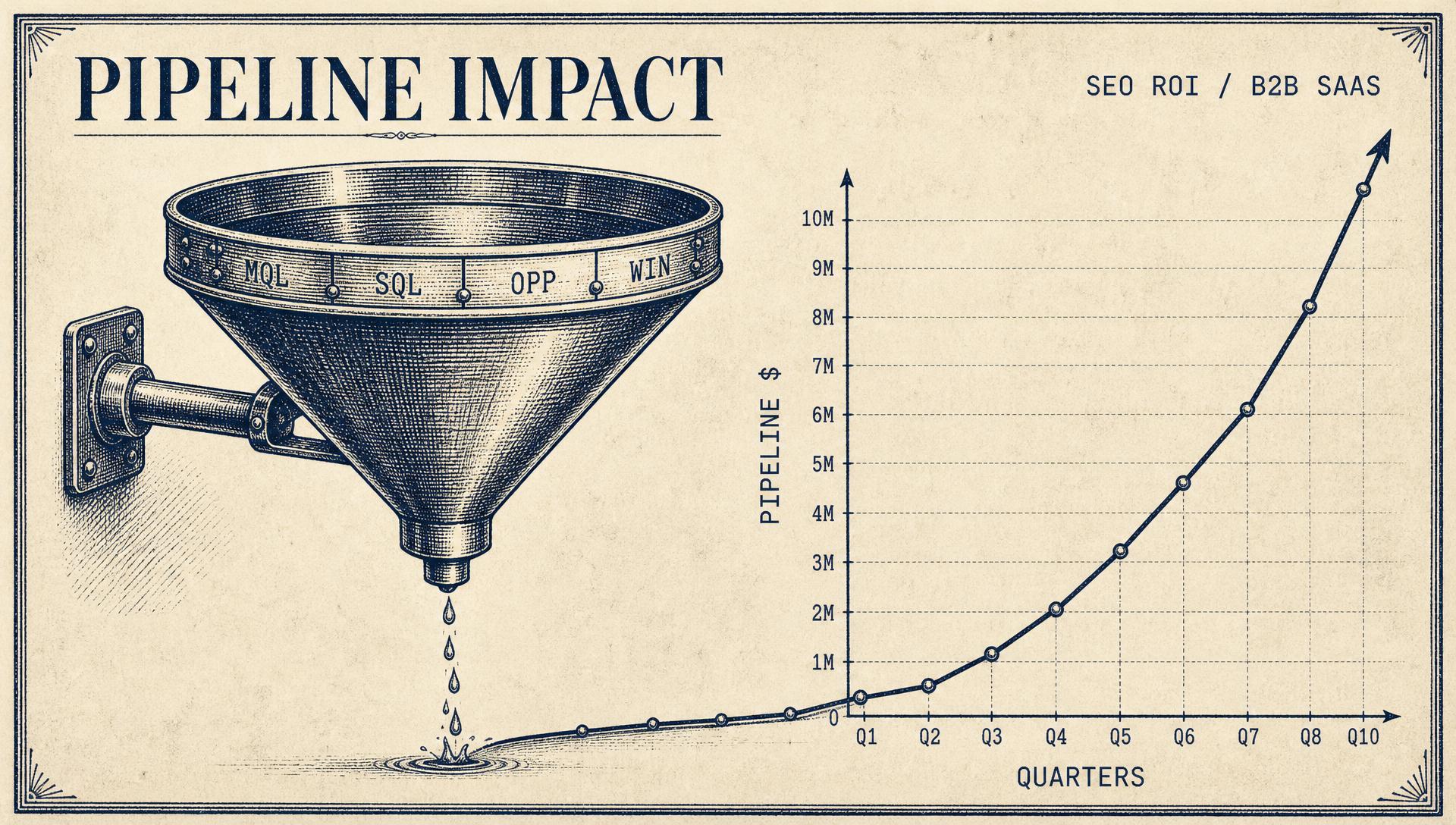
The defense of SEO investment is most fragile in months 6 to 12, after the program has spent money but before pipeline has materialized at scale. This is when budget cuts happen. The defense requires showing leading indicators alongside the pipeline lag.
The CFO's actual question
The CFO is not asking "is SEO working." The CFO is asking "should I keep funding this program when I could put the same dollars into paid acquisition that converts within the quarter." The defense addresses this question directly: paid produces this quarter's pipeline; SEO produces this quarter plus every subsequent quarter for years. The compounding return is the strategic asset. Siteimprove's article on proving SEO ROI to executives frames the same compounding argument with executive-facing language.
What to present in the board deck
The board deck slide on SEO ROI has three components. First, current-quarter pipeline contribution (sourced + assisted, with attribution methodology footnoted). Second, the leading indicators trajectory (rankings, refdomains, AI Search citation share, ranked against the prior 4 quarters). Third, the compounding pipeline projection (modeled pipeline contribution over the next 4 quarters based on current ranking gains and content production cadence).
The 12-month payback model
B2B SaaS SEO programs typically hit pipeline payback (cumulative influenced pipeline exceeds cumulative program cost) between months 9 and 14. The model that defends the investment shows program cost ramping early, pipeline contribution ramping with the typical 6 to 12 month lag, and the cumulative crossover point. Programs cut before month 12 usually cancel right before the crossover, which is what makes the second-year cut chronic. The discipline that prevents this connects to our B2B SaaS SEO program roadmap, which structures the program against the payback timeline from kickoff.
08Common failure modes and operational fixes
Four dominant failures.
The "traffic is ROI" failure: reporting organic sessions and rankings to leadership as if they were ROI metrics. Fix: scorecard format with pipeline contribution as the headline metric.
The "sourced-only" failure: tracking only first-touch attribution and missing 40 to 70 percent of SEO contribution. Fix: position-based or linear attribution with an explicit assisted-touch category.
The "agency invoice only" failure: counting only external agency or contractor fees as program cost. Fix: track all five cost buckets including internal time, tooling, content production, and link building.
The "no leading indicators" failure: reporting only backward-looking pipeline metrics, leaving the program defenseless in months 6 to 12 when pipeline lag is highest. Fix: leading indicators (ranking, refdomain growth, AI Search SoV) reported alongside pipeline.
If you want this measurement infrastructure running on your program, book a 30-minute SEO ROI review with our team and we'll audit your current measurement setup, identify the attribution gaps, and design the scorecard format against your stage. Compare engagement options for SEO strategy programs.
Part of the SEO strategy playbook