On this page
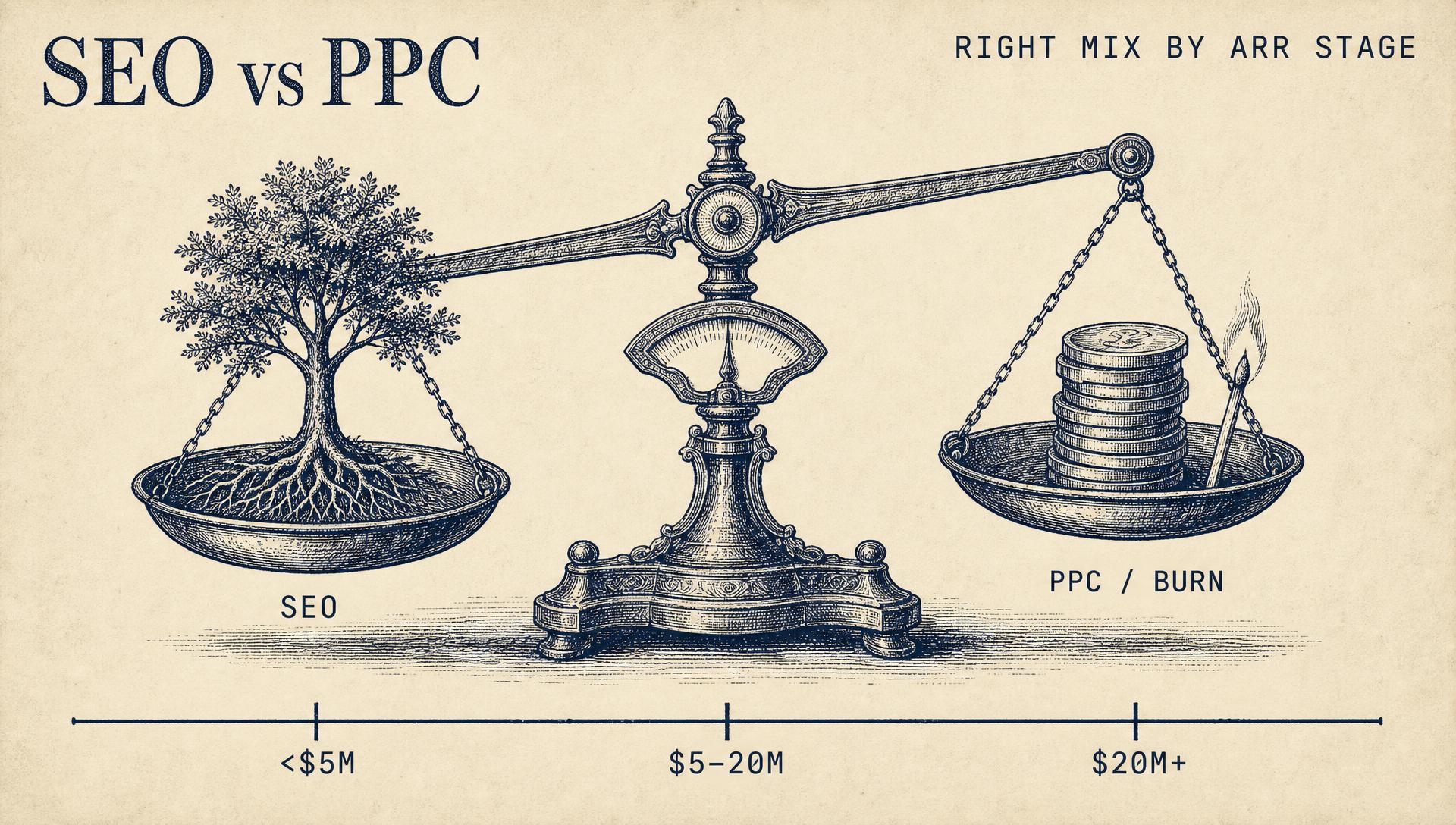
SEO vs PPC is the wrong framing for most B2B SaaS companies. The right framing is the SEO and PPC mix, and the mix shifts by ARR stage. Foundation companies should start mostly paid. Acceleration companies should run both. Compounding companies should be reducing paid as SEO compounds. Authority companies should run SEO as the dominant channel with paid for specific tactical uses.
01Why "SEO vs PPC" is the wrong question
The "SEO vs PPC" question gets asked as if the two are alternatives. They are not. They are different channels with different cost curves, different time horizons, and different roles in a B2B SaaS go-to-market motion. The right question is "what is the right SEO and PPC mix for our stage?" The answer changes by ARR.
What changes when the question is framed correctly
A Foundation-stage company asking "SEO or PPC" usually picks SEO because it sounds cheaper. They run a $5K/month SEO program for 18 months and get no pipeline. Meanwhile their competitors run $5K/month paid programs and produce real pipeline. The framing chose for them. The right framing, "what mix", would have led them to spend $3K on paid and $2K on a Foundation-grade SEO investment. Different outcome.
Why agencies push one channel over the other
Most agencies sell what they execute. SEO agencies argue against paid. Paid agencies argue against SEO. Both are conflicted. The honest answer requires a stage-aware framework rather than a channel preference.
02What SEO actually does
The mechanics matter for the channel math. Most "SEO vs PPC" articles handwave at this. Here is the structural truth.
SEO mechanics
SEO produces a compounding asset. Each piece of operator-grade content earns rankings, traffic, and pipeline that grow over time. The marginal cost of producing the 50th piece of content is roughly equal to the marginal cost of producing the 5th, but the cumulative pipeline from 50 pieces is non-linearly higher than from 5. The asset compounds because rankings strengthen as topical authority grows.
SEO economics
The first 12 months of an SEO program produce roughly zero defensible pipeline. The 12 to 24 month window is where the asset starts paying back. By month 24 to 36, a compounding SEO program produces pipeline at a cost-per-dollar that is structurally below paid channels. The capital requirement is front-loaded; the returns are back-loaded.
SEO failure cases
SEO fails as a channel for companies with sub-30-day buying cycles, ACV below $1,500, no category search demand, unstable PMF, or no leadership time. These are the six failure modes covered in why most B2B SaaS SEO programs fail. If any of these apply, SEO is the wrong channel at any stage.
03What PPC actually does
The mirror image. PPC is structurally different from SEO at every dimension that matters.
PPC mechanics
PPC produces immediate pipeline. Each dollar spent on a credible Google Ads campaign produces pipeline in days, not months. The asset is not compounding, when you stop spending, the pipeline stops. The marginal cost of the 50th impression equals the marginal cost of the 5th. There is no economy of scale on the cost side, though there is improving conversion as the account learns the audience.
PPC economics
PPC has predictable economics from week 1. A B2B SaaS company can run paid for 3 months and know exactly the cost per pipeline dollar at the current scale. The cost is real every month. The asset has no terminal value, if budget cuts come, the pipeline collapses inside 30 days.
PPC failure cases
PPC fails as a primary channel for companies with very high ACV in winner-take-most categories (the cost per click becomes prohibitive), categories with no commercial keyword demand (nothing to bid on), or companies that cannot convert paid clicks into pipeline because the landing pages and product narrative are not built for it.
04The mix at Foundation stage, below $5M ARR
Foundation companies are pre-PMF or recently post-PMF. The mix that wins is paid-heavy with light SEO foundation.
Foundation mix recommendation
70 to 80 percent paid, 20 to 30 percent SEO. The paid budget produces the immediate pipeline that funds the company. The SEO budget is foundational investment: brand pages, the master pillar, 3 to 5 cluster posts, technical hygiene. The SEO program at this stage will not produce defensible pipeline. It builds the asset that pays back in years 2 and 3.
Why heavier on paid at Foundation
Foundation companies cannot wait 14 to 18 months for SEO to pay back. They need pipeline this quarter to make payroll, prove PMF, and raise the next round. Paid produces that. The SEO investment is the long-term hedge, not the near-term engine.
What goes wrong at Foundation
The most common Foundation-stage mistake is going SEO-heavy because SEO sounds cheaper. The result is 18 months of work that produces no pipeline plus 18 months of underfunded paid that also produces no pipeline. The company runs out of runway. We have audited several. The pattern is consistent.
05The mix at Acceleration stage, $5M to $20M ARR
The Acceleration mix is the most balanced. Both channels are productive. The mix is roughly 50-50 with directional drift toward SEO as the stage progresses.
Acceleration mix recommendation
40 to 60 percent SEO, 40 to 60 percent paid, sliding toward SEO as the Acceleration phase matures. By the end of Acceleration (approaching $20M ARR), the mix should be closer to 60-40 SEO-dominant.
What both channels produce at Acceleration
SEO at Acceleration is starting to compound. The first cluster of content has been live for 12+ months, rankings are in top 30, traffic is growing. Pipeline contribution is becoming defensible. Paid at Acceleration is still producing immediate pipeline efficiently because the brand has enough recognition to convert paid clicks at reasonable rates.
Acceleration mix mistakes
The common mistake is keeping the Foundation-stage paid-heavy mix into Acceleration. Paid spend at Acceleration is increasingly expensive relative to the SEO asset that is starting to compound. Companies that do not rebalance lose roughly 20 to 30 percent of pipeline efficiency.
06The mix at Compounding stage, $20M to $50M ARR
This is where the channel mix shifts decisively toward SEO. Paid becomes a complement, not a primary.
Compounding mix recommendation
60 to 70 percent SEO, 30 to 40 percent paid. The SEO program is now producing defensible compounding pipeline at low marginal cost. Paid is increasingly expensive at scale and serves more targeted purposes: retargeting, brand defense, specific competitor keywords.
What changed at Compounding
Two structural changes. First, the SEO asset is now valuable enough that increasing the SEO budget produces 2 to 3x the marginal pipeline of increasing the paid budget. Second, the brand has enough organic search demand that paid is competing against the company's own organic listings on many keywords, which is inefficient.
Compounding mix mistakes
The common mistake at Compounding is leaving the paid budget at Acceleration-stage levels even though SEO is now more efficient. The capital that could be moved into SEO content production or links is stuck producing diminishing returns in paid.
07The mix at Authority stage, above $50M ARR
SEO becomes dominant. Paid becomes tactical.
Authority mix recommendation
70 to 85 percent SEO, 15 to 30 percent paid. The paid budget at Authority stage is for specific tactical uses, not primary acquisition.
What paid does at Authority
Paid at Authority covers: new product launches before SEO can rank for the new category, competitor takeout campaigns where you bid on competitor brand terms, geographic expansion into markets where SEO has not built up yet, retargeting site visitors who did not convert organically. None of these are primary acquisition. They are tactical complements to the dominant SEO engine.
Authority mix mistakes
The Authority-stage mistake is running paid as primary acquisition out of habit. We see this at companies that grew up paid-heavy and never rebalanced. The pipeline efficiency loss is 30 to 50 percent. Companies in this pattern are typically aware their cost-per-pipeline-dollar is high but have not connected it to the mix.
08The transition between stages
The mix does not jump. It shifts gradually over the 6 to 12 months around a stage transition.
How to execute the transition
Reduce paid budget by 10 to 15 percent per quarter for 3 to 4 quarters while increasing SEO budget by the same amount. Watch pipeline contribution from each channel. If pipeline from organic is growing faster than the reduction in pipeline from paid, the transition is working. If not, slow the transition and investigate why the SEO program is not compounding as expected.
Common transition mistakes
Cutting paid budget by 50 percent in one quarter to fund SEO investment is the most common transition mistake. Pipeline drops by roughly 40 percent the following month, panic ensues, and paid budget gets restored at the cost of SEO funding. The transition fails. Gradual shifts work. Abrupt shifts break.
09Workwize channel mix progression
The cleanest channel-mix transition we have shipped. From paid-heavy to SEO-dominant across 22 months.
Workwize starting mix
At engagement start, Workwize was running approximately 80 percent paid, 20 percent SEO. They were at Acceleration stage but with a Foundation-stage channel mix because the SEO program had not yet been built. Monthly pipeline contribution from organic was approximately $360K, mostly from brand-search rather than ranking on commercial-intent terms.
Workwize ending mix
At 22 months, Workwize had shifted to approximately 45 percent paid, 55 percent SEO. Monthly pipeline from organic had grown to approximately $1.16M, primarily from commercial-intent rankings rather than brand-search. The paid budget had not been cut; it had been held flat while SEO scaled. (Full case study walks through the mix shift quarter by quarter.)
What the Workwize shift confirms
The compounding channel-mix shift is real and repeatable. The 6 to 12 month transition window holds. Holding paid budget flat while SEO scales is a cleaner approach than cutting paid to fund SEO.
10FAQ
This FAQ section addresses critical strategic questions for B2B SaaS companies navigating SEO and PPC. We cover channel independence, budget allocation, transition timing, and accurate attribution, providing clear guidance for optimizing your marketing spend.
Can a B2B SaaS company succeed with just one of SEO or PPC?
At Foundation stage, possible with paid alone if the budget is large enough. SEO alone at Foundation typically fails because the 14 to 18 month timeline outruns the company's runway. At Acceleration stage and above, running only one channel costs 30 to 50 percent of pipeline efficiency.
How do I decide the actual dollar split?
Start with the ARR-stage percentage from chapters 04 through 07. Apply it to total acquisition budget. Then adjust based on category dynamics: high-CPC categories tilt toward SEO sooner, low-search-demand categories tilt toward paid longer. The percentage is the starting point, not the final answer.
When should we start shifting from paid to SEO?
When you cross into Acceleration stage and the SEO program has been running for at least 12 months. Before 12 months of SEO, the asset has not compounded enough to absorb paid spend that is being cut. After 12 months, the shift is structurally safe if executed gradually.
Should I test both channels at the same time?
If you are starting from zero on both, yes. A 90-day test of paid with a 12-month commitment to SEO is the standard pattern. The paid test tells you whether the category has commercial demand at all. If it does, the SEO investment becomes defensible.
How do I attribute pipeline between SEO and PPC accurately?
Multi-touch attribution with self-reported attribution at form fill is the most defensible model. First-touch and last-touch each have known failure modes. Self-reported attribution catches the buyer journey reality (saw an ad, then searched, then found the blog, then booked a demo). Without it, attribution conversations between the SEO and paid teams will not converge.
Can we stop paid entirely once SEO is compounding?
Not recommended. Paid still produces incremental pipeline at Authority stage. The recommended floor is 15 to 20 percent of acquisition budget on paid for tactical uses. Cutting paid to zero usually loses 10 to 15 percent of pipeline that paid was incrementally producing.
Part of the
B2B SaaS SEO strategy playbook →
The pillar covering ARR-stage maturity, cluster architecture, attribution design, and the structural decisions that determine whether an SEO program compounds or stalls.
Where this fits in the broader playbook
This piece sits inside the strategy chapter of the operator guide, which is one chapter of the B2B SaaS SEO pillar covering the complete discipline. For deeper framing on the same discipline, see the SEO strategy discipline for SaaS programs.
Closely related reading from the same sub-pillar
- the maturity model , the maturity stages that change the SEO/PPC mix.
- how long organic actually takes , the timing that informs paid vs organic balance.
- the SEO budget calculator , the budget framework for splitting paid and organic spend.
From other corners of the program
- the measurement sub-pillar , the cross-cluster discipline that compounds this work.
- Technotize's content marketing approach for SaaS , the upstream pillar this connects to.
When you're ready to put this into a program, schedule a discovery call or see our service tiers. Average response time: under 4 business hours.