On this page
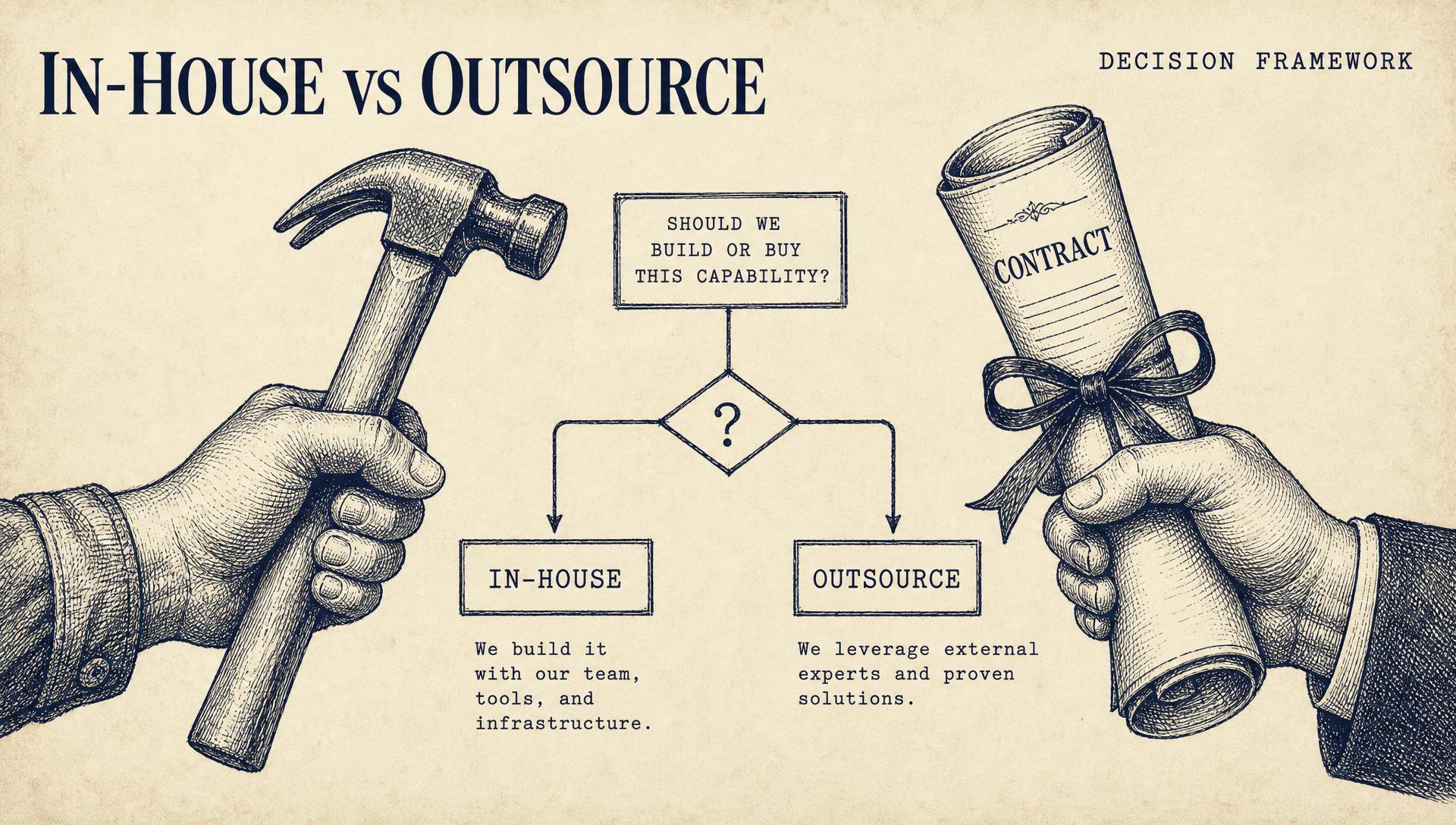
There are four ways to deliver SEO inside a B2B SaaS company, and the right one changes by ARR stage. Pure agency wins below $5M. Hybrid wins from $5M to $50M. Pure in-house starts winning above $50M. The cost math is consistent across all four, and the predictor of success has nothing to do with which model you pick.
01Why this question matters more than people realize
The "agency vs in-house" question gets framed as a choice about who does the work. It is actually a choice about who owns the strategy, who carries the institutional context, and who absorbs the 18-month opportunity cost if the decision is wrong. B2B SaaS marketing leaders ask us this question more than any other in the strategy cluster.
The real cost of getting it wrong
Switching models at month 12 because the first model is not producing usually costs 6 to 9 months of compounding plus $80K to $150K in sunk costs. Switching at month 18 costs more. We have audited companies that went pure in-house, fired the in-house lead at month 14, hired an agency at month 16, fired the agency at month 22, and finally landed on hybrid at month 24. By then their cost-of-acquisition assumptions were broken and the program had to be re-scoped from scratch.
Why this is harder than the surface choice suggests
The honest answer to "should we outsource or build in-house" is "it depends on your ARR, your in-house bandwidth, your category dynamics, and how much marketing leader time you can commit." Most articles on this question try to give a universal answer. There is not one. The framework below tells you how to find your answer.
02The four models, defined
Most agency-vs-in-house writing covers two options. There are four, and only one of them is dominant for most B2B SaaS companies. Naming all four is the first step toward picking the right one.
Pure agency
Everything outsourced to a single agency partner. Strategy, content production, links, technical, reporting. Internal commitment is a marketing-leader counterpart for 4 to 8 hours a week. Best fit for early-stage companies under $5M ARR who have not yet hired marketing leadership headcount focused on SEO.
Pure in-house
Everything done by a dedicated in-house SEO team. Senior content lead, technical SEO specialist, content writers, links and PR lead, sometimes a head of SEO above all of them. Internal commitment is 3 to 6 FTEs depending on scope. Best fit for $50M+ ARR companies with the capital to absorb fully-loaded headcount costs.
Hybrid
One senior in-house lead owns strategy and prioritization. An agency executes content, links, and technical work under the in-house lead's direction. Internal commitment is one FTE plus a marketing-leader counterpart for 2 to 4 hours a week. Best fit for $5M to $50M ARR. This is the dominant model in B2B SaaS in 2026.
Fractional
A part-time senior in-house consultant (10 to 20 hours a week) directs project-based agency engagements as needed. Internal commitment is roughly half a senior FTE's loaded cost plus variable agency invoices. Best fit for companies between $2M and $10M ARR who need senior strategic direction but cannot justify a full FTE yet.
03The cost math, by model
Cost math is where most "agency vs in-house" content gets vague. We will commit to specific numbers. These are 2026 fully-loaded ranges for B2B SaaS companies hiring in the United States or hiring remote senior talent through credible programs.
Pure agency cost
A serious B2B SaaS retainer runs $5K to $25K per month, depending on scope. Annualized: $60K to $300K. The high end of that range gets you what a senior content lead plus a senior technical SEO at the agency would produce. The low end is foundation-stage scope: 3 to 4 pieces a month, light technical, light links.
Pure in-house cost
A senior content lead is $100K to $170K loaded. A senior technical SEO is $115K to $180K loaded. Two senior content writers are $130K to $200K loaded combined. A links and PR lead is $90K to $140K loaded. Tools (Ahrefs, Semrush, Surfer, etc.) are $15K to $25K annual. Loaded annual cost for a credible in-house SEO team: $450K to $715K. Most companies underestimate FTE loaded cost by 25 to 30 percent because they forget benefits, payroll tax, equipment, and management overhead.
Hybrid cost
One senior in-house lead at $115K to $170K loaded, plus a $7K to $15K per month agency retainer for execution. Annualized: $200K to $360K. This is roughly half of pure in-house cost for equivalent output and roughly 1.5x of pure agency cost with significantly more strategic control.
Fractional cost
A senior fractional consultant runs $4K to $8K per month for 10 to 20 hours a week. Project agency invoices add $30K to $90K annual depending on scope. Total annual range: $78K to $186K. The lowest-cost model that still has senior strategic ownership.
04Decision framework by ARR stage
The right model is not a preference. It is a function of where your company sits in the four-stage SaaS SEO maturity model. Map your stage to the right model in this section.
Foundation stage, below $5M ARR
Pure agency wins. Foundation companies need depth on 3 to 5 cluster topics, not breadth across 15. A senior agency executes Foundation programs more cleanly than a junior in-house hire because Foundation programs require pattern-recognition the junior hasn't developed. Pure in-house at this stage is almost always premature.
Acceleration stage, $5M to $20M ARR
Hybrid wins. The company now needs an in-house lead who carries product context into content briefs and owns prioritization. The agency carries the execution capacity that a single FTE cannot match. Pure in-house at Acceleration is feasible but expensive relative to the output it produces.
Compounding stage, $20M to $50M ARR
Hybrid still wins for most. In-house starts catching up because the company can now absorb 2 to 3 senior FTEs and the program is mature enough that institutional context matters more than raw execution capacity. Pure in-house becomes a defensible option toward the upper end of this range.
Authority stage, above $50M ARR
Pure in-house starts winning. The company can absorb 4 to 6 FTE loaded cost, the program is mature enough that velocity is more valuable than agency-side senior brainpower, and the institutional context inside the company is more valuable than any external partner can replicate. The agency role at this stage shifts to specialist project work (technical migrations, specific link campaigns, content peak-load).
05Failure modes by model
Each model fails in a specific way. Knowing the failure mode in advance is the cheapest insurance you can buy on the model decision.
Pure agency failure mode
Agency report theater. Six to twelve months of rankings improvements with no defensible pipeline contribution. The agency talks about foundations. The contract does not renew at month 18. Prevention: insist on pipeline-led reporting from month 1.
Pure in-house failure mode
The hiring problem. The senior content lead seat is hard to fill, and a junior hire in the seat produces foundation-grade content for 12 to 18 months while the company pays Acceleration-stage cost. Prevention: do not green-light pure in-house unless the senior content lead seat is filled by someone with both SEO and product expertise.
Hybrid failure mode
Misaligned authority. The in-house lead and the agency disagree on strategy. The CMO arbitrates every other week. Prevention: write the strategic charter in month 1, signed by CMO, in-house lead, and agency lead. Reference it when conflicts emerge.
Fractional failure mode
The fractional consultant disappears. Senior consultants are in-demand and accounts that don't get prioritized lose their consultant's attention. Prevention: pick a fractional consultant whose other accounts are smaller than yours.
06The predictor of success in each model
Across hundreds of audits, one variable predicts success in every model. It is not budget, agency quality, or in-house hire quality on their own.
The variable
The variable is the relationship between the strategic owner and decision authority. Pure agency succeeds when the agency lead has direct access to the CMO and the CMO trusts the lead's strategic calls. Pure in-house succeeds when the senior content lead has product-team access and the authority to kill content that does not match strategy. Hybrid succeeds when the in-house lead has the authority to overrule the agency on strategy and the agency respects that authority.
Why this matters more than budget
We have seen $300K annual agency engagements fail because the CMO held strategic decisions in their own head. We have seen $90K hybrid engagements outperform $400K pure-in-house programs because the in-house lead had decision authority and a clear strategic charter. Money is downstream of authority structure.
07What 4 to 8 hours per week of marketing leader time actually buys you
The non-delegatable items. No model, agency, in-house, hybrid, fractional, succeeds without this time. Naming the items removes the surprise.
What the time is spent on
SME interview scheduling and follow-up: 1 to 2 hours weekly. Content review at the argument level (not grammar, the argument): 1 to 2 hours weekly. Internal alignment with product and sales: 1 to 2 hours weekly. Strategic check-ins with the agency or in-house lead: 1 hour weekly. Pipeline attribution review: 30 minutes weekly. Total: 4 to 8 hours.
What happens if the time is not committed
Content goes out without SME validation and is technically inaccurate. Pieces ship that do not match the strategy. Product changes don't make it into content. Pipeline attribution drifts. The program degrades by month 6 and the marketing leader does not see it until month 12. This pattern is consistent across all four models.
08How to choose for your company, a 5-question diagnostic
Run this. The composite signal points to one model.
The 5 questions
- What is your ARR right now, today?
- Can you commit 4 to 8 hours a week of marketing leader time, starting month 1, for 18 months?
- Do you have an open senior content lead requisition and a candidate slate of 3+ qualified people?
- Do you have a budget ceiling on monthly SEO spend, and what is it?
- Are you comfortable accepting an honest 14 to 18 month timeline to defensible pipeline contribution?
Mapping answers to a model
Below $5M ARR plus answers 2 and 5 yes: pure agency at $5K to $10K per month. $5M to $50M plus answers 2, 3, and 5 yes: hybrid. Above $50M plus answers 2, 3, and 5 yes plus budget over $400K: pure in-house. Any tier with answer 2 no: stop. SEO will not work as a primary channel for your company yet.
09What a working model looks like: Workwize hybrid
The cleanest hybrid program we have shipped. Verified case study numbers, structurally repeatable.
The Workwize structure
One senior in-house marketing lead at Workwize owned strategy, prioritization, and product-context curation. Technotize executed content, links, technical work, and reporting. The marketing lead spent roughly 6 hours a week on the program. Over 22 months, DR moved from 27 to 71. Monthly pipeline contribution from organic moved from approximately $360K to approximately $1.16M. MQLs from organic moved from 28 a month to 111 a month. (Full case study walks through the engagement month by month.)
What made this hybrid work
The in-house lead had decision authority on content kills. The strategic charter was written in month 1 and referenced when conflicts emerged. SME access was protected, the agency could schedule product team interviews directly. Pipeline attribution was stood up in week 2. None of these are exotic. They are the standard ingredients executed without compromise.
10FAQ
This section addresses common questions B2B SaaS companies have when deciding between outsourcing and building an in-house SEO team. We cover cost-effectiveness, ideal starting models, and the nuances of fractional versus hybrid approaches.
What is the cheapest model that actually works?
Pure agency at the $5K to $7K range is the cheapest credible model. Below that range, the agency cannot afford to staff senior operators and the program falls into Foundation-grade execution that does not compound. Anything cheaper than $5K per month is signaling a junior team will be doing the work.
Can a company start with pure in-house at Foundation stage?
Possible but rarely advisable. The senior content lead seat is hard to hire for, and a junior hire produces 12 to 18 months of mediocre content. The cost-equivalent agency engagement produces stronger outcomes during the same period.
When should we switch models?
When ARR moves into the next stage and the current model becomes structurally undersized or oversized for the work. Foundation to Acceleration triggers a switch from pure agency to hybrid. Compounding to Authority triggers a switch from hybrid to pure in-house. Do not switch models for any reason other than stage progression unless the diagnostic in chapter 08 says the model is wrong.
What is the difference between fractional and hybrid?
Hybrid has one full-time in-house lead carrying institutional context every day. Fractional has a senior consultant for 10 to 20 hours a week with reduced context depth. Hybrid wins when the company can afford a full FTE. Fractional wins when it cannot but still needs senior strategic ownership.
What if our in-house counterpart is junior or part-time?
The agency model will fail. The counterpart vacuum is the single biggest predictor of agency program failure. Either upgrade the counterpart or switch to fractional, where the senior strategic owner is external.
Is 4 to 8 hours of marketing leader time really unavoidable?
Yes. The items in chapter 07 are non-delegatable. If the marketing leader cannot commit this time, the program will fail in one of six predictable ways. The honest move is to either find the time, pick a marketing leader who can, or accept that SEO is not viable as a primary channel right now.
Part of the
B2B SaaS SEO strategy playbook →
The pillar covering ARR-stage maturity, cluster architecture, attribution design, and the structural decisions that determine whether an SEO program compounds or stalls.
Where this fits in the broader playbook
This piece sits inside the strategic foundation for B2B SaaS SEO programs, which is one chapter of how we run B2B SaaS SEO programs end to end. For deeper framing on the same discipline, see the strategy chapter of the operator guide.
Closely related reading from the same sub-pillar
- the budget calculator we use , budget sizing model that informs the in-house decision.
- the maturity model that frames this decision , the maturity stages that change the in-house vs agency answer.
- why poor team structure stalls programs , the failure modes that follow bad team-structure decisions.
From other corners of the program
- the content production sub-pillar , the cross-cluster discipline that compounds this work.
- the comprehensive content marketing pillar , the upstream pillar this connects to.
When you're ready to put this into a program, get in touch or review the pricing structure. Average response time: under 4 business hours.