On this page
The phrase "buyer intent" gets thrown around in B2B SaaS marketing circles like everyone agrees on what it means. They do not. The marketing team's "buyer intent" is the funnel diagram on the wall. The SEO agency's "buyer intent" is a column in a spreadsheet labeled informational, commercial, or transactional. The CMO's "buyer intent" is whatever the CRM says about lead score. None of these is wrong. None of them is useful for picking keywords either.
What is actually useful: knowing exactly which of four buyer stages a prospect is in when they run a specific query, and matching the content to that stage. Get this wrong and you write smart-sounding content that nobody who is about to buy actually reads. Get it right and your content shows up at the moment buyers are choosing, which is the only moment content matters.
This is the framework. It is borrowed from Eugene Schwartz's "Breakthrough Advertising" (1966) and adapted specifically for B2B SaaS, where the buying cycle stretches 3 to 9 months and content needs to do real work at every stage.
01The four stages, in B2B SaaS terms
This section details the four critical stages of the B2B SaaS buyer journey, from initial ignorance to active solution comparison. Understanding these distinct phases is essential for tailoring effective marketing and sales strategies that resonate at each touchpoint. We define each stage and outline its unique characteristics.
Stage 1: Unaware
The buyer does not know they have the problem your product solves. They are not searching for anything related to your category. They might not even know your category exists.
In B2B SaaS terms, this is the marketing director who knows their pipeline reporting is a mess but has not yet connected that to a category called "RevOps tooling." They are frustrated. They are not searching for solutions yet. They are searching for "how to fix sales reporting in HubSpot" or similar adjacent queries.
You almost never target stage 1 buyers with SEO content. They do not run queries you can rank for in any commercially useful way. The exception is broader category-defining content, which is expensive to write and hard to attribute, and which only makes sense for category leaders trying to expand the category itself.
Stage 2: Problem-aware
The buyer knows they have a problem and can describe it, but they do not yet know there is a category of products that solve it. They are searching for the problem, not the solution.
"My sales reps spend two hours per day on reporting" is a problem-aware query. "How to reduce sales rep admin time" is a problem-aware query. "Sales productivity is killing our pipeline" is problem-aware. None of them mention "CRM" or "RevOps" or "sales operations software."
This is where most B2B SaaS marketing teams either over-invest or under-invest. Over-invest means writing twenty 3,000-word pieces about "the modern sales productivity crisis" that never quite name your product. Under-invest means skipping problem-aware content entirely, which leaves your competitors to define the problem in their language. The right amount: 25 to 35 percent of cluster output. Educational, opinionated, ends with "here is the category of tools that solve this and what to look for."
Stage 3: Solution-aware
The buyer knows the category exists. They are researching the category. They are not yet evaluating specific vendors. Queries: "best CRM for outbound teams," "how to choose a project management tool," "what to look for in an ATS."
These queries are where most B2B SaaS programs find their pipeline volume. High commercial intent, high enough volume to matter, and the buyer is genuinely choosing.
The mistake at this stage: confusing solution-aware queries with comparison queries. They are related but not the same. Solution-aware buyers are reading about the category. Comparison-stage buyers (stage 4) have narrowed to two or three vendors and are choosing between them. Different content, different conversion rates.
Stage 4: Vendor-evaluating
The buyer has narrowed to a shortlist. They are running queries like "Pipedrive vs HubSpot," "Salesforce alternatives for series B," "Linear pricing vs Asana."
Lowest volume. Highest conversion. The buyer is moments from a decision. Comparison content, alternatives content, pricing-adjacent content, and migration content all live here. Conversion rates 4 to 8 times higher than stage 3. Pipeline contribution per piece of content: typically the highest in the entire program.
02The volume-vs-intent inversion
Volume goes down at every stage. Intent and conversion go up at every stage. The shape of this curve is the most important thing to understand about B2B SaaS keyword research.
- Stage 1 (unaware): millions of queries, near-zero buyer intent
- Stage 2 (problem-aware): hundreds of thousands of queries, low-to-medium intent
- Stage 3 (solution-aware): tens of thousands of queries, medium-to-high intent
- Stage 4 (vendor-evaluating): hundreds to low thousands of queries, very high intent
Generic keyword tools surface stage 1 and 2 queries because those have the volume the tools were built to surface. Sales call mining (covered in how to mine sales call transcripts for B2B SaaS keywords) surfaces stage 3 and 4 queries because that is where buyers actually live. The asymmetry is the whole game. Programs that know this fact and act on it dominate. Programs that chase volume because the spreadsheets reward it produce traffic without pipeline.
03The mismatch problem (where most programs lose 12 months)
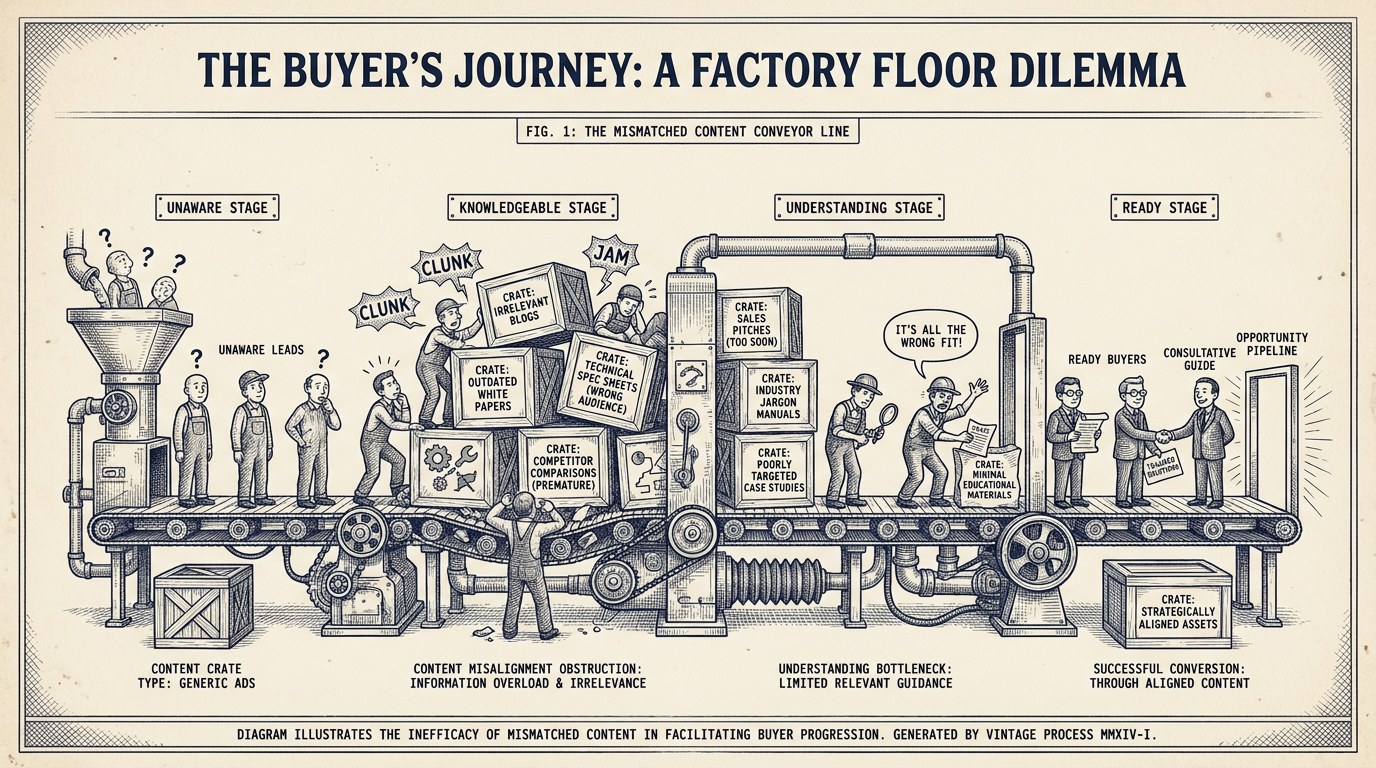
The single most common B2B SaaS content failure: writing stage 2 content for a stage 4 query, or stage 4 content for a stage 2 query.
Stage 2 content for a stage 4 query: a buyer searches "best CRM for outbound sales teams" and lands on a 4,000-word essay about the modern sales productivity crisis. They wanted a comparison. They got a manifesto. They bounce. The page might rank, but the conversion is zero.
Stage 4 content for a stage 2 query: a buyer searches "how do I improve sales pipeline reporting" and lands on a side-by-side comparison of Salesforce vs HubSpot. They wanted to understand the problem space. They got pushed into vendor selection. They bounce.
Both errors are about reading the search intent wrong. Both kill conversion. Both take 6 to 12 months to diagnose because traffic looks fine and rankings look fine. Only the pipeline math reveals the mismatch, and most teams are not tracking pipeline math at the page level.
The fix: every keyword in your spreadsheet has a stage tag. Every content brief specifies the stage. Every published piece is reviewed against the stage it is targeting. Mismatches get caught before publish, not after the budget is gone.
04How to map keywords to stages
The diagnostic question: what does the searcher want to do in the next 24 hours after reading?
- Stage 1: nothing. They did not know they had a problem.
- Stage 2: research. They are learning what is true about the problem space.
- Stage 3: shortlist. They are identifying the 3 to 6 vendors who matter.
- Stage 4: decide. They are choosing between 2 to 3 finalists.
Apply that question to every candidate keyword. If you cannot answer it cleanly, the keyword's intent is not clear enough to write for.
Practical signals that locate a keyword on the curve:
Stage 2 signals
"how to," "why," "what is," problem-naming language, no vendor names. "How to reduce SDR admin time."
Stage 3 signals
"best," "top," category names, generic feature comparisons, "for [use case]." "Best CRM for outbound teams."
Stage 4 signals
vendor names, "vs," "alternative to," "switching from," pricing language, "review." "HubSpot vs Salesforce for outbound teams."
Migration and integration queries (covered in migration and switching keywords and integration page SEO) are almost always stage 4. They are the highest-converting category in B2B SaaS for exactly this reason.
05Cluster mapping by stage
A healthy B2B SaaS content cluster spans stages 2 through 4. The split that works for most programs:
- Problem-aware (stage 2): 25 to 35 percent of pieces
- Solution-aware (stage 3): 35 to 45 percent of pieces
- Vendor-evaluating (stage 4): 25 to 35 percent of pieces
Programs that are 80 percent stage 2 produce traffic and no pipeline. Programs that are 80 percent stage 4 produce pipeline early but cap out because they have no top-of-funnel demand generation. Programs that hit roughly the split above produce both, with the stage 4 content driving conversion and the stage 2 content feeding the pipeline through internal linking and brand recall.
The Workwize program ran roughly 30 / 40 / 30. Stage 4 content drove the early pipeline wins (migration content, comparison content). Stage 3 content carried the steady-state organic traffic. Stage 2 content built the topical authority that lifted everything underneath. The combined cluster pulled DR from 27 to 71 over 22 months and pipeline from $360K monthly to $1.16M monthly at peak. Full numbers in the Workwize case study.
06What this looks like in practice (real B2B SaaS categories)
Concrete examples across three categories.
Project management software
- Stage 2: "how to coordinate distributed teams," "why our team cannot ship fast"
- Stage 3: "best project management tools for engineering teams," "kanban vs scrum software"
- Stage 4: "Linear vs Asana for engineering teams," "switching from Trello to Linear"
CRM
- Stage 2: "why our reps spend so much time in spreadsheets," "what is wrong with our sales reporting"
- Stage 3: "best CRM for B2B outbound," "CRM features for SaaS companies"
- Stage 4: "HubSpot vs Salesforce for outbound," "alternatives to Salesforce for Series B"
Email marketing
- Stage 2: "why are our email open rates dropping," "B2B email engagement problems"
- Stage 3: "best email tools for SaaS B2B," "drip campaign software"
- Stage 4: "Mailchimp vs HubSpot for B2B," "Customer.io alternatives"
The pattern is consistent: stage 2 does not name the category. Stage 3 names the category but not vendors. Stage 4 names specific vendors. That progression is the framework.
07The metric that proves the mapping is working
If your stage tagging is good, the conversion rate of your content should follow the stages. Stage 2 pieces should convert at 0.3 to 0.8 percent of organic visitors to MQL. Stage 3 should convert at 1 to 2 percent. Stage 4 should convert at 3 to 6 percent.
Pull this report quarterly. If your stage 4 content converts at 1 percent, the content is mismatched for the stage you tagged it. If your stage 2 content converts at 4 percent, you mis-tagged a piece that is actually stage 3 or 4. Use the conversion data to correct the mapping. Two or three iterations and your tags settle into something accurate.
This loop is how you get from "we have buyer intent stages in a spreadsheet" to "we know how each piece of our content actually performs by stage." The first version is bureaucracy. The second version is the actual lever. Most programs stop at the first version, which is why most stage tagging exercises do not pay back.
The full taxonomy of high-intent B2B SaaS query types lives in the B2B SaaS keyword research playbook, which is where this framework plugs into the rest of the keyword work.
Want a second pair of eyes on your stage tagging? Book a 30-minute call.
Where this fits in the broader playbook
This piece sits inside our keyword research framework for SaaS, which is one chapter of our comprehensive B2B SaaS SEO methodology. For deeper framing on the same discipline, see the buyer-intent keyword research playbook.
Closely related reading from the same sub-pillar
- the high-volume keyword trap for SaaS , why volume-first keyword sets misfire in SaaS.
- mining sales-call transcripts for keywords , the transcript-mining workflow for buyer-language keywords.
- the migration/switching keyword cluster , the switching-keyword cluster that underrated buyers search for.
From other corners of the program
- the strategic content sub-pillar , the cross-cluster discipline that compounds this work.
- our content marketing program for B2B SaaS specifically , the upstream pillar this connects to.
When you're ready to put this into a program, reach out for a 30-minute audit conversation or look at how engagements are scoped. Average response time: under 4 business hours.