On this page
Sales call mining is the most-talked-about and least-actually-done activity in B2B SaaS keyword research. Almost every agency claims to do it. Almost none of them have ever opened Gong. The handful of teams that actually run the workflow find keywords no SEO tool will surface, with conversion rates that make their volume-chasing competitors look like amateurs.
The Workwize keyword that produced the most pipeline of any single piece in 2025 came out of minute 14 of an actual discovery call. The exact phrase was "we are spending three weeks coordinating laptop returns from offboarded contractors across four countries." Total Ahrefs volume on the exact phrase: zero. Total pipeline produced by the article we wrote against it: more than the entire previous year of "IT asset management software" content put together.
This is the workflow. What to mine, where to mine it, what phrase patterns signal a future search query, the political traps that block most teams from ever actually doing the work, and the specific Workwize examples that came out the other side of this process.
01Why sales calls beat every keyword tool
Three things are true about B2B SaaS keyword research that nobody quite says out loud.
The keywords your buyers actually use look almost nothing like the keywords your marketing copy uses. Your buyers say "we are trying to figure out how to stop losing leads in the handoff between SDRs and AEs." Your marketing copy says "lead management for revenue teams." A page targeting your marketing copy ranks. A page targeting their language converts. The two are not the same set.
The keywords with the highest conversion rates in B2B SaaS are almost always specific, recent, and idiosyncratic to your category. Generic keyword tools surface terms that lots of people search. Sales calls surface terms that the right people search. Volume tools optimize for the first set. Pipeline optimizes for the second.
The only people in your company who hear those phrases are your salespeople. Your marketing team writes copy from internal documents and brand guidelines. Your SEO agency writes copy from keyword tool exports. Your customers' actual language sits in 200 hours of recorded calls per quarter that nobody on the content side has ever opened.
Fix this and you have an unfair advantage that nobody can copy without doing the same work. Skip it and you stay in the volume arms race that everyone is losing.
02Where the buyer language actually lives
Five sources, in priority order. Each captures a different angle.
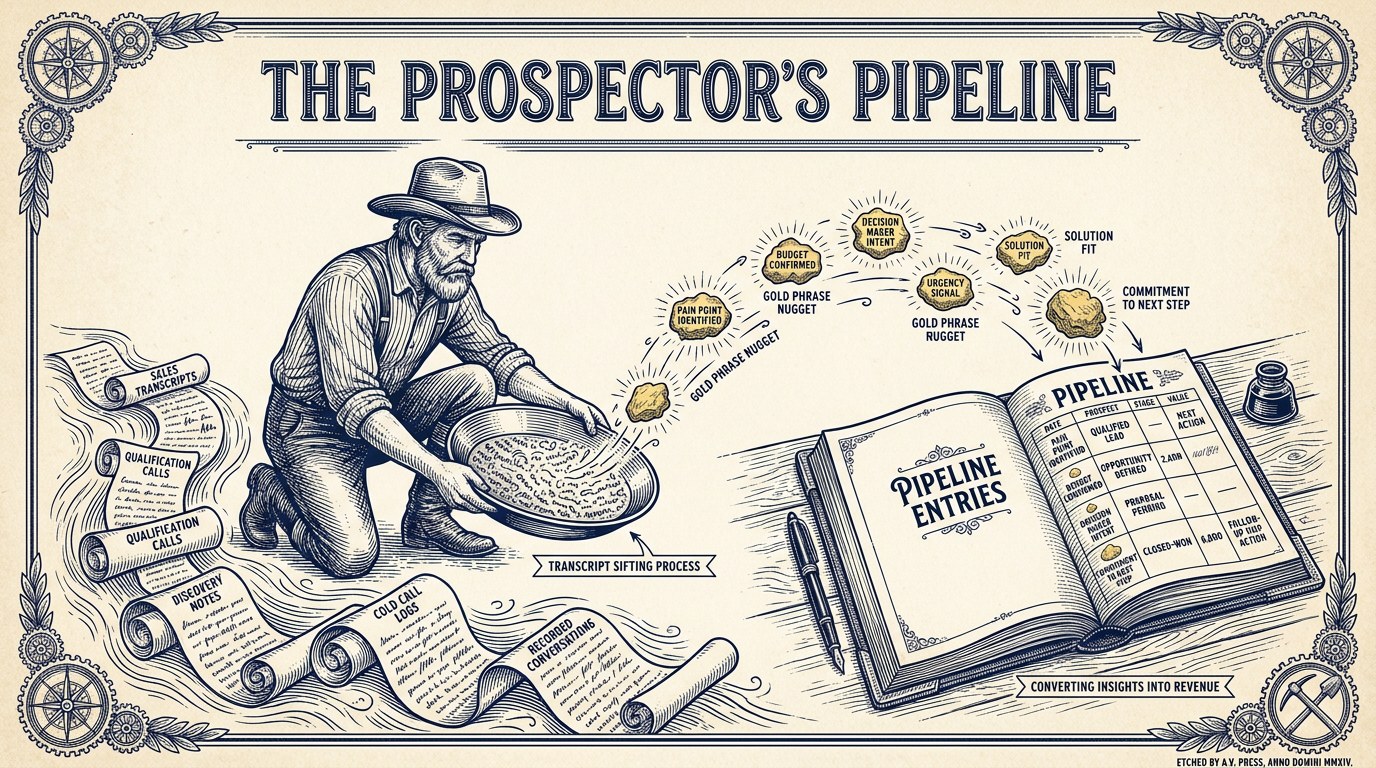
Demo and discovery call transcripts
The richest source. Buyers describe their problem in their own words during the first 10 to 15 minutes of a call. The discovery questions trigger the exact language we want. Tools: Gong, Fireflies, Chorus, Salesloft, raw Zoom recordings with auto-transcription. Read the last 30 to 50 calls. The first 50 produces the pattern library. After that, quarterly refreshes are faster.
Won and lost deal call summaries
The won deals tell you which problems your product solved. The lost deals tell you which problems your product almost solved. Both produce keywords. Lost-deal language is particularly valuable because it tends to be candid about the actual pain. The buyer is no longer trying to talk themselves into your product, so the language gets sharper.
Inbound qualification calls
When prospects book a demo, the BDR or AE usually asks "what made you book this call?" The answer is a future search query, almost always. Pull these summaries quarterly and tag every answer.
Customer onboarding calls
The first 30 days of a customer relationship is when their problem language is freshest. They have not yet adopted your terminology. Every question they ask in onboarding is a question pre-buyers were about to ask before they signed. New customers are essentially pre-buyers who already converted. Their language patterns are the patterns the next pre-buyer will use.
Renewal and expansion calls
Different angle, equally valuable. Customers describe new problems as the relationship matures. Those new problems are the next category of keywords for upsell content and category expansion content.
The combined surface across these five is significant. A B2B SaaS company at Series A typically has 200 to 600 hours of recorded calls per quarter. We mine roughly 8 to 12 percent of that for a typical quarterly keyword refresh and produce 30 to 60 new keywords nobody else in the category has identified.
03The phrase patterns that signal a future search query
Not every sentence in a sales call is a keyword. The patterns that consistently produce searchable queries:
Problem descriptions starting with "we are trying to." Active, present-tense, specific. "We are trying to figure out how to consolidate our equipment vendors across three regions." That phrase, reformatted slightly, becomes a search query. Volume in any keyword tool: probably zero. Intent: extremely high.
Frustration phrases starting with "the problem with." "The problem with Salesforce is the reporting takes forever to set up." Search query: "salesforce reporting setup time" or "salesforce reporting alternatives" depending on which frustration angle you target. Multiple keyword candidates from one phrase.
Comparison statements: "we looked at X and Y." Names competitors and reveals the competitive set. Every named competitor becomes the basis for comparison content. Often the buyer reveals the specific feature dimension they were comparing on, which becomes the comparison page's primary axis.
Migration intent: "we are moving off." Pure commercial intent. "We are moving off HubSpot because it got too expensive at scale." Migration query target locked. Covered separately in migration and switching keywords for B2B SaaS.
Workflow descriptions starting with "currently we have to." Describes the painful manual workflow your product would replace. "Currently we have to export from Pipedrive, reformat in Excel, then re-upload to ChartMogul once a week." Each step is a potential keyword. Each pain point is a content angle.
Tool stack questions: "does it integrate with." Integration intent. Names a specific tool. Becomes an integration page or a comparison. See integration page SEO for B2B SaaS for the full integration play.
Capability questions: "can it handle." Feature requirements. Often surfaces feature combinations no SEO tool will pair: "can it handle multi-region equipment shipping for sub-50-person companies."
Volume language: "we have N of these." Specific scale references. "We have about 80 contractors across four countries." That specificity is the difference between generic content and content that names the buyer's situation.
Tag these patterns when you see them. The tagged transcript is the input to keyword extraction.
04The actual workflow (about 4 hours per quarterly refresh)
This section outlines the precise, four-hour workflow for quarterly keyword refreshes. We detail each step, from transcript preparation to final documentation, ensuring a repeatable and efficient process. This methodical approach guarantees accurate and actionable keyword insights from your B2B SaaS sales calls.
Hour 1: Pull and prep
Export the last 30 to 50 demo transcripts from Gong or your call recording tool. Aim for a mix: won deals, lost deals, deals still in cycle. Label each transcript with the deal stage, the outcome, the company size, and the seat (CMO / VP Marketing / Head of Growth / IT Lead). Without these labels you cannot tell which patterns matter for your ICP versus which are noise.
Hour 2: First-pass tagging
Read transcripts at 1.5x speed but do not skim. Looking for the phrase patterns above. Highlight or tag each one. The first pass tag includes the speaker, the deal stage, and the verbatim phrase. Do not filter yet. If a phrase looks marginal, tag it. The filtering happens in hour 3.
Hour 3: Cluster and prioritize
Group tagged phrases into thematic clusters. The clusters become candidate content topics. Prioritize by how often the same problem language appears across multiple calls. A phrase that shows up in 5 of 30 calls is a strong cluster anchor. A phrase from one outlier call is interesting but lower priority. Expect 30 to 60 candidate phrases at this stage.
Hour 4: Validate and document
Run the strongest 30 to 50 candidate phrases through Ahrefs. Most will have low volume. That is expected and correct. Validate the phrasing matches search syntax (Google's autocomplete is the cheap test: type the first half of the phrase and see what Google offers as completions). Document each candidate in a spreadsheet with the source call ID, the phrase, the deal stage where it appeared, the company size of the buyer, and the proposed content angle.
The deliverable is a refreshed keyword list with 20 to 40 new entries per quarter, each tied to a specific call and a specific content angle. The list goes into the editorial calendar.
05The political traps
Almost every team that tries this workflow runs into the same three obstacles. Naming them upfront is half the fight.
The sales team thinks SEO is wasting their time
"Why does the SEO person want access to my call recordings?" Answer this in the first conversation, not the third. The framing that works: "I am trying to find the exact problems your prospects describe so we can write content that converts the next prospect." Sales teams respond to "convert the next prospect." They do not respond to "topical authority" or "buyer language taxonomy." Make it about pipeline.
The SEO team cannot get access to the call recordings tool
Gong licenses are expensive. The SEO contractor or in-house lead does not have one by default. The compromise: get a senior salesperson to send 30 transcripts as PDFs once per quarter. Suboptimal but workable. The better fix is to get the SEO lead a real Gong seat as part of their onboarding. The ROI on this is dramatically positive, but the budget request often dies because Gong is "a sales tool."
The transcripts are worse than expected
Some call recording tools produce transcripts so messy that the language is unreadable. Speaker identification breaks down. Auto-punctuation is wrong. If yours does, switch to Fathom or Otter for a quarter and see if the output improves. Tooling matters more than people expect.
06What this looked like for Workwize
The Workwize sales team had been recording calls in Gong for 14 months when we started the engagement. Nobody on the marketing side had ever opened a single transcript. Our first quarterly mine produced 47 candidate phrases. After SERP validation and prioritization, 18 of those became target keywords.
Three of those keywords became the basis for the highest-pipeline content of the entire engagement.
"Coordinating laptop returns for offboarded contractors across countries" became a 2,800-word piece that started ranking by week 6 and produced an average of 4 inbound demos per month for the next 18 months.
"Setting up new hires with equipment in a country we do not have an office in" became the trigger for a programmatic content cluster targeting individual country-specific queries (laptop deployment Germany, IT equipment Brazil, equipment shipping Spain). That cluster captured search demand we had no idea existed and built a long-tail organic channel that contributed roughly 12 percent of total Workwize organic pipeline by month 18.
"How do we deal with hardware coming back when contractors leave" became a piece about contractor offboarding compliance, which surprised us by ranking for queries about HR compliance generally and pulling in a steady stream of HR-tech-adjacent buyers. That piece alone produced approximately $180,000 in pipeline contribution in 2025.
None of those keywords showed in any keyword tool. All of them came from minute 14 of an actual sales call. The cumulative pipeline from those three pieces over 22 months runs into seven figures.
For the broader picture, see the Workwize case study. For how this fits into the full keyword research workflow, see the B2B SaaS keyword research playbook.
07Common mistakes
Avoid common pitfalls that undermine the value of sales call transcript analysis. This section outlines key mistakes, from misinterpreting keywords to insufficient call volume, ensuring your transcription efforts yield actionable insights. Learn how to optimize your approach and prevent errors that compromise data integrity.
Reading transcripts looking for keywords
You do not find keywords in transcripts. You find phrases. The conversion from phrase to keyword happens later. Reading with a "keyword brain" makes you skim past the most valuable language because it does not sound like a keyword on first pass.
Mining only won deals
Won deals tell you what worked. Lost deals tell you what almost worked. The "almost worked" language is often more valuable because it identifies problems your product nearly solves but does not quite, which becomes the roadmap for content that tells the right story to the next buyer.
Using AI to summarize transcripts before reading them
AI summaries strip out the specific phrasing that makes sales call mining valuable. Read the raw transcript. The whole point is the verbatim language.
Mining too few calls
5 calls is not a sample. 50 is. The patterns only emerge with volume. If your sales team has fewer than 50 recorded calls per quarter, mine across two or three quarters before drawing conclusions.
Tagging without context
A phrase without the deal stage and outcome is half the data. Tag everything. Patterns that emerge in your ICP segment matter more than patterns across all calls.
Sharing the raw keyword list with sales without framing
Sales reads "keyword list" as "the marketing team is doing SEO again." Sales reads "buyer language reference from your won deals" as "this is sales enablement." Same document, different reception.
Sales call mining sits at the top of the keyword research stack, but it works best alongside buyer intent mapping for B2B SaaS so each phrase you extract is tagged to the right buying stage before it enters the editorial calendar.
Want help running this workflow on your own sales calls? Book a 30-minute call and we will walk through what your transcripts already contain.
Where this fits in the broader playbook
This piece sits inside how we run keyword research for SaaS programs, which is one chapter of our complete approach to ranking B2B SaaS brands. For deeper framing on the same discipline, see the keyword research sub-pillar.
Closely related reading from the same sub-pillar
- the intent-mapping framework , how to translate transcript phrases into intent buckets.
- the volume-first keyword trap , why transcript-derived terms beat volume-first lists.
- the switching-keyword cluster , switching-language patterns surfaced from call data.
From other corners of the program
- how we operate content production at scale , the cross-cluster discipline that compounds this work.
- our complete B2B SaaS content marketing playbook , the upstream pillar this connects to.
When you're ready to put this into a program, schedule a call about your program or review what each engagement level includes. Average response time: under 4 business hours.