On this page
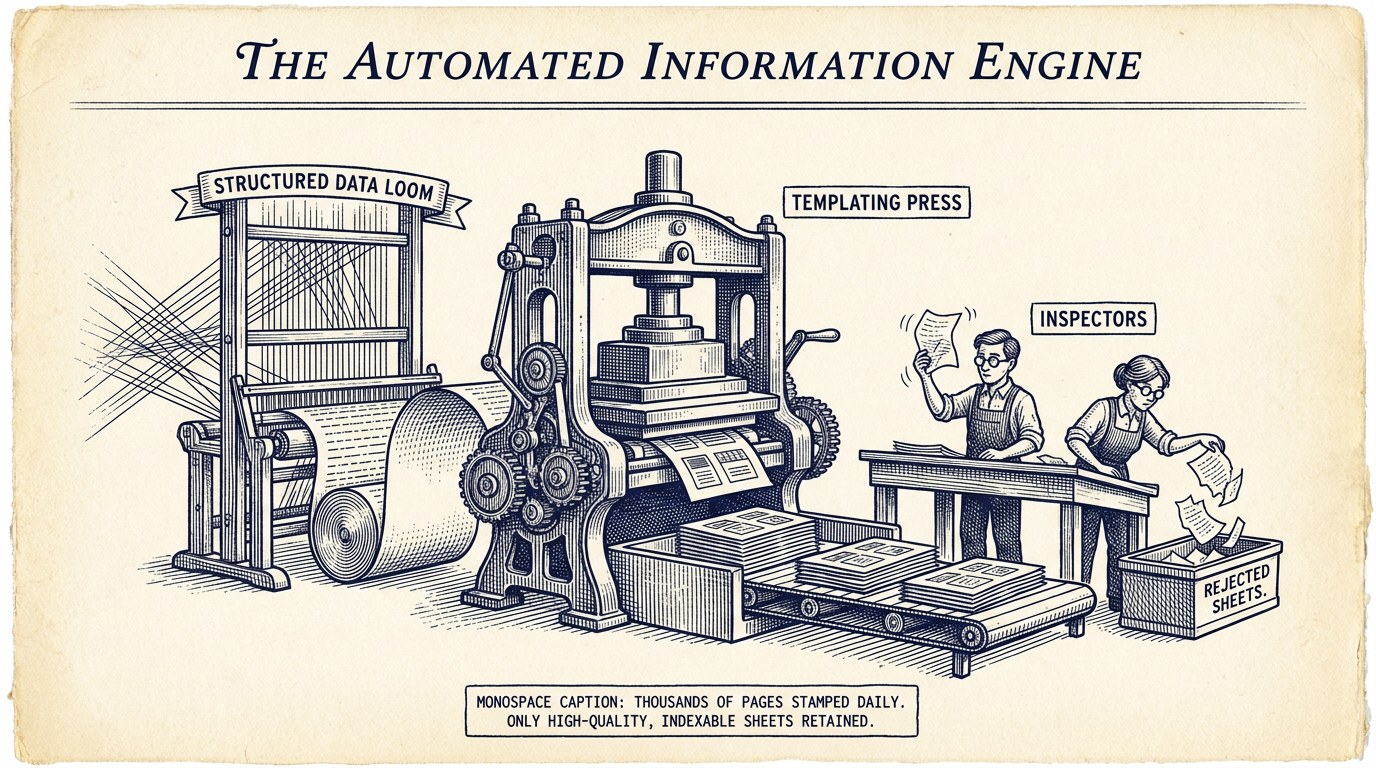
Programmatic SEO is the practice of generating large sets of pages from structured data using templates, where each page targets a specific long-tail query the brand could not realistically write individually. Done well, programmatic SEO produces 100 to 10,000 pages that compound into substantial organic traffic and pipeline. Done poorly, it produces thin content that triggers the Helpful Content signal and degrades rankings across the entire content library.
The technique compounds value at B2B SaaS scale because the product data, integration catalog, customer use cases, and feature matrix already exist inside the company. Programmatic SEO converts that internal data into ranking pages without requiring a writer to draft each page individually. This is the operator framework for the discipline as it applies to B2B SaaS specifically in 2026: which template types produce pipeline, which produce drag, the data model mechanics, the quality threshold that separates assets from liabilities, the realistic keyword strategy for ranking, and the post-Helpful-Content-Update considerations that determine whether the programmatic library lasts.
01What programmatic SEO means for B2B SaaS specifically
Programmatic SEO produces pages by combining a content template with structured data, where each row of data generates one page targeting a specific long-tail query. For B2B SaaS, the structured data is typically the product catalog, integration list, customer use case matrix, or feature comparison data that already exists internally.
The B2B SaaS angle that generic guides miss
Generic programmatic SEO guides cover location pages, jobs listings, real estate listings, and travel destinations. None of these fit B2B SaaS economics. A B2B SaaS company selling project management software does not benefit from 50,000 city-by-product-feature pages. The B2B SaaS programmatic playbook is different: smaller page counts (100 to 5,000), higher quality per page, tighter integration with product and pipeline.
The template-data split is the discipline. The template stays human-edited and high-quality. The data fills variables. Page count scales with data row count. Ahrefs documents the underlying mechanic across many industries; the B2B SaaS specifics get less coverage in generalist guides, which is why this operator framework focuses on what actually works for SaaS programs. This sits inside the technical SEO sub-pillar at the discipline level.
02Where programmatic SEO works for B2B SaaS
Five template types produce pipeline for B2B SaaS. Each maps to a data source the company already maintains internally.
Integration pages
One page per integration partner. The data: integration name, what the integration does, setup steps, use cases, supporting screenshots. For SaaS programs with 50 to 500 integrations, integration pages typically rank for "[your product] [partner] integration" queries at high commercial intent. Conversion rates run 4 to 8 times informational content rates because the buyer is researching a specific use case.
Comparison templates
One page per competitor comparison. The data: competitor name, feature comparison, pricing comparison, use case fit, honest concession (per the comparison content playbook). Programmatic comparison pages work when the underlying data is real and verified; they fail when the data is scraped or generic.
Use-case-by-industry pages
One page per (use case x industry) combination. For SaaS programs with 4 to 8 core use cases across 10 to 20 ICP industries, the page matrix produces 40 to 160 pages each targeting a specific buyer profile. The data: industry-specific terminology, industry-specific buyer concerns, industry-specific customer examples.
Feature plus competitor pages
One page per (your feature x competitor's named alternative) combination. The data: feature name, competitor name, why your feature differs, when each is the right choice. Highest commercial intent of the five template types because buyers searching these queries are deep in evaluation.
Where programmatic produces drag
Location-only pages without service differentiation. Job board pages without real listings. Programmatic blog content where each page is a thin variation on the same topic. These fail the Helpful Content signal and drag down rankings across the rest of the site.
03The data model, building the page database
The data layer determines whether programmatic SEO produces an asset or a liability. Programs that skip the data model investment produce pages that read as padding.
Data structure
Each row in the data table generates one page. Each column maps to a template variable. The minimum column count for B2B SaaS programmatic pages: 8 to 15 columns per row covering the primary entity, descriptive content, supporting data points, internal linking targets, schema markup data, and meta information.
Data sources that work
Customer research. Win and loss interviews surface the verbatim language buyers use in their own words. The verbatim language goes into the data, not into the template. Sales call transcripts. The discipline integrates with the sales call mining methodology for B2B SaaS keyword research. Internal product data. Feature specifications, use case mappings, integration capabilities. Honest competitive evaluation. Hands-on time with competitor products plus their public documentation, not scraped marketing copy.
Data sources that fail
Scraped competitor marketing copy. Produces pages that mirror the competitor's positioning. AI-generated descriptive prose without operator review. Triggers the Helpful Content signal. Generic templates filled with thin variations. Lookalike pages that buyers detect as content padding.
04Template design, balancing scale and quality
The template is the human-written, human-edited foundation that every generated page inherits. Template design is the highest-leverage human work in a programmatic SEO program.
What a strong template includes
Hero section with H1 containing the entity name and target query intent. Definitional opening that establishes context. Three to six content sections covering the key buyer questions for the template type (integration, comparison, use case). Supporting data section that surfaces unique row-specific data. Internal linking section that connects this programmatic page to the broader content estate. Schema markup including Article, BreadcrumbList, FAQPage where applicable.
What separates a programmatic page from a thin page
A programmatic page has unique on-page value beyond the template structure. The row-specific data must produce content the buyer cannot find on any other page on your site or elsewhere. If two programmatic pages from your template could be swapped and the substantive content would not change, you have thin content masking as programmatic.
Template iteration
Template design is iterative across the first 20 to 50 pages. The team ships an initial template, monitors ranking and engagement, adjusts the template based on signals, and re-generates the page batch. Programs running rigid templates without iteration produce libraries that underperform their potential by 30 to 60 percent.
05Indexability and quality control at scale
The quality control layer determines whether 1,000 generated pages help rankings or hurt them. The post-Helpful-Content-Update algorithm weighs page-level quality across the site, which means thin programmatic pages drag down the rest of the library.
The quality gate
Before any programmatic page goes live, an automated quality gate checks: unique on-page content above 400 words, presence of row-specific data the buyer cannot find elsewhere, completed schema markup, internal linking to relevant non-programmatic content, no duplicate content with other pages on the site. Pages failing any check do not publish.
Sitemap and crawl management
The sitemap exposes programmatic pages to Google deliberately, not by default. Programs that submit all 5,000 generated pages to the sitemap on day one signal scale without quality, which the Helpful Content signal weights against. The pattern that works: launch the first 100 pages, monitor indexing and ranking for 30 days, expand to the next 100 based on signal. Google's helpful content documentation emphasizes that volume without quality fails the ranking signal regardless of automation method.
Noindex thin variations
When the data inevitably includes some rows with insufficient unique content (a recently launched integration with no documentation yet, a use case with no customer examples), those pages get noindexed explicitly. Noindex is a quality signal, not a defeat.
06The keyword research model for programmatic at scale
Programmatic SEO succeeds when the page set targets queries with real search volume. Programs that build programmatic pages without keyword validation produce libraries that index but do not rank.
The query stub plus modifier model
Identify the query stub: the head term that captures intent ("[saas product] integration", "[saas product] alternative to", "[use case] for [industry]"). Identify the modifier set: the specific entities that fill the variable (the 200 integration partners, the 50 competitors, the 16 industries). The cross-product produces the target keyword set.
Volume validation
Pull search volume for the cross-product set using a keyword research tool. Filter to keywords with volume above a threshold (typically 10 to 50 monthly searches). The threshold sets the minimum bar for programmatic page generation; queries below the threshold do not get pages.
Long-tail clustering
The B2B SaaS programmatic page set is often 100 to 5,000 pages, not 100,000. The page count comes from the modifier set size, not keyword volume. A SaaS program with 200 integrations produces 200 integration pages. The page count is bounded by the data, which is the discipline that prevents programmatic page count from sprawling into thin territory. This integrates with the broader B2B SaaS keyword research methodology.
07B2B SaaS programmatic SEO worked examples
Two worked examples surface what programmatic SEO at B2B SaaS scale looks like operationally.
Example 1, integration pages at a workflow automation company
A workflow automation SaaS company with 350 integration partners generated 350 integration pages from a structured data table. Each page included: integration name, what the integration does, setup steps from internal documentation, three to five use case examples from customer interviews, screenshots from the live integration. The page set drove 28,000 monthly organic visitors at the 18-month mark, with 4.2 percent of visitors converting to product trials. The template iterated across the first 40 pages before scaling to all 350.
Example 2, use-case-by-industry pages at a CRM company
A CRM SaaS company with 6 core use cases across 14 ICP industries generated 84 (use case x industry) pages. Each page included: industry-specific terminology, the use case framed for the industry's buyer concerns, three customer case studies from the industry, industry-specific ROI calculator output. The page set drove 12,000 monthly organic visitors at the 12-month mark with conversion rates 6 times higher than the company's generic blog content.
What both examples share
Real data per page. Template iteration before scale. Quality gates that prevented thin pages from publishing. Internal linking that connected programmatic pages to the broader content estate. None of the examples relied on AI-generated content as the primary content layer.
08Common programmatic SEO failures and the recovery playbook
Four failure patterns recur across B2B SaaS programmatic SEO programs. Each has a specific corrective discipline.
Failure 1, treating programmatic as AI content automation
The team uses LLM-generated prose to fill template variables. Pages fail the Helpful Content signal because the content has no unique value beyond what the LLM could generate for any other site. The fix is reverting to data-driven content where each page surfaces data the site actually has internally.
Failure 2, scaling page count without quality gates
The team generates 5,000 pages from a thin data set where 4,000 pages have minimal unique content. The Helpful Content signal reweights against the site overall, not just the programmatic pages. The fix is the quality gate from chapter 05 plus retroactive audit of the existing pages.
Failure 3, scraped competitor data
The team scrapes competitor product pages, integration listings, or pricing pages to fill the data table. The content mirrors the competitor's positioning and produces pages buyers detect as inauthentic. The fix is sourcing data internally (product team, sales calls, customer interviews) rather than from competitor materials.
Failure 4, no template iteration
The team designs the template once, generates 1,000 pages, and discovers six months later that the template produced low engagement across the page set. By that point the Helpful Content signal has reweighted. The fix is iterative template design across the first 20 to 50 pages before scaling, plus quarterly template audits across the full page set. This integrates with the content audit framework covering the broader library quality discipline.
09FAQ
These are the questions B2B SaaS technical and content leaders ask most often about programmatic SEO. The answers reflect what operators see running programmatic programs in 2026 specifically.
Is programmatic SEO still effective in 2026?
Yes, with significantly higher quality standards than 2022. The Helpful Content Update and subsequent algorithm revisions reweighted against thin programmatic content, but not against programmatic itself. Programs that build programmatic pages with real data and quality gates compound rankings and pipeline. Programs that use programmatic as a content shortcut fail. The discipline matters more than the technique.
How many programmatic pages should a B2B SaaS program produce?
100 to 5,000 pages depending on the underlying data. The page count is bounded by the data size, not by an abstract target. A SaaS company with 200 integrations produces 200 integration pages. A SaaS company with 6 use cases across 14 industries produces 84 use-case pages. Programs targeting 50,000+ pages without proportionate data investment produce thin libraries that fail the Helpful Content signal.
Should we use AI to generate the programmatic page content?
For descriptive prose around the data: cautiously and with human review per the AI content workflow framework. For the data itself: never. The data must come from the company's real internal sources (product data, customer interviews, sales calls, honest competitive evaluation). AI-generated data is fabrication and produces pages that fail Trustworthiness checks.
How do we measure programmatic SEO success?
Three metrics within 12 months of launch. Aggregate organic traffic to the programmatic page set against the pre-launch baseline. Conversion rate from programmatic pages compared to non-programmatic content. Pipeline contribution attributed to programmatic pages through multi-touch attribution. Programs measuring only page count or indexing percentage miss the ranking and pipeline signals.
What is the difference between programmatic SEO and content automation?
Programmatic SEO uses structured internal data to generate pages from human-designed templates. Content automation uses LLM generation to produce prose without human-designed templates or verified data. The distinction matters because programmatic SEO with real data passes the Helpful Content signal; content automation without verified data fails it. The two are not interchangeable.
Can a small B2B SaaS company succeed with programmatic SEO?
Yes, with adjusted scope. A company with 50 integrations or 4 use cases across 8 industries has enough data to produce a meaningful programmatic page set (50 to 100 pages). The math still produces value at small page counts because the conversion-rate advantage on high-intent commercial queries (integration pages, comparison pages) compounds even at modest traffic.