On this page
AI Search citations are the new top-of-funnel for B2B SaaS in 2026. Buyers ask ChatGPT, Perplexity, and Google AI Overviews about software categories before they touch a traditional search result. Programs without citation tracking are flying blind on whether their AI Search investment is producing results.
Most B2B SaaS programs we audit either don't track AI citations at all or track them poorly (single-tool, single-engine, no competitive baseline). This is the operator playbook for AI citation tracking and brand monitoring: the five surfaces worth tracking, the metric that matters (citation share, not absolute volume), tool selection criteria, and the measurement cadence that turns citation data into program decisions.
01What AI citation tracking measures (and why it matters in 2026)
AI citation tracking is the discipline of measuring how often, where, and how a brand's content is cited in AI Search responses across Google AI Overviews, ChatGPT, Perplexity, and other generative answer engines. It is the measurement layer of our AI Search visibility services for B2B SaaS and the leading indicator for whether the broader AI Search optimization investment is working.
The actionable definition
AI citation tracking is the systematic measurement of brand citation occurrences in AI-generated answer responses, broken down by query, surface, and competitive context. The output is a quantified view of how often your brand appears in the answer responses buyers see when they research your category through AI Search engines. The framework operates independently of any specific tool; the discipline is the measurement methodology, not the dashboard.
Why AI citation tracking matters in 2026
Three reasons AI citation tracking matters in 2026 specifically. First, AI Search citation share now correlates strongly with B2B SaaS top-of-funnel pipeline; buyers using ChatGPT and Perplexity for category research convert at competitive rates with buyers from Google. Second, AI Search is becoming the default discovery surface for technical buyers in product management, engineering, and IT roles, who are over-represented in B2B SaaS buyer personas. Third, without measurement, AI Search optimization becomes unverifiable, defenseless in budget reviews, and prone to the cancellation cycle covered in the failure-mode operator playbook.
What AI citation tracking is not
AI citation tracking is not the same as social listening or brand mention tracking on social media (those measure brand mentions in human-written posts, not AI-generated responses). It is not the same as Google Search Console tracking (which measures traditional ranking, not AI Overview citation specifically). It is also not the same as marketing attribution; citation tracking measures visibility, not conversion. Programs that conflate these measurement layers produce reports that conflate three different growth dynamics.
02The five AI surfaces worth tracking
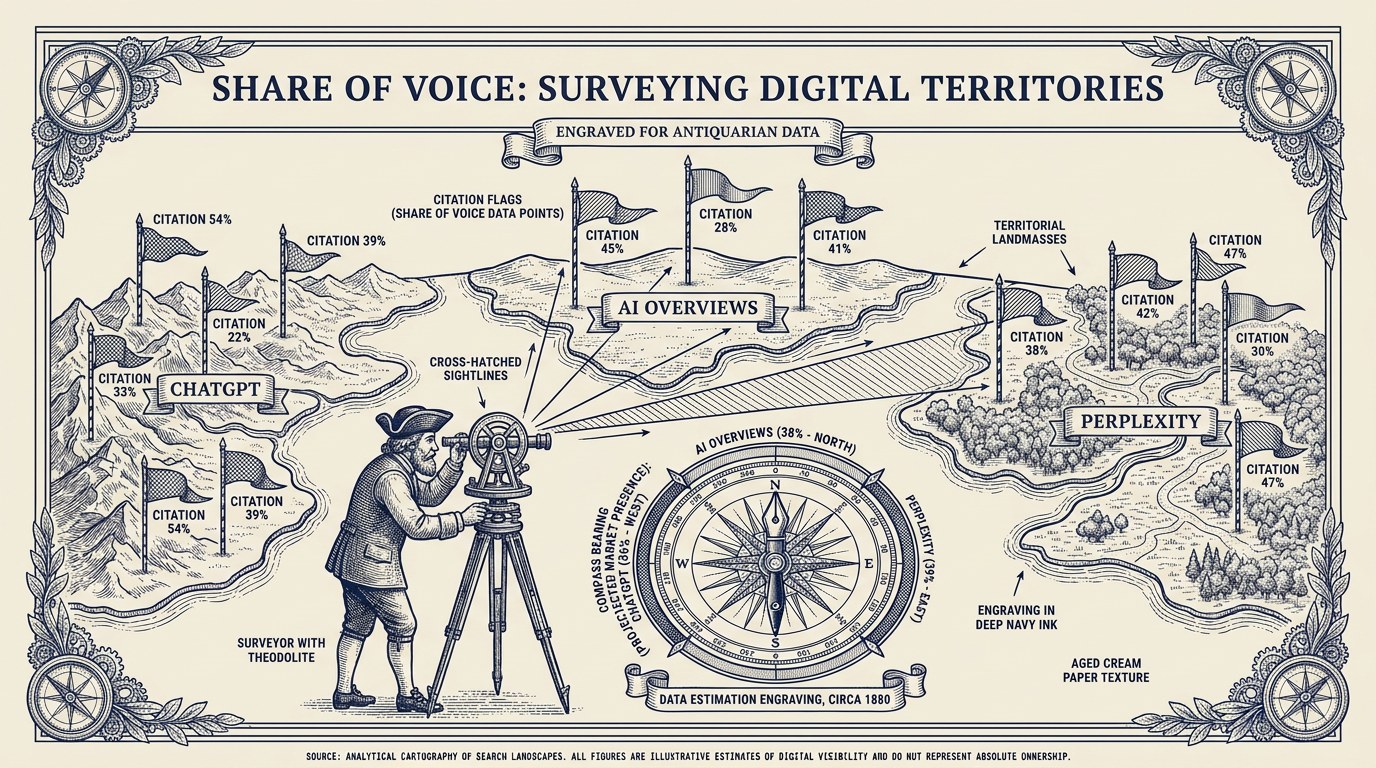
Five generative AI surfaces matter for B2B SaaS citation tracking in 2026. Each operates independently, requires separate tracking, and produces differentiated visibility signals.
Google AI Overviews
Google AI Overviews appear at the top of Google search results for many queries Google judges complex or informational. The Overview cites 3 to 7 sources per query with inline references. AI Overview citations correlate with traditional ranking but are not identical (covered in detail in the AI Overview optimization playbook). Most third-party tracking tools surface AI Overview citation share at the query level.
ChatGPT Search
ChatGPT Search operates as ChatGPT's native search interface, citing sources inline. ChatGPT's retrieval pulls from web sources Microsoft (Bing) and OpenAI's own indexes provide. ChatGPT citation patterns differ from Google AI Overview patterns; pages that earn ChatGPT citations often emphasize different structural signals than Google AI Overview-favored content.
Perplexity
Perplexity is the AI Search engine most heavily used by technical B2B buyers in 2026. Its citation patterns favor authoritative sources, original research, and content with strong topical authority signals. Perplexity also surfaces 5 to 10 source citations per query (more than Google AI Overviews on average), giving more pages a chance to earn citation share per query.
Bing Copilot and Claude
Bing Copilot (Microsoft's AI Search) cites Microsoft's Bing index sources and increasingly drives traffic from enterprise buyers who use Microsoft 365. Claude (Anthropic's AI assistant, increasingly integrated into B2B SaaS products) has limited citation visibility currently but is growing as Claude becomes the default AI assistant for enterprise productivity tools. Both warrant tracking even at lower current volume because the trajectory matters more than the snapshot.
03Citation share versus absolute volume, the right metric
The metric debate matters. Programs measuring AI citation tracking with the wrong primary metric produce reports CFOs can dismiss.
Why share matters more than absolute volume
Absolute citation count fluctuates with how often Google or AI Search engines trigger generative answers for a query. Google adjusts AI Overview triggering frequency periodically; ChatGPT changes its retrieval strategy; Perplexity updates its model. The absolute count moves up and down for reasons outside operator control. Citation share (your brand's citations divided by total citations across the tracked query set) normalizes against the underlying surface volatility; it scales with operator effort and is comparable quarter over quarter.
When absolute volume matters
Absolute volume matters in two cases. First, surface-level platform-trajectory measurement: tracking absolute citation volume across surfaces reveals which surfaces are growing or shrinking, useful for resource allocation. Second, threshold-effect measurement: when entering a new surface (e.g., ChatGPT after only tracking Google AI Overviews), absolute volume crossing thresholds (10, 100, 1,000 citations per month) is operationally meaningful.
The composite measurement
The composite measurement that produces defensible reporting combines both: citation share per surface (primary metric, scales with effort) and absolute volume per surface (secondary metric, surfaces platform-level dynamics). Reports that show both alongside competitive citation share survive CFO scrutiny in budget reviews.
04Tool selection criteria for B2B SaaS
Tool selection is operationally important but methodologically secondary. The right tool depends on B2B SaaS-specific feature requirements.
Tools to evaluate
The category of AI citation tracking tools in 2026 includes: dedicated AI Search tracking tools (Otterly, Hall.ai, Omniseo, several emerging specialists), SEO platform integrations (BrightEdge, Conductor, Authoritas adding AI Search modules), and custom tracking stacks built on AI Search APIs (Perplexity API, ChatGPT API). Each has trade-offs.
Selection criteria for B2B SaaS
Five criteria matter for B2B SaaS specifically. First, per-query tracking across a custom tracked query set (not just keyword volume-weighted samples). Second, competitive citation share tracking with named competitor selection. Third, alerting on citation gain or loss for priority queries. Fourth, historical data retention sufficient for quarter-over-quarter trajectory analysis (12+ months). Fifth, integration with the broader SEO measurement stack (Search Console data joined with AI citation data in a unified dashboard).
Build versus buy decision
For most B2B SaaS programs at $5M to $50M ARR, buying a dedicated AI citation tracking tool is the right call; building custom tracking infrastructure consumes engineering capacity without producing differentiated measurement. For larger programs (above $50M ARR) with established data engineering teams, building on AI Search APIs may make sense for custom workflows and tighter integration with internal data infrastructure.
05The measurement methodology
Tool selection produces data; methodology produces insight. Four methodology layers must be defined before tracking starts.
Defining the tracked query set
The tracked query set is the discipline that makes citation share comparable across periods. Start with 50 to 200 queries that represent your category's buyer-research surface. Include category-defining queries ("[Category]" definitional), competitive queries ("[Your brand] vs [Competitor]"), capability queries ("Does [Your brand] integrate with [Other tool]"), and pricing or comparison queries. Keep the set stable across reporting periods so trajectory is meaningful.
Establishing baselines
Before optimization scales, establish baseline citation share across the tracked query set, segmented by surface and competitive context. Three months of baseline data is the minimum to distinguish operator-driven change from underlying surface volatility. Programs that optimize before establishing baselines produce trajectory data with no comparative anchor.
The monthly tracking cycle
Monthly tracking produces signal without overwhelming the operator with noise. Weekly tracking creates pressure to react to short-term variance; monthly tracking aligns with content optimization cycles. The monthly snapshot includes citation share per surface, citation share per competitor, top-cited pages, and queries with significant citation share movement.
Competitive citation share tracking
Competitive citation share is the share of AI citations your named competitors capture across the tracked query set. Tracking 3 to 8 named competitors (your direct B2B SaaS competition) over the same query set produces the relative-performance picture that absolute citation share alone misses. The competitive frame also drives prioritization: which queries you're losing to a specific competitor identifies the optimization sprints with highest leverage.
06The B2B SaaS AI citation tracking scorecard
The reporting format determines whether the data drives action. Three components matter.
Scorecard structure
The scorecard structure that survives scrutiny includes: aggregate citation share by surface (table), trajectory chart over 4 to 8 prior quarters, top-cited pages with their per-query citation share, competitive citation share comparison, and a "movement of significance" section flagging citation share changes above a defined threshold. Keep the report under one page when possible; longer reports get skimmed.
Reporting cadence and audience
Different stakeholders need different reporting frequencies. Operators need monthly per-page diagnostic data. Marketing leadership needs quarterly aggregate trajectory data. CFOs and executive teams need quarterly composite metrics tied to pipeline contribution. The same underlying data feeds all three; the framing differs.
Integration with broader SEO scorecards
AI citation tracking shouldn't sit as a separate dashboard. The B2B SaaS SEO scorecard should integrate citation share alongside traditional ranking, organic traffic, and pipeline contribution metrics. The integration is the discipline that prevents AI Search measurement from getting siloed and treated as a separate workstream when it's structurally one growth system with traditional SEO. The framework mirrors the SEO ROI playbook for B2B SaaS we ship.
07Common failure modes and operational fixes
Four dominant failures.
The "absolute count only" failure: programs reporting citation count without citation share. Fix: switch the primary metric to citation share across a defined tracked query set; keep absolute count as secondary.
The "single surface" failure: programs tracking only Google AI Overviews and missing ChatGPT and Perplexity citation share. Fix: add per-surface tracking across the five surfaces in Chapter 02 from the start; the cost of tracking five surfaces is marginally higher than tracking one.
The "no baseline" failure: programs optimizing AI Search visibility without three months of baseline data, producing trajectory reports with no comparative anchor. Fix: hold optimization-spend constant for the first three months while baseline data accumulates; the patience produces dramatically more defensible measurement once optimization scales.
The "no competitive frame" failure: programs reporting citation share without competitive citation share, defenseless in budget reviews when leadership asks "are we beating [Competitor]?" Fix: identify 3 to 8 named B2B SaaS competitors and track competitive citation share across the same query set.
08Building the AI citation tracking operating cadence
The cadence that turns citation data into program decisions has three tiers.
The weekly diagnostic
Weekly cadence: pull citation share data for priority queries (typically 10 to 30 high-commercial-value queries), identify pages with citation share movement, feed the data into the weekly content optimization sprint. The weekly diagnostic doesn't produce reports; it produces optimization decisions.
The monthly review
Monthly cadence: pull aggregate citation share across the full tracked query set, identify trajectory patterns, compare to prior month, surface anomalies for investigation. The monthly review produces the operator-facing report that drives the next month's content production prioritization.
The quarterly strategic review
Quarterly cadence: present aggregate citation share trajectory across 4 to 8 prior quarters, competitive citation share comparison, and pipeline contribution data alongside citation share. The quarterly review is the stakeholder-facing report that defends AI Search investment and feeds budget planning.
If you want this AI citation tracking discipline running on your program, book a 30-minute AI visibility audit with our team.
09FAQ
What is AI citation tracking?
AI citation tracking is the systematic measurement of how often, where, and how a brand's content is cited in AI Search responses across Google AI Overviews, ChatGPT, Perplexity, and other generative answer engines. The discipline produces a quantified view of brand visibility in AI Search, separate from traditional ranking measurement. It is the measurement layer that turns AI Search optimization from an unverifiable claim into a defensible program investment.
Should I track absolute citation count or citation share?
Citation share. Absolute citation count fluctuates with how often AI Search engines trigger generative responses for a query, which is outside operator control. Citation share (your brand's citations divided by total citations across a defined tracked query set) scales with effort and is comparable quarter over quarter. Use absolute count as a secondary metric for surface-level platform-trajectory analysis.
Which AI surfaces should B2B SaaS programs track?
Five surfaces matter in 2026: Google AI Overviews, ChatGPT Search, Perplexity, Bing Copilot, and Claude. Each operates independently with different retrieval and citation patterns. Programs that track only one surface miss the cumulative visibility picture. The cost of tracking five surfaces is marginally higher than tracking one; the discipline is establishing the per-surface tracking infrastructure from the start.
How do I choose an AI citation tracking tool?
Five criteria matter for B2B SaaS: per-query tracking across a custom tracked query set, competitive citation share tracking with named competitors, alerting on citation gain or loss, historical data retention of 12+ months, and integration with the broader SEO measurement stack. For most B2B SaaS programs, buying a dedicated tool (Otterly, BrightEdge, Conductor, Authoritas, or similar) beats building custom. Larger programs may benefit from building on AI Search APIs.
What's the right cadence for AI citation tracking reviews?
Three-tier cadence: weekly diagnostic (priority queries, drives content optimization decisions), monthly review (full tracked query set, surfaces trajectory patterns), quarterly strategic review (aggregate trajectory plus competitive citation share plus pipeline contribution, defends AI Search investment in budget planning). Daily tracking produces noise; quarterly-only tracking misses optimization opportunities.
Part of the AI Search playbook
This is the citation tracking chapter of the AI Search sub-pillar.
The strategic framework covering AI Search visibility as a discipline, AI Overview-specific optimization, and how AI Search integrates with traditional SEO, lives on the parent sub-pillar.