On this page
HARO died in December 2024. Connectively died with it. Featured.com revived the HARO brand in April 2025, but the revived platform is overrun with AI-generated pitch noise. The journalist-source landscape that B2B SaaS programs once relied on for editorial links and brand mentions has fragmented across six to eight platforms, each with different strengths and audiences. This is the operator playbook for the post-HARO reality: which platforms work for B2B SaaS specifically, the pitch pattern that earns placements when journalists detect AI-generated content within two sentences, the campaign cadence that produces 30 to 60 placements per year rather than 4 to 8, and the measurement layer that now spans traditional SEO authority and AI Search citation share simultaneously.
01What digital PR for B2B SaaS SEO actually is
The first step is establishing what the discipline covers and why it carries more leverage in 2026 than it did during the HARO era. The working definition matters because the campaign decisions, platform choices, and measurement infrastructure all derive from it. The 2026 framing matters because the strategic case for digital PR has shifted significantly in the past 18 months and most B2B SaaS marketing leaders are still operating on the 2022 mental model.
A working definition
Digital PR for B2B SaaS SEO is the systematic discipline of earning editorial mentions and backlinks from industry publications, business news outlets, and journalist-written content. The mechanism: B2B SaaS subject matter experts respond to journalist queries through platform marketplaces or direct outreach, providing quotable expertise that journalists incorporate into their published articles. The article publishes with the SaaS company's brand mentioned, frequently linked, and contextually positioned as an authority on the topic the article covers.
The discipline matters for B2B SaaS SEO because editorial backlinks from authoritative publications carry disproportionate SEO weight (DR 70+ publications producing followed links accelerate domain authority in months rather than years) and because the brand mention itself now carries independent value as AI Search citation signal (covered in Chapter 07). This sits inside our complete digital PR playbook for B2B SaaS programs at strategic depth and inside the full link-building reference for B2B SaaS at the pillar level.
Why digital PR matters more in 2026 than it did in 2022
Three forces compound the discipline's importance in 2026 versus the 2022 peak of the HARO era. AI Search engines (ChatGPT, Perplexity, Google AI Overviews) treat editorial brand mentions as primary trust signals when generating responses; backlinks alone do not produce the ambient citation signal that brand mentions in journalist-written content provide. The traditional backlink graph is increasingly polluted with paid placements, link insertions, and AI-generated guest posts; editorial mentions earned through legitimate journalist queries are the cleanest signal Google's algorithm can identify. And the platform landscape has fragmented, which means the marketplace efficiency that HARO once provided no longer exists; programs that build the operational discipline to monitor multiple platforms outcompete programs that abandoned the discipline when HARO died.
The implication: digital PR is now a higher-leverage SEO investment than it was three years ago, but the operational complexity has increased. Programs that adapt to the fragmented landscape capture disproportionate value, and the industry shift is well documented across PR Week's coverage of post-HARO platform fragmentation over the past 18 months. Programs that wait for HARO's replacement to consolidate the market continue waiting.
02What happened: HARO, Connectively, and the December 2024 shutdown
The journalist-source platform landscape went through four distinct phases between 2008 and 2026. Each phase shifted the operational rules and the strategic positioning for B2B SaaS programs running digital PR. Understanding the timeline matters because most current platform recommendations on the web were written during one of the earlier phases and no longer reflect the 2026 reality. The four phases below cover the rise, the rebrand failure, the shutdown, and the partial revival.
The HARO era: 2008 to early 2024
Help A Reporter Out (HARO) launched in 2008 as Peter Shankman's side project connecting journalists with expert sources. Over 16 years, it grew to roughly 2 million expert subscribers and 500,000 active source contacts. The mechanism was simple: three times per day, HARO sent journalist queries via email; sources could respond directly; journalists picked the best responses and quoted them in published articles. HARO became the dominant marketplace for editorial mentions across business, marketing, technology, and adjacent verticals.
The discipline peaked roughly 2019 to 2022. Then two forces eroded the platform's value. AI tools (ChatGPT and successors) flooded HARO with AI-generated pitches that overwhelmed journalist inboxes. By mid-2023, journalists reported sorting 30 to 100 AI-generated responses per query for every useful one. The signal-to-noise ratio collapsed. Then Cision acquired HARO and rebranded it.
The Connectively rebrand and rapid failure
Cision relaunched HARO as Connectively in early 2024 with a paid pricing model ($29 to $149 monthly tiers plus per-pitch fees) and a more complex user interface. The intended improvements (quality control, journalist relationship management, advanced filtering) did not materialize at the scale the rebrand required. Long-time HARO users , particularly small businesses, independent consultants, and agencies managing multiple clients , found the new pricing prohibitive. Journalist engagement dropped sharply as fewer sources responded and the quality of responses did not improve proportionally.
Within nine months of the rebrand, the platform was operationally a zombie. Sources had migrated to alternatives. Journalists had stopped checking the platform. Cision had not yet committed to a public shutdown.
December 9, 2024: the shutdown
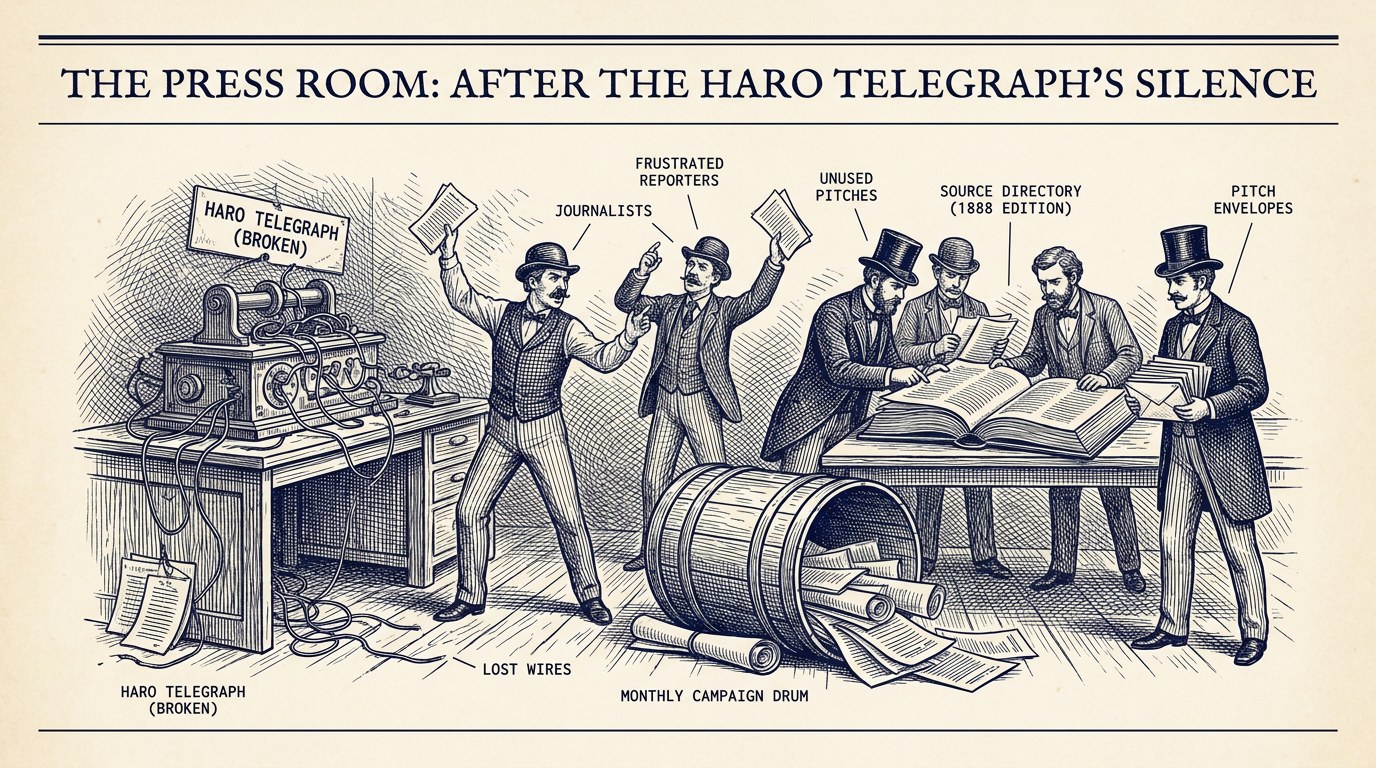
Cision announced Connectively's permanent discontinuation on December 9, 2024. The company redirected resources to CisionOne, its enterprise media monitoring and journalist outreach product. The Connectively shutdown left a vacuum in the journalist-source platform market that had been growing through 2024 as competing platforms accelerated their build-out.
The shutdown affected B2B SaaS programs disproportionately. Many had been paying $49 to $149 monthly for Connectively subscriptions without strong placement returns; the shutdown forced a platform reassessment. Programs that had built rotational coverage across multiple platforms during the Connectively era recovered quickly, often because they had already supplemented inbound platforms with direct journalist outreach through tools like Muck Rack's journalist database. Programs that had stayed loyal to HARO or Connectively lost months of campaign continuity.
April 2025: Featured.com revives HARO
In April 2025, Featured.com (a competing platform formerly known as Terkel) acquired the HARO brand and relaunched the service under the original name at the helpareporter.com domain, with daily journalist queries resumed by April 22, 2025. The relaunch produced initial enthusiasm but quickly ran into the same problem that killed HARO originally: AI-generated pitches flooded the platform within weeks of relaunch. Journalists who had migrated to alternatives during the Connectively era largely did not return.
The revived HARO continues operating in 2026 but functions more as a brand legacy than a primary platform. Source of Sources (Peter Shankman's new platform, launched after watching Connectively implode), Qwoted, Featured.com, and Help a B2B Writer have absorbed most of the journalist engagement that HARO once held.
03The 2026 journalist-source platform landscape
The post-HARO landscape comprises eight platforms with materially different strengths, audiences, and pricing models. None of them carries the volume HARO did at its peak; together they cover most of the journalist query universe HARO once aggregated. The sections below run through each platform with the operator-level detail needed to decide where to invest attention and budget. The B2B SaaS-specific stack recommendation lives in chapter 04.
Qwoted
Free with premium tiers ($99 to $299 monthly for advanced filtering and direct journalist contact). Verified expert profiles, transparent journalist identity, growing volume across business and technology verticals. Strong for B2B SaaS programs targeting marketing, finance, and SaaS industry publications specifically. Volume in 2026: roughly 200 to 400 relevant queries per week for active B2B SaaS profiles.
Featured.com
Paid subscription ($50 to $200 monthly based on tier). Formerly Terkel, Featured.com now operates HARO under acquired brand alongside the original Featured platform, running a curated-expert model that filters AI-generated pitch volume more strictly than the open HARO inbox. High conversion rates for tech and business expert profiles. Strong journalist editorial relationships across business publications. Volume: 100 to 250 relevant queries per week.
Source of Sources (SOS)
Free. Built by Peter Shankman after watching Connectively fail. Runs on honor system: pitch off-topic and you're banned. Lower volume than Qwoted or Featured but exceptional signal-to-noise ratio. Strong for sources with genuine expertise who can't justify paid platform fees. Volume: 50 to 150 relevant queries per week.
ProfNet and JustReachOut
ProfNet (Cision-owned product that survived the Connectively shutdown) costs roughly $1,000 to $2,500 monthly and is best for academics, healthcare professionals, and enterprise-level PR teams. JustReachOut ($50 to $300 monthly) is AI-driven with 700,000+ media contacts and is strongest for outbound journalist pitching rather than inbound query response. Both work for B2B SaaS but at different price points and use cases.
Help a B2B Writer
Paid subscription ($39 to $99 monthly). Specifically built for B2B verticals , SaaS, technology, marketing, finance, professional services. Smaller total volume than general platforms but exceptional query quality for B2B SaaS programs. Roughly 80 to 150 relevant queries per week for active SaaS profiles. The single highest-leverage platform for B2B SaaS digital PR in 2026.
SourceBottle and JournoRequest
SourceBottle is an Australia-based free platform with strongest coverage for AU/NZ media but useful global reach. JournoRequest is X (Twitter) hashtag monitoring (#JournoRequest, #PRRequest) , no platform, no subscription, real-time response opportunity. Both supplement the primary platforms rather than replacing them. Combined weekly volume: 40 to 80 relevant queries for B2B SaaS.
04Which platforms work for B2B SaaS specifically
The eight platforms from chapter 03 narrow significantly when filtered for B2B SaaS use cases. Three platforms cover 70 to 80 percent of useful journalist queries at $40 to $100 monthly total tooling cost. The remaining 20 to 30 percent surfaces through supplementary platforms that are worth monitoring but not worth primary investment. The sections below cover the recommended B2B SaaS stack, the specific reasoning behind the primary platform choice, and when the supplementary platforms earn their place.
The B2B SaaS platform stack
The recommended platform stack for B2B SaaS digital PR programs in 2026: Help a B2B Writer (primary, $39 to $99/mo) + Qwoted (secondary, free tier sufficient initially) + Source of Sources (tertiary, free). Total monthly tooling cost: $40 to $100. Combined weekly relevant query volume: 250 to 500.
The stack covers roughly 70 to 80 percent of useful journalist queries for typical B2B SaaS programs. The remaining 20 to 30 percent surfaces through Featured.com, ProfNet (if budget allows), JournoRequest monitoring, and direct journalist outreach. Programs at $5M ARR and below should start with just Help a B2B Writer plus Qwoted free tier ($39 to $99/mo total) before expanding. Programs at $20M ARR and above can justify the full stack plus Featured.com.
Why Help a B2B Writer leads for B2B SaaS
Three properties make Help a B2B Writer the primary recommended platform. The query quality is B2B-specific: almost every query is relevant to B2B SaaS programs (versus general platforms where 60 to 80 percent of queries are irrelevant consumer or general business topics). The journalist editorial relationships skew toward B2B publications that drive actual buyer attention (industry publications, SaaS-focused outlets, B2B marketing publications). The pricing is accessible: $39 to $99 monthly is justifiable for any B2B SaaS program at $1M ARR or above.
The platform's smaller absolute volume (80 to 150 weekly queries versus Qwoted's 200 to 400) is more than offset by the higher relevance rate. Programs ship more pitches per useful query identified on Help a B2B Writer than on any other platform.
When Qwoted and SOS earn their place
Qwoted earns its place when the program's expertise extends beyond pure B2B SaaS into adjacent topics that broader business publications cover (marketing, sales, finance, technology trends, HR, leadership). The journalist universe on Qwoted is wider; relevant queries for cross-functional expertise surface more frequently. SOS earns its place because it costs nothing and the signal-to-noise ratio is exceptional. Programs with bandwidth to monitor a third platform get incremental placements from SOS without incremental cost.
Programs that try to operate across four or more platforms simultaneously typically underperform because attention fragments. Three platforms is the operational ceiling for sustained quality response.
05The B2B SaaS digital PR campaign: brief, pitch, follow-up
A sustained B2B SaaS digital PR campaign has three operational phases that work as a system. Programs shipping all three phases earn 30 to 60 placements per year. Programs shipping phases 1 and 2 but skipping phase 3 cap at 12 to 18 placements regardless of platform investment. The sections below cover what each phase delivers, who owns it, and the operational discipline that separates programs that compound from programs that stall. This sits inside the strategic frame for digital PR work at the sub-pillar level.
Phase 1: the campaign brief
The campaign brief is a documented two-page reference that the team monitors against when reviewing daily platform queries. The brief operates within the strategic four-layer framework that designs the campaign brief, which sets the narrative angles, publication tier map, and quarterly themes the brief inherits. Three sections.
- Expertise definition. Specific topics on which the program has subject matter authority. For B2B SaaS, typically 4 to 8 topics tied to the product category, customer pain points, and adjacent operational disciplines. Examples for a B2B SaaS marketing platform: content marketing strategy, MQL definition, multi-touch attribution, B2B SaaS pricing strategy, sales-marketing alignment, content team operations. The expertise definition prevents pitch dilution: only queries matching documented topics earn a pitch response.
- Target publication tier. The publications the program prioritizes for placement. Tier 1: industry-leading publications (Forbes, Inc., Business Insider, Harvard Business Review, TechCrunch, SaaStr). Tier 2: vertical industry publications. Tier 3: emerging or niche publications with relevant audiences. Programs typically aim for 30 to 50 percent Tier 1 placements, 40 to 50 percent Tier 2, and 10 to 20 percent Tier 3.
- Narrative angles. The two to four narratives the program consistently positions. Each narrative connects the brand's product or service to a broader theme journalists cover. Strong narratives surface naturally across multiple queries; weak narratives require forced fit. The narrative discipline produces consistent brand positioning across placements that compounds over 12 to 24 months.
Phase 2: the pitch
Pitches respond to journalist queries within 60 minutes of the query appearing on the platform. Speed matters because journalists work to deadlines and high-quality queries close within hours of posting. Programs responding to morning queries by afternoon typically find the journalist has already selected sources.
The pitch structure has four elements. Opening sentence stating the pitch's relevance to the query ("Responding to your query on [specific topic] , I have direct expertise on this from running [specific context]"). Two to four sentences providing quotable content (claim-led, specific, citation-ready). Brief credential statement (one sentence establishing why the source is credible). Direct contact information and offer of further conversation.
Pitches that follow this structure consistently outperform pitches that lead with credentials, pitch the company rather than the expert, or read as AI-generated polish without substantive expertise.
Phase 3: the follow-up
The follow-up phase is where programs that ship phases 1 and 2 separate from programs that ship all three. After a placement publishes, the program acknowledges the journalist directly, shares the placement on owned channels (LinkedIn, X, company blog), and adds the journalist to a relationship tracking system for future direct outreach beyond platform queries.
Over 12 to 24 months, follow-up discipline produces a relationship inventory of 30 to 80 active journalist contacts who will respond to direct outreach for relevant story angles. This relationship inventory becomes a parallel placement channel that operates independently of platform queries. Programs that build this inventory earn placements through direct journalist relationships at 3 to 5 times the rate of programs that operate purely through platform queries.
06Pitch patterns that earn B2B SaaS placements
Three pitch patterns produce disproportionate placement rates for B2B SaaS programs in 2026. The patterns work because they match what journalists actually need (speed, specific expertise, quotable human sources) and against what flooded the platforms when AI-generated content scaled. The sections below cover each pattern with the operational mechanics. Programs that apply all three see placement rates 2 to 4 times higher than programs sending well-written pitches that miss any one.
The 60-minute response rule
Pitch within 60 minutes of the query appearing on the platform. The reasoning is mechanical: high-quality journalist queries on platforms like Help a B2B Writer and Qwoted close within 4 to 12 hours because journalists need sources before their article deadlines. Programs responding morning queries by afternoon discover the journalist has already selected sources.
Operationally, the 60-minute rule requires either dedicated daily monitoring (someone checking platforms 3 to 5 times daily during business hours) or automated alerting with priority routing. Programs at $5M to $20M ARR typically dedicate 30 to 60 minutes per day to platform monitoring as part of a marketing operations role. Programs at $20M+ ARR justify a dedicated digital PR coordinator role.
Specificity over polish
Specific pitches outperform polished pitches. Journalists prefer a line like "We tracked content-attributed pipeline across [N] B2B SaaS programs over four years; the median ROI multiple at year two was [X]", filled in with your own data, over "We've helped many B2B SaaS companies achieve significant content marketing ROI through our proven methodologies."
The first is specific and quotable. The second is generic marketing language. AI-generated pitches default to the second pattern because the underlying language models optimize for fluency rather than evidentiary specificity. Programs that write pitches with concrete data points, named examples, and specific time periods consistently outperform programs that rely on generic claim language.
The expertise-attribution pattern
Pitches that attribute expertise to a named individual (with title, company, and credibility marker) outperform pitches that attribute expertise to the company brand. "According to Sarah Chen, VP Marketing at [Brand], who has run content marketing programs for three B2B SaaS companies through IPO" outperforms "According to [Brand]'s research."
The pattern works because journalists need quotable human sources, not corporate attribution. Programs that consistently position individual experts (founders, VPs, subject matter specialists) earn placements at 2 to 4 times the rate of programs that pitch corporate expertise only. The discipline scales: a program with three named expert profiles across the company runs three parallel pitch tracks.
07Measuring digital PR ROI for B2B SaaS programs
Digital PR measurement in 2026 runs across two systems simultaneously. The traditional SEO measurement layer captures placements, links, and referring domain growth. The AI Search citation measurement layer captures brand mentions that compound across training corpus and retrieval indexes. Both layers feed the quarterly digital PR scorecard. The sections below cover what each layer captures, why both are required for accurate ROI measurement, and how the quarterly scorecard format reconciles them.
Traditional SEO measurement: placements and links
The traditional measurement layer captures placement count (publications mentioning the brand or expert per month), backlink count (followed editorial links per month from those placements), and referring domain growth (new unique domains linking to the program). Tracked monthly. Baseline benchmarks for B2B SaaS programs running digital PR as a sustained discipline: 4 to 8 placements per month, 2 to 5 followed links per month, 8 to 20 new referring domains per quarter from digital PR work specifically.
These metrics matter because they connect to traditional SEO authority signals that compound the program's domain rating over 12 to 24 months. Programs with sustained digital PR cadence typically see DR gains of 15 to 35 points over 24 months attributable to digital PR placements alone, layered onto whatever other link building investment the program runs.
AI Search citation as the new measurement layer
The second measurement layer captures AI Search citation signal generated by digital PR placements. The mechanism (covered in detail in the mechanism guide explaining how AI Search engines actually rank and cite content) is that brand mentions in journalist-written content enter the training corpus for ChatGPT, get retrieved by Perplexity, and influence Google AI Overviews response generation. The measurement requires dedicated tooling because GA4 and Search Console cannot surface AI Search referral traffic reliably.
Tools (Profound, Quattr, AthenaHQ, Otterly , covered in the operational 47-item AEO checklist that executes the citation strategy) issue structured queries to ChatGPT, Perplexity, and Google AI Overviews at intervals and track which brands get cited. Programs running sustained digital PR see citation share gains on priority queries that correlate strongly with placement volume but lag by 60 to 120 days as placements enter training corpus and retrieval indexes.
The quarterly digital PR scorecard
The reporting format that survives scrutiny is a single-page quarterly scorecard with three sections. Traditional SEO metrics scorecard (placements, links, referring domains, DR trajectory). AI Search citation scorecard (citation share gains by query category, comparison to prior quarter). Narrative section (the placements that produced disproportionate impact, the pitch patterns that worked, the platforms producing the highest yield).
The quarterly cadence works because digital PR placements compound over 60 to 180 days rather than weeks. Monthly reporting produces noise; weekly reporting produces panic. Quarterly cadence aligns with the actual signal-to-action loop for digital PR work and pairs with the broader content marketing measurement framework for B2B SaaS programs that operates on the same quarterly cadence for compounding metrics.
08Common failures and the ChatGPT-pitch-dumping problem
Three failure modes account for most underperforming B2B SaaS digital PR programs in 2026. The first is recent and specific to the AI era. The second is structural and has been the dominant failure mode for a decade. The third is quiet, recent, and produces invisible undermeasurement of work the program is otherwise doing well. Each failure has a corresponding fix that is operationally simple but disciplinarily difficult.
Failure 1: ChatGPT-pitch dumping
The most common failure pattern in 2026. Programs use ChatGPT or similar tools to generate pitches at scale and ship 50 to 200 pitches per week against journalist queries. The placement rate collapses to near zero because journalists detect AI-generated content within 2 to 3 sentences. Across journalist communities in 2025 and 2026, the consensus has hardened: AI-generated pitches are an instant disqualification signal.
The mechanism behind the detection: AI-generated pitches optimize for fluency, follow predictable structural patterns (opening pleasantry, three-bullet response, polite close), and lack the specific evidentiary detail that human experts produce naturally. Even AI pitches with explicit instructions to sound "natural" or "human" follow detectable patterns. Programs that use AI to scale pitch volume earn lower placement rates than programs sending half as many human-written pitches.
The fix is operationally simple but disciplinarily difficult: write pitches by hand, ship fewer per week, target the ones where the expertise is genuinely strong. The discipline is treating each pitch as a craft artifact rather than a volume play.
Failure 2: treating digital PR as a side activity
The second-most-common failure. Programs allocate "spare time" to digital PR work, monitor platforms inconsistently, miss the 60-minute response window on most quality queries, and earn 4 to 8 placements per year across erratic activity. The platform investment ($40 to $300 monthly across tooling) produces marginal return because the operational cadence does not match the platform's signal cycle.
The fix is treating digital PR as a sustained discipline with documented operational cadence. Daily monitoring, briefing the team on the campaign brief monthly, quarterly reporting against the placement scorecard. Programs that build this cadence earn 30 to 60 annual placements: 5 to 10 times the side-activity baseline at the same tooling cost.
Failure 3: missing the AI Search measurement layer
The third failure is more recent (post-2025) and quieter than the first two. Programs run digital PR successfully against traditional SEO metrics (placements, links, DR growth) but never deploy the AI Search citation measurement layer. The placement work generates AI Search citation share gains that are invisible to the program because the measurement infrastructure does not surface them.
The fix is deploying the AI Search measurement tools (Profound, Quattr, AthenaHQ, Otterly) as part of the digital PR program's quarterly scorecard. The investment is $150 to $2,500 per month depending on tool selection and query volume, which is justifiable for any B2B SaaS program at $5M ARR and above running sustained digital PR. The fix surfaces 30 to 80 percent additional value from existing placement work that was previously invisible. If you want to scope the right measurement infrastructure for your digital PR program, book a 30-minute conversation with our team and we will design the measurement layer against your current program scale.
09FAQ
Seven questions covering the topics most commonly searched on the post-HARO landscape, each with a self-contained answer designed for direct citation extraction by ChatGPT, Perplexity, and Google AI Overviews. The Q&A structure feeds the FAQPage schema mainEntity, which is the highest-leverage schema for AI Search citation pickup.
What is digital PR for B2B SaaS SEO?
Digital PR for B2B SaaS SEO is the systematic discipline of earning editorial mentions and backlinks from industry publications, business news outlets, and journalist-written content. B2B SaaS subject matter experts respond to journalist queries through platform marketplaces or direct outreach, providing quotable expertise that journalists incorporate into published articles. The discipline matters because editorial backlinks from authoritative publications carry disproportionate SEO weight and because brand mentions in journalist content now carry independent value as AI Search citation signal.
Is HARO still active in 2026?
HARO was acquired by Cision and rebranded to Connectively in early 2024. Cision shut down Connectively on December 9, 2024. Featured.com acquired the HARO brand and revived the service in April 2025. The revived HARO operates in 2026 but is overrun with AI-generated pitch noise, and most active journalists who once used HARO have migrated to Qwoted, Source of Sources (Peter Shankman's new platform), Help a B2B Writer, and Featured.com. HARO functions more as a brand legacy than a primary platform.
What replaced HARO and Connectively for B2B SaaS programs?
For B2B SaaS specifically, three platforms cover 70 to 80 percent of useful journalist queries: Help a B2B Writer ($39 to $99 monthly), Qwoted (free with premium tiers), and Source of Sources (free). Total tooling cost: $40 to $100 per month for the core stack. The remaining 20 to 30 percent of useful queries surface through ProfNet (Cision's enterprise-tier product), Featured.com, JournoRequest hashtag monitoring on X, and SourceBottle.
How many digital PR placements should a B2B SaaS program target per year?
Programs treating digital PR as a side activity earn 4 to 8 placements per year. Programs treating it as a sustained discipline with daily platform monitoring and structured campaign cadence earn 30 to 60 placements per year. The operational cadence is the multiplier, not the platforms or pitching templates. Daily monitoring across the priority platforms is the operational baseline that separates the two outcomes.
How long does digital PR take to show SEO results?
Traditional SEO impact (DR growth, referring domain growth) compounds over 12 to 24 months of sustained digital PR work. Programs typically see DR gains of 15 to 35 points over 24 months attributable to digital PR placements alone. AI Search citation share gains lag placements by 60 to 120 days as the content enters training corpus and retrieval indexes. The quarterly reporting cadence aligns with the actual signal-to-action loop for digital PR work.
Do AI-generated pitches work for digital PR?
No. Journalists in 2025 and 2026 detect AI-generated content within 2 to 3 sentences and discard. AI pitches optimize for fluency and follow predictable structural patterns, lacking the specific evidentiary detail that human experts produce naturally. Programs using AI to scale pitch volume earn lower placement rates than programs sending half as many human-written pitches. The 2026 winning pattern is fast (under 60-minute response time), specific (cited expertise plus concrete examples), and human-written.
What is the difference between digital PR and link building?
Digital PR is one tactic within the broader link building discipline. Link building includes guest posting, resource page outreach, broken link recovery, niche edits, unlinked brand mention recovery, and digital PR. Digital PR specifically focuses on earned editorial mentions and links from journalist-written content. The category produces some of the highest-quality backlinks in the link building landscape because editorial links carry strong topical relevance and authority signals, but operational complexity is higher than guest posting or resource page outreach.