On this page
Anchor text mix is where most B2B SaaS link building programs fail without realizing it. Programs invest in qualified prospecting, professional outreach, and editorial relationships, then waste the investment by acquiring links with anchor text patterns that signal manipulation. Google's link spam policies and decades of empirical SEO data agree: anchor text patterns that lean too heavily toward exact-match commercial keywords produce algorithmic devaluation at best and manual penalties at worst. This is the operator playbook for anchor text mix strategy in B2B SaaS: the six anchor categories that matter, the distribution patterns that look natural versus engineered, the per-page concentration limits, the competitive benchmarking discipline, and the over-optimization warning signs that surface before penalties land.
01Why anchor text mix is the most common B2B SaaS link building failure
Anchor text mix is the discipline of managing the distribution of anchor text types across a site's backlink profile to look natural rather than engineered. It is one chapter of our link insertion services for B2B SaaS and the operating discipline that determines whether link building investment produces compounding value or triggers algorithmic problems.
The pattern Google actually evaluates
Google's link spam policies explicitly call out "keyword-rich anchor text widely distributed" as a link scheme pattern. The detection mechanism isn't manual review of individual links; it's pattern recognition across the backlink profile. Programs that focus on individual link quality without managing the aggregate pattern get caught by the pattern evaluation despite each individual link looking acceptable in isolation.
The B2B SaaS context
B2B SaaS programs are particularly vulnerable to anchor over-optimization because the high-value target keywords are commercial-intent terms (crm software, marketing automation platform, b2b seo agency). When the program targets these commercial terms through aggressive exact-match anchor building, the pattern becomes obvious very quickly. Programs running aggressive anchor strategies in commercial B2B niches typically see initial ranking gains followed by sustained ranking suppression as the algorithmic devaluation engages.
The economic case for discipline
Programs that invest in anchor mix discipline produce link building outcomes that compound for years. Programs that don't typically see periodic ranking instability as algorithmic systems evaluate and devalue link patterns. The discipline pays back through sustained rankings rather than one-time gains followed by losses.
The Penguin context (still relevant)
Penguin (now integrated into Google's core algorithm) operates continuously rather than periodically. The integration means anchor over-optimization gets detected and devalued in near-real-time rather than during periodic algorithm updates. Programs operating with anchor discipline based on outdated mental models (where Penguin was a discrete update happening occasionally) often produce link patterns that get devalued faster than the older mental models suggest.
02The six anchor text categories that matter
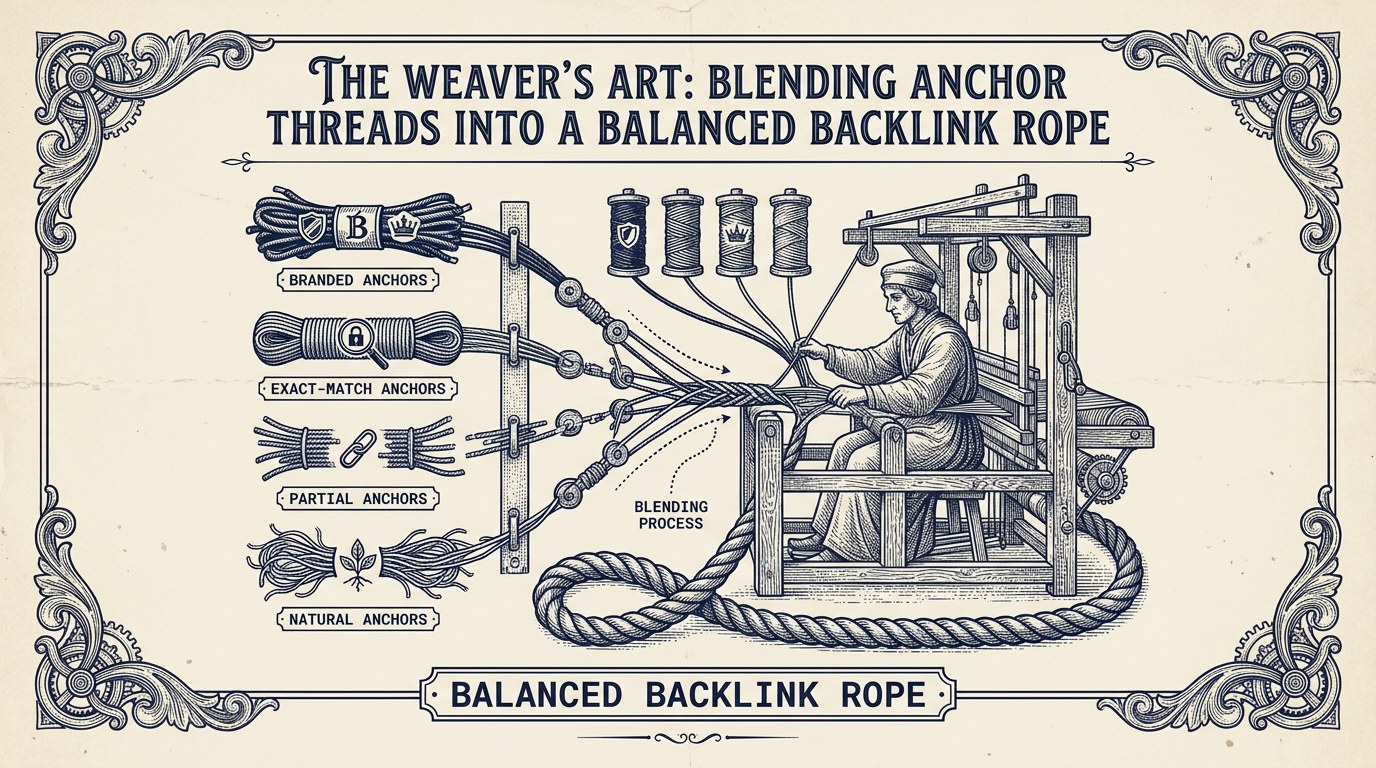
Six anchor categories cover the operational range. Each serves a different distribution function.
Category 1: Branded anchors
Anchor text matching the brand name, brand variations, or company name. Examples: "Technotize," "Technotize.io," "the Technotize team." Branded anchors signal natural editorial citation patterns; sites with strong branded anchor representation get treated as established brands rather than as link building targets. Healthy B2B SaaS profiles typically run 30 to 50% branded anchors.
Category 2: Naked URL anchors
Anchor text matching the URL of the linked page. Examples: "https://technotize.io," "technotize.io/insights/seo-roi-b2b-saas." Naked URL anchors signal casual citation patterns; bloggers and writers commonly link with URLs when they don't have a specific phrase for the link. Healthy profiles typically run 10 to 20% naked URL anchors.
Category 3: Generic anchors
Anchor text using non-specific descriptive terms. Examples: "click here," "read more," "this article," "this guide." Generic anchors signal informal citation patterns. Despite traditional SEO advice to avoid generic anchors, natural backlink profiles include a meaningful generic anchor presence (5 to 15% typically). Profiles with zero generic anchors often look engineered.
Category 4: Partial-match anchors
Anchor text containing some of the target keyword along with additional context. Examples: "our SEO strategy guide" (when targeting "b2b saas seo strategy"), "this comprehensive content marketing framework" (when targeting "content marketing"). Partial-match anchors provide topical signal without over-optimizing. Healthy profiles typically run 10 to 20% partial-match.
Category 5: Exact-match commercial anchors
Anchor text matching the target commercial keyword exactly. Examples: "b2b saas seo agency," "content marketing services," "crm software." Exact-match anchors carry the strongest topical signal but also the strongest manipulation signal. The discipline: keep exact-match concentration under 5% of the total profile to maintain natural pattern signals.
Category 6: Topical and contextual anchors
Anchor text describing the topic or context of the linked page without matching specific commercial keywords. Examples: "the framework for measuring SEO ROI," "their approach to B2B content strategy," "the technical SEO playbook they ship." Topical anchors signal genuine editorial engagement with the content; healthy profiles run 15 to 25% topical anchors. As Ahrefs' analysis of anchor text distribution patterns shows, topical anchor variety is one of the strongest signals of natural editorial citation rather than engineered link building.
03Distribution patterns that look natural
Distribution patterns matter more than individual anchor choices. Three pattern dimensions matter.
Aggregate ratio targets
Healthy B2B SaaS profile aggregate ratios: 30 to 50% branded, 10 to 20% naked URL, 5 to 15% generic, 10 to 20% partial-match, under 5% exact-match commercial, 15 to 25% topical. The ratios are targets, not absolute requirements; some natural variance is expected, and the ratios should be calibrated to the program's specific competitive context per Chapter 05.
Variation across linked pages
Different pages on the same site can sustainably have different anchor distributions. The homepage typically receives more branded anchors (because brand mentions naturally point to the homepage). Service pages can sustain slightly higher partial-match concentrations (because content describing services naturally uses topic language in anchors). Blog posts typically see the most topical and generic anchor variety.
Temporal distribution consistency
Anchor patterns should evolve gradually rather than shifting suddenly. A site with stable 40% branded anchors that suddenly shifts to 25% branded over two months signals coordinated link building. The temporal consistency signal pairs with Google's link spam policies detection patterns; programs that ramp link building velocity should maintain consistent anchor distribution during the ramp.
Referring domain anchor diversity
Across the program's referring domains, anchor text should vary meaningfully. A site receiving the same exact-match anchor from 30+ different referring domains signals coordinated outreach (which is real) but more importantly signals that the program is selecting the anchor rather than the editorial team. Editorial teams left to their own naturally produce diverse anchors; uniform anchors signal pitcher-driven anchor selection.
04Per-page concentration limits
Per-page concentration matters operationally because aggregate-level audits miss page-level over-optimization. Three per-page limits matter.
Per-page exact-match concentration
Single pages should typically receive under 10% exact-match commercial anchors. Pages receiving 20%+ exact-match anchors signal aggressive targeting even when the site's overall profile looks acceptable. The pattern: programs target high-value pages with concentrated exact-match anchor building, producing per-page concentrations that don't show up in aggregate site-level analysis.
Per-page anchor diversity
Single pages should receive anchors across multiple categories rather than concentrated in one category. A commercial service page receiving 80% partial-match anchors and 20% exact-match (with no branded, generic, or topical) signals engineered link building targeting that specific page. Healthy per-page distributions show meaningful diversity across at least 4 of the 6 categories.
Per-page referring domain diversity
Single pages should accumulate referring domains over time, not in concentrated batches. A page going from 5 referring domains to 50 in 30 days signals link velocity issues that often combine with anchor over-optimization for the worst penalty risk. The content lifecycle value playbook covers complementary cumulative-link-growth patterns.
Audit cadence for per-page concentration
Quarterly audit: pull anchor data for the program's top 20 to 50 pages by backlink count, calculate per-page concentration across the six categories, flag pages exceeding limits, schedule remediation work for flagged pages. The cadence catches over-optimization before it accumulates into penalty-trigger territory.
05Competitive anchor benchmarking discipline
Generic anchor ratios fail because what's natural varies by niche. Competitive benchmarking produces ratio targets matched to actual market signal.
The competitor selection process
Select the top 3 to 5 ranking competitors for the target keyword (or the program's primary target keywords). The selection should match the search intent of the target keyword: ranking competitors for "b2b saas seo agency" are the right benchmark for that keyword, not ranking competitors for "b2b saas seo strategy" (different intent, different anchor patterns).
The competitive anchor extraction
For each competitor's ranking page, pull the anchor text distribution across their backlink profile. Aggregate the patterns across competitors. The aggregate produces an "implied natural pattern" for the keyword's competitive context: what anchor mix is actually winning at the SERP level.
The gap analysis
Compare the program's current anchor distribution against the competitive benchmark. Identify where the program is over-indexed (e.g., 12% exact-match where competitors average 3%) and under-indexed (e.g., 18% branded where competitors average 45%). The gap analysis surfaces specific imbalances that explain ranking gaps and informs the remediation strategy.
The benchmarking refresh cadence
Competitive context evolves; benchmarks should refresh quarterly. New competitors enter SERPs, existing competitors' anchor patterns evolve, search intent shifts subtly. Programs running stale benchmarks make anchor decisions against outdated competitive patterns. As described in Backlinko's analysis of Google ranking factors, anchor text remains a relevancy signal but the operational discipline depends on understanding what competitive patterns actually win for the specific keyword context.
06Over-optimization warning signs and recovery
Over-optimization typically shows warning signs before triggering algorithmic devaluation. Three warning sign categories matter.
Anchor concentration drift signals
Warning sign: per-page exact-match concentration trending upward over 60 to 90 days. The drift signal often precedes ranking suppression by 30 to 60 days. Mitigation: when drift signals appear, pause exact-match anchor building on the affected pages and concentrate new link acquisition on branded, naked URL, and topical anchors to rebalance the distribution.
Sudden distribution shifts
Warning sign: the program's overall anchor distribution changing more than 5 to 10 percentage points in any category within 60 days. The shift signals coordinated link building that algorithmic systems detect. Mitigation: pause aggressive anchor building, focus subsequent link acquisition on rebalancing categories that decreased disproportionately.
Competitive divergence
Warning sign: the program's anchor distribution diverging from competitive benchmarks by more than 10 to 15 percentage points in any category. The divergence signals the program is operating outside the natural pattern for its competitive context. Mitigation: rebalance link acquisition toward categories underrepresented compared to competitive benchmarks.
Recovery patterns after suppression
If algorithmic suppression has already engaged (rankings dropped without clear cause, organic traffic decline that doesn't match content quality issues), recovery requires substantial rebalancing rather than just pausing aggressive building. Pattern: 6 to 12 months of mostly-branded and mostly-topical anchor building, paired with content quality improvements, typically restores ranking trajectory. Pursuing more aggressive link building during recovery typically extends the suppression rather than shortening it. Programs experiencing severe suppression should also review Google's manual actions report for unnatural link warnings.
07Operational workflow for anchor mix management
Operational anchor mix management requires structured workflow. Three workflow components matter.
Per-campaign anchor planning
For each link building campaign or outreach batch, plan the target anchor distribution before executing. The planning prevents the ad-hoc anchor selection that produces over-optimization. The planning should specify: target distribution across the six categories, per-page allocation for any high-value target pages, branded anchor inclusion in at least 30 to 40% of campaign anchors.
Anchor tracking database
Per-link tracking: which referring domain, which anchor text used, which target page, which campaign. The database enables aggregate-level distribution analysis, per-page concentration monitoring, and temporal pattern tracking. Programs running link building without anchor tracking can't operate the discipline at scale.
Monthly anchor portfolio review
Monthly cadence: pull the program's full anchor distribution, compare against competitive benchmarks and against prior-month patterns, identify drift signals or concentration issues, plan the next month's anchor allocation to rebalance any problematic patterns. The cadence keeps the anchor mix evolving gradually rather than producing the sudden shifts that warning signs surface.
Integration with broader link building cadence
Anchor mix management should integrate with the broader link building cadence covered in the link velocity playbook for B2B SaaS we ship. The combined disciplines produce link building outcomes that compound rather than triggering algorithmic problems.
If you want this anchor text mix strategy running on your program, book a 30-minute anchor audit with our team. Compare engagement options for link building programs of different scales.
08Common failure modes and operational fixes
Four dominant failures.
The "exact-match-heavy targeting" failure: programs concentrating exact-match commercial anchors on high-value pages, producing the per-page over-optimization that algorithmic systems detect. Fix: enforce the under-5% aggregate exact-match limit and under-10% per-page exact-match limit from Chapters 03 and 04.
The "generic ratio rules" failure: programs applying universal anchor ratios without competitive benchmarking, producing patterns mismatched to their actual competitive context. Fix: implement the competitive benchmarking workflow from Chapter 05; competitive context produces better ratio targets than generic rules.
The "no per-page audit" failure: programs auditing only at aggregate site level, missing per-page concentration issues that aggregate audits hide. Fix: ship the per-page audit cadence from Chapter 04; per-page audits catch the manipulation signal that site-level audits miss.
The "no anchor tracking" failure: programs running link building without anchor tracking, unable to manage distribution patterns. Fix: ship the anchor tracking database from Chapter 07; even simple spreadsheet tracking enables the operational discipline.
This is one chapter of the link insertion sub-pillar.
The full strategic framework covering link insertion, niche edits, anchor text mix, link velocity, and ROI measurement lives on the parent sub-pillar.
Read the link insertion sub-pillar →