On this page
How long does B2B SaaS SEO actually take? The honest answer is 14 to 18 months to defensible pipeline contribution, broken into five distinct phases. Anyone selling a six-month timeline is either misrepresenting the work or pricing for a different kind of outcome. This post walks through what each phase produces, what each phase does not, and how to survive the month-six CFO conversation that kills most programs.
01The honest timeline question
Marketing leaders ask "how long until SEO starts working" more than any other timeline question in the strategy cluster. The honest answer is uncomfortable. Defensible pipeline contribution from B2B SaaS SEO arrives between months 14 and 18 of a credible program. That is the bar serious agencies set for themselves and meet. Anyone offering a shorter timeline is either misrepresenting the work or pricing for a different kind of outcome.
Why "6 month results" claims are wrong
The 6 month results claim is the most common sales lie in SEO. It survives because some keywords do rank in 6 months. Almost none of them are the keywords that drive pipeline. A company can chase quick-rank long-tail terms and watch traffic grow in 6 months while pipeline does not move. That is the failure pattern. Quick wins on the wrong keywords obscure the structural problem until month 18.
Why the answer is not "it depends"
"It depends" is the second-most common dodge. The honest answer is that the timeline does depend on ARR stage, category, and starting DR, but the variance is 4 to 6 months around a 16 month median. The right answer to a CFO is "14 to 18 months to defensible pipeline, broken into 5 phases, with these specific milestones at these specific times." That is a defensible commitment.
02The 5 phases, mapped to months
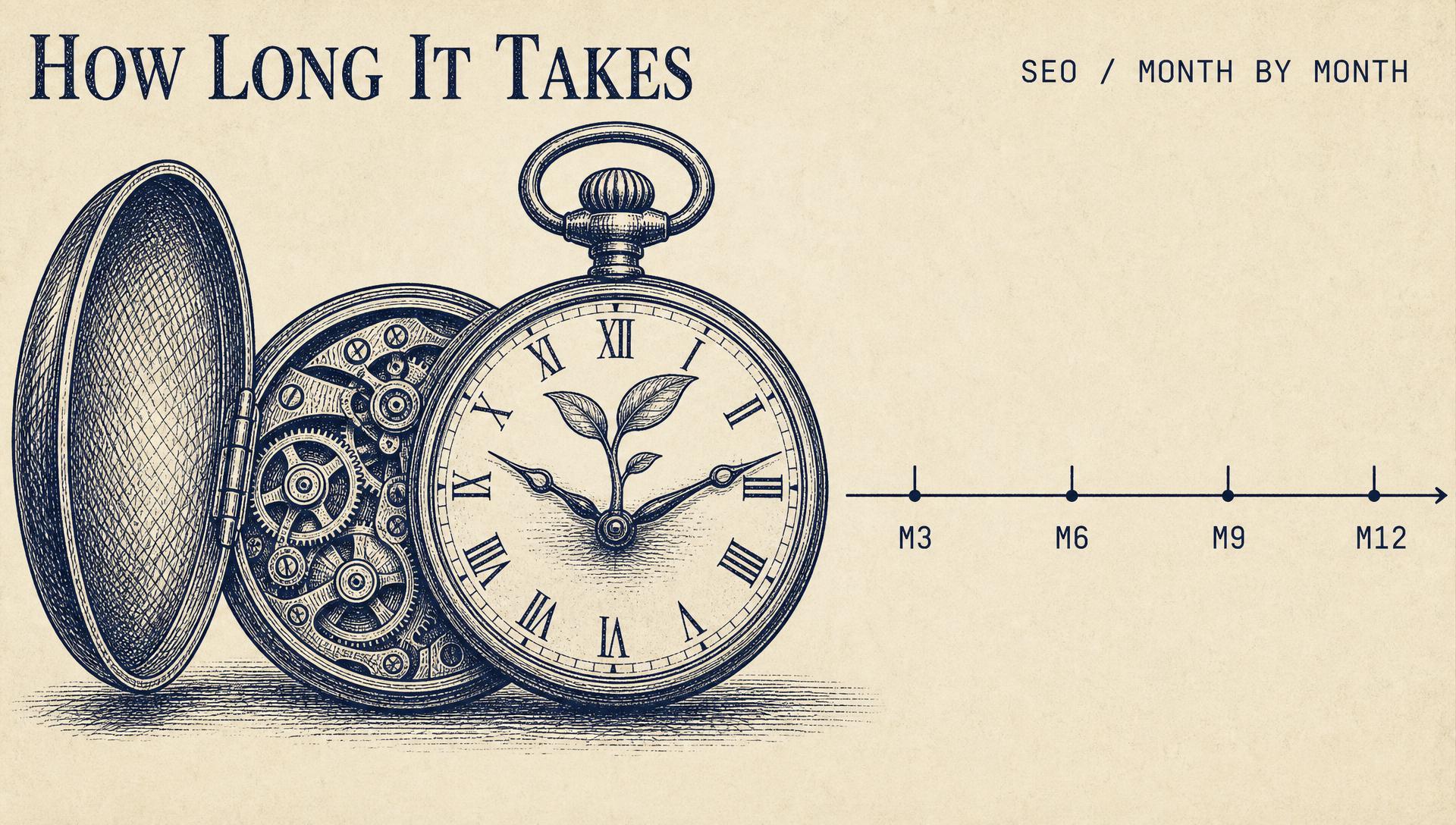
A credible B2B SaaS SEO program progresses through 5 distinct phases. Each phase produces specific outputs. The timeline below is the median for an Acceleration-stage company ($5M to $20M ARR) starting at DR 20 to 30.
Phase 1: Baseline and strategy, months 1 to 2
The strategy phase. Attribution infrastructure built. Pipeline definition document written. Cluster architecture defined. ICP and personas locked. Initial keyword research complete. SME interview schedule built. No content has shipped yet. The output of phase 1 is a 12 to 18 month thesis the entire team agrees on. If the team cannot agree on the thesis in 6 weeks, the program is starting on weak foundations.
Phase 2: Technical audit and remediation, months 2 to 3
Technical SEO audit complete and remediation underway. Core Web Vitals at target. Schema markup audit done. Internal linking audit done. Crawlability issues fixed. Page-type templates locked. By the end of phase 2, the site is ready to receive content that compounds. Programs that skip technical remediation publish into a leaky bucket for 12 months.
Phase 3: Content launch, months 3 to 6
The first cluster of content ships. Roughly 6 to 12 pieces in this phase, all in the same topical cluster, each piece passing the brand voice and SEO playbook standards. First links start coming in. First rankings start appearing in positions 30 to 50. This is the phase that looks slow from outside. It is the phase that determines whether the program will compound.
Phase 4: Compounding, months 6 to 12
Rankings move from positions 30 to 50 into positions 10 to 30. Topical authority builds. Internal linking strategy matures. Second and third clusters launch. Editorial backlinks start arriving from real publications. Traffic begins growing at a rate that is visible in the analytics. This phase is where most programs that fail are misdiagnosed as succeeding, because traffic is up. Pipeline contribution is still not defensible yet.
Phase 5: Pipeline contribution, months 12 to 18
Rankings move into top 10 positions on commercial-intent keywords. Demo requests and pipeline contribution from organic become defensible. The CFO conversation becomes pleasant. The program is now compounding faster than the cost of operating it. Phase 5 continues indefinitely; year 2 produces 1.5x to 2.5x the pipeline of year 1 at roughly flat cost.
03What each phase produces (and what it does not)
Knowing the deliverables per phase removes the surprise. The deliverables are not "more content", they are specific assets and milestones.
Phase 1 deliverables
A signed 12 to 18 month thesis document. A keyword spreadsheet with at least 50 candidates scored on the 3-axis framework. The cluster architecture diagram. The SME interview roster. The pipeline definition document. The attribution setup in GA4 and the CRM. No published content yet.
Phase 2 deliverables
A site audit report with prioritized issues. Engineering tickets filed for each issue. Core Web Vitals at target on mobile. All schema markup audited and corrected. Internal linking remediation complete. No published content yet.
Phase 3 deliverables
6 to 12 published pieces in the first cluster. Each piece passes the brand voice and SEO playbook standards. Each piece has earned at least one editorial-grade link by the end of the phase. First-position-30-to-50 rankings appearing in Search Console.
Phase 4 deliverables
20 to 40 total published pieces by the end of phase 4. Rankings moving from 30 to 50 into 10 to 30. Top-of-funnel traffic visibly growing in analytics. First demo requests attributable to organic. Editorial backlink count growing roughly 5 to 10 per quarter.
Phase 5 deliverables
Top 10 rankings on commercial-intent keywords. Defensible pipeline contribution in the CFO's preferred attribution model. Cost per pipeline dollar from organic dropping below paid channels. The program now operates as a compounding asset rather than an expense.
04Why the timeline varies by ARR stage
The 14 to 18 month median has real variance. Below is the honest range for each maturity stage.
Foundation stage timeline (below $5M ARR)
16 to 20 months to defensible pipeline contribution. Foundation companies typically start at lower DR (under 20), have less brand search demand, and need longer to build topical authority. Foundation programs that try to hit 14 months usually have to cut corners on quality, which collapses the compounding.
Acceleration stage timeline ($5M to $20M ARR)
14 to 16 months. Acceleration companies typically start at DR 20 to 35, have some brand demand, and can move into compounding faster because the audience already exists. This is where the median program lives.
Compounding stage timeline ($20M to $50M ARR)
12 to 14 months. Compounding companies typically start at DR 30 to 50, have meaningful brand demand, and have product-team capacity to support content quality. The shorter timeline is real but is contingent on the company actually committing to the work.
Authority stage timeline (above $50M ARR)
12 to 14 months for new clusters in the existing topical authority. New categories the company is entering may take longer because the topical authority does not yet transfer.
05The CFO conversation in month 6
The most common point of program death. Most programs that get killed are killed in the month 6 budget review, not the month 18 review. Knowing this in advance is what prevents the death.
What the CFO sees at month 6
Traffic graph: roughly flat or slightly growing. Rankings improvements: visible but not in top 10. Pipeline contribution: not defensible yet. Spend: 6 months times the monthly retainer or in-house cost. The CFO does the math: "We have spent $60K to $120K and pipeline is not moving." That is technically correct and structurally wrong, because the program is on a 14 month timeline.
How to survive the conversation
The conversation is survivable only if the 14 to 18 month timeline was committed to in month 1, in writing, with leading-indicator milestones the program is hitting on schedule. If the timeline was not committed to upfront, the conversation is unrecoverable. If it was, the CFO can see "rankings moving into top 30, editorial backlinks appearing, leading indicators on schedule" and continue funding. The leading indicators are the budget defense.
06What "results" actually means at each phase
The word "results" gets used to mean different things across phases. Naming the right metric per phase removes the confusion.
Phase 1-2 metric: strategic readiness
The right metric is whether the thesis document is signed, the cluster architecture is approved, and attribution infrastructure is functional. No traffic or ranking metrics matter here.
Phase 3 metric: leading-indicator coverage
Keyword count appearing in Search Console at any rank. First editorial backlinks earned. SME interviews completed per piece. Quality-gate pass rate on published pieces.
Phase 4 metric: ranking movement
Percentage of target keywords moving from positions 30+ into 10 to 30. Editorial backlinks added in the quarter. Traffic growth quarter over quarter. Top-of-funnel demo requests attributable to organic.
Phase 5 metric: pipeline contribution
Monthly pipeline contribution from organic. MQLs from organic per month. SQLs from organic per month. Cost per pipeline dollar from organic. Year-over-year pipeline growth.
07How to set realistic expectations upfront
The single most important conversation in a B2B SaaS SEO engagement is the month 0 expectations conversation. Done right, it protects the program from the month 6 death. Done wrong, it sets up the program to fail.
What to commit to in month 0
A written 14 to 18 month timeline with milestone deliverables per phase. The leading indicators the program will hit at month 3, month 6, month 9, month 12. The CFO-defensible language for the month 6 budget review. The escalation path if leading indicators slip.
What not to commit to
Do not commit to specific traffic numbers in months 1 to 6. Do not commit to specific revenue numbers before month 12. Do not commit to "results by quarter 2." Any of these commitments are structural lies that come due at month 6.
08How agencies and in-house teams handle this differently
The timeline is the same regardless of delivery model. The conversation about the timeline differs.
Agency timeline behavior
Honest agencies put the 14 to 18 month timeline in the sales conversation. Dishonest agencies use the timeline question to test the prospect's pain, if the prospect says "we need results in 6 months," the dishonest agency agrees and runs a velocity-trap program that fails at month 12. The honest agency walks away from the engagement instead.
In-house team timeline behavior
In-house teams often hide from the timeline question because committing to 18 months internally is politically harder than committing externally. The senior content lead who commits in writing to a 14 month timeline survives the month 6 conversation. The one who hedges does not. The political work of committing to the timeline upfront is the most important political work the in-house lead does.
09Workwize timeline as a reference
The cleanest 22-month timeline we have shipped. Verified phase-by-phase markers.
Workwize phase progression
Phase 1-2 (months 1 to 3): thesis signed, audit complete, technical remediation shipped. Phase 3 (months 3 to 6): first 9 pieces published, first 4 editorial backlinks earned. Phase 4 (months 6 to 14): 26 additional pieces published, DR moved from 27 to 52, traffic grew 4x. Phase 5 (months 14 to 22): top 10 rankings on commercial-intent terms, monthly pipeline contribution moved from approximately $360K to approximately $1.16M. DR ended at 71. (Full case study walks through each phase month by month.)
What the Workwize timeline confirms
The 5-phase model is repeatable. The 14 to 18 month range to defensible pipeline holds for a hybrid-model engagement at Acceleration stage. The Workwize ratio of phase-3 published pieces to phase-5 pipeline contribution (35 pieces total to $1.16M monthly pipeline) is consistent with what we see across the portfolio.
10FAQ
This FAQ section addresses common concerns about B2B SaaS SEO timelines, including realistic expectations for traffic growth and ROI reporting. We also explore the impact of agency changes and why some providers promise faster results.
What is the fastest credible timeline?
12 to 14 months to defensible pipeline contribution at Compounding stage and above. Faster timelines exist on paper but break under audit. The structural minimum is the time it takes to build topical authority, and that is around 12 months.
How do I show ROI in month 6?
You cannot show pipeline ROI in month 6. You can show leading indicators on schedule: rankings moving from non-ranked into positions 30 to 50, editorial backlinks earned, content quality-gate pass rate, attribution infrastructure complete. If you committed to these leading indicators in month 1, the month 6 conversation is defensible.
Should I see traffic growth in months 1 to 3?
No. Months 1 to 3 are strategy and technical work. Traffic growth in this phase usually means the program is using stale baseline data or skipping the strategy work. Both are red flags.
What does year 2 look like?
Year 2 produces 1.5x to 2.5x the pipeline of year 1 at roughly flat operating cost. This is the compounding payoff. Programs that get past month 18 typically renew indefinitely because the year-over-year math becomes overwhelming.
If we switch agencies at month 12, does the clock restart?
Partially. The published content and earned links carry forward. Strategic context and institutional knowledge do not. A mid-engagement switch typically adds 3 to 6 months to the original timeline.
Why do some agencies claim 6 month results?
Because some keywords do rank in 6 months. The keywords that drive pipeline almost never do. Agencies that sell 6 month timelines are typically chasing rank on the wrong keywords. The traffic looks good in the dashboard. The pipeline does not move.
Part of the
B2B SaaS SEO strategy playbook →
The pillar covering ARR-stage maturity, cluster architecture, attribution design, and the structural decisions that determine whether an SEO program compounds or stalls.
Where this fits in the broader playbook
This piece sits inside our B2B SaaS SEO strategy framework, which is one chapter of the full B2B SaaS SEO playbook. For deeper framing on the same discipline, see the strategic foundation for B2B SaaS SEO programs.
Closely related reading from the same sub-pillar
- the maturity-model framework , the four maturity stages SaaS SEO programs progress through.
- the SEO vs PPC decision framework , the SEO/PPC mix that fits each ARR stage.
- why SaaS SEO programs stall out , the specific failure modes that stall SaaS SEO programs.
From other corners of the program
- how we earn editorial coverage , the cross-cluster discipline that compounds this work.
- the link building pillar covering all five disciplines , the upstream pillar this connects to.
When you're ready to put this into a program, book a call with our team or review what each engagement level includes. Average response time: under 4 business hours.