On this page
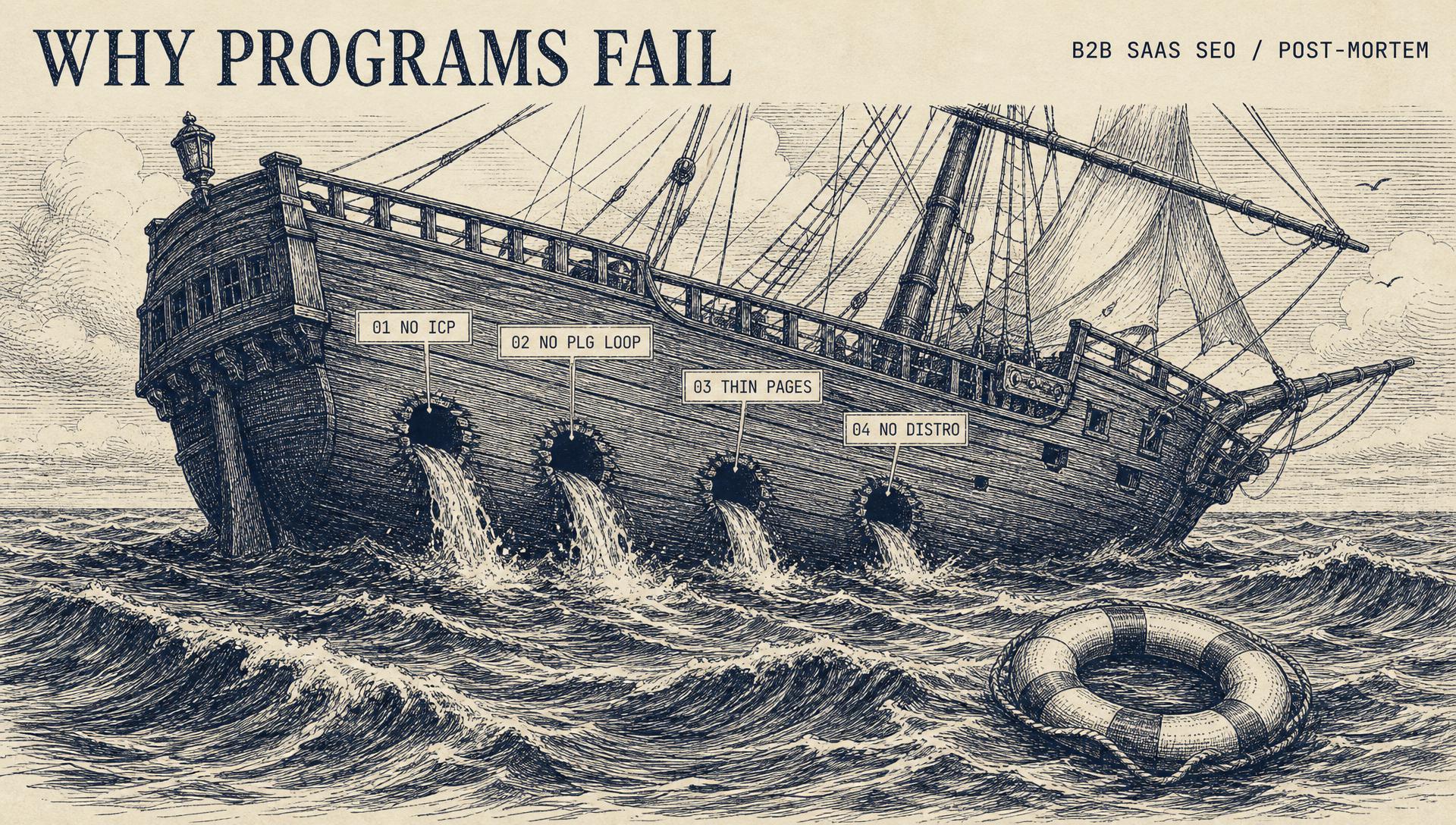
70 to 80 percent of B2B SaaS SEO programs fail to produce defensible pipeline within 18 months. The failure rate is not because SEO does not work for B2B SaaS. It is because the program design is structurally wrong. Six specific failure modes explain almost every case we have audited.
01The B2B SaaS SEO failure rate
Most B2B SaaS marketing leaders quietly suspect their SEO program is underperforming. They are usually right. Across the engagements we have audited over the past four years, somewhere between 70 and 80 percent of B2B SaaS SEO programs fail to produce defensible pipeline contribution within 18 months. That is not a clickbait number. It is the bar agencies set for themselves and miss.
Defining "failure" specifically
Failure does not mean zero traffic. Failure means the program cannot defensibly tie itself to pipeline at month 18. Sessions are up. Rankings are up. Keywords ranking in the top 10 are up. Pipeline contribution from organic search is under 5 percent of total inbound. The CFO asks for ROI. The CMO does not have a clean answer.
Why the problem is invisible for 8 to 10 months
The leading indicators are positive for the first 8 to 10 months. Traffic grows. Rankings climb. The agency presents a confident deck every month. The lag between activity metrics (rankings, traffic) and outcome metrics (qualified pipeline) hides the structural problem until the renewal conversation forces it into the open.
The moment of recognition
The pattern is the same every time. Month 14 to 18. Budget review. Someone in the room asks "what did this generate in pipeline this year?" The team has impressions, rankings, and traffic. Pipeline contribution is unclear. The agency switches to bridging language about foundations and compounding. Six months later the contract does not renew.
02Failure mode 1, wrong stage targeting
The most common structural failure is a program designed for an ARR stage the company does not have. Foundation companies (under $5M ARR) running Acceleration playbooks. Acceleration companies ($5M to $20M ARR) running Foundation playbooks. Both mismatches produce the same symptom: 12 months of activity, no compounding. The ARR-stage maturity model is the framework we use to diagnose this.
Foundation companies running Acceleration playbooks
A Foundation-stage company hires an agency and asks for "everything." The agency obliges. Eight blog posts a month, link building at scale, technical audits, product-led pillars. The result at month 12: thin coverage across too many topics, no topical authority, no rankings on the keywords that would actually drive pipeline. Foundation programs need depth on 3 to 5 cluster topics, not breadth across 15.
Acceleration companies running Foundation playbooks
The opposite failure. A Series B company with PMF, a defined ICP, and 20 buying committees a month spends 14 months on "brand awareness content" and "thought leadership pieces." The program produces traffic. The traffic does not match the buying committee. Acceleration programs need content built for the personas in the active buying committee. Educational content for the audience that is not yet shopping is a Foundation move.
The symptoms of each mismatch
The Foundation-with-Acceleration-playbook symptom is "we are publishing 30 pieces a quarter and ranking for nothing high-value." The Acceleration-with-Foundation-playbook symptom is "we are getting traffic from buyers who do not match our ICP." Both end with a budget conversation that goes badly.
03Failure mode 2, the content velocity trap
The lie that kills more B2B SaaS SEO programs than any other is "more content equals more rankings." It is the most natural mistake to make. The agency wants to demonstrate output. The CMO wants to see deliverables in the report. The blog gets stuffed with 30 mediocre pieces a quarter. Nothing ranks. A real B2B SaaS content strategy produces the opposite pattern.
The "more content equals more rankings" lie
Search engines in 2026 rank pages on topical authority and information gain, not page count. A site with 6 pieces of operator-grade content on a tight cluster will outrank a site with 60 pieces of generic content on a sprawling topic map. The math does not favor velocity. It favors depth.
The 30-pieces-zero-rankings pattern
We audit at least one program a quarter where the team published 30 pieces in the prior year and none of them rank in the top 20 for their target keyword. The pattern is the same every time. Briefs were short. Writers were juniors or freelancers. SME interviews did not happen. Drafts were edited for grammar, not argument. Each piece is publishable. Together they signal "site without expertise" to Google.
Why velocity without strategy collapses
The content velocity trap is hard to escape because it does not look like a problem from the outside. The output report shows a healthy publishing cadence. The team feels productive. The agency is happy to keep producing. The collapse is in the lagging indicator (pipeline) which arrives 12 to 16 months after the wrong decision.
04Failure mode 3, agency report theater
The third failure mode is the agency report that is designed to justify spend rather than measure outcomes. We have audited dozens of these. The fingerprint is consistent. Rankings up. Traffic up. DR up. Pipeline contribution either absent from the report or buried under qualifications.
Reports designed to justify spend
An honest SEO report leads with pipeline and works backwards to attribution. A theatrical report leads with rankings, traffic, and impressions, and stops before pipeline. The theatrical report is more common because agencies that lead with pipeline cannot hide an underperforming program. Agencies that lead with rankings can hide one for 14 months. (The B2B SaaS SEO budget calculator covers what an honest pipeline-tied report should actually report on.)
The "rankings up, traffic up, pipeline flat" pattern
The signature of a failing program in its theatrical phase: 12 months of reports showing ranking improvements and traffic growth, with pipeline contribution unchanged from baseline. The agency frames this as "early-stage signals are positive." The CMO is told to be patient. Patience without measurement is how programs reach month 18 without anyone realizing they have failed.
Report behaviors that signal trouble
Three specific patterns mean the program is failing. First, ranking lists with no commercial-intent tagging (rankings for informational keywords presented alongside rankings for commercial keywords, undifferentiated). Second, traffic growth without a conversion-path analysis (where does the traffic go, what does it convert to). Third, no demand-stage segmentation (what percentage of traffic sits at problem-aware, solution-aware, and vendor-evaluating intent).
05Failure mode 4, the in-house counterpart vacuum
The single biggest predictor of program success or failure is not the agency. It is the in-house counterpart. We have seen the same agency produce DR 70 outcomes for one client and DR 25 outcomes for another. The variable was the counterpart's authority, product knowledge, and time.
What the counterpart actually does
The in-house counterpart owns prioritization, internal alignment, SME scheduling, content review at the argument level, and the relationship between the SEO program and the product roadmap. None of these are delegatable to an agency from outside. An agency without an in-house counterpart who has real authority is producing content into a void.
Common counterpart problems
Three common counterpart failure patterns. First, no decision authority. The counterpart cannot approve content, cannot greenlight technical changes, cannot redirect strategy without escalating. The program runs at the pace of someone else's calendar. Second, no product knowledge. The counterpart cannot review the technical accuracy of a draft, so SME reviews get skipped, and content goes out vague. Third, no time. The counterpart has SEO as a slice of their week, not a focus, and the program drifts.
Why agencies cannot fix this from outside
Agencies that try to substitute for a weak counterpart end up making product claims they cannot verify, producing content the brand does not actually stand behind, and shipping work that gets rolled back at internal review. The right move is to flag the gap to the CMO in month 1 and either fix it or scope the engagement around the constraint. Most agencies do not flag it because they do not want to lose the account.
06Failure mode 5, measurement framework that arrives too late
Measurement built in month 12 cannot save a program designed in month 1. The fifth structural failure is treating measurement as something added later, after content is published and traffic starts growing. By then the foundation cannot be inspected.
Pipeline attribution built in month 12, not month 1
The right time to build pipeline attribution is the audit phase, before any content has been published. Month 1. The wrong time is month 12, when leadership asks for ROI. Building attribution in month 12 means reconstructing twelve months of buyer behavior from incomplete data. The numbers that come out are caveated, uncertain, and unconvincing to a CFO.
The recovery problem
A program with no month-1 attribution baseline cannot demonstrate progress against itself. Recovery requires comparing current performance to a documented starting point. Without that starting point, every conversation becomes a debate about whether the program is working. The conversation is unrecoverable inside the same fiscal year.
What month-1 measurement actually looks like
A correct measurement setup has four components in place before content publishes. GA4 with cleaned attribution. CRM with self-reported attribution at form fill. UTM hygiene across all internal links. A pipeline-definition document everyone agrees on (what counts as "a qualified lead from organic"). Without these, attribution conversations in month 18 will not produce defensible answers regardless of what the program actually did.
07Failure mode 6, the channel mismatch
The sixth and most uncomfortable failure mode: SEO is the wrong channel for some B2B SaaS companies. Not all of them. Not most of them. But more than agencies admit. The mismatch is the cleanest failure because it is the most preventable.
Five category signals against SEO
Five signals that B2B SaaS SEO is the wrong primary channel. First, the buying cycle is under 30 days. SEO compounding takes 12 to 18 months. The math does not work. Second, ACV is below $1,500. The cost of acquisition through SEO is structurally too high for this LTV. Third, the category does not have meaningful search demand (an emerging category, a niche operator-only term, a product without clear keyword associations). Fourth, PMF is unstable. SEO cannot fix a positioning problem. Fifth, founders cannot commit 4 to 8 hours a week for 18 months. Without leadership engagement, no SEO program survives.
Why we turn down 1 in 3 prospect calls
We turn down roughly 1 in 3 prospect calls because one of these five signals is present. The conversation is short. We tell the prospect honestly that SEO is not their highest-impact channel right now, and we recommend what is (often paid search, founder-led outbound, or category creation through PR). The prospect leaves the call without a contract. They tell other operators. Honest mismatches are how we earn trust.
Honest mismatches save everyone time
The cost of taking a misfit account is much higher than walking away. 12 to 18 months of work that will not produce results. A reference relationship that ends badly. Internal review cycles that consume bandwidth without producing pipeline. We would rather decline the engagement and refer the prospect to a better-fit channel partner than burn both teams' time.
08Is your program failing? A 7-question diagnostic
Most underperforming programs are recoverable if the failure mode is named early and the right correction is applied. Below is the 7-question diagnostic we run when a new client comes to us mid-engagement. Answer honestly. The composite signal at the end maps to which failure modes are active.
The 7 questions
- Can you defensibly tie at least 10 percent of monthly inbound pipeline to organic search?
- Are 60 percent or more of your published pieces ranking in the top 20 for their target keyword?
- Does your monthly report lead with pipeline contribution, not rankings or traffic?
- Does your in-house counterpart have decision authority and at least 4 hours a week for the program?
- Was pipeline attribution built before content publishing began?
- Has the agency named the keywords they will not target (and why)?
- Does the program have a written 18-month thesis tied to ARR-stage maturity?
What each "no" maps to
Each "no" maps to a failure mode. No to question 1 indicates measurement-framework failure (mode 5) or wrong-stage targeting (mode 1). No to question 2 indicates content velocity trap (mode 2). No to question 3 indicates agency report theater (mode 3). No to question 4 indicates counterpart vacuum (mode 4). No to question 5 indicates measurement-framework failure (mode 5). No to question 6 indicates report theater (mode 3) or velocity trap (mode 2). No to question 7 indicates wrong-stage targeting (mode 1) or channel mismatch (mode 6).
The composite signal
Three or more "no" answers means at least two failure modes are active and the program is structurally underperforming. Recovery is possible. It requires changing the program design, not changing the tactics. Five or more "no" answers means the program needs to be restarted on a new contract or moved to a different agency. (What we charge and what's included is published in full.)
09What working programs look like
What does a working B2B SaaS SEO program actually look like? Workwize is the cleanest counter-example we have shipped. The structural ingredients are visible, repeatable, and unglamorous.
The Workwize structural ingredients
Workwize started at DR 27. They ended at DR 71 in 22 months. Monthly pipeline contribution from organic search moved from approximately $360K to approximately $1.16M. MQLs from organic moved from 28 a month to 111 a month. The structural ingredients that made it work were not exotic. They were the standard ingredients executed without compromise. Cluster architecture built in month 1. Real SME interviews on every piece. In-house counterpart with decision authority and product knowledge. Pipeline attribution from the start. Roughly 6 pieces a month, not 30. (The full Workwize case study walks through the engagement month by month.)
Where the discipline shows up
The discipline shows up in the editing room, not the publishing calendar. Drafts that did not pass the SME review went back to the writer. Pieces that did not match the cluster strategy were killed before they shipped. The blog page count grew slowly. The pipeline contribution grew quickly.
The honest signal that a program is on track
The honest signal that a B2B SaaS SEO program is on track at month 6 is not the ranking improvements or traffic growth. It is whether the in-house counterpart is comfortable defending the program's pipeline contribution to the CFO if asked tomorrow. If the answer is yes, the program is on track. If the answer requires hedging, one of the six failure modes is active.
10FAQ
This FAQ addresses common questions about B2B SaaS SEO program failures. We define what failure means in this context, discuss timelines for assessing performance, and offer guidance on corrective actions.
What does "fail" mean for a B2B SaaS SEO program specifically?
Failure means the program cannot defensibly tie itself to pipeline contribution at month 18. Sessions, rankings, and traffic can all be up. Without a clean line to pipeline, the program is structurally underperforming.
How long should I wait before declaring a program failed?
The fair window is 14 to 18 months. SEO compounding is real and the lag between activity and outcome is real. Before month 14, the diagnostic in chapter 08 is the right tool, not the verdict. After month 18 without defensible pipeline contribution, the program is failing.
Should I fire the agency if the program is failing?
Not always. The agency is one of six possible failure modes. If the in-house counterpart is the weak link, firing the agency does not fix the program. Run the diagnostic. Identify which failure modes are active. Address those modes specifically.
Are these failure modes specific to B2B SaaS or general SEO?
The six modes apply to most SEO programs, with different weights by industry. In B2B SaaS specifically, the counterpart vacuum and channel mismatch failures are more common than in e-commerce or local SEO. The content velocity trap is universal.
How do I know if SEO is the wrong channel for my company?
Run the five signals from chapter 07. If any two are present, SEO is at minimum the wrong primary channel, even if it remains a useful secondary channel. Buying cycle under 30 days, ACV under $1,500, no category search demand, unstable PMF, or no leadership time are the disqualifying signals.
What does month 1 of a healthy program look like?
Month 1 is the audit phase. Cluster architecture defined. Pipeline attribution stood up. SME pipeline built. In-house counterpart's hours and authority confirmed. Content is not published yet. The output of month 1 is a written 18-month thesis the team agrees on, not a piece of content.
Part of the
B2B SaaS SEO strategy playbook →
The pillar covering ARR-stage maturity, cluster architecture, attribution design, and the structural decisions that determine whether an SEO program compounds or stalls.
Where this fits in the broader playbook
This piece sits inside the SEO strategy discipline for SaaS programs, which is one chapter of Technotize's framework for B2B SaaS SEO programs. For deeper framing on the same discipline, see the strategy sub-pillar covering audience-first SEO.
Closely related reading from the same sub-pillar
- the maturity model framework , the maturity model that prevents the most common failures.
- our in-house-vs-agency framework , the team-structure choice that drives many of these failures.
- realistic SaaS SEO timelines , realistic timing expectations that prevent premature judgments.
From other corners of the program
- the outreach discipline for B2B SaaS , the cross-cluster discipline that compounds this work.
- the broader link building program structure , the upstream pillar this connects to.
When you're ready to put this into a program, talk to us about your specific situation or see the engagement options. Average response time: under 4 business hours.