On this page
Most B2B SaaS programs that invest in linkable assets produce content that ranks but earns almost no citations. The disconnect is rarely asset quality. It is asset-to-program fit, the 60/40 production-to-distribution allocation most teams get wrong, and a measurement window short enough to bail before the data exists.
This page is the operator playbook for linkable assets in B2B SaaS: which asset class to build at each program stage, what each one should cost to produce, and how to measure whether the investment paid back inside the window that matters.
01What linkable assets actually are for B2B SaaS
A linkable asset is content other publications, journalists, analysts, and operators want to cite, reference, or embed inside their own work. The phrase has a fifteen-year history in SEO and the canonical reference is still Ahrefs' six-type framework, which catalogs the asset categories that work across general SEO. The framework matters. It also stops short of the question every B2B SaaS marketing leader is actually asking: which of these should my program build first.
For B2B SaaS specifically, three properties separate genuinely linkable content from content that is technically excellent but never cited. The asset must answer a question the citing party already has. It must provide information or capability the citing party cannot easily produce on their own. And it must be structured so citing it is mechanically simple: a number to quote, a chart to embed, or a framework to reference by name. Content missing any of the three earns links inconsistently, and the earnings are concentrated in the tail of the campaign, not the head.
The B2B SaaS-specific filter
Programs marketing to B2B buyers fail a fourth implicit test that consumer brands rarely have to worry about. The asset has to be defensible inside a buying committee. A general-audience listicle earns links from lifestyle blogs. A defensible benchmark on cost-per-acquisition by SaaS vertical earns links from analyst publications, industry trade press, and the vendor's own competitor research teams. The audience that does the linking is narrower, more skeptical, and far harder to reach without earned credibility. Our linkable assets services for B2B SaaS work backs into this filter on every brief.
02Why outreach fails without an anchor asset
Most underperforming B2B SaaS link building programs share a single root cause. They scaled outreach before the assets existed. Outreach without a linkable asset is the same operational pattern as paid advertising without a landing page. The traffic arrives, but the conversion vehicle is missing. The publication runs the pitch through their editorial filter, finds nothing concrete to cite, and the email goes into the closed folder.
The pattern compounds. A program that runs outreach without strong assets builds a reputation among target journalists for low-value pitching, and that reputation lowers response rates on future outreach by an order of magnitude. Search Engine Journal's coverage of linkable assets documents exactly this feedback loop in the press contact databases used by mid-market PR teams.
The three-layer link building stack
A B2B SaaS link building program that works has three layers. Layer one is linkable assets, the production discipline that anchors everything else. Layer two is acquisition, the outreach work that surfaces those assets to publication audiences. Our digital PR strategy framework covers the acquisition layer in operator-grade detail. Layer three is editorial relationships, the partnerships that compound the first two layers across years. Programs that skip layer one and invest only in layers two and three produce inconsistent results because there is no asset for the outreach or the relationship to point at.
03The five-tier B2B SaaS linkable asset stack
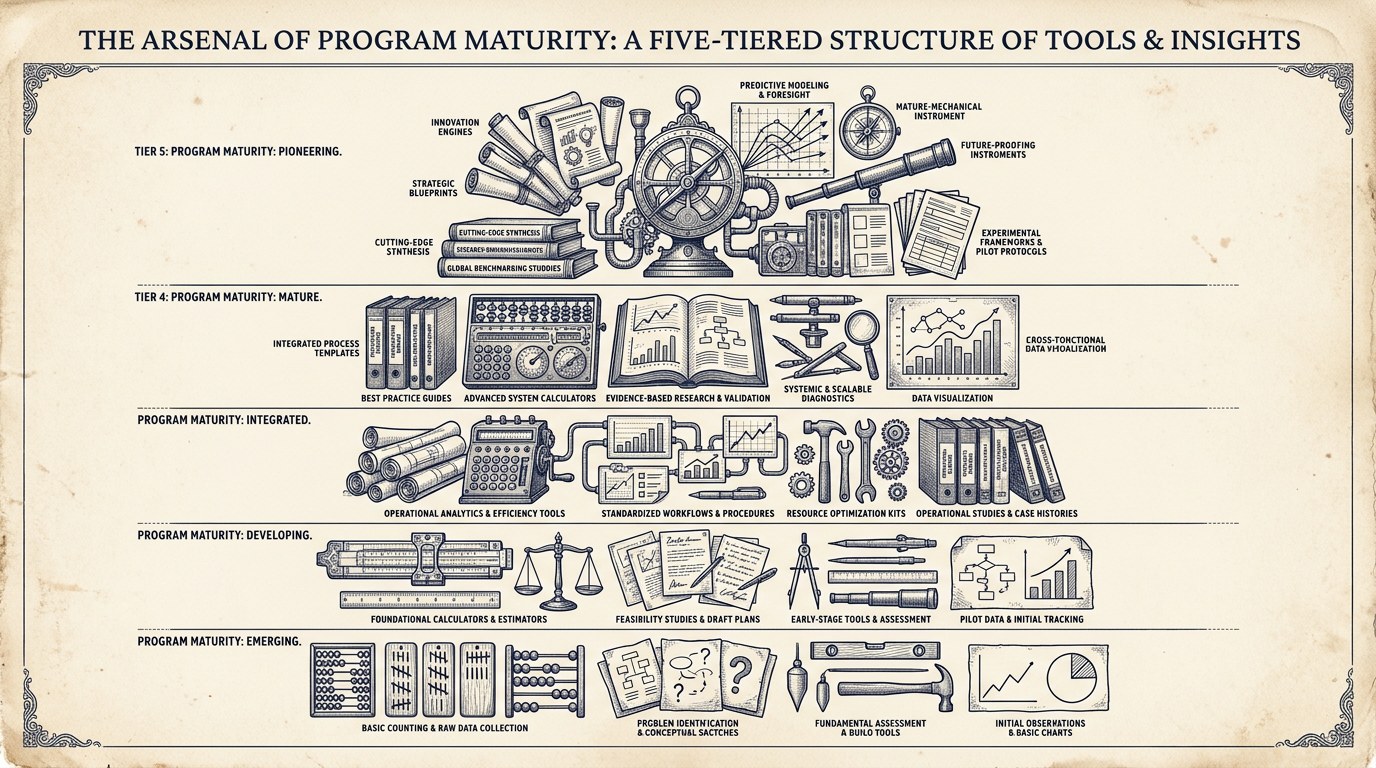
The framework most useful for B2B SaaS programs is not a flat list of asset types. It is a tiered stack keyed to program maturity. Each tier sits at a different production cost, earns links at a different rate, and only justifies its investment once the program has the foundation to amplify it. The Ahrefs taxonomy lists six types of assets in any order. The stack below ranks them by when to build each one.
Tier 1, definitional and category content (Foundation, DR under 40)
Definitional guides on category-defining terms are the cheapest linkable asset class to produce and the highest-volume in raw output. Production cost typically lands at $500 to $1,500 per asset. Each asset earns 20 to 80 referring domains over the first two years if distributed competently. Foundation-stage programs benefit most because broad-base topical coverage is what makes higher-tier assets eligible later. Mailchimp's reference on linkable asset patterns covers the editorial standards that distinguish a citable definitional guide from a generic glossary entry.
Tier 2, industry benchmark data (Acceleration, DR 40 to 55)
Annual benchmark reports on category-specific metrics sit at the second tier. Production cost ranges from $2,000 to $8,000 per edition, mostly survey instrument design and data analysis. Each report earns 40 to 200 referring domains over the eighteen months following publication, with second and third editions earning more than the first. Acceleration-stage programs benefit because their existing topical authority gets reinforced by the data citations.
Tier 3, free tools and calculators (Compounding, DR 55 to 65)
Interactive tools and calculators are the highest engineering cost class and the highest sustained earn rate. Production cost ranges from $5,000 to $25,000 depending on tool complexity and data sources. Each tool earns 80 to 400 referring domains over three years, and unlike static assets, the citation pace does not decay. The Technotize playbook on SaaS calculators as linkable assets covers the build-versus-buy decision and the dual-scope design that earns links while also feeding the product-led growth funnel.
Tier 4, original research with proprietary data (Compounding to Authority, DR 60 plus)
Original research with proprietary data sits at the fourth tier. Production cost ranges from $10,000 to $40,000 depending on methodology and sample size. Each research piece earns 60 to 300 referring domains over twenty-four months. The Technotize guide to original research as a B2B SaaS linkable asset covers the survey design, methodology disclosure, and embargo strategy that determines whether a research piece earns industry citations or sits unread on the company blog.
Tier 5, awards and recognition programs (Authority, DR 65 plus)
Annual awards programs, top-100 lists, and category certifications sit at the fifth tier. The production cost is ongoing rather than per-asset: roughly $5,000 to $15,000 per year for a credible program. Earn rates accumulate slowly but indefinitely. A three-year-old awards program in a defensible category earns 150 to 600 referring domains across its lifetime. Authority-stage programs are the only ones with the brand standing to make the recognition matter.
04Asset-program fit, matching the tier to your DR and team
Two variables determine which tier a program should invest in first. The first is current domain rating, which proxies for the program's foundational authority and the credibility of any asset attached to its name. The second is team capacity, specifically whether the program has engineering or research resources beyond marketing-only headcount. Most underperforming asset investments fail this fit test.
A program at DR 30 with a marketing-only team should produce three to five definitional guides per quarter, not one expensive calculator. The calculator will earn fewer links because the supporting brand authority is not yet there to amplify it. A program at DR 55 with in-house engineering should not be producing definitional content. They should be building tools or shipping benchmark data, which will earn three to five times the referring domains per dollar at that authority level.
Workwize as a worked example
When Technotize took over the Workwize SEO program in mid-2024, the site sat at DR 25 with twelve referring domains. The team capacity question pointed clearly at Tier 1 work: definitional guides on remote-work-equipment category terms. We produced sixteen definitional guides in the first nine months. Eight months in, with DR climbing past 40, we moved up the stack to a quarterly benchmark study on remote IT spend patterns. By month eighteen, with DR past 55, the program could justify a free tool, and the equipment-cost calculator we shipped became the highest single-asset earner across the engagement. DR closed at 71 in May 2026 across the twenty-two-month window.
05Production planning that ships on cadence
The discipline that separates programs producing linkable assets from programs talking about producing linkable assets is calendar enforcement. Most programs fail at this stage because asset production gets crowded out by reactive work: feature launches, executive content, sales enablement. The fix is treating linkable asset production as a separate function with its own quarterly OKRs.
The production rhythm we run inside engagements has three components. A quarterly asset commitment, set at the start of each quarter with explicit author assignments and ship dates. A monthly progress review where each asset gets a quality scorecard before it moves toward distribution. And an annual format review where the previous year's earned-link data informs whether each format gets a second edition.
Annual recurring formats earn more than one-off projects
The single highest-ROI pattern in B2B SaaS linkable assets is the annual recurring format. An annual industry benchmark in its third edition earns three to five times the cumulative referring domains of three separate one-off studies on adjacent topics. The reason is simple: publications that cited the first edition cite the second by default, and the third edition has compounded both audiences. Our free tools as linkable assets playbook covers the related pattern for tool refreshes versus tool launches.
06Distribution, the 60/40 budget rule most teams reverse
The single most consistent mistake across the twenty-three B2B SaaS programs Technotize has audited or run since 2024 is the production-to-distribution budget allocation. The default allocation that produces the best results sits at roughly sixty percent on production, forty percent on distribution. The allocation most programs actually run sits closer to eighty on production, twenty on distribution. The reallocation alone, with no change to asset quality, produces two to three times the referring domains from the same total budget.
The distribution budget covers four line items. Editorial outreach to publications likely to cite the asset, which is the largest distribution line. Paid amplification on LinkedIn and selected industry newsletters, sized to the asset's category fit. Internal employee advocacy with named outbound goals per quarter. And ongoing content distribution through summary pieces, podcast appearances, and conference talks built around the asset.
Why the default allocation skews to production
Production feels safer because the deliverable is concrete. Distribution feels softer because the activity is contingent on response rates. Marketing leaders default to the concrete deliverable because the production line item is what gets reviewed in budget meetings. The 60/40 rule survives the budget review only when distribution gets named line items with named owners and named publications.
07Measuring linkable asset performance
Three metrics are worth tracking. The other thirty are either lagging indicators of these three or vanity statistics that distract from the budget review. Programs measuring the wrong things cancel before the right things show up.
Referring domains per asset over twenty-four months
The primary KPI is referring domains attributed to each named asset, measured monthly with a twenty-four-month rolling window. Ahrefs and Semrush both expose this data through their referring-domain history reports. The window matters because the first six months of any asset's life undercounts the eventual total by sixty to eighty percent.
Cascade citation rate
The secondary KPI is the share of referring domains that arrived without direct outreach. Ahrefs' large-scale content traffic study documents that the majority of content earns no organic traffic and therefore no citations. Programs producing assets with cascade citation rates above 40 percent have built genuinely linkable content. Below 20 percent and the asset is functionally a press-release campaign in disguise.
Time-to-first-citation
The third KPI is time-to-first-citation from a non-paid, non-related source. For B2B SaaS assets, the median window is four to nine weeks if distribution is competent. Assets that have not earned a citation by week twelve almost never recover the trajectory, and the program should redirect distribution budget toward a new asset rather than continuing to flog the old one.
08When linkable assets are the wrong investment
Three program profiles should pause linkable asset production until other foundational work matures. Investing in assets before the foundation is in place produces a budget burn pattern that looks productive on paper and earns almost nothing in citations.
Pre-foundation programs at DR under 25
A site at DR 22 with forty referring domains needs broad-base authority growth before concentration. Guest posting, digital PR, and earned editorial coverage produce the referring domain volume that makes higher-value assets earn at all. Asset investment at this stage allocates budget to a vehicle the broader program cannot yet amplify.
Programs without distribution capacity
A program with no PR function, no employee advocacy budget, and no paid amplification line item should not build expensive linkable assets. The asset will be technically excellent and operationally invisible. Guest posting outreach produces a higher per-dollar return for these programs until the distribution function exists.
Categories with no editorial outreach surface
A handful of vertical B2B SaaS categories have almost no contextually relevant publishing surface. Industries with fewer than two hundred total addressable accounts, regulated categories where editorial coverage is functionally prohibited, and product categories that exist in trade publications only. Programs in these categories produce better authority returns from industry events, certifications, and analyst-relations work than from linkable assets, and we cover the qualifying questions on our contact page.
09FAQ
What counts as a linkable asset for a B2B SaaS program specifically?
For B2B SaaS programs, a linkable asset is content that answers a question a B2B buyer or analyst has, that the citing party cannot easily produce themselves, and that contains a quote, chart, or framework that can be referenced by name. Definitional guides on category-defining terms, annual benchmark reports, free tools and calculators, original research with proprietary data, and awards programs are the five classes that work. Content that fails one of the three criteria, regardless of how well it is produced, will not earn citations at scale.
How much should a B2B SaaS program spend on linkable assets per year?
For Foundation-stage programs (DR under 40), $25,000 to $60,000 per year supports a quarterly cadence of Tier 1 assets. For Acceleration programs (DR 40 to 55), $60,000 to $150,000 supports a quarterly Tier 1 plus an annual Tier 2. For Compounding programs (DR 55 to 65), $150,000 to $400,000 supports the full stack including a Tier 3 tool. Authority programs typically run $400,000 to $1.2M per year across all five tiers.
How long does it take a linkable asset to start earning links?
The first citation typically arrives between weeks four and nine for assets with competent distribution. The earning curve peaks between months four and nine. Cumulative referring domains continue accumulating for twenty-four to forty-eight months on assets that earn at all. Programs measuring asset performance at the four-week mark are measuring before the data exists.
Which linkable asset type earns the most links?
Free interactive tools earn the highest sustained citation rate across all five tiers, but they also cost the most to produce and require the highest program authority to amplify successfully. Original research earns the highest single-asset peak in citations during the first six months but decays faster than tool-based assets. Awards programs earn the lowest per-month rate but accumulate the largest lifetime total across multi-year horizons.
Can a small B2B SaaS team produce competitive linkable assets?
Yes, at Tier 1 and Tier 2. Definitional guides and benchmark surveys can be produced by a marketing team of two to four without engineering involvement. Tier 3 (tools), Tier 4 (research at scale), and Tier 5 (awards programs) require either internal engineering capacity, a research budget that supports outsourced survey work, or both. The fit framework in Chapter 4 of this post should guide the choice.
Should we build a linkable asset before we have any link building program at all?
No. The asset is the anchor of a distribution motion, not a standalone investment. Without an outreach function, employee advocacy, or a paid amplification line item, even the best asset sits unread. Build the distribution capacity first or in parallel, then commission the asset. If you are unsure where your program sits, the qualifying conversation on our linkable assets services for B2B SaaS page is the right starting point.
This post sits inside the Linkable Assets sub-pillar under our Link Building & Digital PR pillar. Continue with the SaaS calculators playbook, the free tools playbook, or the original research playbook.