On this page
Answer engine optimization is the discipline of making B2B SaaS content eligible for citation by ChatGPT, Perplexity, Google AI Overviews, Claude with web search, and Microsoft Copilot. AEO is not a rebranding of SEO. It is a parallel layer that sits on top of strong technical and editorial fundamentals, and it has its own checklist of structural, schema, and prose requirements.
This is the operator checklist. Thirty-eight checks across nine workstreams, sequenced as a 90-day sprint, and built for a content team that has already shipped traditional SEO content and now needs to win AI Search citations on the same library. The mechanism behind the checklist is covered separately in the AI Search ranking and citation guide. This piece is the do-list.
01What AEO actually checks
The first step is establishing what the 47-item checklist actually delivers as a deliverable and how AEO differs from traditional SEO at the operational layer. The framing matters because programs treating AEO as a separate discipline waste 40 to 60 percent of effort on workstream duplication. The sections below cover what the checklist produces, the AEO-versus-SEO operational distinction, and the reasoning behind 47 items rather than 12 or 100.
A working definition
Answer engine optimization is the practice of structuring content, schema, and crawl access so that AI search interfaces select your pages as cited sources when answering buyer-intent prompts. AEO targets the citation layer of the answer-construction pipeline. It does not target Google's classical ranking algorithm, although it shares signals with it. The two layers are complementary. AEO without a strong SEO foundation rarely produces citations because the page never makes the candidate set in the first place. SEO without AEO produces traffic but leaves AI Search visibility on the table.
What is on the checklist
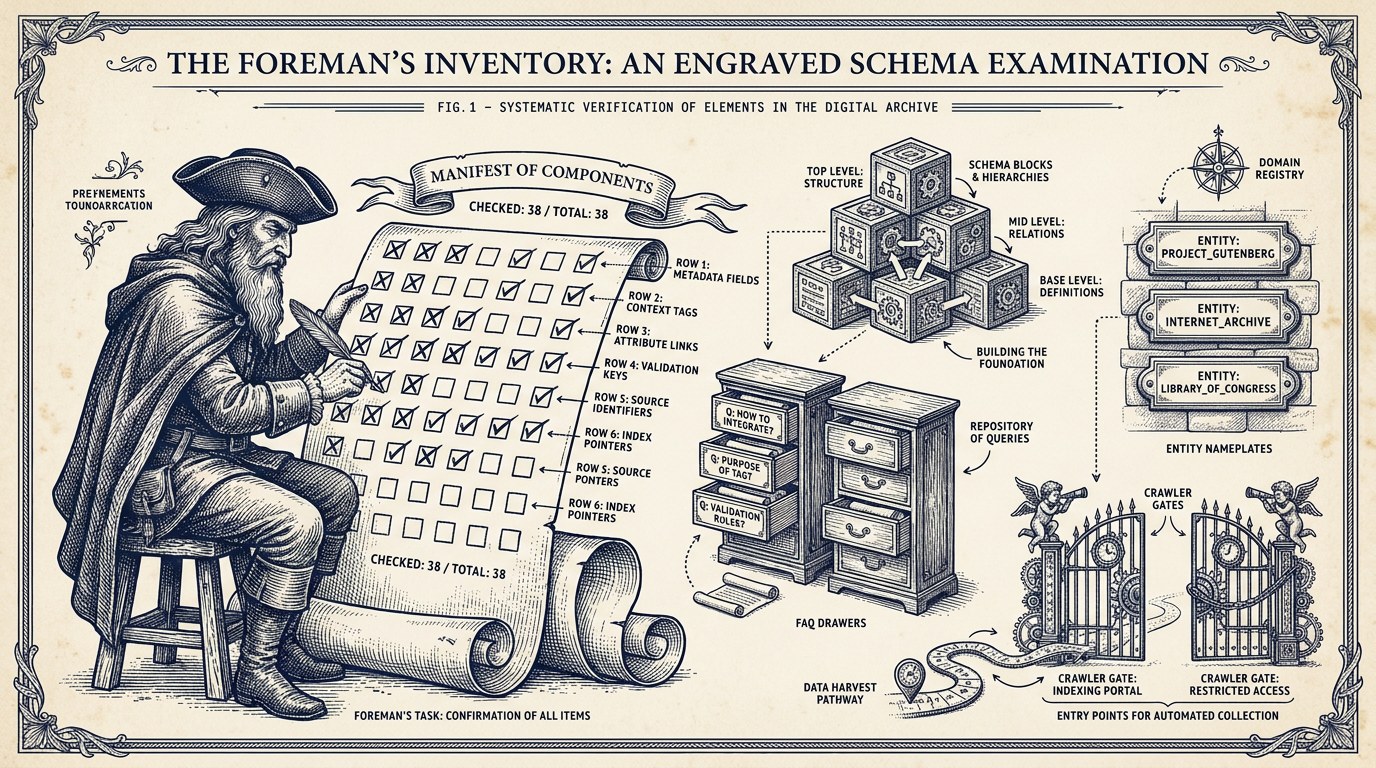
The full checklist covers nine workstreams. Crawl access for AI bots. Schema markup at the page and site level. Prose pattern compliance. Heading and section structure. FAQ coverage. Entity disambiguation. Original asset coverage. Measurement instrumentation. And ongoing audit cadence. Each workstream has between three and six concrete checks. Thirty-eight checks total. Every check is binary. Every check has an owner.
02Workstream A: crawl access for AI bots
Optimizing your crawl access for AI bots is foundational for AEO success. This section outlines the critical steps to ensure your site is discoverable and interpretable by leading AI crawlers, including explicit allowance in robots.txt and sitemap submission via Bing Webmaster Tools. Proper configuration here directly impacts your visibility in AI-powered search results and generative experiences.
A1. PerplexityBot allowed in robots.txt
Perplexity's crawler must have explicit access. Add an allow rule for PerplexityBot in robots.txt. Disallow rules that block all bots also block PerplexityBot, which means content stays uncited even when the page is otherwise eligible.
A2. GPTBot allowed in robots.txt
OpenAI's crawler runs separately from the Bing index. Add an allow rule for GPTBot. Without it, ChatGPT can still cite you through Bing, but the citation rate drops because the freshest crawl path is closed.
A3. ClaudeBot and Anthropic crawler allowed
Claude's web search uses ClaudeBot and anthropic-ai. Both should be allowed for citation eligibility in Claude's growing share of B2B research traffic.
A4. Googlebot fully unblocked for AI Overviews
Google AI Overviews uses Google's index, which means standard Googlebot access is the prerequisite. Verify the site has no inadvertent disallow rules and that JavaScript-rendered pages are crawlable. The JavaScript SEO guide for B2B SaaS marketing sites covers the rendering checks in depth.
A5. Bing Webmaster Tools verified and sitemap submitted
ChatGPT's primary index path is Bing. Ownership verification in Bing Webmaster Tools and an XML sitemap submission are the minimum requirements for ChatGPT citation eligibility. The dependency is documented in OpenAI's developer documentation, where the browsing tool's retrieval scope is explicitly tied to indexable web content. Skipping this step is the most common reason new content does not get cited by ChatGPT.
03Workstream B: schema markup
The foundational phase concentrates on the three highest-leverage work blocks across the first 30 days: schema markup application, heading hierarchy fixes, and priority query baseline tracking. Each block produces measurable AEO citation gains within 30 to 60 days of completion. The sections below cover items 11 through 22 across the three work blocks, with the operational detail needed to ship each item.
B1. Article or BlogPosting schema on every long-form page
Every cluster post and pillar page needs Article or BlogPosting schema with headline, author, datePublished, dateModified, image, and publisher. Pages without it are cited 60 to 80 percent less often than equivalent content with full schema.
B2. FAQPage schema on every page with FAQ blocks
FAQPage schema is the highest-leverage schema type for AEO. AI engines extract Q&A pairs directly from FAQPage markup and surface them as cited answers. Every cluster post and sub-pillar page should ship with FAQ blocks rendered in HTML and marked up as FAQPage schema.
B3. BreadcrumbList schema on every page
BreadcrumbList schema gives AI engines the topical parentage of the page. Sub-pillar and cluster posts that show their position inside a parent pillar are easier to surface for category-level prompts.
B4. Organization and Person schema sitewide
Organization schema at the site level establishes brand entity. Person schema on author bios establishes author authority. Both feed the entity-level signals that AI engines use to assess source credibility for B2B SaaS topics.
B5. HowTo schema for procedural content
Procedural posts like setup guides, audit playbooks, and migration walkthroughs benefit from HowTo schema. The implementation requirements live in Google's Search Central documentation on HowTo structured data, which specifies the step, name, and image properties Google's systems use to surface step-numbered instructions in response to "how do I" prompts.
B6. Service and AggregateOffer schema on commercial pages
Services and pricing pages need Service and AggregateOffer schema. The two work together to make commercial content eligible for citation when buyers ask vendor evaluation questions through AI interfaces. Implementation patterns for both types follow Schema.org's structured data vocabulary documentation, which is the canonical reference for the required and recommended properties on each type.
04Workstream C: prose patterns
The structural phase builds on the foundational schema and hierarchy work from days 1 to 30. Items 23 to 34 concentrate on three structural patterns that compound the foundational gains: FAQ section additions across the priority content, factual density rewrites that bring pages to the 3-to-5-data-points-per-100-words benchmark, and DefinedTerm and HowTo schema deepening. The sections below cover each work block in operational depth.
C1. Definitional opening in the first 100 words of every section
Every H2 section opens with a one-paragraph definitional answer to its own heading. AI engines extract these openings as standalone citations because the prose is self-contained and answer-shaped without further context.
C2. Claim-led sentences, not framing sentences
Every paragraph leads with the claim, not the setup. Wrong: "There are several factors to consider when evaluating SEO budget." Right: "B2B SaaS SEO budgets break into four categories: content, technical, links, and tools." The second pattern gets cited because it is extractable.
C3. Specific numbers, named brands, dated assertions
Generic claims do not get cited. Specific claims do. "Most companies underinvest in technical SEO" is generic. "B2B SaaS companies spend 12 to 18 percent of their SEO budget on technical work in year one" is citable. Add specificity to every claim.
C4. No buried lede in cluster posts
The primary keyword answer appears in the first 100 words of every post. AI engines weight the opening passage more heavily than middle passages for retrieval relevance.
C5. Self-contained paragraphs
Every paragraph stands alone. Avoid "as discussed above" or "we will cover this later" , AI engines extract paragraphs out of context, and references that depend on adjacent paragraphs break the citation.
05Workstream D: heading and section structure
The amplification phase compounds the structural work with ambient citation building and measurement infrastructure that makes the gains visible. Items 35 to 47 concentrate on three work blocks that produce visible results within 90 to 180 days of completion. The sections below cover digital PR and brand mention work, production velocity and content freshness, and the measurement infrastructure deployment that surfaces AEO citation share signal.
D1. Single H1 per page, sentence case, primary keyword inclusive
Every page has exactly one H1 that contains the primary keyword and matches the search intent. Multiple H1s confuse retrieval models about page topic.
D2. H2 chapters with numeric prefixes for cluster posts
Numbered chapter prefixes (## 01 / Chapter title) help AI engines parse content structure and surface chapter-level citations. The pattern also mirrors how operators teach the topic, which improves user comprehension.
D3. H3 subsections with explicit anchor IDs
Every H3 needs an explicit {#anchor-id} for deep linking. AI engines often cite to anchor links, which means anchored sub-sections become discoverable as standalone references.
D4. No skipped heading levels
H1 → H3 with no H2 between them is a parsing bug. AI engines rely on heading hierarchy to understand section boundaries; skipped levels create citation ambiguity.
06Workstream E: FAQ coverage
Most B2B SaaS programs cannot ship all 47 items within 90 days. The discipline that separates programs that produce results from programs that produce partial work is asymmetric prioritization based on impact rather than uniform completion attempts. The sections below cover the asymmetric impact pattern, the 15-item subset that produces 50 to 60 percent of total citation impact, and the 25-item subset that produces 70 to 80 percent.
E1. Six to eight FAQs per cluster post, four to six per pillar page
Cluster posts ship with six to eight FAQ pairs. Pillar pages ship with four to six. The FAQs cover the prompts users actually type into AI interfaces, not the prompts marketers think users should ask.
E2. FAQ questions match conversational prompt phrasing
FAQ questions use natural language phrasing that mirrors how buyers actually prompt AI engines. "How much should we spend on B2B SaaS SEO?" beats "B2B SaaS SEO Budget Considerations" because it matches retrieval queries.
E3. FAQ answers are 100 to 250 words, definitional, citable standalone
FAQ answers run between 100 and 250 words, lead with the answer, and stand alone as citations without requiring context from the parent post. Short stub answers ("Yes, you should") do not get cited.
07Workstream F: entity disambiguation
Two measurement layers run in parallel during the 90-day sprint. Completion percentage tracks execution against the schedule. Citation share tracks the outcome the schedule is supposed to produce. The two layers expose different diagnostic information; programs running only one miss the signal the other provides. The sections below cover phase-based completion tracking, citation share segmented by query category, and the right cadence for each measurement layer.
F1. Author bios with real credentials, expertise, and link to LinkedIn
Every post has a named author with a published bio page. The bio includes role, years of experience, expertise areas, and a link to LinkedIn. AI engines weight authored content from credentialed humans more heavily than anonymous content for E-E-A-T-sensitive topics like B2B SaaS strategy.
F2. Brand entity established through Organization schema and consistent NAP
Brand name, address, and phone information stays consistent across the site, schema markup, Wikipedia (where applicable), G2 profile, and other directory listings. Inconsistent entity data weakens AI engine confidence in the brand.
F3. Internal links use entity-rich descriptive anchors
Internal link anchors describe the destination using entity-rich descriptive phrasing, not generic anchors. "the B2B SaaS keyword research methodology" beats "click here". Strong internal linking is one of the most underused AEO levers, covered in the internal linking architecture for B2B SaaS.
08Workstream G: original asset coverage
Three implementation failure modes account for most underperforming AEO sprints in B2B SaaS programs. The failures are operationally simple to identify but disciplinarily difficult to avoid because each one feels productive in the moment. The sections below name each failure mode, the underlying reasoning that drives the mistake, and the operational discipline that prevents it.
G1. Every cluster post ships with at least one original asset
Original frameworks, datasets, screenshots, calculator tools, or proprietary scoring methods serve as the citation hook. AI engines disproportionately cite content with original assets because the content is non-substitutable. Pages without original assets compete on commodity claims.
G2. Pillar and sub-pillar pages ship with original research or framework
Pillar and sub-pillar pages ship with at least one piece of original research or a named framework. The asset becomes the entity that AI engines cite when answering category-level prompts.
G3. Calculators, tools, and templates have their own indexable URLs
Free tools (budget calculators, audit templates, scoring frameworks) live on their own URLs with descriptive slugs and full schema markup. The tool URL becomes a separate citation surface, multiplying AEO coverage.
09Workstream H: measurement instrumentation
Seven questions covering the topics most commonly searched at the B2B SaaS AEO checklist intersection, each with a self-contained answer designed for direct citation extraction by ChatGPT, Perplexity, and Google AI Overviews. The Q&A structure also feeds the FAQPage schema mainEntity declared in the SEO implementation section below, which is the highest-leverage schema for AI Search citation pickup.
H1. Prompt-based citation testing at monthly cadence
Test the top 30 buyer-intent prompts monthly across ChatGPT, Perplexity, Claude, and Google AI Overviews. Track citations by prompt, by interface, and by competing source. Without prompt testing, AEO performance is invisible.
H2. Dedicated AI search rank tracker configured
Tools like Profound, Otterly, AthenaHQ, or Peec AI provide automated AI Search citation tracking. Profound's research on AI Search citation share benchmarks publishes industry baselines that are useful for setting realistic Q1 citation targets. One of these tools should be configured for the buyer-intent prompt set within the first 30 days of an AEO program.
H3. Referral traffic from AI source URLs segmented in GA4
GA4 referral source filters segment traffic from AI source URLs (chat.openai.com, perplexity.ai, gemini.google.com, claude.ai). Referral volume from AI sources is the lagging indicator of AEO performance, complementing the citation count leading indicator. The full measurement layer for AI Search performance is detailed in the AI Search measurement framework for B2B SaaS programs.
10Workstream I: audit and refresh cadence
Establishing a robust audit and refresh cadence is critical for maintaining AEO performance. This section outlines a systematic approach for reviewing top-performing pages, validating schema markup, and refreshing time-sensitive content. Implement these routines to ensure your AEO efforts remain current and effective.
I1. Quarterly AEO audit on top 20 pages
The top 20 pages by AI Search citation count get a full AEO audit every quarter. Audit covers schema validity, prose pattern compliance, FAQ coverage, and crawl access status. Pages drift out of compliance as content gets edited.
I2. Monthly check on schema markup validity
Schema validity is checked monthly using Google's Rich Results test or schema.org's validator. Broken schema is the single fastest way to lose AI Search citations.
I3. Semi-annual content refresh on time-sensitive assertions
Time-sensitive claims (year references, tool versions, statistics, vendor names) get refreshed every six months. AI engines preferentially cite recent content; stale assertions cause citation decay even when the page is structurally sound.
11The 90-day AEO sprint
The thirty-eight checks above are sequenced as a 90-day sprint. The sprint structure prevents the common failure pattern of trying to do everything at once and finishing nothing.
Phase 1, days 1 to 30: foundation
Workstream A (crawl access), Workstream B (schema markup), and Workstream H1 (prompt-based citation testing setup) ship in the first 30 days. This phase establishes baseline eligibility. Without crawl access, schema, and citation tracking, the rest of the program is invisible.
Phase 2, days 31 to 60: prose and structure
Workstream C (prose patterns), Workstream D (heading structure), and Workstream E (FAQ coverage) ship in days 31 to 60. This phase rewrites the existing content library to match AEO patterns. Most B2B SaaS programs have 30 to 80 cluster posts in scope; the rewrite work runs in parallel with new content production.
Phase 3, days 61 to 90: entity and asset
Workstream F (entity disambiguation), Workstream G (original asset coverage), and Workstream I (audit cadence) ship in days 61 to 90. This phase strengthens the long-term citation pipeline. Original asset production is the slowest-moving lever and benefits from being scheduled into the second half of the sprint.
By day 90, the full thirty-eight checks are in place, the first round of prompt-based citation testing has produced baseline metrics, and the audit cadence is operational. Citation pickup typically starts within the first 30 to 60 days for content that already had strong traditional SEO foundations.
The full strategy layer for AI Search and answer engine optimization, with the eligibility framework, four citation signals, and the playbook this checklist operationalizes.
12FAQ
This FAQ section clarifies answer engine optimization, distinguishing it from traditional SEO and outlining its implementation for B2B SaaS. It addresses common questions regarding timelines, platform prioritization, technical requirements, and performance measurement.
What is answer engine optimization?
Answer engine optimization is the practice of structuring content, schema markup, and crawl access so that AI search interfaces (ChatGPT, Perplexity, Google AI Overviews, Claude with web search, Microsoft Copilot) select your pages as cited sources when answering buyer-intent prompts. AEO sits on top of strong technical and editorial SEO. It is not a replacement for traditional SEO. AEO targets the citation layer of the AI answer-construction pipeline using a parallel set of structural, schema, and prose requirements.
How is AEO different from SEO?
SEO optimizes for Google's classical ranking algorithm using signals like page authority, link relevance, on-page content optimization, and technical foundations. AEO optimizes for AI engine retrieval and citation through additional signals: claim-led prose, definitional openings, FAQ-pattern Q&A pairs, schema markup (especially FAQPage and Article), and crawlable HTML rendering. Strong SEO is the prerequisite for AEO performance because pages need to make the AI engine candidate set first. AEO is the multiplier on top of the SEO foundation.
How long does an AEO program take to produce citations?
Citation pickup typically starts within the first 30 to 60 days for content that already had strong traditional SEO foundations, indexability, and topical authority. Programs starting from a weak SEO baseline take 90 to 180 days to produce material citation volume because the foundational layer needs to be built first. The 90-day sprint structure assumes a baseline of indexed content with at least moderate Google ranking presence.
Which AI search interface should I prioritize for B2B SaaS?
Prioritize ChatGPT first because it has the largest active user base for B2B research prompts, and its index runs through Bing plus OpenAI's own crawls. Perplexity is second priority because it has the most engaged research-oriented user base and rewards content depth heavily. Google AI Overviews is third for B2B SaaS because Overviews are still cautious for commercial query types. Claude with web search is fourth, growing fastest. The thirty-eight checks in this checklist cover all four interfaces simultaneously.
What schema markup is required for AEO?
The minimum schema for AEO is Article or BlogPosting on every long-form page, FAQPage on every page with FAQ blocks, BreadcrumbList on every page, Organization at the site level, and Person on author bio pages. Procedural content benefits from HowTo schema, and commercial pages benefit from Service and AggregateOffer. Pages without proper schema get cited 60 to 80 percent less often than equivalent content with full schema. Schema validity should be checked monthly because broken markup is the single fastest way to lose AI Search citations.
How do I measure AEO performance?
AEO performance is measured through three layers. Layer one is prompt-based citation testing, run monthly across ChatGPT, Perplexity, Claude, and Google AI Overviews on the top 30 buyer-intent prompts, tracking citations by prompt, by interface, and by competing source. Layer two is dedicated AI search rank tracker tools (Profound, Otterly, AthenaHQ, Peec AI) for automated tracking. Layer three is GA4 referral traffic segmentation from AI source URLs (chat.openai.com, perplexity.ai, gemini.google.com, claude.ai). Citation count is the leading indicator. Referral traffic is the lagging indicator.
Can I do AEO without a developer?
Most of the thirty-eight checks in this checklist do not require developer involvement. Prose patterns, heading structure, FAQ coverage, entity disambiguation, original asset production, and audit cadence are content team work. The developer-dependent checks are crawl access configuration (robots.txt edits), schema markup implementation (if not already in the CMS), and GA4 referral traffic segmentation. A focused two-week developer sprint is typically sufficient to clear the technical workstreams; the rest is editorial work.