On this page
Here is the uncomfortable truth about this search result: almost every list on it was written by an enterprise SEO agency, and several rank themselves first on scoring rubrics they grade themselves. We are not going to pretend to be different in the first respect. Technotize runs our enterprise SEO practice for B2B software companies, this is our list, and we sit at the top of it.
What we changed is the evidence standard. Every agency below, ours included, is judged the way an RFP committee would judge it: verified client work with the source of every claim named, demonstrated niche expertise, and honest fit notes about who should not hire them. A rubric you grade yourself is an adjective wearing decimals; a named engagement someone else can check is evidence, and enterprise buyers have seen enough of the first kind. What follows: the eleven firms worth your RFP, the questions that expose the rest, real cost ranges, and where AI answers now move the finish line.
01How we judged this list
Method first, names second, because the method is the only defense a self-published ranking has. Three things below: where the enterprise line actually sits, the tests every entry passed, and what counts as evidence on this page.
What makes SEO enterprise in the first place
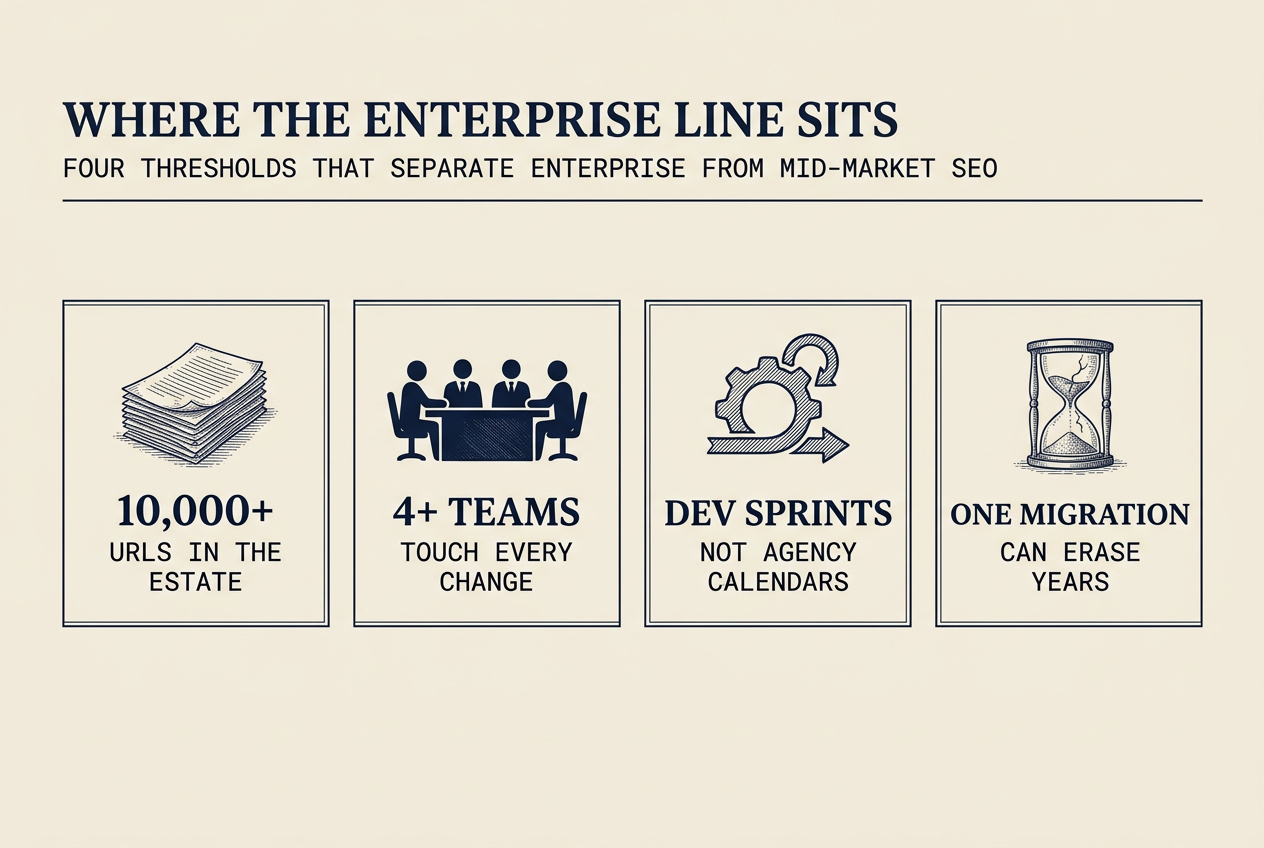
The label gets stapled onto anything with a five-figure invoice, so draw the line properly. SEO becomes enterprise when the URL estate passes roughly 10,000 pages, when changes route through four or more internal teams, engineering, content, legal, brand, when work ships on development sprint cycles rather than on the agency's calendar, and when a single botched migration or hreflang decision can erase years of equity. At that scale the job is prioritization, coordination, and damage prevention as much as optimization. An agency that has never argued a ticket through a crowded sprint backlog, or carried a migration that went sideways and lived to document it, has not done enterprise SEO, whatever the deck says.
The tests every entry passed
Four filters produced these eleven. Named clients at genuine scale, on the record, not silhouetted logos. Demonstrated process for scale: migration history, dev-team fluency, and reporting that survives a CFO. Niche depth a buyer can interrogate: which enterprise categories, which platforms, which migration classes, answered specifically by enterprise SEO experts on the record. And claims that survive checking: where a firm's numbers appear below, we name whether they come from its own materials, third-party reporting, or our index pull.
What counts as evidence here
Lists of enterprise SEO firms love scores. Technical, nine. Content, eight. Totals out of fifty, graded by the seller. We drafted a version of this page with a data column instead, each agency's own site traffic, and killed it before publishing, because the best enterprise operators sell through rosters and relationships rather than their own blogs, and a column that punishes Terakeet for not blogging measures the wrong thing. So the standard here is the one your procurement team already uses: verified work, with the source of every claim named inline, the agency's own materials, public record, third-party reporting, or a client-approved case page, plus niche depth and honest fit notes. Where a claim could not be verified, it is not on this page.
02The 11 best enterprise SEO agencies
The order tracks the buyer we serve, an enterprise software company shortlisting for pipeline, and the honest answer to who belongs where changes with your stack, team, and category. The enterprise SEO companies below split into full programs, specialist engines, and senior consultancies; the table tells you which is which, and our SaaS-wide agency comparison covers the tier below this one.
| Agency | Best for | Model | Verified enterprise work (source) |
|---|---|---|---|
| Technotize | Enterprise B2B SaaS measured in pipeline | Full program: technical, content, authority, AI | Workwize: 28 to 111 MQLs, $1.16M peak monthly pipeline (case page) |
| Terakeet | Fortune-scale brands, owned-asset strategy | Enterprise-only managed program | Fortune-scale owned-asset programs (public roster) |
| Seer Interactive | Analytics-heavy organizations | SEO + data warehouse integration | 20+ years, hundreds of brands; analytics practice (public record) |
| Siege Media | Content and links as one enterprise engine | Content-led SEO + digital PR | Instacart: 34,000+ LLM citations (published case) |
| Directive | B2B SaaS tied to CRM revenue | SEO inside a GTM program | CRM-attributed B2B SaaS programs (published cases) |
| WebFX | Scale, tooling, and published pricing | Full-service + proprietary platform | Published pricing; proprietary platform at scale (own site) |
| First Page Sage | Thought-leadership content programs | Editorial SEO, published fee schedule | Logitech, Verizon, Salesforce roster (own materials) |
| iPullRank | The hardest technical problems | Technical + AI search consultancy | Published enterprise technical casework (public record) |
| NP Digital | Global brand-name demand | Full-service enterprise packages | Global multi-market enterprise packages (own materials) |
| Powered by Search | Enterprise SaaS demand generation | SEO + RevOps integration | 150+ B2B tech brands incl. VMware, Elastic (SeoProfy) |
| Previsible | Senior counsel without an agency wrapper | Consultant collective | Founders ran SEO at eBay, Searchmetrics (public record) |
Source named per claim: client-approved case pages, provider materials, public record, or third-party reviews.
1. Technotize
 Technotizetechnotize.io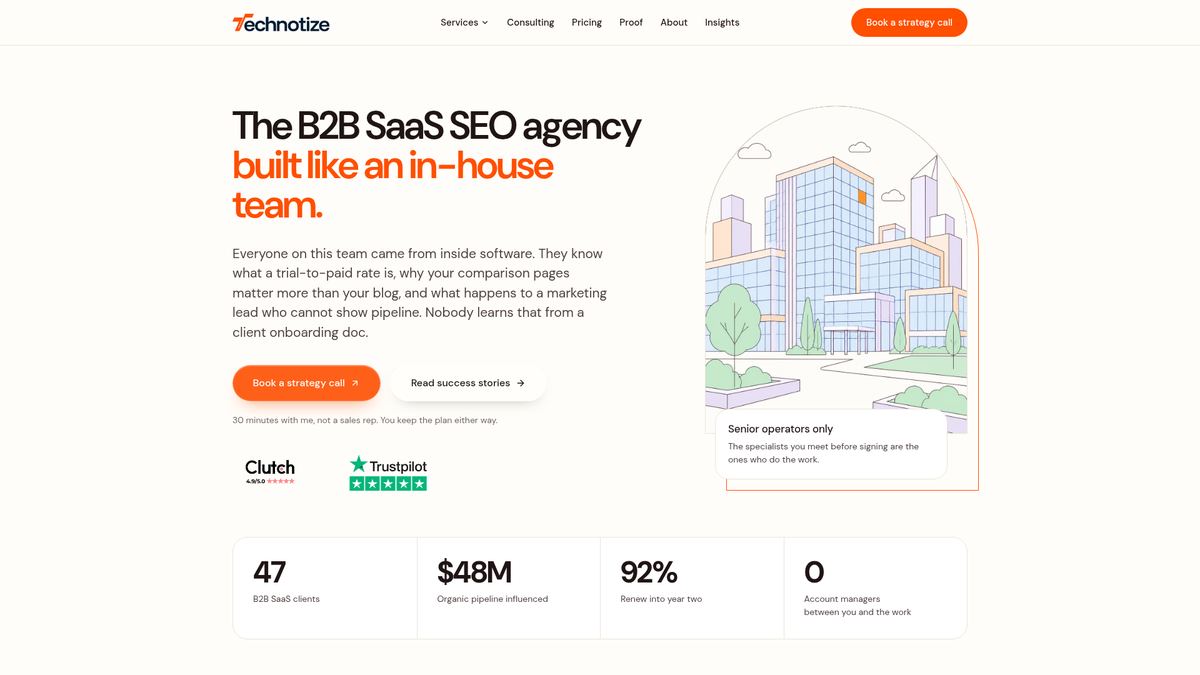
Start with the evidence, since we demand it of everyone else on this page. Workwize, a multi-country IT asset platform, ran 22 months with us to 13,420 monthly organic sessions, marketing-qualified leads up 28 to 111 a month, and organic inbound peaking at $1.16M in monthly pipeline, documented to procurement standard. Da Vinci, a cloud warehouse system serving 3PLs with a place in Gartner's Midmarket Quadrant, multiplied organic 25 times and drew 74 AI citations. The program covers what the enterprise line demands: technical work at estate scale, content operations, authority building, and per-platform AI measurement, run for B2B SaaS exclusively. Best for enterprise software companies that want the engagement measured in pipeline and are willing to check our math. Judge us against the standard this page applies: named work, named sources, and fit notes honest enough to send you elsewhere.
2. Terakeet
The pure-play at national scale: enterprise is not Terakeet's upper tier, it is the only tier. The firm builds what it calls owned-asset strategies for Fortune-scale consumer and B2B brands, treating a company's own pages as the media channel and organic as the distribution. Engagements are large, senior-staffed, and built for organizations where brand risk vetoes shortcuts. It sells through enterprise relationships and a public roster rather than inbound content, which is what you should expect at this tier. Best for household-name brands that need a partner already fluent in legal review, brand governance, and board-level reporting.
3. Seer Interactive
The analytics house. Seer's differentiation is the data layer under the SEO: warehouse-level integration, custom pipelines, and measurement built in tools enterprise BI teams already run, which makes it the natural pick when the real blocker is that nobody trusts the numbers. Two decades in, with hundreds of brands served and founder Wil Reynolds still one of the field's most cited practitioners, it carries third-party review aggregates in the high fours across a hundred-plus write-ups. Best for organizations that want SEO decisions to come out of the same data stack as every other channel.
4. Siege Media
 Siege Mediasiegemedia.com
The content engine at enterprise grade, and a firm whose own roundup ranks on this exact search result, which tells you it competes where it sells. Siege pairs editorial production with design and digital PR so assets earn links on merit, and its published Instacart case reports blog traffic value growth of $73,000 alongside more than 34,000 LLM citations, per its own materials. Independent reviews place most of its enterprise engagements at $10,000 to $25,000 and up monthly. We compared the link building agency market it also plays in separately. Best for enterprises that want content, design, and authority produced as one integrated motion.
5. Directive
 Directivedirectiveconsulting.com
The revenue-attribution pick for software. Directive runs SEO inside a broader B2B go-to-market program and connects the work to CRM pipeline rather than traffic reports, which is precisely the reporting language enterprise SaaS marketing leaders answer to. The trade-off is philosophical: you are buying a demand program with SEO inside it, not an SEO specialist with blinders on. The firm publishes constantly in its category, and its cases are written in the same revenue grammar it reports in. Best for funded and public software companies that need organic defended in revenue terms every quarter.
6. WebFX
The scale operator. WebFX brings the largest delivery machine on this list, a proprietary platform in MarketingCloudFX for attribution and reporting, and the rarest enterprise trait of all: pricing published openly on its site. That combination suits organizations that want process, tooling, and predictable procurement more than a boutique's senior hours. The published pricing is the tell: an operation confident its process survives being compared line by line. Best for enterprises that value operational maturity, transparent pricing, and one vendor able to staff everything.
7. First Page Sage
 First Page Sagefirstpagesage.com
The thought-leadership editorial model is the product, and the roster is the demo: Logitech, Verizon, and Salesforce appear in its own enterprise materials. First Page Sage publishes its fee schedule openly and runs its own agency rankings as part of that editorial engine, so apply this list's standard to it exactly as we applied it to ourselves. Best for enterprises whose growth thesis is senior-authored content at volume, in categories where expertise on the page is the ranking weapon.
8. iPullRank
 iPullRankipullrank.com
The technical bench for the problems that frighten other agencies: JavaScript rendering at estate scale, migrations with real stakes, crawl and indexation on six-figure URL counts, and an early, serious generative AI search practice. Founder Mike King has spent a decade publishing the field's hardest technical material, and the published casework under the relevance-engineering banner is cited by the field itself, which is what a consultancy selling depth looks like on the record. Best for enterprises whose organic ceiling is an engineering problem, and for in-house teams that need a heavyweight second opinion.
9. NP Digital
 NP Digitalnpdigital.com
The brand-name operator with global reach. NP Digital converts the demand its founder's audience generates into full-service enterprise engagements, staffed across the major markets, with packaged programs that procurement teams can compare cleanly. Best for enterprises that want an established global vendor, multi-market coverage, and the research resources a large network funds.
10. Powered by Search
The enterprise SaaS demand specialist. Operating from Toronto with a deliberately compact senior team, the firm has partnered with more than 150 B2B technology brands including VMware, Elastic, and Basecamp, per SeoProfy's 2026 review, and wires SEO into revenue operations, HubSpot infrastructure, and demand generation rather than running it as an island. Best for enterprise software companies that want organic managed by people who speak RevOps natively and will not need the funnel explained.
11. Previsible
The consultant collective. Previsible sells senior operator hours from leads who ran SEO inside genuine enterprises, its founders include eBay's former head of SEO, and the deliberately thin marketing footprint is the point: the product is the people, not a content engine. Engagements look like embedded counsel, roadmap ownership, and in-house team acceleration rather than managed delivery. Best for enterprises with execution capacity in-house that need the judgment layer, and a fit we expand on in the consultant question below.
03How to choose an enterprise SEO agency
Eleven credible options still leaves the hard part: matching one to your organization's actual constraint. The RFP questions, the flags that end evaluations, the consultant fork, and the in-house question, in that order.
Questions that belong in the RFP
Ask for a migration story that went wrong and what the firm changed afterward; scar tissue is the credential, and a portfolio of only clean launches means the hard ones are missing. Ask how they get tickets shipped when your engineering backlog is six sprints deep, because recommendations without implementation muscle are decoration at this scale. Ask which named person runs your account after the pitch team leaves the room, and for the attribution model in writing: what gets credited, in which system, reviewed by whom. Then ask for one named engagement and permission to verify it directly. Anyone selling organic growth at this tier can survive that call; the ones who cannot were selling the deck.
Red flags at enterprise scale
Guaranteed rankings, at any scale, but especially this one. A senior pitch team that hands delivery to juniors the week after signature. Scoring rubrics the seller grades itself, presented as research. Activity reporting, deliverables shipped, words published, links acquired, with no revenue column. And any firm eager to start producing before it has mapped your estate, your stakeholders, and your release process, because at enterprise scale, speed before mapping is how equity gets erased.
Enterprise SEO consultant vs agency: who fits when
An enterprise SEO consultant sells judgment; an agency sells judgment plus hands. Choose the consultant model, a Previsible-style collective or an independent operator, when you own execution capacity in-house and the gap is strategy, prioritization, or a credible voice to arbitrate internal disputes. Choose the agency when the gap includes production: content operations, technical implementation, authority building at volume. The expensive mistake is buying strategy twice, hiring an agency for delivery while a consultant relitigates its roadmap, so decide which chair is empty before filling either.
Hiring alongside an in-house team, not instead of it
Most enterprises that hire from this list already employ SEO people, and the engagements that work treat that as the design constraint. The internal team holds institutional knowledge, political capital, and platform access; the agency brings bandwidth, specialist tooling, and the outsider's license to say what insiders cannot. Split the map accordingly in the contract: who owns the roadmap, who owns implementation tickets, who fronts executive reporting. The failure mode is symmetrical, agencies that route around the internal team and internal teams that treat the agency as a threat, and how we structure enterprise engagements exists in writing precisely because this seam is where value leaks.
04What enterprise SEO costs
Numbers before adjectives. The ranges below combine what we quote and win against, the floors published by firms on this list, and independent reporting, with sources named so you can discount ours.
Retainer ranges in 2026
Credible enterprise programs run $10,000 to $50,000 and up per month, with the premium national firms above that band. The checkable points bracket it: WebFX and First Page Sage publish their pricing openly, independent reviews place Siege's typical enterprise engagements at $10,000 to $25,000 and up, and the market's own published guidance clusters expectations at nine to twelve months minimum before significant results, with successful programs commonly running eighteen to twenty-four. Anything quoted at $2,000 a month with the word enterprise attached is a mid-market package wearing a costume.
What actually drives the price
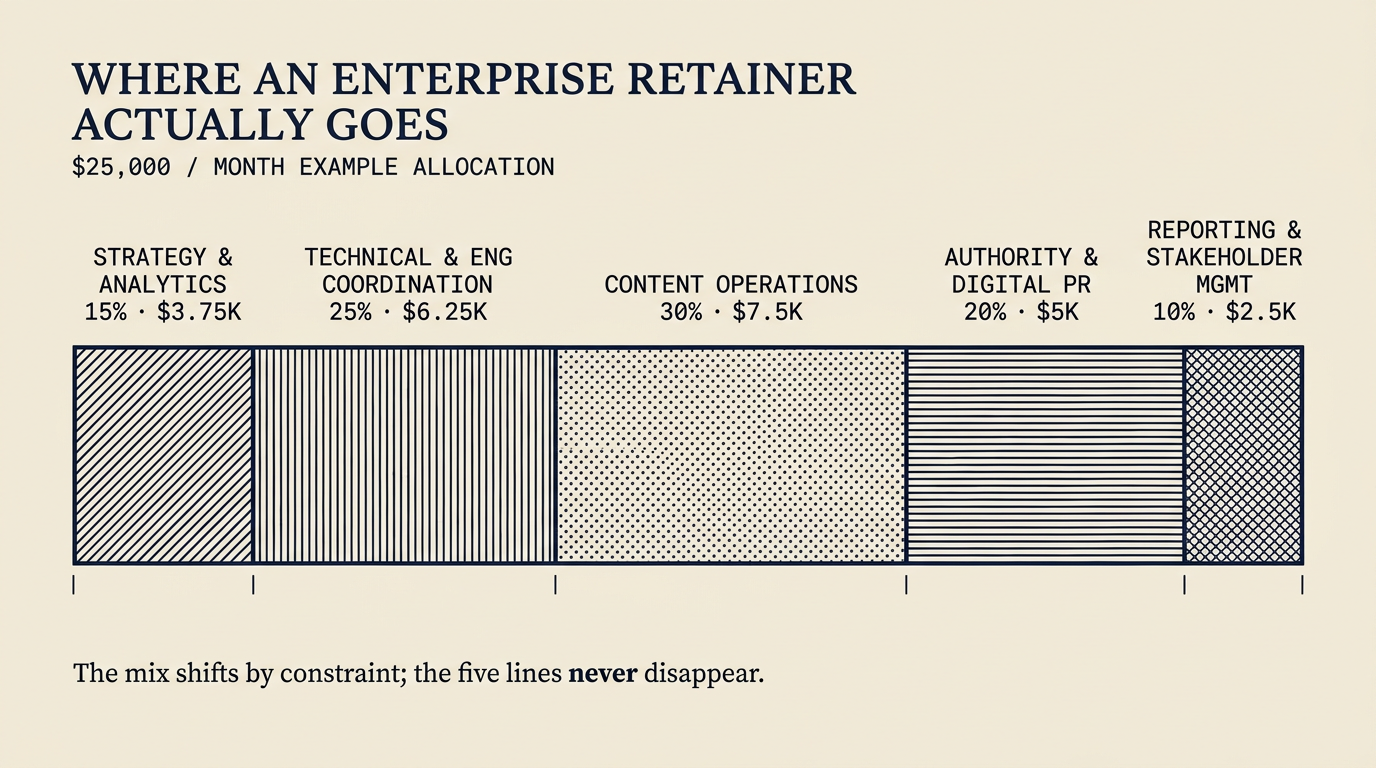
Five inputs move the invoice. Estate size, because auditing and maintaining 200,000 URLs is a different job than 8,000. Engineering coordination, the unglamorous hours spent turning recommendations into shipped tickets. Content operations, where volume with editorial standards is the single largest line. The authority program, since enterprise categories rarely move without one. And reporting depth, because at this tier the deliverable includes making the CMO's case to the CFO. Firms that cannot itemize across those five are guessing, with your budget.
When enterprise pricing is theater
Some five-figure quotes buy scale; some buy the word enterprise. The theater tells: seat-count padding, ten names on the account with two doing the work; tool licenses marked up and rebranded as proprietary platforms; and rebadged mid-market playbooks where the only thing enterprise is the invoice. The antidote is the itemization above, plus one blunt procurement question: which line items shrink if our engineering team implements everything you specify on time?
05Where AI answers change enterprise SEO
Enterprise deals were already committee-driven; AI assistants just gave every committee member a private analyst. What that does to the work, and what to measure, in three parts.
Buying committees now ask machines
Gartner's buying-journey research puts six to ten stakeholders inside a typical B2B purchase, and the buyer study Google commissioned in late 2025 found AI assistants sitting inside roughly six of ten purchase processes. Multiply those and the picture is plain: several people on every enterprise deal are privately asking machines who to shortlist, before your sales team knows the deal exists. The sources those machines cite skew toward the same earned authority the committee already respected, which is why this chapter belongs on a page about agencies rather than a page about tools.
Citation churn makes it a program, not a project
Profound's findings as reported by Fortune show cited-source turnover reaching ninety percent over time, with each model working from a mostly separate pool of sources. For an enterprise that means AI visibility is not a box to check during a quarterly sprint; it is a maintained position, like rankings were, only faster-moving. Google's optimization guide for AI in Search says the quiet part directly: the practices that earn search visibility are the ones its AI features reward, so the maintenance program is one program, not two.
What an enterprise should be tracking
Citations per platform, never blended, because assistants retrieve from different indexes and will not move together. Share of answers across the prompts a committee actually asks. AI referral traffic with its conversion rate. And description accuracy, since a machine confidently misdescribing your security posture is a sales problem wearing an SEO costume. We mapped the GEO agency market separately, and the mechanics of how language models pick their sources are documented for the technical team; the takeaway for this page is simpler: put per-platform AI reporting in the RFP now, and watch which firms flinch.
06What it looks like when it works
Two named engagements close this out, because the standard we demanded of ten other firms applies hardest to us: named client, sourced numbers, sign-off, and a curve long enough to mean something.
Workwize: 22 months to a seven-figure pipeline
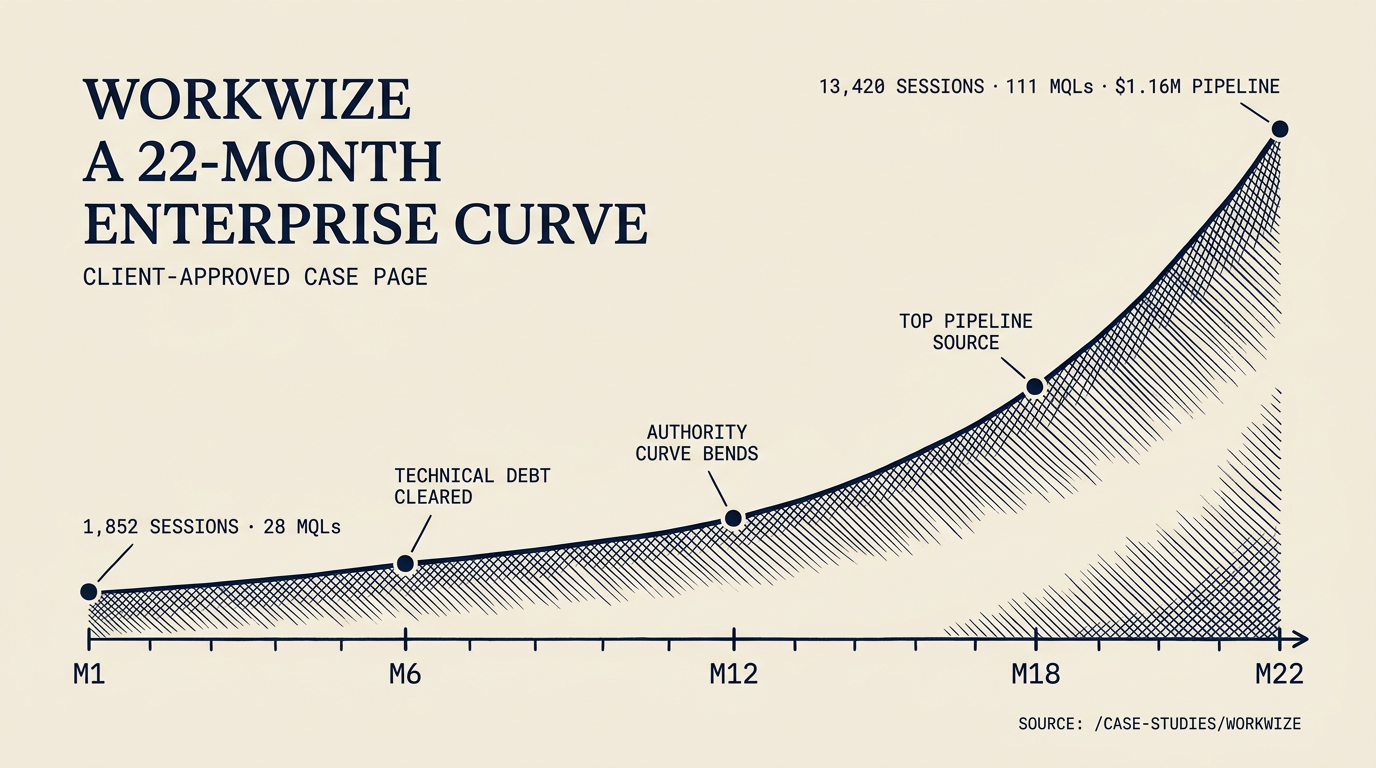
A multi-country IT asset management platform, exactly the committee-driven, procurement-heavy sale this page describes. Over 22 months, organic sessions grew 1,852 to 13,420, marketing-qualified leads from 28 to 111 a month, domain rating 27 to 71 as a case fact, and organic inbound peaked at $1.16M in monthly pipeline, with Workwize's 22-month record publishing every figure and its source. The length is the lesson: the market's own guidance says nine to twelve months minimum, and the compounding paid out in the back half.
Da Vinci: authority a Gartner category noticed
A cloud warehouse system built for third-party logistics providers, holding a place in Gartner's Midmarket Quadrant, which is enterprise credibility of the kind committees check. Eleven months took organic from 100 to 2,482 monthly sessions, domain rating 19 to 55, and the earned authority converted into 74 AI citations spread over six platforms, the newer scoreboard this page just argued for. The Da Vinci engagement documents the curve end to end, sources included, and it kept climbing after the contract closed.
07FAQ
Who is the leading enterprise SEO agency?
There is no single leader, because the category splits by constraint: Terakeet leads Fortune-scale owned-asset work, WebFX leads on operational scale, First Page Sage on editorial volume, iPullRank on technical depth, and we make the strongest case we know for enterprise B2B SaaS measured in pipeline. Distrust any list, ours included, that answers this question without asking about your stack and team first.
How much does enterprise SEO cost?
Credible programs run $10,000 to $50,000 and up per month, with published floors from firms on this list starting around the low five figures and premium national firms above the band. Expect nine to twelve months minimum before significant results per the market's own guidance, and budget for eighteen to twenty-four.
What is the best enterprise SEO company?
The same answer with different labels: agency, company, and firm describe identical services here. Match the model to your constraint, full program, specialist engine, or consultant collective, then apply the RFP questions above. The best enterprise SEO company for you is the one whose named work survives the source-checking this page just did in public.
How long does enterprise SEO take to work?
The market's published guidance clusters at nine to twelve months minimum, with successful programs running eighteen to twenty-four, and our longest documented curve took 22 months to peak at $1.16M in monthly pipeline. Early technical wins can land inside a quarter; the compounding that justifies the retainer lives in the back half.
Should we hire an enterprise SEO agency or build the team in-house?
Most enterprises that get this right do both: an internal owner for institutional knowledge, platform access, and politics, plus an external partner for bandwidth, specialist tooling, and the license to say hard things. Hire agency-only when you lack the headcount; consultant-plus-in-house when you lack only judgment; and write the roadmap, ticket, and reporting ownership into the contract either way.
Related agency and craft reads
Adjacent operator reads worth pairing with this one.
- the SaaS link building agency landscape, ranked on numbers you can check — Which link building agencies actually earn coverage worth citing for enterprise SaaS.
- the SaaS content marketing agencies judged on work you can read — The content marketing agencies whose case work survives procurement diligence.
- the generative engine optimization agencies you can actually verify — GEO agencies judged on evidence you can spot-check across ChatGPT, Perplexity, and AI Overviews.
- how GEO differs from SEO and what never changed — The operator's read on GEO vs SEO framing that enterprise buying committees now expect.