On this page
Schema markup for B2B SaaS is over-discussed and under-deployed. Every agency adds it to their checklist. Most B2B SaaS sites have it implemented inconsistently, with the wrong types, or as broken markup that quietly fails GSC's validation. The result: schema errors in Google Search Console, missed AI Search citation opportunities, rich result eligibility that fluctuates randomly because the markup keeps drifting between deployments.
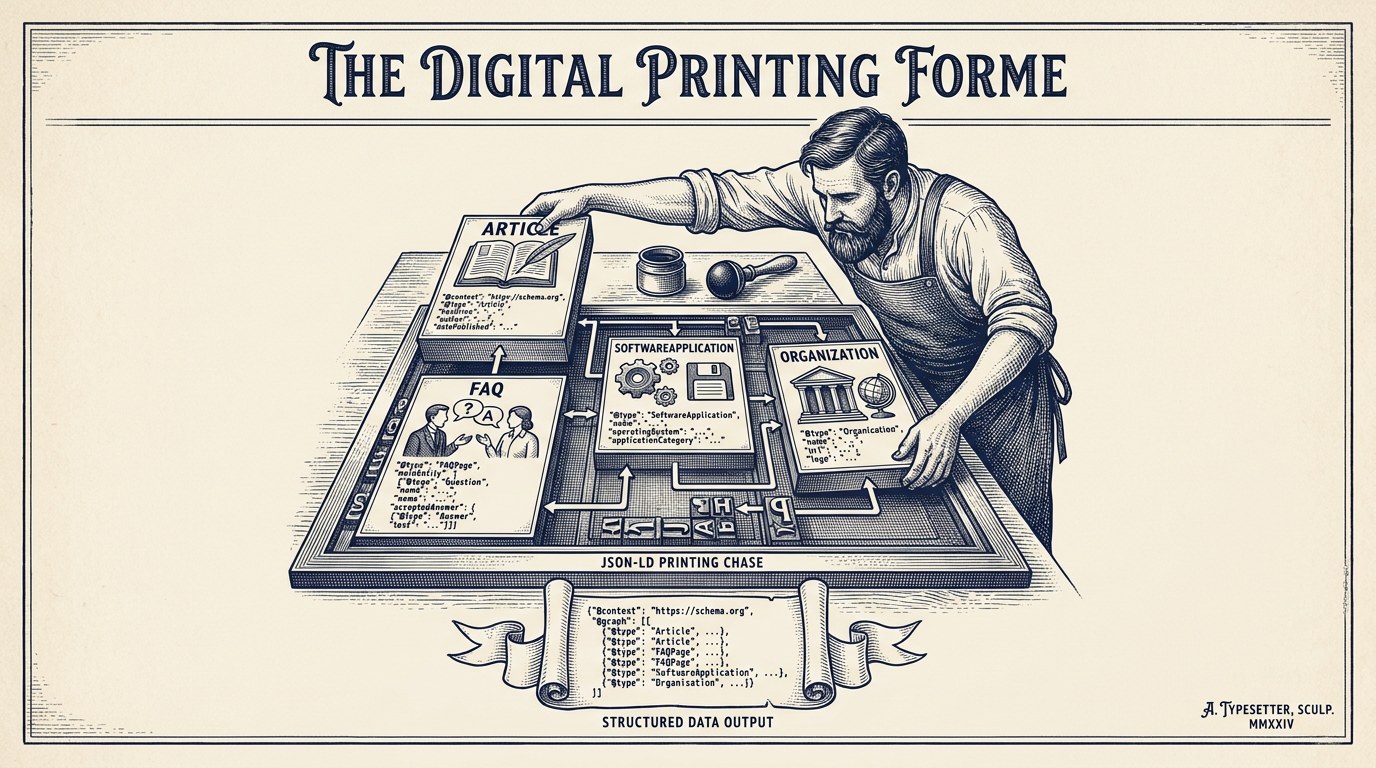
This is the practical guide. Eight schema types that matter for B2B SaaS marketing sites, concrete JSON-LD examples for each, where each goes, the deployment approach that works, and the validation discipline that prevents schema decay over time.
01The eight schema types that matter
For B2B SaaS marketing sites, eight schema types produce real value. Everything else is either niche or counterproductive.
Organization
One block, deployed on the homepage and global footer. Foundational for knowledge graph entity recognition. Establishes who you are.
WebSite
Deployed on the homepage. Enables sitelinks search box in some Google results when the site has working internal search.
Article
Every blog post, every pillar page, every sub-pillar. The single most-deployed schema on a B2B SaaS site.
FAQPage
Every page with a real FAQ section. The strongest signal for AI Search citation because AI extractors lift Q&A pairs cleanly when structured.
BreadcrumbList
Every page, not just blog posts. Reinforces hierarchical structure for both Google and AI crawlers.
Person
Every author profile page. Critical for the E-E-A-T signal.
SoftwareApplication
The product page itself. More accurate than generic Product type for B2B SaaS.
Review or AggregateRating
Conditional. Only if you have real, verifiable reviews. Otherwise skip entirely.
02Organization schema (homepage + footer)
{
  "@context": "https://schema.org",
  "@type": "Organization",
  "name": "Technotize",
  "url": "https://technotize.io",
  "logo": "https://technotize.io/assets/technotize-logo-fFWOojI5.png",
  "description": "B2B SaaS SEO agency. Senior operators only.",
  "foundingDate": "2024-10",
  "founders": [{"@type": "Person", "name": "Rizwan Khan"}],
  "contactPoint": {
    "@type": "ContactPoint",
    "contactType": "customer service",
    "email": "rizwan@technotize.io"
  },
  "sameAs": [
    "https://www.linkedin.com/company/technotize",
    "https://twitter.com/technotize"
  ]
}
The sameAs array matters more than most teams realize. Each link to a verified social profile reinforces entity disambiguation in Google's knowledge graph. Include LinkedIn (priority), Twitter/X, GitHub if relevant, Crunchbase, and any industry directory listings (G2, Capterra, etc.).
03WebSite schema (homepage only)
{
  "@context": "https://schema.org",
  "@type": "WebSite",
  "name": "Technotize",
  "url": "https://technotize.io",
  "potentialAction": {
    "@type": "SearchAction",
    "target": {
      "@type": "EntryPoint",
      "urlTemplate": "https://technotize.io/search?q={search_term_string}"
    },
    "query-input": "required name=search_term_string"
  }
}
The SearchAction block enables sitelinks search box in Google. Only include if your site has working internal search. Adding it without functional search is misleading and can be penalized.
04Article schema (every blog post and pillar)
{
  "@context": "https://schema.org",
  "@type": "Article",
  "headline": "Core Web Vitals Targets for B2B SaaS Sites in 2026",
  "description": "2026 LCP, INP, and CLS thresholds. Where to measure, the three biggest LCP killers, and the third-party widget INP problem.",
  "image": {
    "@type": "ImageObject",
    "url": "https://technotize.io/og/core-web-vitals-b2b-saas-2026.png",
    "width": 1200,
    "height": 630
  },
  "datePublished": "2026-05-15T09:00:00Z",
  "dateModified": "2026-05-15T09:00:00Z",
  "author": {
    "@type": "Person",
    "name": "Rizwan Khan",
    "url": "https://technotize.io/team/rizwan-khan",
    "jobTitle": "Founder",
    "worksFor": {"@type": "Organization", "name": "Technotize"}
  },
  "publisher": {
    "@type": "Organization",
    "name": "Technotize",
    "logo": {
      "@type": "ImageObject",
      "url": "https://technotize.io/assets/technotize-logo-fFWOojI5.png"
    }
  },
  "mainEntityOfPage": {
    "@type": "WebPage",
    "@id": "https://technotize.io/insights/core-web-vitals-b2b-saas-2026"
  }
}
Five fields that programs commonly miss or get wrong:
dateModified: must update every time the article is meaningfully refreshed. Many CMSes auto-update on minor edits, which is fine. Do not skip this.author.url: must link to the author's profile page on your site (not LinkedIn). The author profile page itself needs Person schema (covered below).image: includewidthandheight. Naked URL strings work but explicit ImageObject with dimensions is safer.mainEntityOfPage: the canonical URL of the article. Critical for self-canonicalization.publisher.logo: must be a real, accessible image URL. 600x60 minimum. PNG or SVG. Many sites have broken logo URLs in their schema and the rich results never trigger.
05FAQPage schema (every page with a real FAQ)
{
  "@context": "https://schema.org",
  "@type": "FAQPage",
  "mainEntity": [
    {
      "@type": "Question",
      "name": "How long does B2B SaaS SEO take to produce results?",
      "acceptedAnswer": {
        "@type": "Answer",
        "text": "Defensible ROI to a CFO arrives at month 14 to 16. Programs that need ROI inside 6 months are using the wrong channel."
      }
    },
    {
      "@type": "Question",
      "name": "Should we hire an SEO agency or build in-house?",
      "acceptedAnswer": {
        "@type": "Answer",
        "text": "Below $20M ARR, hire an agency. Above $25M ARR, build in-house. Between $10M and $50M ARR, run a hybrid with an in-house owner plus an agency for execution."
      }
    }
  ]
}
FAQPage is the highest-leverage schema for AI Search visibility. ChatGPT, Perplexity, Claude, and Gemini all extract Q&A pairs from FAQPage schema cleanly and frequently cite them as sources. A B2B SaaS site with comprehensive FAQPage schema deployed across its pillar pages and high-traffic blog posts measurably outperforms equivalent sites without it for AI citation.
Three rules:
- The questions and answers in the schema must match exactly what is rendered on the page. Discrepancies are penalized.
- Each answer should be self-contained (readable out of context).
- Avoid promotional language in answers. Schema is for objective information.
06BreadcrumbList schema (every page)
{
  "@context": "https://schema.org",
  "@type": "BreadcrumbList",
  "itemListElement": [
    {"@type": "ListItem", "position": 1, "name": "Home", "item": "https://technotize.io"},
    {"@type": "ListItem", "position": 2, "name": "B2B SaaS SEO", "item": "https://technotize.io/b2b-saas-seo"},
    {"@type": "ListItem", "position": 3, "name": "Technical Checklist", "item": "https://technotize.io/b2b-saas-seo/technical-seo"}
  ]
}
Cheap to deploy, consistently helpful for both rich results and AI crawlers. The breadcrumb hierarchy reinforces the site's topical structure. Match the BreadcrumbList in the schema to the visible breadcrumb on the page.
07Person schema (every author profile)
{
  "@context": "https://schema.org",
  "@type": "Person",
  "name": "Rizwan Khan",
  "url": "https://technotize.io/team/rizwan-khan",
  "image": "https://technotize.io/assets/team/rizwan-khan.jpg",
  "jobTitle": "Founder",
  "worksFor": {
    "@type": "Organization",
    "name": "Technotize",
    "url": "https://technotize.io"
  },
  "description": "Founder of Technotize. 7 years in B2B SaaS SEO.",
  "sameAs": [
    "https://www.linkedin.com/in/rizwan-khan",
    "https://twitter.com/rizwankhan"
  ],
  "knowsAbout": [
    "B2B SaaS SEO",
    "Content Strategy",
    "Technical SEO",
    "Link Building"
  ]
}
The knowsAbout field is underused and matters for AI Search. It tells the knowledge graph what topics the person is an expert in. Match these to the topics the author actually writes about on your site.
The sameAs array, like for Organization, is critical for entity disambiguation. Link to the author's verified LinkedIn at minimum. Twitter, GitHub, personal blog, and any conference speaker pages all help.
08SoftwareApplication schema (the product page)
{
  "@context": "https://schema.org",
  "@type": "SoftwareApplication",
  "name": "Technotize",
  "applicationCategory": "BusinessApplication",
  "operatingSystem": "Web",
  "offers": {
    "@type": "Offer",
    "price": "5000",
    "priceCurrency": "USD",
    "priceValidUntil": "2026-12-31"
  },
  "aggregateRating": {
    "@type": "AggregateRating",
    "ratingValue": "4.9",
    "reviewCount": "47"
  }
}
Two rules:
aggregateRatingmust reflect real, verifiable reviews. If you have G2 reviews, link them. If you have customer testimonials with names and companies, that counts. If you do not have real reviews, leave this field out.applicationCategoryshould be specific. "BusinessApplication" is acceptable. "DesignApplication," "FinanceApplication," "DeveloperApplication" are better when applicable. Avoid "OtherApplication."
09Validation discipline
Schema deployed once and never validated decays. Templates change, fields drift, dynamic content breaks. Three discipline rules:
Pre-deploy validation
Every new page type goes through Google's Rich Results Test before deploying broadly. The test catches missing required fields, syntax errors, and warnings about recommended fields.
Post-deploy monitoring
Google Search Console's Enhancements report shows schema errors after deployment. Check monthly. The errors usually emerge from template changes that nobody remembered touching the schema.
Annual schema audit
Schema requirements evolve. Once per year, re-validate every page type and check for new schema features that have been added since the last deployment.
10Common deployment mistakes
Six mistakes we see consistently on B2B SaaS sites.
- Schema deployed via Google Tag Manager. GTM injects schema after page load, which Google reads inconsistently. Deploy server-side in the HTML response.
- Author URL points to LinkedIn instead of the author's profile page on your site. The schema works but the E-E-A-T signal is weaker.
- FAQPage schema with questions and answers that do not match the visible page content. Penalized when caught.
- AggregateRating with a fabricated review count. Will trigger a manual review.
- Schema validating in Rich Results Test but appearing differently in GSC. Always check both.
- Schema not updated when the page is refreshed (
dateModifiedstale). The page looks outdated to Google.
11Part of a larger technical playbook
This article covers schema markup specifically. The full B2B SaaS technical SEO process is in our B2B SaaS technical SEO checklist. For related deep dives, see Core Web Vitals targets for B2B SaaS in 2026 and JavaScript SEO for B2B SaaS marketing sites.
Where this fits in the broader playbook
This piece sits inside the technical SEO sub-pillar, which is one chapter of our complete B2B SaaS SEO operator framework. For deeper framing on the same discipline, see how we approach technical SEO for SaaS.
Closely related reading from the same sub-pillar
- the JavaScript SEO playbook , how JS frameworks affect schema rendering.
- the CWV thresholds for 2026 , why schema changes can affect CWV.
- the internal linking playbook , how internal linking interacts with structured data.
From other corners of the program
- the optimization discipline for B2B SaaS programs , the cross-cluster discipline that compounds this work.
- the full B2B SaaS content marketing methodology , the upstream pillar this connects to.
When you're ready to put this into a program, get in touch or see the engagement options. Average response time: under 4 business hours.