
On this page
Five of the pages ranking beside this one were written by agencies that put themselves on their own list. So was this one. Technotize sells content marketing through our content marketing practice, we sit first below, and you should treat that placement with exactly the suspicion it deserves, then use what makes this category different from every other agency market: the work is public. You do not have to trust anyone's badges. You can read the actual articles.
So that is how this page judges a SaaS content marketing agency: published client work with named outcomes and the source of each claim attached, niche depth in software, and honest fit notes for who should hire someone else. The ten below cleared that bar. The thirty-minute audit further down will let you re-run the test on any agency, including us, before a single sales call.
01How we judged this list
Most rankings in this market are participants grading their own homework, and this page cannot escape that; it can only make the grading auditable. Three parts: the test this category uniquely allows, the filters every entry passed, and the definition that keeps blogging vendors off the list.
The one test this category allows: read the work
You cannot read a technical SEO program or audit a link placement negotiation from outside. You can read an article. Content is the only agency category where the work itself is public, which makes every badge, award, and testimonial on an agency site strictly worse evidence than the thing sitting one click away: the client work. This entire page is downstream of that fact. Entries were judged by reading what they shipped, checking the outcomes they publish against sources, and noting who the work would and would not fit, and you can repeat all of it without asking anyone's permission.
The tests every entry passed
Four filters. Named SaaS clients with outcomes that carry a source, the agency's published case, third-party profiles, or client-controlled data. A visible process for real expertise: subject-matter access, named writers, editorial standards, because process is what separates a content operation from a text generator with an invoice. Strategy tied to signups and pipeline rather than traffic applause. And AI-search readiness that goes deeper than adding a service line to the menu. Any SaaS content marketing firm that could not show at least three of the four did not make the page.
What counts as content marketing for SaaS
Publishing articles is not the job; the job is building an organic acquisition system. That means strategy that maps pain points, comparisons, and use cases to what buyers actually search, production with expertise inside it, optimization that keeps assets earning, and measurement that reports in trials, demos, and pipeline. The agencies below disagree about method, pain-point-first, editorial-first, research-first, and that disagreement is useful: it means you are choosing a theory of growth, not a word count. Our own content strategy layer exists as a service precisely because the mapping, not the writing, is where programs live or die.
02The 10 best SaaS content marketing agencies
Lists of the top SaaS content marketing agencies usually order by fame. This one orders by fit, for the SaaS buyer who wants content judged in pipeline, seller first and disclosed, and the verified-work column tells you what each firm has actually done, with the source of every claim named.
| Agency | Best for | Model | Verified work (source) | From |
|---|---|---|---|---|
| Technotize | B2B SaaS measured in MQLs and pipeline | Strategy, production, optimization, measurement | Workwize: 28 to 111 MQLs, $1.16M peak monthly pipeline (case page) | $4,000, published |
| Grow & Convert | Signups-first content programs | Pain Point SEO | Decade of published signup-focused casework (own materials) | Not published |
| Animalz | Enterprise-grade editorial and thought leadership | Editorial content plus AEO practice | SupportLogic 5X organic case; Zendesk, Intercom, Wistia roster | $15,000 reported |
| Omniscient Digital | Strategy-led organic programs | SEO plus content strategy | Leadership ran content at HubSpot, Shopify, Workato | Not published |
| Siege Media | Content, design, and links as one engine | Content-led SEO plus digital PR | Figma +4,125% organic; Vena +751% backlinks (published cases) | $5,000 reported |
| Campfire Labs | Research-driven thought leadership | Original research plus narrative content | Loom, Airtable, Toast, Lattice roster | Not published |
| Column Five | Multi-format: video, data viz, interactive | Embedded content partner | Instacart, Databricks, Vercel, Uber, SAP roster | $10,000 published |
| Growth Plays | Pipeline-mapped content for scale-ups | GTM-mapped content systems | Lattice, Gremlin, Calendly, LaunchDarkly roster | Not published |
| Minuttia | Specialist at a published price | SaaS-only content plus SEO | Toggl: 91 pieces, 26K clicks, 200+ conversions (published case) | $4,000 published |
| Grizzle | Technical audiences and complex products | Deep-dive technical content | Technical-SaaS specialization (independent review) | Not published |
Four of ten publish a starting price. Where a figure is marked reported, it comes from third-party reviews rather than the agency's own site. Checked August 2026.
1. Technotize
 Technotizetechnotize.io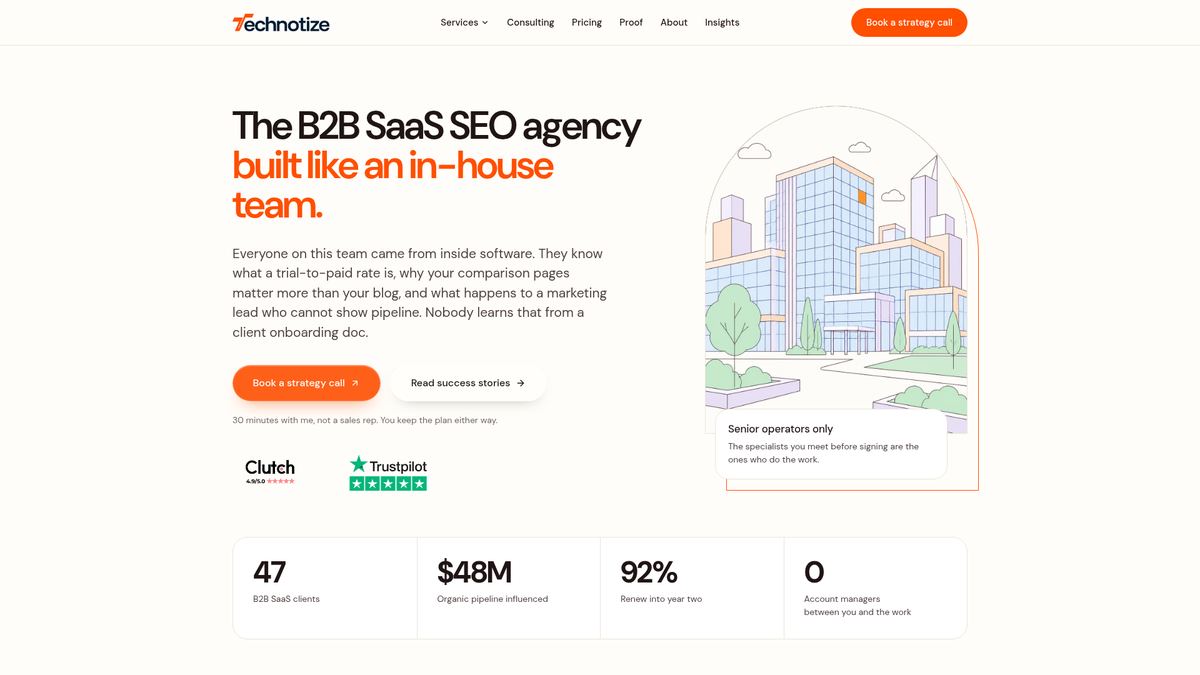
We run content marketing as the middle of a revenue system, not as a publishing schedule. Strategy maps pain points, comparisons, and use cases to real search demand before anything gets written; production carries operator review and named sources in the copy; optimization keeps assets earning after publish; measurement reports in the units a CFO recognizes. The verified work: Workwize, an IT asset platform operating across multiple countries, ran this engine for 22 months inside a complete B2B SaaS SEO program, and the content program's share of the outcome is public: sessions climbing 1,852 to 13,420, MQLs moving 28 to 111, and a $1.16M peak month of organic pipeline, every figure sourced on the case page linked below. Da Vinci's program multiplied organic 25 times in 11 months and turned the resulting authority into 74 AI citations.
Pricing: from $4,000 a month, published in full, since publishing it is one of this page's own criteria.
Best for B2B SaaS companies that want content judged in MQLs and are willing to read our work before believing any of this.
Not for you if content is the only thing you want bought. We will not run it separately from the technical and authority work underneath it, and if that is the brief, three shops below serve it better.
2. Grow & Convert
The originators of Pain Point SEO, the doctrine that content should chase signups rather than traffic, and after ten-plus years the most internally consistent shop in the market: strategy, production, and reporting all point at trials and demos. Its founders publish the methodology openly, its evaluation guide for this exact category ranks on this page's search result, weigh that self-interest as you weigh ours, and its published casework is written in signups, not sessions.
Pricing: not published. Flat monthly retainer per its own materials.
Best for SaaS companies who want every article accountable to a conversion number.
Not for you if you need volume. The doctrine trades cadence for conversion, on purpose.
3. Animalz
The editorial house of the category. Animalz built its name on long-form content that reads like expert guidance, with a roster third-party profiles list as Zendesk, Intercom, and Wistia, and industry vocabulary, content decay, quality tiers, that those same profiles credit to its team. Its published SupportLogic case pairs an AI-proofed strategy with a five-fold organic traffic outcome, and its AEO practice now runs from audits through citation outreach to measurement, per its own materials.
Pricing: not published on its own site. Third-party reports place programs at $15,000 to $30,000 a month.
Best for funded and enterprise SaaS buying thought leadership with editorial standards attached.
Not for you if your budget sits under roughly $15,000 a month, or if your bottleneck is technical rather than editorial.
4. Omniscient Digital
 Omniscient Digitalbeomniscient.com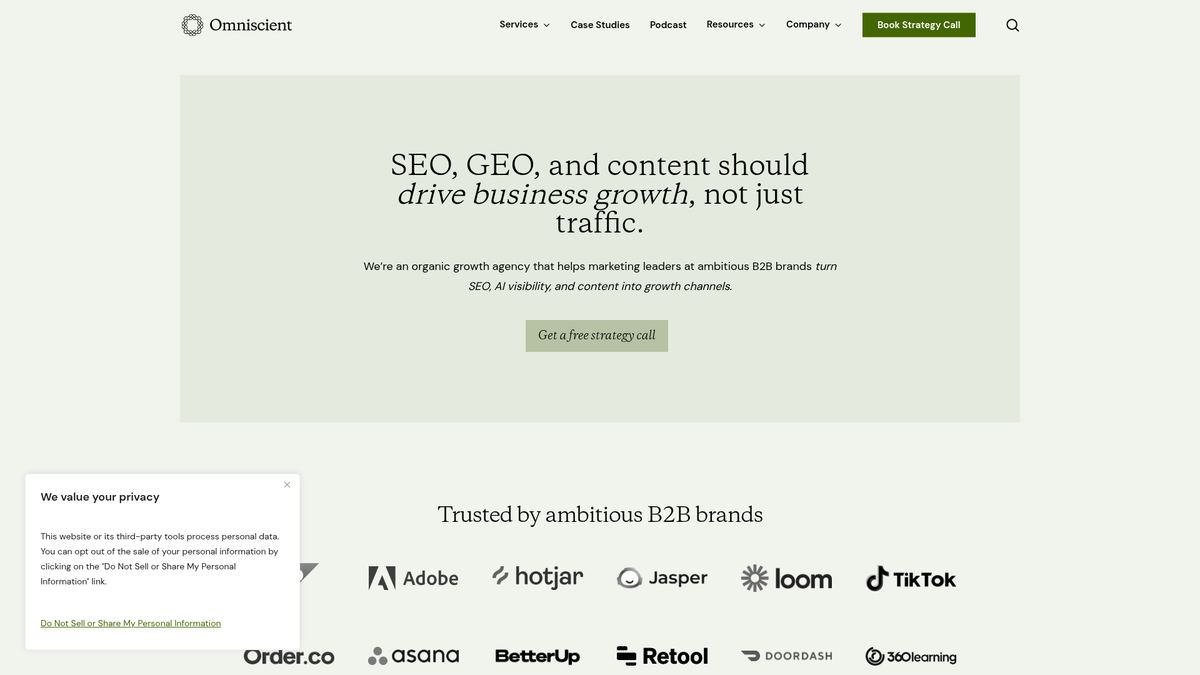
The strategy-first pick, with the most verifiable kind of pedigree this category offers: third-party profiles document its leadership running content programs at HubSpot, Shopify, and Workato before founding the agency in 2019. Programs start with business goals and turn into content systems, and the firm publishes its own research and provider evaluations steadily enough to audit its thinking, not just its claims.
Pricing: not published. Positioned at the premium end.
Best for B2B SaaS companies that want the strategy layer senior and the production layer built to serve it.
Not for you if you are at seed stage, where paying for a discovery phase before anything ships is a luxury.
5. Siege Media
 Siege Mediasiegemedia.com
The production engine with design inside it. Siege's published cases carry the two most concrete numbers on this page, Figma's organic traffic up 4,125 percent and Vena's backlinks up 751 percent through data-driven PR, and its model explains them: content, design, and link earning produced by one team so assets are built citable from the brief.
Pricing: not published. Third-party reviews place retainers from $5,000 a month, scaling with volume.
Best for mid-market and enterprise software brands that want content, design, and authority produced under one roof.
Not for you if you want SaaS-only focus. Siege works across fintech, ecommerce and health as well.
6. Campfire Labs
The incumbent on this exact search result, included on the same terms as everyone else. Campfire's model is original research and narrative-grade writing, journalism-adjacent per third-party profiles, with a roster those profiles name as Loom, Airtable, Toast, and Lattice.
Pricing: not published.
Best for SaaS brands whose growth thesis is credibility, original data, and stories worth citing.
Not for you if you need a steady publishing cadence. The model produces fewer, larger pieces, so teams needing a weekly rhythm will feel the gap.
7. Column Five
The multi-format outlier. Seventeen years in, grown from a data-visualization studio into an embedded content partner, Column Five produces editorial alongside video, interactive, data viz, and sales enablement, with a roster its own materials list as Instacart, Databricks, Vercel, Uber, Dropbox, and SAP, and AI-visibility monitoring folded into production.
Pricing: published from $10,000 a month.
Best for SaaS companies whose content ambitions outgrew text and who want one team owning the whole format range.
Not for you if written content is the whole brief. You would be paying for format range you never use.
8. Growth Plays
The pipeline cartographer. Growth Plays maps content to go-to-market priorities before anything ships, builds for multi-surface discovery, Google, AI answers, social, natively rather than as a retrofit, and carries a scale-up roster third-party profiles list as Lattice, Gremlin, Calendly, and LaunchDarkly. The model is consulting-heavy by design.
Pricing: not published.
Best for funded SaaS and dev-tools companies that want content decisions made from the revenue map, not the keyword list.
Not for you if the GTM map already exists internally. The consulting layer is most of what you are paying for.
9. Minuttia
 Minuttiaminuttia.com
The published-price specialist. SaaS-only by charter, with the clearest floor on this list, and casework with actual unit economics attached: its published Toggl program shipped 91 pieces in roughly a year, drove 26,000 clicks, and reports 200-plus conversions from the top performers.
Pricing: published from around $4,000 a month, per its own materials.
Best for B2B SaaS past product-market fit that wants a focused specialist and a price it can budget before the first call.
Not for you if you are pre-product-market-fit, or if you need link building in the same contract.
10. Grizzle
The technical-depth lane. Grizzle specializes in deep-dive content for complex SaaS, the material technical buyers actually finish, and independent reviews consistently slot it exactly there, for products where a generalist writer's output gets caught by the audience in the first paragraph. Its own roundup of this category ranks on this search result, so apply the standard disclosure discount.
Pricing: not published.
Best for developer tools, infrastructure, and security products whose content must survive expert readers.
Not for you if your audience is non-technical. The depth that wins engineers loses everyone else.
03How to choose a SaaS content marketing agency
Ten credible shops, three different theories of growth, one budget. Here is the audit that replaces the sales deck, the staffing fork most buyers skip past, and the flags that have changed since the AI flood.
The thirty-minute portfolio audit
Pull three recent client articles from any agency you are considering, theirs to name, yours to choose which three. Check claim density first: count the numbers, named sources, and concrete examples per section, because expertise leaves fingerprints and filler does not. Check who wrote it and whether that person plausibly knows the subject. Check the intent match: does the piece answer what its target searcher wanted, or orbit it. Check the publish-to-now decay: is the asset maintained or abandoned. Then check whether their case studies survive contact with how AI systems choose what to quote, specific, verifiable, attributable claims, because that is the bar their work will face on the new surfaces. Thirty minutes, no sales call, and it filters harder than any RFP.
SaaS content marketing consultant, SaaS content marketing freelancer, or agency
A SaaS content marketing consultant sells the decisions: what to write, in which order, measured how. A SaaS content marketing freelancer sells the writing itself, and a strong one costs less per article and more per decision, because the decisions stay yours. An agency sells both plus the machine around them. Buy the consultant when production exists in-house and the gap is direction; buy the freelancer when strategy is solid and throughput is the constraint; buy the agency when neither exists and the channel has to work anyway. The expensive mistake is the mismatch: paying agency retainers for freelancer output, or asking a freelancer to invent the strategy their rate never included.
Red flags, 2026 edition
Volume pitched as strategy, forty posts a month is a quota, not a plan. Traffic-only reporting with no path to signups. No named writers, which in 2026 usually means no writers. Guarantees of rankings or citation counts. And the newest one: AI-scaled production sold at human-expertise prices, detectable in thirty minutes with the audit above, because the fingerprints of real content production standards, sources, specifics, a point of view, cannot be faked at scale.
04What a SaaS content marketing agency costs
The numbers below are published floors and independently compiled ranges, sources named, with our operator view of what the money should buy at each level, the same standard the practice these ranges describe holds itself to.
Retainer ranges in 2026
Independent 2026 compilations, citing a 350-plus-business survey, put the most common SaaS content retainer between $5,000 and $15,000 a month, with the market's full spread running roughly $5,000 to $25,000. The published floors on this list bracket it cleanly: Minuttia posts programs from about $4,000, third-party reviews place Siege from $5,000, Column Five publishes retainers from $10,000, and Animalz's reported band runs $15,000 to $30,000. Below roughly $3,000 a month you are buying articles, not a program, which is sometimes exactly right and worth naming honestly.
What a real article costs
A piece worth publishing in a competitive SaaS category carries a subject-matter interview or equivalent expertise, research with named sources, writing, editing that would survive a hostile expert reader, and enough design to be citable. Priced honestly, that lands in the hundreds to low four figures per piece depending on depth, consistent with compiled market hourly rates of $100 to $149. The corners available for cutting are exactly the ingredients that make content work, which is why per-article price is the most honest predictor in this market: not of quality directly, but of what could possibly be inside.
The cheap-content tax
A serviceable informational article now costs nothing to generate, which means it is worth nothing to publish: the market's own leading guides open with the same observation, and the SERPs confirm it daily. Undifferentiated content does not rank, does not get cited, and does not convert, so the money spent producing it buys a second invoice later, the rewrite, plus the opportunity cost of quarters lost. The tax is avoidable with one discipline: never pay for anything you could have generated yourself. What you are buying from this list is precisely the residue, expertise, original data, editorial judgment, a defensible point of view, and every entry above was filtered for it.
05Content marketing for AI answers
The distribution layer moved, and content marketing is the discipline most directly repriced by it. Three things a buyer should understand before signing any 2026 retainer.
Citable specifics are the new currency
The KDD 2024 benchmark out of Princeton tested what makes generative systems pick a source and found the levers are what good content carries anyway, citations, quotations, statistics, moving source visibility up 30 to 40 percent across ten thousand test queries. Translated for a content budget: claim density is no longer a style preference, it is distribution. The audit above counts it for precisely that reason, and our content optimization work spends most of its hours retrofitting exactly this into assets that were written before the rules changed.
Buyers moved before the market did
Late-2025 buyer research Google commissioned showed AI assistants now touching roughly 60 percent of B2B purchases somewhere in the journey, and assistants compose answers by splitting questions into fragments and quoting whoever wins each one. For content strategy that changes the target: pieces have to win the sub-questions inside their topic, not just the headline query, which rewards the structured, specific, one-idea-per-section writing this page keeps demanding. Google's guidance for AI features in Search closes the loop from the platform side: no separate system, the same quality signals decide both surfaces.
Measure both scoreboards or fly blind
A 2026 content program should report rankings and pipeline, and alongside them, citations per AI platform, your share of the answers buyers' actual prompts produce, and AI referral conversion. Most content agencies added the service line; far fewer added the instrumentation, and the GEO agency comparison exists because that gap became its own market. The cheap test for any shop on this page: ask them to name the platforms they report one by one. A blended score is a blindfold with a dashboard.
06What a content engine looks like on a P&L
We asked every agency above for named work with sources. Here is ours, held to the same standard: two clients, public data, client sign-off. It is worth saying plainly that this is the only place on the page where we could get data at this depth, because it is the only client relationship we control.
| Client | Metric | Start | End | Months |
|---|---|---|---|---|
| Workwize | Monthly organic sessions | 1,852 | 13,420 | 22 |
| Workwize | Monthly MQLs | 28 | 111 | 22 |
| Workwize | Peak monthly organic pipeline | n/a | $1.16M | Month 19 |
| Da Vinci | Organic sessions | Baseline 100 | 25x | 11 |
| Da Vinci | AI citations across six platforms | Near zero | 74 | 11 |
Both client-approved. Every figure sourced on the case pages.
Workwize: the content program behind a seven-figure pipeline
An IT asset management platform selling across borders, 22 months, one integrated engine where content carried the demand capture. The engine moved every stage: 1,852 monthly sessions became 13,420, 28 MQLs a month became 111, and the organic channel's best month reached $1.16M in pipeline, with the Workwize content program documented figure by figure, source by source. The number that matters most for this page's argument is the middle one: MQLs, because traffic that does not become pipeline is a hobby with reporting.
Da Vinci: content that machines started quoting
A cloud warehouse platform for third-party logistics, 11 months, organic multiplied 25 times from a hundred-session baseline, and the same asset base earned 74 AI citations on six platforms, the two-scoreboard outcome this page's AI chapter describes, achieved with one content system rather than two. Da Vinci's case documentation publishes the curve and its sources, and it kept compounding after the contract closed.
07FAQ
Who is the best SaaS content marketing agency?
It depends on your theory of growth: Grow & Convert for signups-first doctrine, Animalz for enterprise editorial, Siege for content-plus-links at scale, Campfire for original research, us for content measured in MQLs inside a full organic program. The best SaaS content marketing agency for you is the one whose public work survives the thirty-minute audit for your category.
How much does a SaaS content marketing agency cost?
Published floors on this list run from about $4,000 to $15,000-plus monthly, and independent compilations put the common retainer band at $5,000 to $15,000. Four of the ten publish a price at all. Per-article, honest expert work lands in the hundreds to low four figures; below that, the ingredients that make content perform cannot be inside.
Should we hire an agency or build an in-house content team?
In-house brings product depth and institutional memory; an agency brings speed, senior strategy, and immunity to your first three wrong hires. The pattern that works most often: one internal owner for direction and review, external partner for strategy and production, with the exit path to in-house written into the plan from day one.
How long until content marketing works for SaaS?
Meaningful movement typically starts inside one to two quarters, and the compounding that justifies the spend arrives later: our longest documented program took 22 months to peak. Any promise of a first-month transformation is describing paid media with extra steps.
Will AI writing tools replace SaaS content marketing agencies?
They already replaced the commodity tier, which is the best thing that ever happened to the honest one. What remains valuable is exactly what tools cannot generate: proprietary data, practitioner experience, named sources, and a point of view someone will defend. Agencies selling that survive; agencies reselling generation do not deserve to.
This roundup sits inside our content marketing practice, alongside content strategy, content production, and content optimization.
Related agency and craft reads
Adjacent operator reads worth pairing with this one.
- the vendor selection playbook for SaaS link building — The link building partners that actually earn coverage for the content programs you commission.
- which enterprise SEO agencies actually run programs at scale — Enterprise SEO agencies whose content workstreams survive CFO review.
- how GEO agencies compare on measurable citations — GEO agencies judged on measurable AI-engine citations tied to content.