
On this page
Every GEO vs SEO article gives you a definitions table and tells you to do both. Useful, as far as it goes, and it does not go far, because almost none of those articles are written by someone running both disciplines on real budgets and reporting the results with sources. This one is. We run AI visibility programs for B2B software companies, we measure both through Ahrefs, and one of our named clients holds rankings and AI citations earned by the same engagement, which makes this comparison less a theory piece and more a report from the field.
Here is where we land, stated upfront so you can argue with it: GEO and SEO are one engine with two scoreboards. The work overlaps far more than the acronym wars suggest, the differences that do exist are real and operational rather than philosophical, and the companies winning right now are not choosing between them. The rest of this page is the evidence.
The short answer
SEO earns your pages positions in ranked search results. GEO earns your brand presence inside AI-generated answers, the ones ChatGPT, Perplexity, Google's AI Overviews and AI Mode, Copilot, and Gemini compose when someone asks a question instead of scanning links. Same goal, visibility where buyers look; different surface, different scoreboard.
And here is the part the "vs" framing hides: the inputs are mostly shared. AI systems assemble answers from sources they consider authoritative, current, and safe to quote, which means the domains winning citations look suspiciously like the domains winning rankings: real authority, specific verifiable claims, structure a machine can parse. If someone asks what GEO vs SEO really comes down to, the honest one-liner is this: one engine, two scoreboards, and a handful of genuinely new habits that the rest of this page walks through.
What GEO and SEO each mean
SEO, search engine optimization, is the thirty-year-old discipline of making pages easy for crawlers to find, understand, and rank: keywords and intent, technical health, internal architecture, and the earned authority of links. Its scoreboard is positions and the organic sessions they produce, and its practices are documented to the point of folklore.
GEO, generative engine optimization, is barely two years old as a named thing. The term comes from an academic paper, "GEO: Generative Engine Optimization", posted to arXiv in November 2023 by researchers from Princeton, IIT Delhi, Georgia Tech, and the Allen Institute for AI, and published at KDD 2024. The team benchmarked nine content tactics across 10,000 queries and found the strongest — adding citations, quotations, and statistics — lifted a source's visibility in generative responses by 30 to 40 percent. That paper did two useful things: it named the discipline, and it demonstrated with data that what AI engines quote can be influenced by how content is written. Everything the industry now sells under GEO, AEO, or AI SEO descends from that finding.
One disambiguation worth stating plainly, because the acronym collides with two decades of marketing vocabulary: GEO here has nothing to do with geographic targeting or local search. Andreessen Horowitz's analysis of the shift put the contrast in ten words: "Traditional search was built on links. GEO is built on language."
GEO vs SEO: the side-by-side
The comparison table you came for, honest edition.
| SEO | GEO | |
|---|---|---|
| Optimizes for | Ranked positions in search results | Presence inside AI-generated answers |
| Primary metric | Rankings, organic sessions, conversions | Citations and mentions per platform, AI referrals |
| Content shape | Query-shaped, topical depth across pages | Answer-shaped, specific and quotable claims |
| Volatility | Algorithm updates, then stability | Sources rotate constantly; maintenance is structural |
| Attribution | Click-through, session-level analytics | Often zero-click; brand-level and referral measurement |
| Age of discipline | Practiced since the 1990s | Named in a November 2023 research paper |
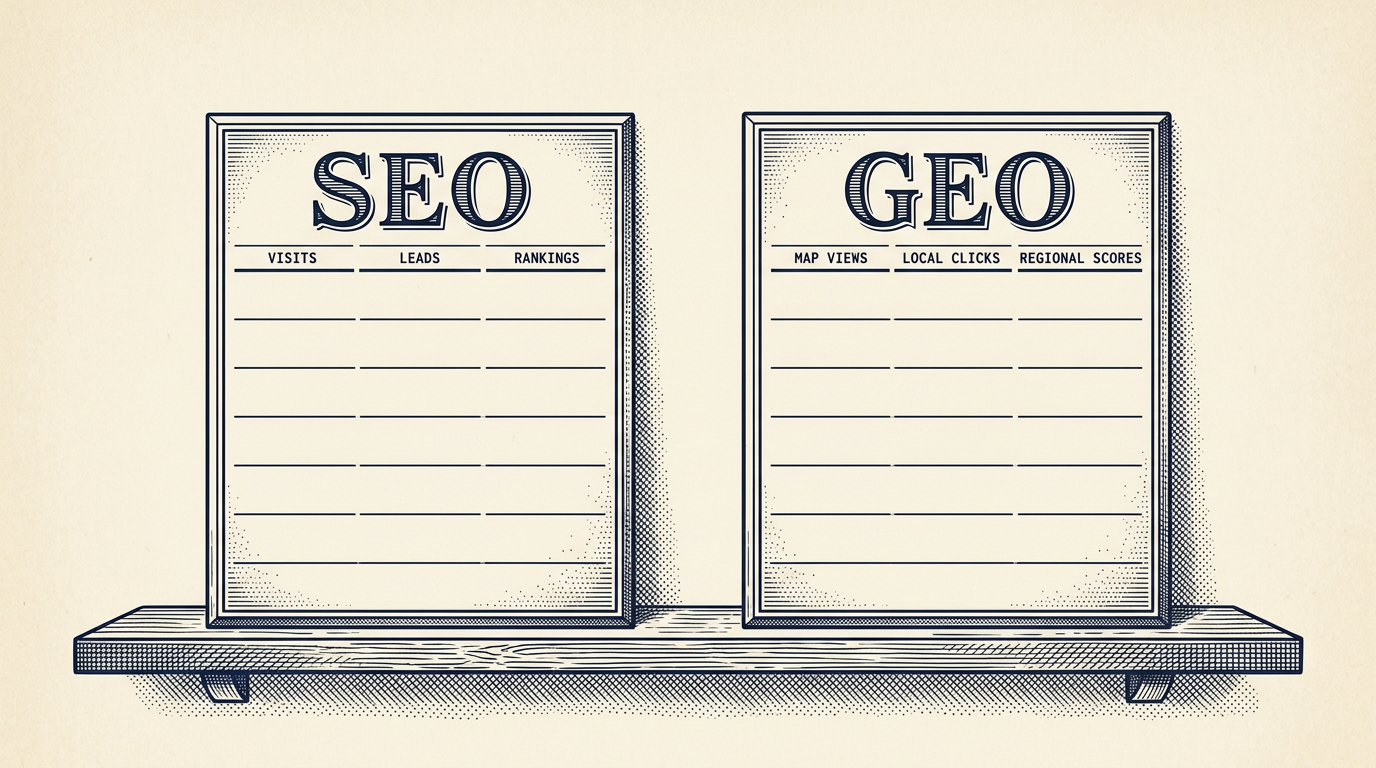 GEO vs SEO — two scoreboards for the same underlying work.
Generative engine optimization vs traditional SEO: what actually differs
Strip the hype and five differences survive. Each one changes how you work, none of them replaces the work.
First, measurement. Rankings are a solved problem: one engine, positions you can track nightly. AI visibility fragments across platforms that compose answers differently, so tracking means counting citations per surface, watching share of answers for your core prompts, and separating brand mentions from linked citations.
KPIs for GEO vs SEO
On the SEO side the scoreboard is familiar: rankings on money terms, organic sessions, referring domains, and the conversions attribution can see. On the GEO side, the KPIs that matter are citations per platform (counted separately for AI Overviews, AI Mode, ChatGPT, Perplexity, Copilot, and Gemini, because they draw from different pools), share of answers for your priority prompts, AI referral sessions and their conversion rate, and accuracy of how the answers describe you. We track the GEO column through Ahrefs' AI answer data for every client, and the platform split matters: our reference client's citation counts differ by a factor of thirty between their strongest and weakest platform, which a blended score would erase.
Second, content shape. People type fragments into Google and full questions into assistants, so pages built to be quoted lead with the answer, carry specific numbers and named sources, and structure claims a model can lift without distortion, exactly the tactics the Princeton benchmark validated.
Third, entity precision. Search engines rank pages; generative engines describe brands. That makes consistency of facts about you across your site, directories, reviews, and third-party coverage a ranking-adjacent discipline of its own, because a model that cannot resolve who you are will not risk recommending you.
Fourth, churn. Fortune's reporting on Profound's research found that as many as nine in ten sources cited in AI answers can rotate over time. Rankings decay politely; citations churn aggressively. GEO therefore has maintenance built into its economics, monthly, not as an upsell.
Fifth, surface fragmentation. There is no single AI answer layer. Each platform assembles from its own retrieval mix, which is why platform-level reporting is a non-negotiable and why "we improved your AI visibility score" without a breakdown should end a vendor conversation.
What never changed
The list of things GEO did not replace is longer than the list of things it added.
Authority still decides who gets believed. The domains AI systems quote are overwhelmingly ones that earned trust the old way: real links, real coverage, real expertise, and our own client data keeps confirming that citations follow the authority curve, not precede it. Content quality still decides who gets quoted, and structure still decides who gets parsed; clean architecture and schema serve crawlers and AI retrieval alike. Even the source of truth is unchanged: Google's documentation for AI search features says there is no separate playbook, no special markup, no secret system, the practices that earn search visibility are the practices that earn AI visibility. Semrush's comparison guide, one of the two big pieces ranking for this exact question, lands on the same overlap list: quality, structure, topical authority, original data. When the biggest tool vendor and the search engine agree with the operators, the "vs" is settled: GEO extends SEO. It does not bury it.
 One engine, two scoreboards. The foundation is shared.
Clicks vs citations
The scoreboards do not just look different, they pay differently, and this is where budgets get argued.
SEO's payment is visible: a click, a session, a conversion path attribution can follow. GEO's is often invisible at the session level, because answers satisfy many queries on the spot; Bain research widely cited across the industry puts about 80 percent of users settling roughly 40 percent of their searches without clicking anything. That sounds like loss until you look at what the remaining clicks do. AI referrals arrive pre-sold, people who already read the comparison inside the answer, and behave like late-stage visitors rather than browsers. Andreessen Horowitz's analysis notes ChatGPT referring 10 percent of new signups for Vercel, a developer platform, which is the shape of the new channel: fewer visits, further along. And one distinction keeps both scoreboards honest: being quoted is not the same as being recommended. An answer can cite your blog post as background and hand the actual recommendation to a competitor two sentences later, so the metric that ultimately matters is not whether AI systems use your content but whether they name your product when buyers ask what to buy.
GEO vs SEO vs AEO: the three-way version
Add AEO to the comparison and you get three acronyms wrapped around two real distinctions.
AEO, answer engine optimization, frames the work around answers wherever they appear: AI assistants, featured snippets, voice. GEO frames it around generative engines specifically. In practice the overlap between them approaches total, and both sit on the SEO foundation described above, so the three-way comparison resolves simply: SEO is the base layer, and GEO and AEO are two names for the answer layer built on top of it, one from the research community, one from marketing. Teams searching seo vs geo vs aeo in any of its five orderings are usually asking a budget question wearing an acronym costume, and the budget answer is in the next section. The naming only matters when a vendor uses it to sell the same work twice.
SEO vs GEO: which should you invest in
The honest version of the budget answer, by situation.
If your organic channel already produces pipeline, you are closer to AI visibility than you think: the authority exists, so the additions are answer-shaped content on your money topics, entity cleanup, and per-platform citation tracking, weeks of work, not a second retainer the size of the first. If you are starting from low authority, resist the pitch that GEO lets you skip the foundation; the citation data says the opposite, so build authority and citable content as one program and let both scoreboards light up as it compounds. And if you are unsure whether your category has moved yet, look at your buyers rather than your traffic: buyer research Google commissioned in October 2025 found roughly 60 percent of B2B buyers leaning on AI tools mid-purchase, which means the answers about your category are already being written. The one wrong investment is the one this page's title implies: choosing. It is one budget doing work that two scoreboards count.
One budget, both scoreboards
One named engagement, both numbers, sources the client controls.
Da Vinci, a cloud WMS for third-party logistics providers, hired us for search visibility, not for GEO. The engagement ran eleven months of the shared foundation: referring domains climbing from 113 to 357, commercial content built around operator questions, entity and structure work throughout. The search scoreboard responded the way SEO scoreboards do: DR 19 to 55, top-20 keywords from 26 to 712, organic traffic up 25x. The AI scoreboard responded to the same work: 74 separate citations over six different AI platforms as measured through Ahrefs this month, 37 of them in AI Overviews, in a category where the incumbents barely register. Nobody bought a GEO add-on. The Da Vinci case page publishes every number with its source, and Workwize's case page shows the sequel: AI referrals arriving on top of an organic channel that peaked at $1.16M in monthly pipeline. That is the entire argument of this page in two clients: the engine is one thing, and both scoreboards count it.
 Da Vinci — one engagement, both scoreboards counted it.
Related agency and craft reads
Adjacent operator reads worth pairing with this one.
- the generative engine optimization agencies you can actually verify — The GEO agency shortlist judged on citation evidence, once you understand the discipline.
- the enterprise SEO agency landscape, ranked on verified work — Enterprise SEO agencies whose programs now integrate GEO into a single measurement frame.
- the SaaS content marketing agencies judged on work you can read — Content agencies whose prose actually earns AI Search citations, not just rankings.