On this page
LLM SEO is the practice of making your content easy for large language models to find, parse, trust, and quote. That one sentence hides a lot of machinery, and the machinery is the point: the brands that show up inside ChatGPT, Gemini, Perplexity, and Copilot answers are not there by luck. They are there because specific systems retrieved them through specific doors, and every one of those doors can be checked, opened, and measured. This page opens them one at a time, with named crawlers, real client numbers, and the straight version of the parts the industry oversells.
Two notes before the mechanics. First, we run AI search work for software companies and measure results per platform through Ahrefs, so the claims below travel with data instead of screenshots of one lucky prompt. Second, LLM SEO has a twin-meaning problem: it also gets used for "doing SEO work with AI tools," which is a different topic. This page covers the first meaning, getting quoted by the machines, and the FAQ handles the second so nobody leaves with the wrong article.
01What is LLM SEO?
The fastest useful answer: LLM SEO is search optimization aimed at the systems that write answers instead of ranking links. The three parts below give you the working definition, the boundary of what it is not, and the scale that explains why the term exists at all.
LLM SEO meaning, in one working definition
LLM SEO, large language model search engine optimization, is the discipline of earning a seat inside AI-generated answers by making your site and brand legible to the models composing them. Legible means four concrete, auditable things. Retrievable: the systems can reach and read your pages. Parseable: a machine can lift your claims without mangling them. Trustworthy: quoting you is safe, because your facts check out and your domain has earned authority. Specific: there is something quotable on the page at all, a number, a definition, a named example. When all four hold, your brand starts appearing where research increasingly happens, in the answer itself.
What LLM SEO is not
It is not a replacement for SEO, and it is not the practice of using ChatGPT to write meta descriptions. The first misunderstanding costs money, because the systems this page describes pull overwhelmingly from domains that earned trust the classic way; skipping the foundation and buying "LLM magic" buys nothing. The second is just a vocabulary collision, using LLMs as workers versus optimizing for LLMs as readers, and only the reader side is covered here.
The scale that makes it matter
The audience moved first and the discipline is catching up. OpenAI announced that 800 million people were using ChatGPT weekly at its October 2025 DevDay, Reuters reported the figure passing 900 million by mid-2026, and that is one assistant among six major answer surfaces. Add Google pushing AI Overviews and AI Mode into default search, and the question stops being whether your buyers read AI answers and becomes whether those answers know you exist.
02The four names for one discipline
The industry named this work four times, and each name tells you who is speaking. Knowing the map saves you from paying for the same service twice.
Who uses which name
LLM SEO is the developer's framing, named for the technology doing the reading. GEO, generative engine optimization, is the researcher's framing, coined in a Princeton-led academic paper. AEO, answer engine optimization, is the marketer's framing, named for where the output appears. AI search optimization is the umbrella buyers reach for before picking a tribe. One hire sits under all four labels, and when a vendor prices LLM SEO and GEO as separate line items, one of those line items is decorative.
LLM SEO vs GEO: any real difference?
In the work, no. In the emphasis, slightly: LLM SEO conversations skew technical, crawlers, rendering, retrieval mechanics, while GEO conversations skew content and measurement. Both optimize the same systems with the same inputs, and we keep a full comparison of how GEO and SEO actually divide for readers who want the versus question treated properly. The practical rule: judge any proposal by the layers of work it names, not by which acronym it wears.
03How LLM SEO works: two pathways into an answer
Every AI answer that mentions a brand got that brand through one of two doors, and the doors reward different work on different timelines. Most guides only cover one of them, which is half a strategy.
The training data pathway
Models learn about brands from the text they were trained on, and the backbone of that text is public web archives like Common Crawl plus licensed and scraped sources. A brand consistently described across many credible pages gets absorbed as a fact about the world, which is why models name category incumbents even in answers where they never touch the live web. This pathway moves on training-run timelines, months, not days, and it rewards exactly one thing: widespread, consistent, credible mention of who you are and what you do. Every review, directory listing, press mention, and linked or unlinked citation is a deposit here, and the compounding is slow but brutal for latecomers.
The live retrieval pathway
When a model decides a question needs current information, it queries an index, fetches pages, and composes an answer with citations, the mechanism usually called retrieval-augmented generation. This pathway moves fast, sometimes within days of publishing, and rewards what retrieval systems can score: relevance to the query, freshness, parseable structure, and the authority of the domain being fetched. The Princeton-led benchmark that coined GEO proved this side is genuinely optimizable, lifting source visibility 30 to 40 percent across 10,000 test queries, chiefly by layering citations, quotations, and statistics into the source content.
Query fan-out: one prompt, many searches
Retrieval has a wrinkle that changes keyword strategy: the systems rarely search the user's full prompt. They split it into narrower sub-queries, a mechanic Google has described openly for AI Mode. Ask an assistant for the best warehouse system for a 3PL with 40 clients and it may quietly run searches like "WMS for 3PL providers," "warehouse software multi-client billing," and "WMS pricing comparison," then compose from whatever wins those. The consequence: your content needs to win the fragments, not the paragraph, which is ordinary keyword and intent work wearing a new hat, and one more reason the two disciplines share a foundation.
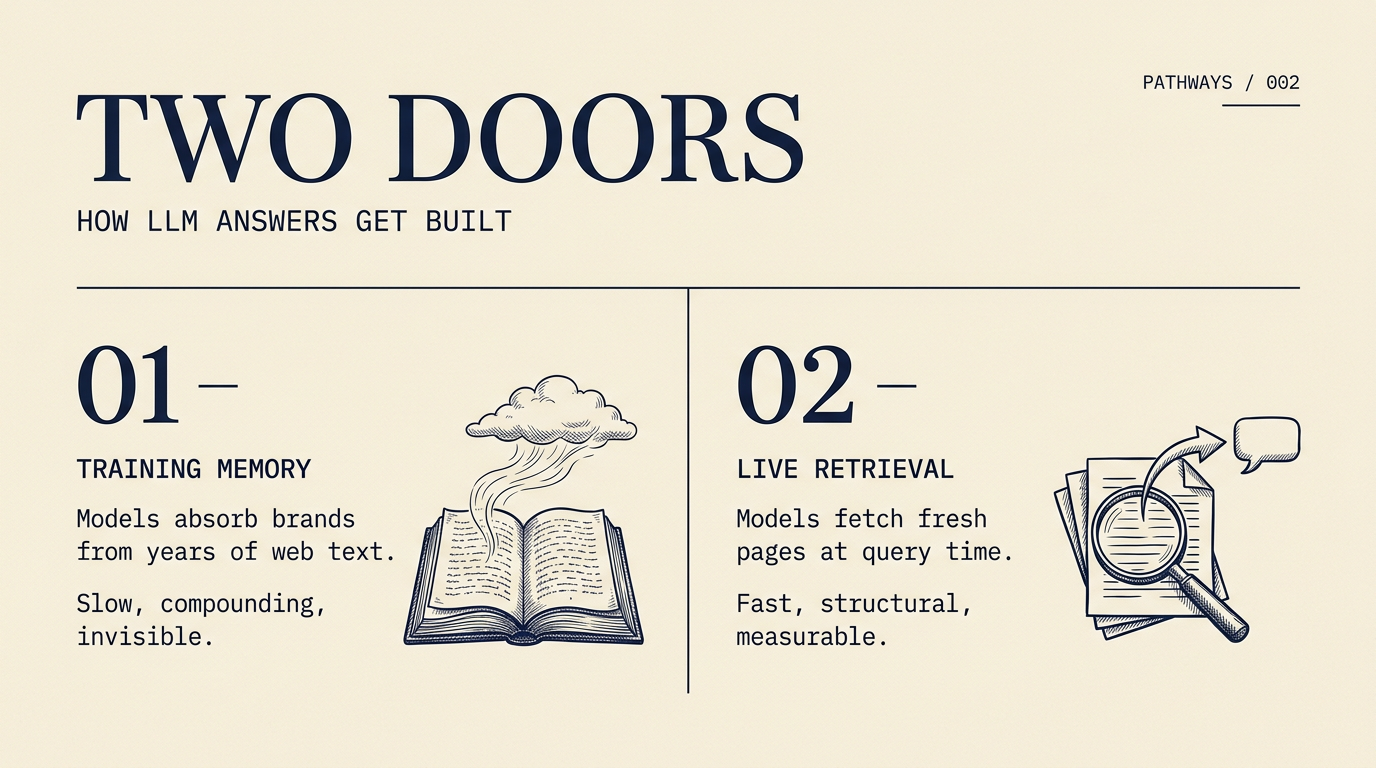 Two doors, different speeds, one answer. Real programs feed both.
04Where each AI actually gets its sources
No single AI index exists. Each platform reads the web through its own doors, which is why one brand can dominate an assistant and not exist in its neighbor. Here is the map, platform by platform, then the crawler roster you control.
ChatGPT: Bing plus OpenAI's own crawl
ChatGPT's live search leans heavily on Bing's index alongside OpenAI's own fetching infrastructure. The unglamorous consequence: a site that never bothered with Bing Webmaster Tools is handicapped inside the most-used assistant on the planet. ChatGPT visibility work therefore starts embarrassingly simply, verified Bing indexation, then moves to the presence in listicles and comparisons its retrieval demonstrably favors.
Google's AI surfaces: AI Overviews and AI Mode
AI Overviews and AI Mode compose from Google's index and ranking systems, running fan-out queries against ordinary Google results. Classic Google visibility feeds them directly, and Google's own docs for AI features in Search say so without ceremony: there is no separate optimization system, no special markup, and the same habits that earn search visibility earn the AI kind.
Perplexity, Copilot, Claude, and Gemini
Perplexity maintains its own crawl and index, which is why its citation patterns diverge hardest from Google's. Copilot rides Bing. Gemini rides Google. Claude fetches live pages when browsing. The strategic point sits above the details: Fortune's reporting on Profound's internal research found different models draw from largely distinct source pools, with up to nine of every ten cited sources rotating over time. Distinct pools plus constant rotation equals two rules: measure per platform, and never stop.
The AI crawler list to check in robots.txt
Each company sends named crawlers whose access you control: GPTBot gathers OpenAI training data, OAI-SearchBot serves ChatGPT search, ChatGPT-User handles live fetches during chats, ClaudeBot serves Anthropic, PerplexityBot feeds Perplexity's index, Google-Extended is the robots token governing whether your content trains Gemini without touching search, and Bingbot's index feeds Copilot and ChatGPT search alike. Check your robots.txt and firewall rules before buying any AI visibility strategy; the technical audits we run keep finding companies paying for advice while blocking the exact crawlers that would deliver it.
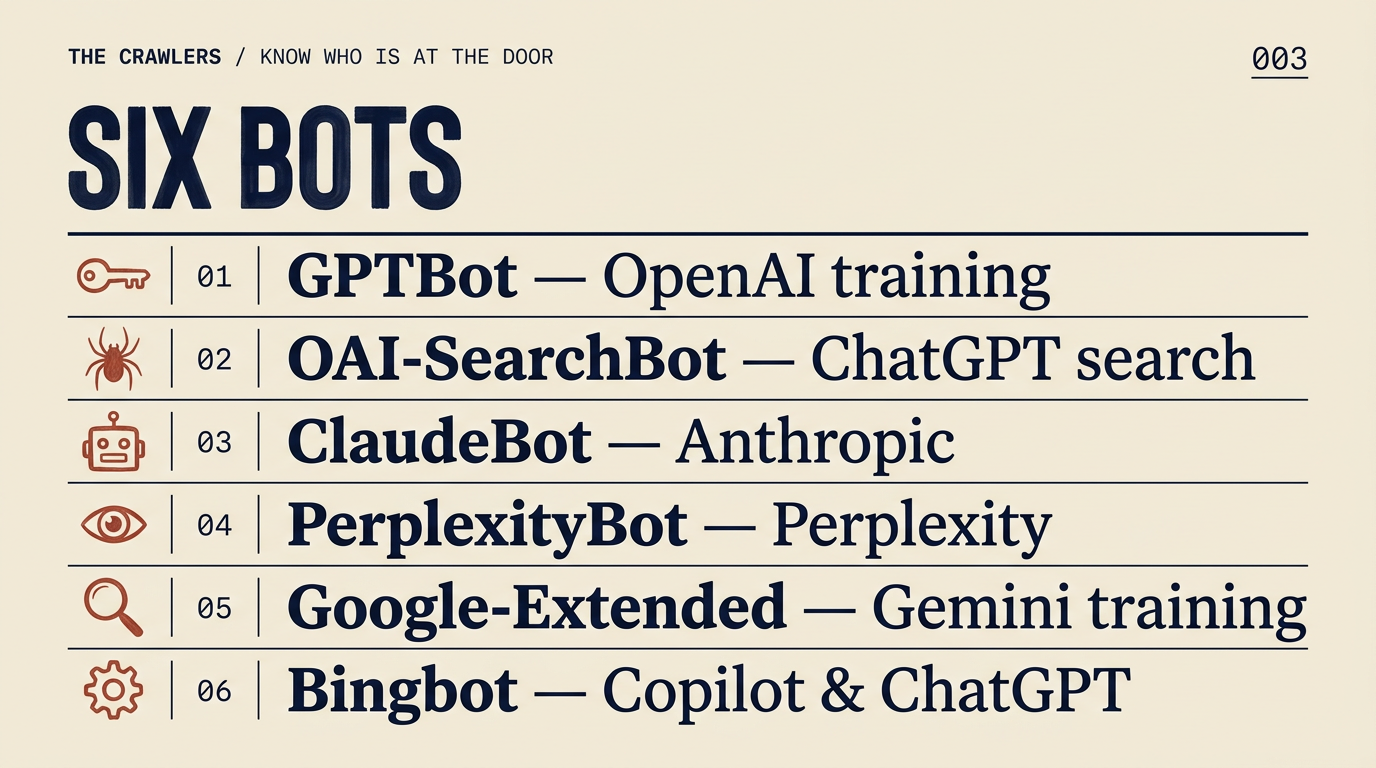 The doors, by name. Check yours before buying strategy.
05SEO for LLMs: what changes and what transfers
The overlap with classic SEO is the majority of the job. The differences are few, technical, and expensive to ignore, so each gets its own subsection.
JavaScript rendering: the silent blocker
Google executes JavaScript when indexing. Most AI crawlers do not; they read the raw HTML response and move on. Anything that only exists after client-side rendering, tab content, accordion text loaded on click, single-page-app copy, is absent from the material these systems quote, no matter how good it is. If your site runs on a modern JavaScript framework, server-side rendering for everything you want machines to read is the first fix on the list, and in our audits it is the most common silent failure on otherwise healthy sites.
Freshness and content decay
Retrieval systems favor recently updated sources, and answers rebuild constantly, so pages left untouched quietly rotate out of answers their older versions used to win. The rotation statistic above makes the schedule concrete: when most cited sources can churn, a quarterly refresh pass on your money pages is not housekeeping, it is defense of positions you already hold.
Brand mentions vs backlinks
A model deciding whether you are real weighs how consistently the web describes you, linked or not. Unlinked mentions in reviews, forums, and coverage feed both pathways, training data directly and retrieval through the corroboration it finds when checking you out. Links still carry the authority that retrieval scores, so nothing here demotes link building; it promotes mention-building alongside it, which quietly turns PR and review presence from nice-to-have into input.
What transfers untouched
Authority, content quality, crawlability, and intent coverage transfer whole. The domains these systems cite earned trust through the same signals B2B SaaS SEO has always been built on, and our client citation data keeps confirming the order of operations: citations trail the authority curve, they never lead it. Anyone selling LLM visibility detached from that foundation is selling the acronym.
06LLM optimization in practice: the work, layer by layer
Here is the discipline as a workplan rather than a definition, four layers plus the loop that keeps them honest. Proposals worth signing name all five; proposals worth declining name a dashboard.
Access and rendering
Crawler permissions verified against the roster above, server-side rendering for money content, clean HTML that survives a no-JavaScript read, and Bing indexation confirmed because of where ChatGPT shops. Thirty minutes of checking that prevents months of invisible effort.
Legibility: entities and structure
Consistent facts about your company everywhere it is described, schema that labels what things are, headings that mean what they say, and definitions stated plainly enough to lift. A machine that cannot pin down who you are will not gamble a recommendation on you, so this layer is trust infrastructure wearing markup.
Quotable substance
The layer most programs skip: claims specific enough to quote. Numbers with named sources, concrete examples, direct answers to the questions buyers actually ask assistants, the exact traits the Princeton benchmark validated as citation-lifters. If a page contains nothing a careful machine could safely repeat, no amount of access and markup will make it citable.
Reputation and maintenance
Beyond your domain: the mentions, reviews, listicles, and coverage both pathways read as evidence you matter, which is where this discipline hands off to what the tooling gold rush says about monitoring versus doing. And underneath everything, the maintenance loop, because retrieval favors the fresh and sources rotate; LLM optimization is closer to gardening than construction, and anyone selling it as a one-time project has told you their retention numbers.
07llms.txt: proposal vs proof
Every LLM SEO conversation reaches the new file eventually, so here is its actual status, separated into what it is and what the evidence supports.
What llms.txt is
A proposed convention: a markdown file at your domain root handing AI systems a curated map of your most important content, robots.txt's helpful cousin. Adoption has spread fast, with major CMS and SEO plugins now generating it in one click, which is the strongest thing that can honestly be said for it: it is cheap, harmless, and might help.
What the evidence says
No major AI platform has confirmed consuming the file, and Google's John Mueller has publicly cautioned against treating it as a ranking lever. Our client position is proportional: thirty seconds of effort deserves thirty seconds of expectation. Generate it, keep it accurate, and spend the real budget on the four layers above, because a curated menu means nothing to systems that never agreed to read it.
08How to measure LLM SEO
The discipline earns its keep only if you can count it, and it can be counted, per platform, monthly, against competitors. Here is the scoreboard, a live example, and where the tooling fits.
LLM SEO KPIs
Four numbers carry the program. Citations per platform, each surface counted on its own, because the retrieval map guarantees platforms will not move together. Share of answers on the prompts your buyers actually ask, tracked as a panel over time. AI referral traffic and how it converts, which is where the channel touches revenue. And description accuracy, whether the answers get your facts right, because a wrong answer citing you is its own project. Blended visibility scores hide all four; platform-named reporting is the standard to demand from any vendor and any internal dashboard.
A real per-platform example
Our warehouse-software client Da Vinci holds 74 citations as of this month: 37 in Google AI Overviews, 21 in AI Mode, 9 in ChatGPT, 3 each in Perplexity and Copilot, and 1 in Gemini. That thirty-to-one spread between strongest and weakest platform sits inside one brand's footprint, and an averaged score would have flattened it into a number that says nothing. Da Vinci's platform-split numbers are public with sources the client controls, and Workwize's AI referral figures show the channel converting, not just appearing, next to a seven-figure monthly organic pipeline.
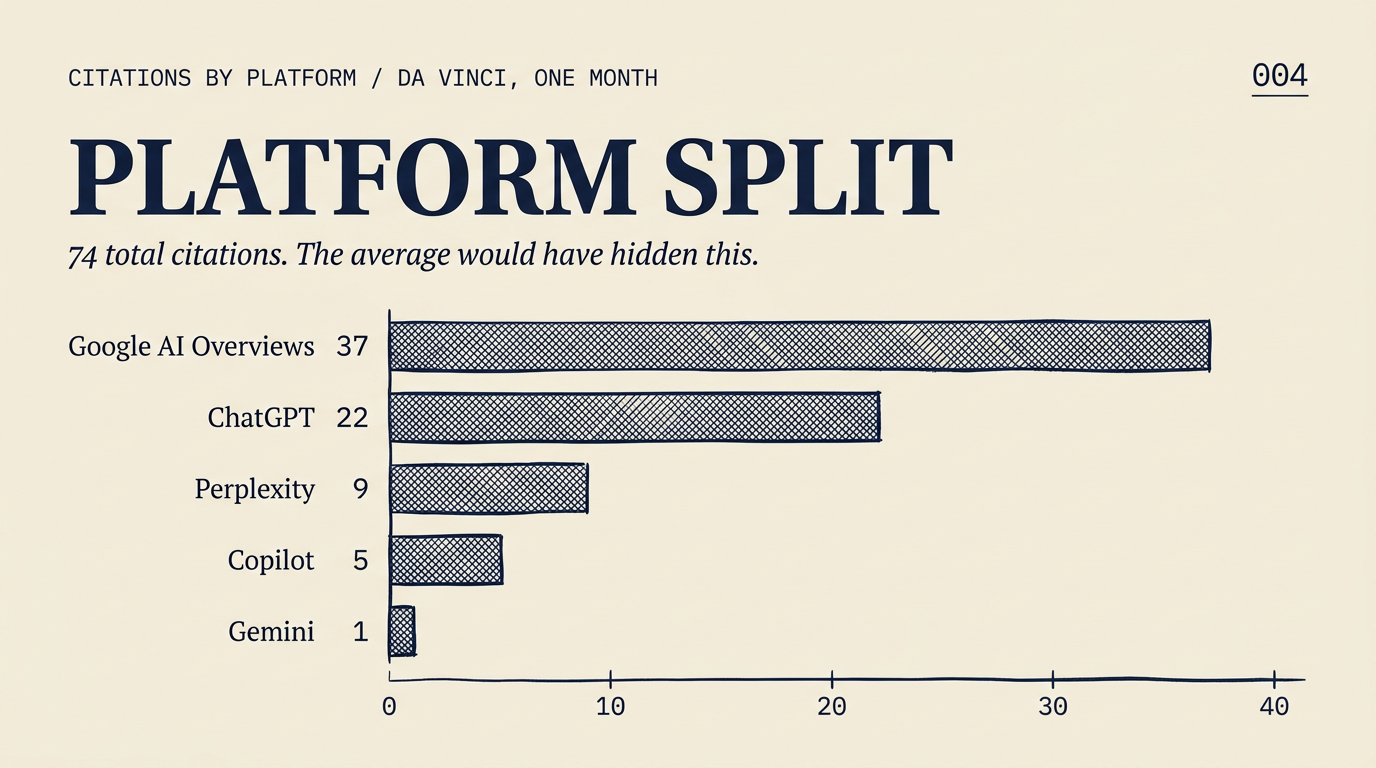 One brand, seven numbers. The average of these would have said nothing.
LLM SEO tools and trackers
A crowded market of LLM SEO tools now sells exactly this counting, from enterprise platforms to point trackers, and the honest summary is that the instrument matters less than the standard: platforms named, citations counted, months compared, competitors included. We run the measurement through Ahrefs' AI citation dataset; our full roundup of the trackers is the staged companion to this page and will link from here when it publishes.
Keep reading
The parent sub-pillar covers the full AI search program: strategy, execution, and how it plugs into B2B SaaS SEO as a whole.
09FAQ
Is LLM SEO different from GEO?
Not in the work. LLM SEO is the developer-flavored name and GEO the research-flavored name for the same discipline: getting named and cited inside AI answers through retrievable, parseable, trustworthy, specific content. If a proposal prices them as separate services, one line item is decorative.
Which LLM is best for SEO?
That question is usually about the other meaning, using AI models to do SEO work. There the operator matters far more than the model, and serious teams use several. For being visible inside LLMs, the subject of this page, the platform that matters most is wherever your buyers ask their questions.
Do LLMs crawl my website?
Yes, through named crawlers you can see in logs and control in robots.txt: GPTBot, OAI-SearchBot, and ChatGPT-User from OpenAI, ClaudeBot from Anthropic, PerplexityBot, and Google-Extended governing Gemini training. Blocking them blocks the visibility this page describes, so audit access first.
Does llms.txt actually improve AI visibility?
There is no confirmed evidence that major AI platforms consume the file, and Google's John Mueller has cautioned against expecting ranking effects. It costs nothing to generate and keep accurate, so do that, then put the real budget into rendering, content, and authority.
Will SEO be replaced by AI?
The counting is changing faster than the craft. The systems writing the answers pull overwhelmingly from domains that earned trust the classic way, and their retrieval runs on search indexes, so the foundation transfers. What gets replaced is measurement built only on rankings and clicks.