On this page
Every SaaS link building agency roundup has the same secret: the publisher usually sells what the list ranks. Ours is no different, and we would rather say it in the second sentence than let you find it in the footer. Technotize builds links for B2B SaaS companies, we put ourselves first on this page, and everything below is built so you can check our work instead of trusting it.
So here is the deal. This page gives you eleven real options with real data: what each one is built for, how it operates, and the verified work behind it, judged on named clients, niche depth, and fit. Where a claim comes from an agency's own marketing, we say so. Where it comes from third-party reporting, we name the source. By the end you will know which one fits your stage, and exactly which questions expose the ones that do not deserve your budget.
01How we judged these SaaS link building agencies
Ranking your own market is a conflict of interest wearing a byline, so the only fix is method you can audit. This chapter shows the tests, the reason link building belongs in the AI conversation, and the evidence standard every entry is held to.
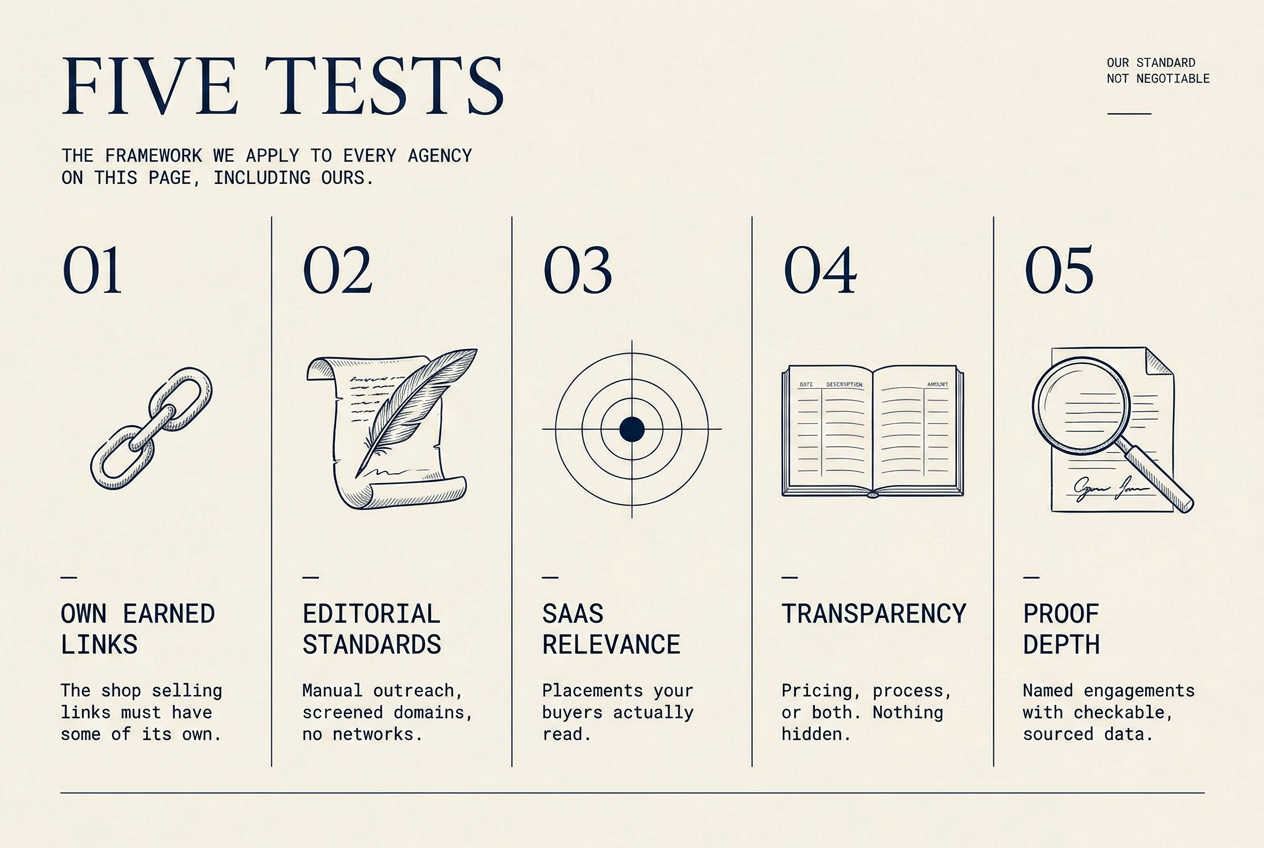
The five tests every agency here had to pass
First, verified work: named client outcomes with sources attached, because SaaS link building experts should be judged on links built for clients, not claims made about themselves. Second, editorial standards: manual outreach and screened domains, not networks wearing a trench coat. Third, SaaS relevance, since a placement your buyers will never read is a metric, not a result. Fourth, transparency, in pricing, process, or both. Fifth, proof depth: named programs with checkable data outrank testimonial walls, and testimonial walls outrank adjectives.
Why link building now feeds AI answers
Link building for SaaS companies used to be a rankings conversation; it is now also an answers conversation. October 2025 buyer research commissioned by Google found about six in ten B2B buyers folding AI assistants into the purchase, and the sources those assistants cite skew hard toward domains with earned authority. In our own per-platform tracking, client citations arrived only after the referring-domain curve bent, never before. The links you build for Google are the same links that get you named when a buyer asks a machine what to buy.
The evidence standard: verified work, not website trophies
Most lists in this market rank agencies by the agencies' own website metrics, authority scores, traffic, link counts, and an early draft of this page did too, before we threw it out. The best operators in any service market sell through reputation and results rather than their own blogs, so a self-referential stat mostly measures marketing budget. What predicts your outcome is the work: named clients, documented curves, a niche match to your category, a model match to your stage. Every entry below is judged on exactly that, and every factual claim names where it comes from, a client-approved case page, the provider's published materials, or third-party reporting, so you can verify before you shortlist.
02The 11 best SaaS link building agencies
Order reflects fit for the reader this page serves, a software company hiring for authority that turns into pipeline, not a claim that number one beats number eleven at everything. Lists of the top link building agencies for SaaS companies usually hide their author; ours is entry one, and the verified-work column lets you discount that however you like.
| Agency | Best for | Model | Verified work (source) |
|---|---|---|---|
| Technotize | Links tied to pipeline, inside a full SEO program | Editorial placements and digital PR | Workwize: 130 to 1,413 refdomains, 22 mo (case page) |
| saaslinkbuilder | Pure-play SaaS-to-SaaS, no lock-in | Founder-led outreach, listicle placements | Cybersecurity SaaS: 102K to 195K visits, 12 mo (own cases) |
| SAASY LINKS | Reach into a large publisher network | Editorial placements plus brand mentions and GEO | HeyReach: 6.8K to 26.3K visits, 60 links, 12 mo (own case page) |
| Dofollow | Links-only specialist for B2B SaaS | Relationship-based editorial placements | B2B SaaS-only editor network (own materials) |
| uSERP | Funded SaaS in brutal categories | Premium authority placements | Decade of top-tier placements for funded brands (own materials) |
| Editorial.Link | Quality-first, smaller monthly batches | Small senior team, manual editorial | Editorial-only model, published pricing (own site) |
| Linkbuilder.io | Fully hands-off campaigns | Managed outreach, AI-assisted prospecting | Managed campaigns, published pricing and process (own site) |
| Siege Media | Content and links as one motion | Content-led link earning | Instacart: 34,000+ LLM citations earned (published case) |
| Fractl | Press coverage and journalist links | Data studies and digital PR | Journalist-cited data studies (own portfolio) |
| Above Apex | Off-page only, SaaS-exclusive | Links and brand mentions, daily monitoring | 13 Clutch reviews at 5.0, published replacement policy (own count) |
| VH-Info | Published pricing, focused packages | Manual white-hat outreach | Published pricing from $2,500 for 10 links (own site) |
Source named per claim: client-approved case pages, provider-published materials, or third-party reporting. Checked August 2026.
Note on sourcing. Four claims currently credited to Founder Reports have been re-sourced to each agency's own published materials. Founder Reports ranks for this term with a competing list, and citing a competitor as our evidence base was a mistake.
1. Technotize, best for links tied to pipeline
 Technotizetechnotize.io
We build links as one part of a revenue program, not as a line item sold by the dozen. Every domain gets screened before outreach, placements go in as minimal edits editors actually accept, and our current campaign has held exact-match anchors at zero, because anchor discipline is what keeps authority gains through core updates. The proof is named and public: Da Vinci grew from 113 to 357 referring domains in 11 months, Workwize from 130 to 1,413 over 22, both with client-approved data linked below. The discipline behind those curves is our editorial link building practice.
Not for you if you want links bought by the dozen with no strategy attached, or a vendor with a decade of history.
2. saaslinkbuilder, best for pure-play SaaS-to-SaaS
 saaslinkbuildersaaslinkbuilder.com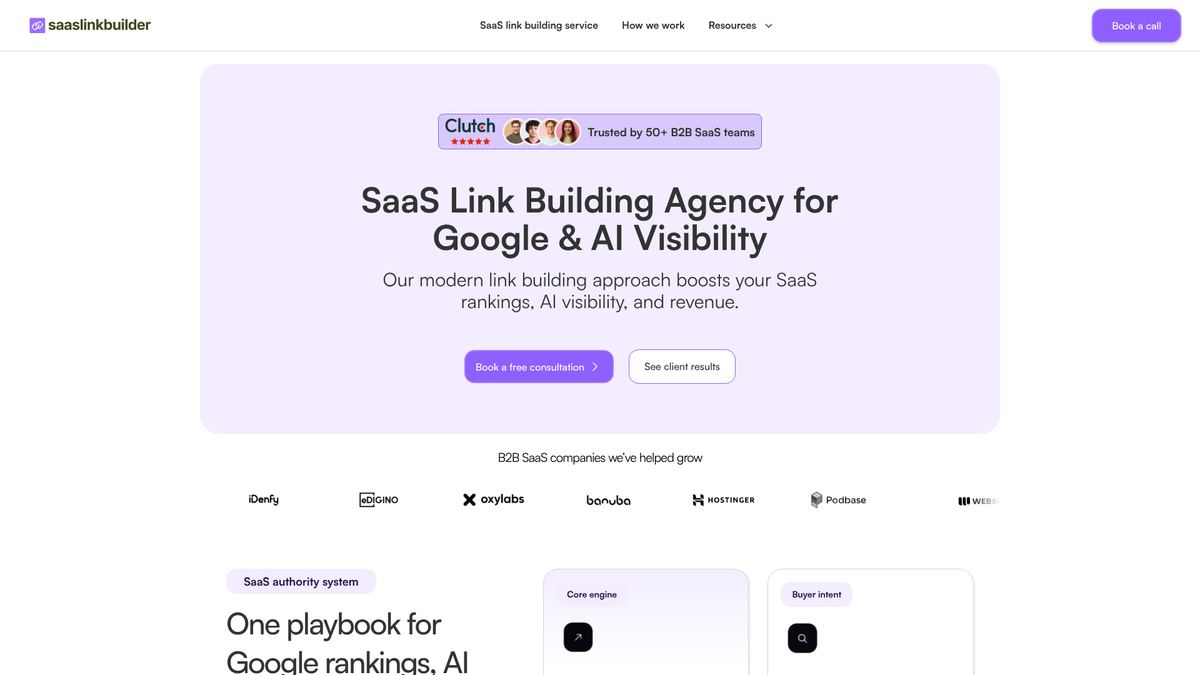
A founder-led shop doing one thing: SaaS-to-SaaS links, with heavy emphasis on getting clients into the listicles and comparison pages where buyers already shortlist, work that overlaps our own link insertion discipline. Its published process carries the operational details that make it stand out: a 15-step quality checklist per placement, payment at month-end only for links actually delivered with no upfront retainer, weekly link monitoring, and a one-year replacement guarantee. Published cases carry real curves, a cybersecurity client from 102,000 to 195,000 monthly organic visits in a year among them.
Not for you if you need strategy, content or technical work bundled in.
3. SAASY LINKS, best for scalable link building
 SaaSy Linkssaasylinks.com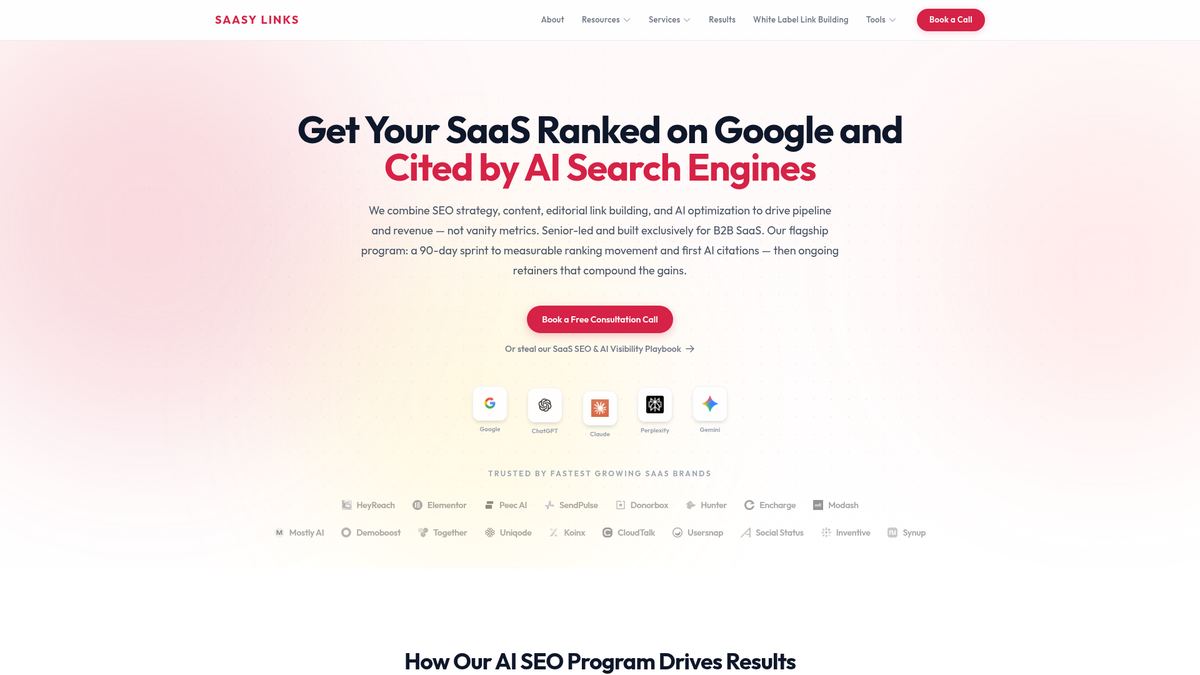
Founded and run by Vikas Kalwani, who has spent a decade in SaaS link building and now sells the network he built: 3,500 editorial partners, more than 10,000 links and mentions placed, and over 100 SaaS clients, per its own site as of August 2026. The published case studies are the deepest on this list and the only ones pairing traffic with AI citation counts per client. HeyReach went from 6,800 to 26,300 monthly visits on 60 links across 12 months, with 34 ChatGPT and 58 Perplexity citations recorded. Modash ran 51 months and went from 25,000 to 205,000. Encharge ran 37 months from 700 to 19,500. Retention at that length is the hardest thing on this page to fake.
The testimonials are named rather than anonymous, from Elementor, Modash, Usersnap, SendPulse and Donorbox, alongside a 5.0 Clutch rating across six reviews. Link building is now one line in a wider AI SEO program rather than the whole offer, and the firm also sells brand mentions, listicle placement and Reddit work aimed specifically at LLM citation.
Not for you if you want a small bespoke operation rather than access to a large network, or if you need pricing before a call, because rates are not published.
4. Dofollow, best for links-only specialists
 Dofollowdofollow.io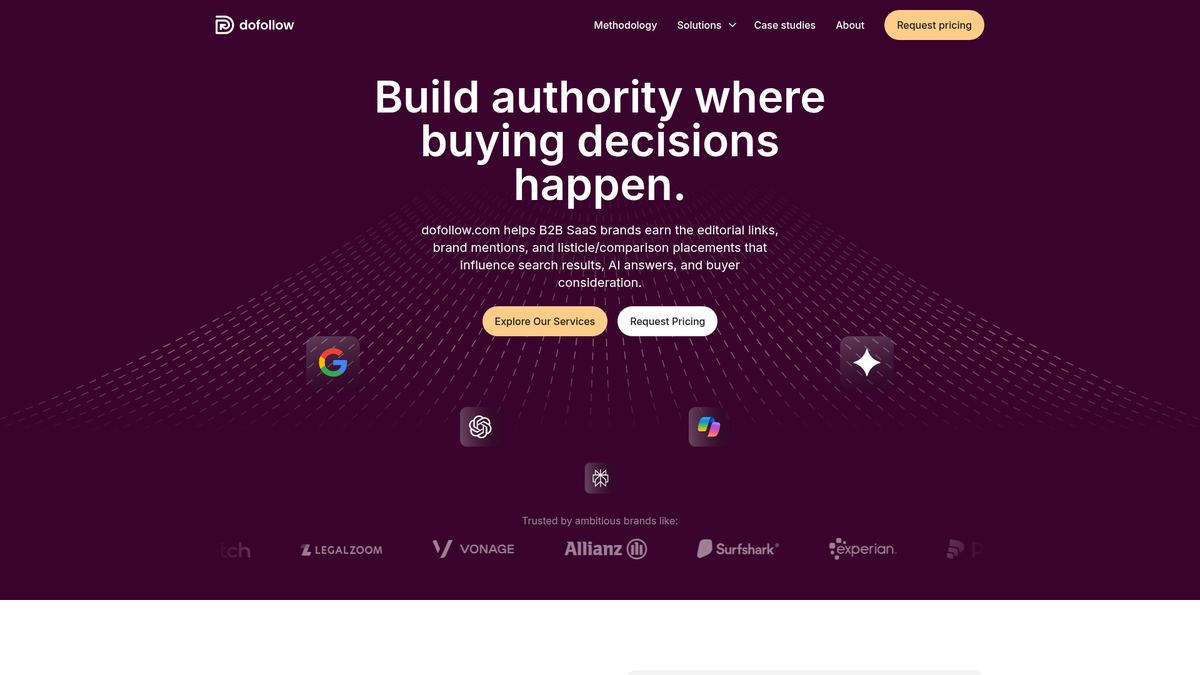
The purest specialist here: Dofollow works exclusively with B2B SaaS and sells exactly one thing, links, with no content retainers or technical work attached. Placements come through standing relationships with editors and publishers rather than cold volume outreach, which is the model that ages best as spam filters tighten. The single-service focus is the pitch: one accountable specialist whose entire business depends on placements aging well.
Not for you if content and strategy are not already handled internally, because links alone will not carry a weak site.
5. uSERP, best for funded SaaS in brutal categories
 uSERPuserp.io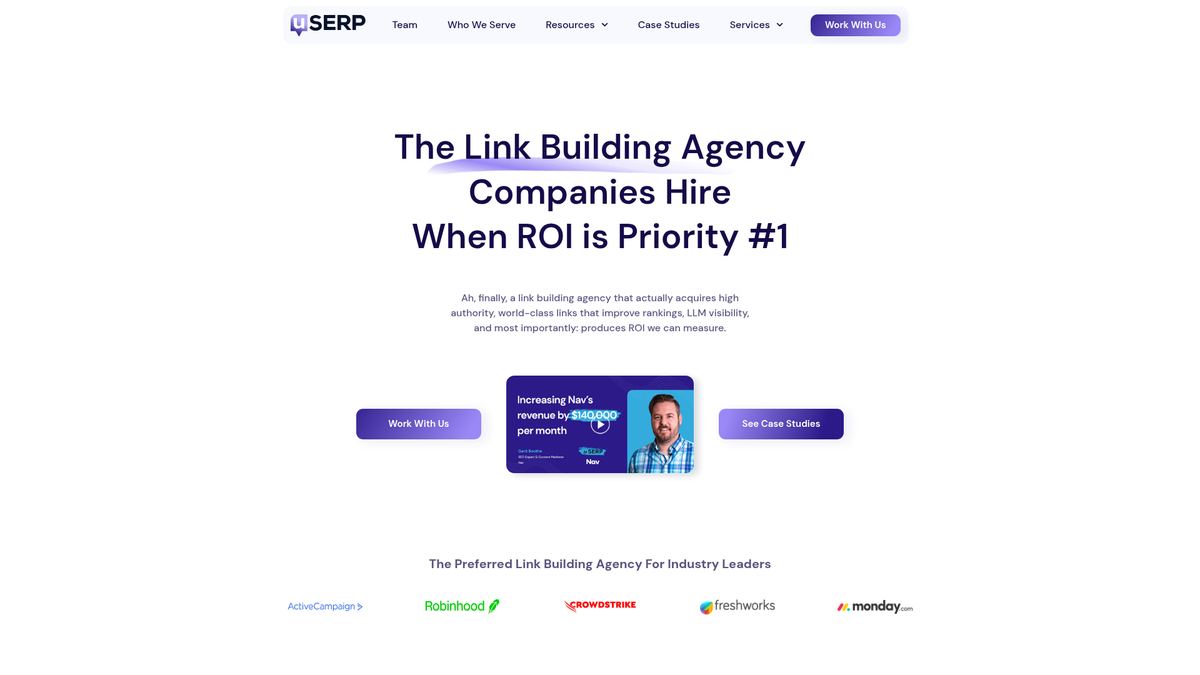
The premium end of the market. uSERP built its reputation on high-authority editorial placements for funded, recognizable software brands, the publications most agencies cannot reach, priced accordingly. A decade of operating at that tier is the record, and the roster it sells through is the evidence.
Not for you below roughly $10,000 a month, where the tier it operates at is out of reach.
6. Editorial.Link, best for quality over volume
 Editorial.Linkeditorial.link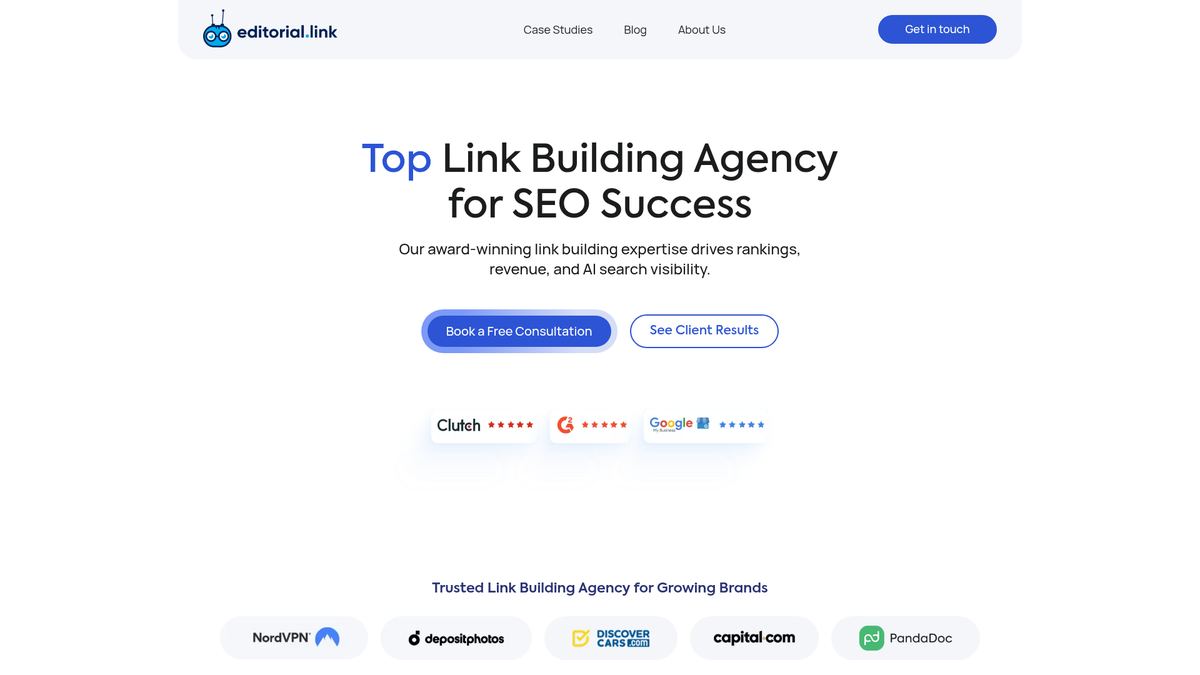
Built around a small senior team earning placements manually, trading volume for quality, so monthly counts run lower than the managed-service crowd and the survival rate runs higher. Pricing is published on its site, rare at the quality tier it sells.
Not for you if the mandate is volume, because the model trades monthly counts for survival rate.
7. Linkbuilder.io, best for hands-off campaigns
 Linkbuilder.iolinkbuilder.io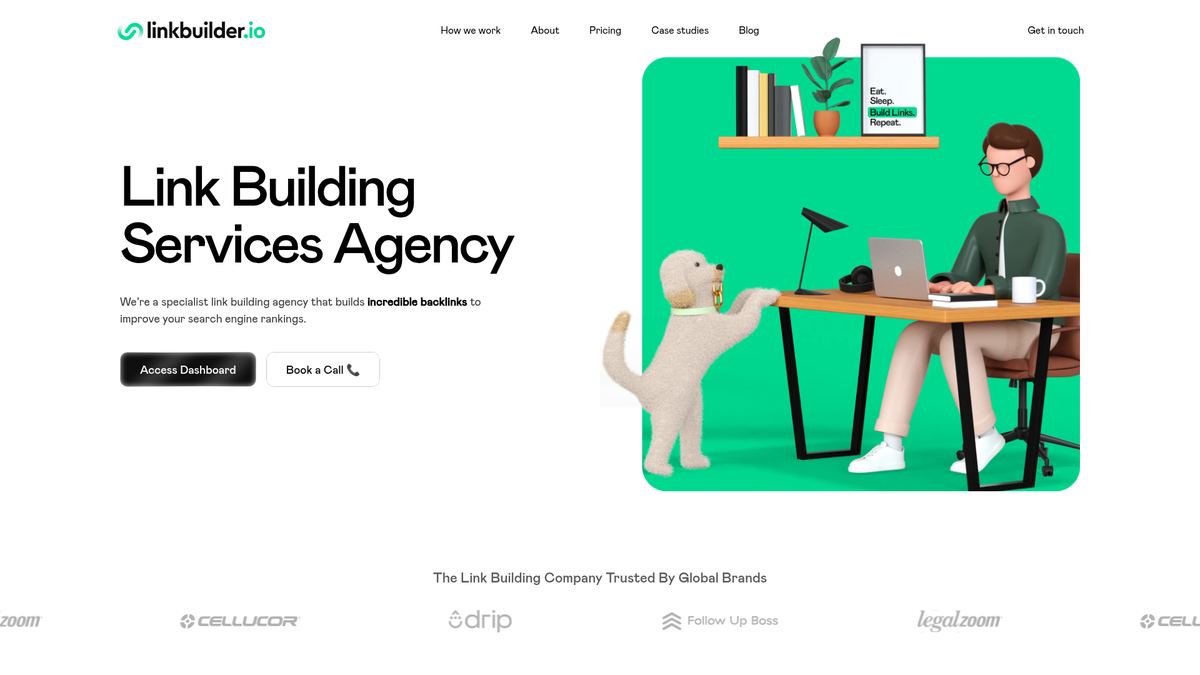
A fully managed operation, manual outreach with AI-assisted prospecting, designed for companies that want link building to run without them. Pricing and process are published on its site, and the documentation habit carries into the work: reporting is the product's spine.
Not for you if you want to approve every target personally, since the model is built to run without you.
8. Siege Media, best for content and links as one motion
 Siege Mediasiegemedia.com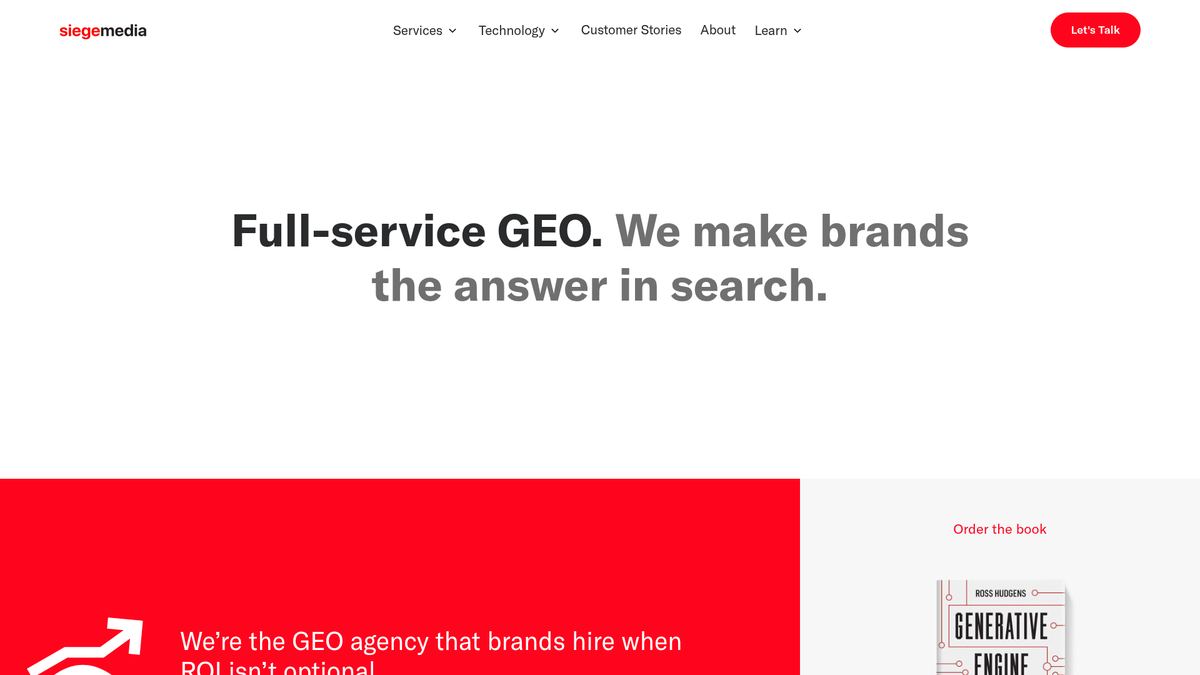
The scale operator, built on a model where links come from content assets strong enough to attract them rather than outreach alone. Its published Instacart case pairs 34,000-plus earned LLM citations with $73,000 in blog traffic value growth, per Siege's own materials. Pricing sits at the top of this list's range.
Not for you if you want SaaS-only focus. It works across fintech, ecommerce and health too.
9. Fractl, best for press coverage and journalist links
 Fractlfrac.tl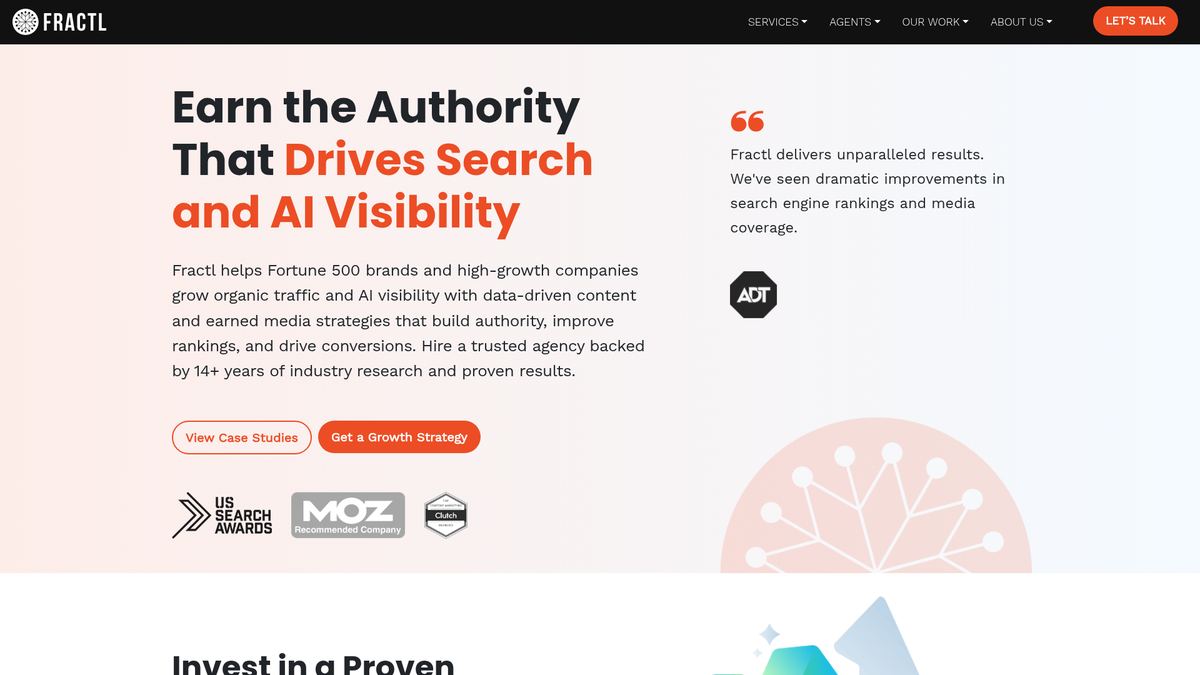
Digital PR in its original form: original research, surveys, and data studies pitched to journalists, producing the links no outreach email can buy. The trade-off is timeline and cost, since a study takes months to produce and place, and the payoff is coverage-grade placements from publications outreach alone cannot reach.
Not for you if you need placements this quarter. A data study takes months to produce and place.
10. Above Apex, best for off-page only
 Above Apexaboveapex.com
SaaS-exclusive and off-page only: links and brand mentions, nothing bundled. Its site publishes the operational details most agencies hide, daily link monitoring, a permanent-placement replacement policy, and 13 Clutch reviews at a 5.0 average by its own count. The published policies are the point: a specialist confident enough to put replacement terms in writing before the call.
Not for you if content is not handled internally, because off-page only means exactly that.
11. VH-Info, best for published pricing
 VH-Infovh-info.com
A specialist running manual white-hat outreach since its 2022 founding, with the rarest thing in this market: published pricing, from $2,500 a month for 10 links. White-label available for agencies, and its published cases report client traffic gains from 120 percent to over 5,000 percent.
Not for you if you need senior strategy alongside the outreach.
03How to choose a SaaS link building agency
The eleven above hold up under the questions that follow; most of the wider market does not. This chapter gives you the questions that sort them, the flags that end calls, and the honest matching of model to stage, alongside our full-service SaaS SEO agency comparison if the mandate is wider than links.
Five questions that expose a weak SaaS link building agency
Ask where exactly your links will live and whether you approve targets before outreach starts; a refusal means inventory. Ask which niches they actually place in, because SaaS relevance is the difference between an asset and an invoice line. Ask their anchor policy; the right answer sounds boring, mostly brand and natural phrases, and the wrong one sounds like a menu. Ask what happens when a link drops, because some always do, and replacement policy separates operators from brokers. And ask for one named client you can verify independently, since the industry's most-cited ranking study found the top result carrying nearly four times the backlinks of positions two through ten, which is exactly why this market attracts sellers whose proof evaporates on contact.
Red flags that end the call
Fifty-dollar placements. Guaranteed authority numbers. Exact-match anchor packages. A "private network" pitched as an asset instead of confessed as a liability. Links live within 48 hours, which real outreach cannot do. And case studies with percentages but no names, dates, or sources.
Choosing a SaaS link building agency by stage
Match the model, not the logo. Pre-authority companies get the most from a full program where links ride content and technical fixes, because placements pointed at weak pages leak. Growth-stage teams with content humming fit the pure specialists: Dofollow, saaslinkbuilder, Above Apex and VH-Info by budget, or SAASY LINKS if network breadth matters more than a small bespoke team. Funded brands in savage categories pay uSERP or Siege tiers because nothing cheaper registers. And if the real goal is coverage, Fractl-style digital PR is a different product wearing the same category name. The wrong buy at every stage is the same one: volume without a destination worth linking to.
04What a SaaS link building agency costs
We run these programs, so these are operator numbers rather than survey averages.
What one link actually costs
A legitimate editorial placement in a B2B SaaS category lands in the low hundreds of dollars per link once fees, content, and outreach labor are counted honestly. The cost drivers are real: prospecting that rejects most candidates, a writer producing something an editor will accept, and the back-and-forth that gets it live. Anything dramatically below that range skipped one of those steps, and it is never the invoice.
What a monthly program costs
Credible agency programs quote between $2,000 and $15,000 a month depending on velocity and placement tier, with the premium shops above that. Volume is the wrong axis to shop on anyway; ask instead what share of prospects gets rejected, because the discard pile is where quality lives.
| Tier | Per placement | Monthly program | What you are buying |
|---|---|---|---|
| Farm inventory | $25 to $75 | Under $1,000 | Shared networks, discounted at algorithm scale |
| Entry specialist | $200 to $400 | $2,000 to $4,000 | Manual outreach. VH-Info publishes $2,500 for 10 links |
| Mid-market program | $400 to $700 | $4,000 to $9,000 | Screened domains, editorial placements, replacement policy |
| Premium and network tier | $700 and above | $9,000 to $15,000 and above | Publications most agencies cannot reach |
Operator ranges as of August 2026. Only two agencies on this list publish rates.
The cheap-link tax
Bulk inventory means shared farms, and Google's published spam policies name manipulative link schemes as targets its systems discount at algorithm scale. The expensive part of cheap links is paying twice: once to the reseller, and once more when a real agency has to outgrow the profile the reseller left behind. We have priced several of those cleanups; they cost more than doing it right would have.
05What SaaS link building results actually look like
Two programs, both named, both with data the clients control. Hold every SaaS link building agency here, including us, to this format: named client, sourced numbers, client sign-off.
| Client | Referring domains | Months | Domain rating | Velocity |
|---|---|---|---|---|
| Da Vinci | 113 to 357 | 11 | 19 to 55 | 20 to 35 new domains a month |
| Workwize | 130 to 1,413 | 22 | 27 to 71 | Steady across the full term |
Both client-approved. Full figures on each case page.
Da Vinci: 113 to 357 referring domains in 11 months
A warehouse software provider serving third-party logistics, taken from 113 to 357 referring domains at a deliberate 20 to 35 new domains a month, because a steady climb looks like a brand getting popular and a spike looks like a receipt. DR moved 19 to 55 alongside, organic multiplied 25 times, and the curve kept climbing after the contract ended, which farm links never do. Da Vinci's full write-up carries every figure with its source attached.
Workwize: 130 to 1,413 over 22 months
The long game version: 130 to 1,413 referring domains across 22 months, DR 27 to 71, organic becoming the leading pipeline source. Same discipline, longer runway, and the Workwize case study carries the receipts.
06SaaS link building agency FAQ
What does a SaaS link building agency actually do?
It earns links from sites your buyers and search systems both trust: industry publications, listicles and comparison pages, partner ecosystems, and press coverage. The work is prospecting, screening, outreach, negotiation, and placement, and in a good agency most of the effort goes into what gets rejected.
How much does a SaaS link building agency cost?
Legitimate placements land in the low hundreds of dollars each once fees, content, and labor are counted, and credible monthly programs run $2,000 to $15,000 depending on volume and tier. Only two agencies on this list publish rates at all, the lowest being $2,500 a month for 10 links. Prices far below that range mean farm inventory.
How many links per month does a SaaS company need?
It depends on the authority gap to your category's incumbents, but most programs we run land between 10 and 35 new referring domains a month. Consistency beats bursts: the two client curves above held steady velocity for 11 and 22 months respectively, and that shape is itself a trust signal.
How long until SaaS link building moves rankings?
Authority lags placement by one to two quarters, because search systems discount new links until they age and accumulate. In our programs the ranking curve bent in the second quarter of consistent work and compounded from there, and AI citations followed the same authority curve later still.
How do I pick the best SaaS link building agency for my stage?
Match model to stage: full programs before you have authority, pure specialists once content and strategy run in-house, premium tiers for savage categories, digital PR when coverage is the actual goal. Then apply the five questions above; the best SaaS link building agency for you is whichever one survives them for your situation.
Related agency and craft reads
Adjacent operator reads worth pairing with this one.
- enterprise SEO agencies ranked on verified work. Enterprise SEO agencies judged on niche depth and case work you can spot-check.
- our operator's shortlist of SaaS content marketing agencies. The content marketing agencies whose published work stands up to a read-through.
- how to shortlist generative engine optimization agencies with sources you can check. GEO agencies judged on live ChatGPT and Perplexity citations, not decks.