On this page
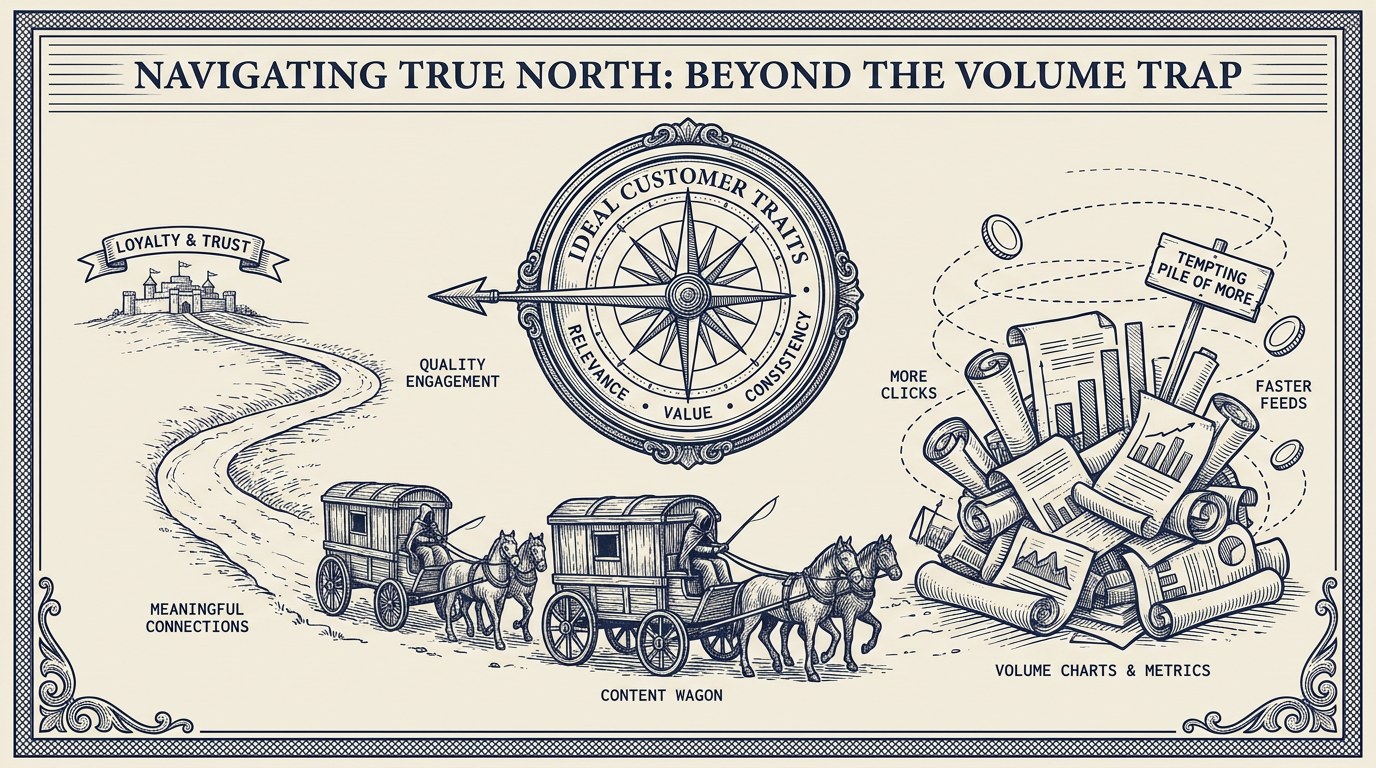
Most B2B SaaS content strategies start with keyword volume. The team pulls top-of-funnel keyword lists from Ahrefs or Semrush, ranks by volume and KD, picks the top 50 to 100 targets, and ships content against them. The output ranks for keywords. It rarely produces pipeline. ICP-driven content strategy inverts the workflow: customer research drives topic selection, keyword research validates and structures the output. This is the operator playbook for ICP-driven content strategy in B2B SaaS: the customer research methodology that produces useful data, the prioritization workflow that turns ICP signal into topic decisions, and the measurement framework that proves the discipline beats keyword-volume-only content.
01What ICP-driven content strategy is (and why it beats keyword-volume-only)
ICP-driven content strategy is the discipline of letting Ideal Customer Profile research drive every content decision, with keyword research operating as a validation and structuring input rather than the primary topic selector. It is one chapter of our content strategy services for B2B SaaS and the operating discipline that separates content programs producing pipeline from content programs producing traffic without pipeline.
The actionable definition
ICP-driven content strategy starts every topic decision with the question "which ICP segment does this serve and what stage of their buying journey." Topics that don't map to a named ICP segment at a named buying stage don't get produced. The output is a content portfolio where every piece has an explicit role in moving a specific buyer through a specific stage of the journey. Keyword volume is a tiebreaker between topics that already serve an ICP segment at a buying stage, not the primary input.
Why ICP-driven beats keyword-volume-driven
Keyword-volume-driven content strategy produces a content portfolio optimized for traffic. The traffic often doesn't convert because the keyword targets don't map to the company's actual buyer. ICP-driven content strategy produces a content portfolio optimized for buyer-journey progression, which compounds into pipeline contribution. The two strategies produce dramatically different outcomes against the same production budget. We cover the underlying measurement framework in the broader B2B SaaS content marketing strategy framework post.
What ICP-driven content strategy is not
ICP-driven content strategy is not just persona development. Personas are useful artifacts but most B2B SaaS personas are written once and never updated; they become decorative documents that don't drive operational decisions. ICP-driven content strategy is not just buyer journey mapping either; the journey mapping is a sub-component of the broader discipline (covered in detail in the buyer journey content mapping playbook). The discipline is the operational workflow that connects customer research to topic prioritization to production to measurement.
02The ICP research methodology that produces useful data
ICP research produces useful data only when it actually surfaces the underlying decision-making patterns of the buyer. Three primary sources, ranked by signal quality.
Customer interviews as primary source
Direct customer interviews with 8 to 15 customers per ICP segment, run by someone with the skill to ask follow-up questions and extract specifics, produce the highest signal data. The interview structure that works: 30 minutes per customer, semi-structured, covering the buying trigger, the evaluation process, the alternatives considered, the decision criteria that mattered, the implementation experience, and the current usage pattern. Notes get coded for patterns across interviews. The pattern recognition is where the ICP signal emerges.
Sales call transcripts as secondary source
Recorded sales call transcripts (Gong, Chorus, Fireflies, similar tools) provide a complementary data source at scale. The volume advantage is significant; a B2B SaaS sales team running 50 to 200 calls per month produces transcript data far beyond what 15 customer interviews can match. The trade-off: sales call transcripts capture the sales conversation, which is filtered by the rep's framing. Use sales call transcripts to validate patterns from customer interviews, not to replace them. The keyword research methodology that mines sales call transcripts covers the data extraction patterns.
Support ticket and product analytics as tertiary source
Support tickets surface the post-purchase pain points and adoption blockers. Product analytics surface usage patterns that signal which capabilities customers actually value. Both inform the ICP research at the post-purchase stage but tell you less about the buying decision. Use these as tertiary sources to refine the ICP profile, not as primary topic prioritization inputs.
Synthesizing into ICP profiles
The synthesis discipline that works: each ICP segment gets a 1 to 2 page profile covering buyer role and seniority, company size and stage, buying trigger patterns, evaluation criteria, content consumption preferences (where they research, what formats they engage with), and the named alternatives they consider. The profile gets reviewed against actual customer interviews quarterly; profiles that drift from observed customer reality get rewritten. The SME interview process for B2B SaaS content we run covers the broader interview methodology that produces this depth of synthesized data.
03Converting ICP data into content topic prioritization
ICP data is operationally useful only when it actually drives topic prioritization decisions. Three layers of prioritization matter.
Topic relevance scoring
Score every potential topic against the relevance to each ICP segment. A 1 to 5 scale per segment, with explicit definitions for each score level (1 = irrelevant, 5 = directly addresses a buying decision the segment must make). Topics that score 4 or 5 for at least one segment make the production shortlist; topics that score 3 or below across all segments get cut even if keyword volume is attractive.
Topic depth calibration
For topics that make the shortlist, calibrate depth against where the segment is in their buying journey. Awareness-stage buyers need framing and category definition. Consideration-stage buyers need comparison and capability depth. Decision-stage buyers need implementation specifics and named-alternative comparison. The same topic produced at the wrong depth for the wrong stage wastes production capacity even when the topic relevance score is high.
Topic timing against buyer stage
Buying journeys have stage-specific information needs. A "what is [Category]" awareness piece serves a buyer 6 to 12 months from purchase. A "[Tool A] vs [Tool B]" consideration piece serves a buyer 2 to 6 months from purchase. A "implementation guide" decision piece serves a buyer 0 to 2 months from purchase. Content production timing should match the inbound flow from each stage; programs producing only awareness content miss the buyers already moving through consideration and decision stages.
04The four content layers an ICP-driven strategy ships
ICP-driven content strategy ships across four layers per ICP segment. Most B2B SaaS programs over-invest in layer 1 and under-invest in layers 3 and 4.
Awareness-stage content
Content that frames the category, defines the problem the product solves, and helps buyers understand why this kind of solution matters. Examples: "What is [Category]," "Why [Buyer role] needs to think about [Problem]," "[Problem] in 2026: the state of [Category]." This layer feeds organic search traffic and AI Search citations on category-defining queries; the conversion rate per visitor is low, the absolute volume is high.
Consideration-stage content
Content that compares solutions, evaluates capabilities, and helps buyers form a shortlist. Examples: "[Tool A] vs [Tool B]," "[Category] buyer's guide," "How to evaluate [Category] vendors." This layer is the highest-leverage AI Search citation real estate for B2B SaaS (covered in the comparison content playbook for B2B SaaS). The conversion rate per visitor is materially higher than awareness content.
Decision-stage content
Content that addresses the specific concerns of buyers ready to commit. Examples: "Implementation guide for [Category]," "Migration from [Competitor] to [Your tool]," "[Category] pricing transparency: what to expect." Most B2B SaaS programs ship 1 to 3 pieces of decision-stage content per quarter; the rate should be 10 to 20% of total production. The conversion rate per visitor is the highest of any content category.
Post-purchase content
Content that supports adoption, expansion, and customer success. Examples: "[Product] adoption checklist," "How [Customer segment] gets the most out of [Product]," expansion play playbooks for existing customers. This layer doesn't produce new pipeline but feeds expansion revenue and reduces churn. Programs that skip this layer leave material revenue on the table.
05Distribution decisions driven by ICP signal
Distribution is where ICP-driven strategy compounds against keyword-volume-driven strategy. Three patterns matter.
Where each ICP segment actually consumes content
ICP research surfaces where each segment researches. Technical buyers (engineering, IT, security) over-index on Hacker News, technical Reddit communities, GitHub-adjacent content, and specific industry publications. Marketing buyers over-index on LinkedIn, Substack newsletters, and specific marketing publications. Sales buyers over-index on LinkedIn and Sales Hacker. Operations buyers over-index on industry-specific communities. Programs distributing "everywhere" dilute production capacity; programs distributing where each ICP segment actually is concentrate impact.
Channel-content fit by segment
Each channel has format preferences. LinkedIn rewards 6 to 12 paragraph posts with operator specifics. Substack rewards 1,500 to 3,500 word essays with strong opening hooks. YouTube rewards 8 to 15 minute video formats with specific tactical demos. Reddit rewards conversational expertise with verifiable claims. The same content idea translated to different channels with channel-specific format adaptation outperforms one-format-everywhere distribution.
The distribution-content production loop
Distribution data feeds back into content production prioritization. LinkedIn engagement on a specific topic surfaces buyer interest the keyword research didn't surface; high comment density on a Reddit post about a specific pain point validates topic relevance independently of search volume. Programs that close this loop produce content portfolios that compound against the keyword-volume-only competition. HubSpot's research on B2B content distribution covers complementary distribution patterns at the category level.
06Measuring ICP-driven content performance
ICP-driven content strategy is operationally defensible only if the measurement framework proves the discipline produces results. Three measurement layers matter.
Per-segment performance measurement
Aggregate content performance metrics (organic traffic, engagement, conversion) hide ICP-segment-specific signal. The discipline is measuring content performance per ICP segment: organic traffic from segment-matching queries, engagement from segment-matching company profiles (where measurable through tools like Clearbit or Apollo), conversion to pipeline by segment. Per-segment measurement surfaces which segments the content portfolio is actually serving and which segments are underserved.
Pipeline contribution by content category
The reporting layer that survives CFO scrutiny: pipeline contribution attributable to content, segmented by the four content layers (awareness, consideration, decision, post-purchase) and by ICP segment. The attribution methodology depends on the broader marketing attribution infrastructure; even imperfect attribution surfaces which content categories produce pipeline disproportionately.
The quarterly ICP content scorecard
The reporting format that drives action: a quarterly scorecard showing content production by ICP segment and stage, performance metrics per segment, pipeline contribution per content category, and a comparison against prior quarters. The scorecard mirrors the SEO ROI scorecard framework for B2B SaaS we ship for SEO performance reporting, with content-strategy-specific metrics added.
07Common failure modes and operational fixes
Four dominant failures.
The "keyword-volume-driven" failure: programs starting topic selection from keyword volume rather than ICP relevance, producing content that ranks but doesn't convert. Fix: invert the workflow per Chapter 03; keyword volume becomes a tiebreaker between ICP-relevant topics, not the primary input.
The "personas as decoration" failure: programs that write persona documents once and never reference them in topic decisions. Fix: build the prioritization workflow in Chapter 03 such that every topic decision references the ICP profile explicitly; profiles that never get used are decorative.
The "awareness-stage over-investment" failure: programs producing only awareness content because awareness keyword volume is largest, missing the higher-conversion consideration and decision stages. Fix: target 40% awareness, 30% consideration, 20% decision, 10% post-purchase as a starting ratio, calibrate against inbound traffic by stage.
The "no quarterly refresh" failure: programs operating with stale ICP profiles that no longer match the actual buyer mix. Fix: quarterly ICP refresh sprint covered in Chapter 08; profiles get reviewed against actual customer interviews quarterly.
08Building the ICP-driven content operating cadence
The cadence that turns ICP data into program decisions has three tiers.
The quarterly ICP refresh
Quarterly cadence: 4 to 8 customer interviews per ICP segment plus review of the prior quarter's sales call transcripts, support tickets, and product analytics. The output is an updated ICP profile per segment. The quarterly refresh prevents profile drift and maintains strategy fitness against the evolving buyer.
The monthly content prioritization review
Monthly cadence: review the topic backlog against current ICP profiles, score topics against the four layers and segments, prioritize the next 4 to 8 weeks of production. The monthly review feeds the production sprints; it also surfaces topic gaps the keyword research alone didn't surface.
The weekly production sprint
Weekly cadence: 2 to 4 pieces of content in active production, each mapped to a named ICP segment and stage. The weekly sprint cadence aligns with how production teams actually operate; the segment-and-stage mapping keeps ICP discipline embedded in production execution. The content marketing plans framework for B2B SaaS covers the production planning structure that integrates this cadence.
If you want this ICP-driven content discipline running on your program, book a 30-minute content strategy audit with our team. Compare engagement options for content programs of different scales.
This is one chapter of the content strategy sub-pillar.
The full strategic framework covering content strategy, ICP-driven prioritization, buyer journey mapping, and budget allocation lives on the parent sub-pillar.
Read the content strategy sub-pillar →