On this page
Linkable assets are the highest-leverage backlink generation pattern in the post-2024 link-building landscape. For B2B SaaS specifically, free tools dominate the asset class hierarchy because they demonstrate product capability while earning editorial coverage from publications that would never write about a software vendor directly.
The framework below covers what linkable assets actually are, why free tools outperform other asset types for B2B SaaS, the five categories that account for 80 percent of placements, the dual-scope design framework (link bait plus PLG funnel) that listicle competitors miss, the build-versus-buy decision matrix, the promotion playbook for earning the first 50 backlinks, the ROI measurement that justifies the investment, and the maintenance discipline that prevents asset decay over 18 to 24 months.
01What linkable assets actually are (and why they matter for B2B SaaS SEO)
The first step is establishing what linkable assets are, what separates them from regular content, and why the discipline matters more in 2026 than during the early link-building era. The framing matters because programs treating linkable assets as a content marketing tactic miss the strategic SEO leverage; programs treating them purely as SEO infrastructure miss the content marketing amplification. Both layers compound when the discipline is operated correctly.
A working definition
A linkable asset is a content or interactive resource designed specifically to attract backlinks naturally because it provides value journalists, bloggers, and operators want to reference. The defining characteristic is reference-worthiness: a linkable asset gives external content creators a specific reason to link to it (a data point, a calculation, a tool, a definitive guide) rather than mention the brand generally. Regular content can earn backlinks, but linkable assets are engineered for it from the design phase.
The category includes free tools (calculators, generators, audits, benchmark databases), original research and surveys, comprehensive guides on specific topics, interactive content (quizzes, configurators), template libraries, and visual data resources (infographics, charts, maps). For B2B SaaS specifically, free tools dominate the category because they demonstrate product capability while earning editorial coverage, covered in detail in chapter 02. This sits inside our complete linkable assets playbook for B2B SaaS programs at the sub-pillar level and connects to the broader B2B SaaS link-building playbook at the pillar level.
Why linkable assets matter more in 2026 than in 2022
Three forces have shifted the linkable asset case in the past 24 months. First, traditional link-building tactics (guest posting, niche edits, broken link recovery) have lost effectiveness because publication standards rose after multiple Google algorithm updates targeting low-quality link networks. Linkable assets earn placements through editorial value rather than negotiated relationships, which makes them durable against future algorithm changes.
Second, AI Search engines weight ambient brand mentions and editorial citations more heavily than backlink-focused SEO frameworks predict. A free tool earning 80 mentions on tool roundup pages and industry guides produces AI Search citation signal that backlink count alone cannot capture. Third, the operational economics improved because LLM-assisted development reduced free tool build costs by 40 to 70 percent compared to 2022 baseline. Tools that required $40,000 to build in 2022 now build for $12,000 to $20,000 in 2026, which shifts the ROI math meaningfully toward the discipline.
02Why free tools dominate the B2B SaaS linkable asset hierarchy
For B2B SaaS specifically, free tools outperform other linkable asset categories at scale. The reasons are structural rather than situational, which means the pattern holds across SaaS verticals and ARR stages. The sections below cover the product-capability advantage that other asset types cannot replicate, the PLG funnel adjacency that compounds the SEO investment, and why other linkable asset types systematically underperform for B2B SaaS programs.
The product-capability advantage
Free tools demonstrate product capability without selling. A B2B SaaS content marketing platform offering a free content audit scanner shows journalists, prospects, and SEO operators what the platform can do without requiring a demo, sales conversation, or trial commitment. The demonstration produces editorial trust that other asset categories cannot match. Journalists writing about content marketing strategy reference the scanner because it offers a tangible reference point readers can verify themselves.
Other linkable asset categories produce value without product demonstration. Original research and surveys produce data but do not show product capability. Comprehensive guides produce expertise demonstration but do not give readers an interactive way to verify the brand's claims. Templates produce utility but commoditize quickly. Free tools sit at the intersection of utility, verification, and product demonstration, which is why they earn editorial coverage at rates other asset categories cannot match.
The PLG funnel adjacency
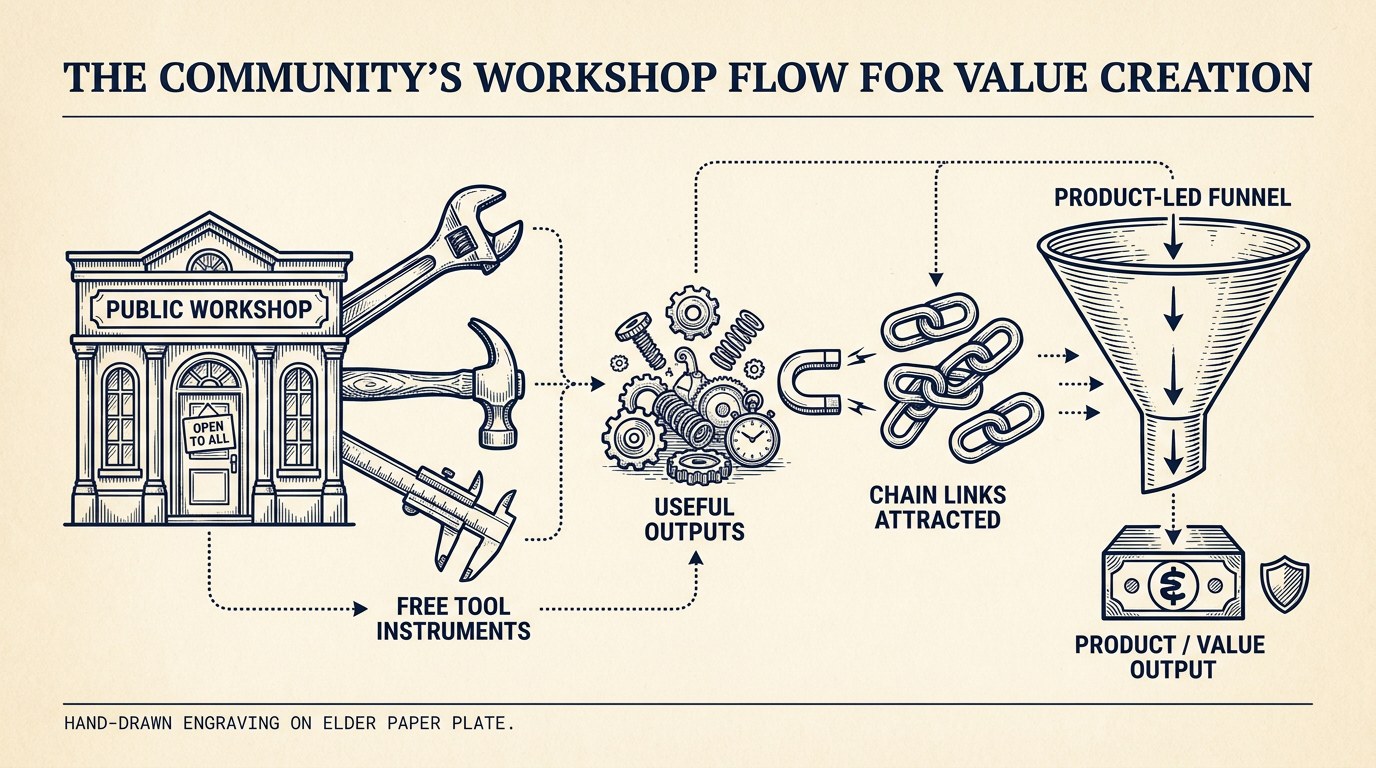
Free tools double as PLG funnel entry points when designed for both link bait and product-led growth. The pattern: a content marketer searches "content audit framework" and lands on a content audit scanner tool offered by the platform. The tool delivers a free audit. The audit results page includes a clear path to the paid product (deeper audit features, automation, integration with the broader content stack). The free tool user becomes a product trial signup at conversion rates that pure marketing content cannot match.
The PLG adjacency means free tools serve two business systems simultaneously: SEO authority through editorial backlinks, and product growth through trial signups. Programs that scope tools for only one system underdeliver on the other. The dual-scope design framework covered in chapter 04 prevents the failure pattern.
Why other linkable asset types underperform for B2B SaaS
Original research underperforms because B2B SaaS programs at $5M to $50M ARR rarely have proprietary data large enough to support compelling annual industry research. The research that earns placements (Salesforce State of Sales, HubSpot State of Marketing) requires datasets from 1,000 plus customers that most B2B SaaS programs do not have access to. Smaller research efforts produce thin findings that journalists discount.
Comprehensive guides underperform because the SERP for definitional and how-to queries is saturated by Ahrefs, Semrush, HubSpot, and Mailchimp at DR 90 plus. HubSpot's marketing statistics page is the canonical example of a linkable asset that earned thousands of referring domains over a decade by becoming the default citation for any "marketing benchmark" query, and new entrants competing on guide quality alone face 12 to 24 months of compounding before earning equivalent traffic. Templates underperform because they commoditize quickly: once one template exists for a topic, dozens follow, and editorial placements fragment across all of them. Free tools avoid these failure patterns because each tool occupies a specific functional niche that does not commoditize the way generic templates do.
03The five categories of free tools that earn backlinks
Five categories of free tools account for roughly 80 percent of B2B SaaS linkable asset placements across our portfolio. Each category fits different content marketing integration patterns and produces different ROI profiles. The sections below cover each category with B2B SaaS-specific examples, the typical backlink yield per category, and the operational considerations that determine which categories fit a specific program.
Category 1: calculators
Calculators perform structured computations that produce specific numeric outputs based on user inputs. Examples in B2B SaaS: ROI calculators (content marketing ROI, paid acquisition ROI, sales productivity ROI), pricing calculators (total cost of ownership, payback period, cost-per-seat), and benchmark calculators (industry-average conversion rates, sales cycle length, customer acquisition cost).
Calculator backlink yield is moderate to high (typically 40 to 120 referring domains over 18 months for well-promoted tools). Calculators rank well in Google because the SERP for calculation queries rewards interactive content over informational content. Calculators produce strong AI Search citation pickup because the calculation output gives AI engines a specific data point to attribute to the source brand.
Category 2: generators
Generators create assets, code, content, or structured outputs from user inputs. Examples: schema markup generators, meta description generators, FAQ generators, email signature generators, ICP profile generators. Generators differ from calculators because they produce assets users save and use elsewhere, which extends the tool's reference life beyond the initial session.
Generator backlink yield is high (typically 80 to 250 referring domains over 18 months for tools that solve real operational pain). Generators earn placements on tool roundup pages, "best free tools for X" articles, and operator newsletter mentions. The reference life extension produces compounding ambient citation as users save generator outputs and reference them across their work.
Category 3: audits and scanners
Audits and scanners analyze user-submitted URLs, content, or data and return structured findings with recommendations. Examples in B2B SaaS: SEO audit scanners, content quality scanners, technical SEO crawlers, social media audit tools, ad copy quality analyzers. Audits and scanners produce the strongest product capability demonstration of any free tool category because the output directly mirrors what the paid product delivers at scale.
Audit and scanner backlink yield is high to exceptional (typically 100 to 400 referring domains over 18 months for category-leading tools). They earn placements on industry guide articles, professional services agency resource pages, and educational content. The PLG funnel adjacency is strongest for this category because the audit output naturally bridges to the paid product. This adjacency connects to the broader operator playbook for B2B SaaS content audits covered in the four-bucket content audit framework for B2B SaaS programs.
Category 4: benchmark databases
Benchmark databases let users compare their metrics against industry-aggregated data. Examples: salary benchmark databases, SaaS metrics benchmark databases (CAC, payback, retention, NRR), content marketing performance benchmarks, paid advertising performance benchmarks. The category requires substantial data aggregation infrastructure but produces disproportionate authority signal once published.
Benchmark database backlink yield is exceptional (typically 200 to 800 referring domains over 18 months for category-leading databases). They earn placements on industry research articles, journalist commentary pieces, and earnings call references for public companies. The category requires ongoing data refresh investment but produces backlink value for 24 to 36 months per refresh cycle.
Category 5: template libraries
Template libraries provide curated, downloadable templates users can adapt for their work. Examples in B2B SaaS: marketing brief templates, content brief templates, sales email templates, OKR templates, board deck templates. Templates earn placements on operator resource pages and educational content, but the placement decay rate is faster than for data-backed assets like the ones Statista's research database catalogs across categories, where editorial citations compound for 24 to 36 months because the data refreshes give journalists new reasons to cite.
Template library backlink yield is moderate (typically 30 to 90 referring domains over 18 months for well-promoted libraries). The category commoditizes faster than other categories because the marginal cost of producing a competing template is low. Template libraries work best when paired with original framework content that the templates operationalize.
04Designing the free tool: scoping for both link bait and PLG funnel
Free tool design has dual scope: link bait (earning editorial backlinks) and PLG funnel entry (converting users to product trials). Programs scoping for only one underdeliver on the other. The dual-scope framework below balances both objectives during the design phase, before any building or promotion begins. The sections cover the framework explicitly, the failure patterns when scope tilts to one extreme, and the mid-design checks that catch scope drift before launch.
The dual-scope framework
The framework has three constraints that must be satisfied simultaneously. Constraint 1: the tool must be useful enough as a standalone resource that journalists and operators reference it without the brand context. Constraint 2: the tool must demonstrate product capability clearly enough that users completing the tool naturally consider whether the paid product solves the next layer of their problem. Constraint 3: the tool output must include a clear, non-aggressive path to the paid product (a specific CTA, a contextual mention, a related-resources block that includes paid offerings alongside other free resources).
Constraints 1 and 2 produce tension. Pure utility tools (Constraint 1 maximized) lose product demonstration. Pure demo tools (Constraint 2 maximized) lose editorial credibility. The design discipline balances both at roughly 70 percent utility, 30 percent product demonstration. Programs that resolve the tension by picking one side produce tools that fail at the failed dimension.
Scope mistakes that produce link bait without PLG
The most common failure pattern in our portfolio. Programs design tools optimized for SEO authority and editorial placement, ignore PLG funnel integration, and earn 60 to 150 backlinks over 18 months without producing measurable product signups from tool users. The post-mortem usually reveals three causes. The tool output page has no clear path to the paid product. The tool functionality stops short of demonstrating what the paid product does at scale. The brand positioning on the tool feels generic rather than specifically pointing toward the paid product.
The fix happens during design, not after launch. The dual-scope framework's Constraint 2 (product demonstration) and Constraint 3 (clear path to paid product) need to be specified as success criteria during the design phase. Programs that add them retroactively after launch require complete tool redesign, which costs 60 to 80 percent of the original build budget.
Scope mistakes that produce PLG without link bait
The inverse failure. Programs design tools optimized for trial signup conversion, with paywall-adjacent gating, signup requirements before the tool delivers value, or feature limitations that frustrate non-paying users. The tools convert well for users who reach them but earn 5 to 15 backlinks over 18 months because journalists and operators do not reference tools with friction-heavy access. The editorial coverage that would compound over 12 to 24 months never materializes.
The fix during design: the tool must deliver real value without signup, without credit card requirements, without aggressive paywalls. Constraint 1 of the dual-scope framework requires non-gated utility as a non-negotiable. The paid product becomes the next layer above what the free tool provides, not a gate on what the tool already promises.
05Building the free tool: build versus buy, MVP versus polished
The building phase requires two decisions: build versus buy (in-house development or external development partner or licensed tool platform), and MVP versus polished (initial launch quality versus invested production quality). Both decisions interact with the tool category, the program's strategic priority, and the build budget available. The sections below cover the decision matrix for build-versus-buy, when MVP versus polished launches fit each context, and the common build pitfalls that cost programs 30 to 60 percent of their budget on rework.
Build versus buy: the decision matrix
Build in-house when the tool requires proprietary data, custom backend logic, integration with the product platform, or strategic differentiation that an external developer would not understand. Build in-house also when the engineering team has bandwidth that the marketing team can negotiate access to.
Use an external development partner when the tool is purely UI and calculation (no proprietary data, no product platform integration), the engineering team has no bandwidth, and the timeline is faster than internal hiring allows. External partners typically deliver pure UI tools in 1 to 4 weeks at $3K to $20K cost. Licensed tool platforms (Outgrow, Calconic, Apester) work for calculators, quizzes, and simple generators when the customization needs are minimal; cost is $50 to $500 monthly with no upfront build investment.
The choice often surprises programs. Many programs that assume in-house build is the default discover external partners deliver faster and cheaper for pure UI tools. Many that assume external is the default discover the proprietary differentiation the tool needs requires in-house build. The discipline is matching the tool category to the right build approach, not defaulting to one path across all tools.
MVP versus polished: when each fits
MVP launches fit when the tool category is new for the program, the strategic value is testing whether the category produces results, or the program has limited build budget and wants to validate before deeper investment. MVP launches typically deliver working core functionality at 60 to 70 percent of polished launch quality, with promotional emphasis on the utility rather than the polish.
Polished launches fit when the tool category is proven to produce results for the program, the strategic value is winning category authority against existing tools, or the program has invested in pre-launch awareness that expects polished quality. Polished launches deliver complete functionality at 90 to 100 percent quality with brand-aligned design, comprehensive edge case handling, and supporting documentation.
The mistake most programs make is polished launches for unproven categories (wastes 40 to 60 percent of build budget if the category does not produce results) or MVP launches for proven categories (loses authority share to competitors with polished tools). The discipline is matching launch quality to strategic context.
Common build pitfalls
Three build pitfalls account for most cost overruns and timeline slips. Pitfall 1: scope creep during build when product or executive stakeholders see early prototypes and request feature additions that were not in the original scope. Fix: lock scope at design phase end, treat any addition as a v2 conversation rather than a v1 change.
Pitfall 2: insufficient mobile optimization for tools that journalists and operators primarily use on desktop but readers click through to from mobile devices via social shares. Fix: design mobile-first and validate on actual mobile devices throughout build, not at end of build.
Pitfall 3: undermeasured analytics infrastructure that makes ROI measurement impossible after launch. Fix: deploy analytics tagging during build, not after launch. Track tool usage, user paths from tool to product, and source attribution from the first user.
06Promoting the free tool: earning the first 50 backlinks
The first 50 backlinks come from targeted outreach to publications already covering the topic. Programs that publish the tool and wait for organic discovery earn 5 to 10 backlinks in the first quarter. Programs that promote actively through structured outreach earn 30 to 80 in the same window. The compounding starts after the first 50, but the first 50 require deliberate work. The sections below cover the three-phase promotion sequence, the success benchmarks at each phase, and the failure patterns that cap programs below the 50-backlink threshold.
Phase 1: targeted outreach to publications already covering the topic
Phase 1 runs during the first 60 days post-launch. The work: identify the publications, blogs, and operator newsletters that have written about the tool's category in the past 24 months, build a targeted outreach list of 80 to 150 destinations, and pitch the tool as a relevant addition to their existing content.
The outreach pitch follows the pattern covered in the post-HARO digital PR playbook for B2B SaaS programs: under 60-minute response time to journalist queries, specific expertise framing, concrete examples from the tool's actual functionality. Programs running phase 1 well typically earn 20 to 40 backlinks in the first 60 days from this work alone, and the methodology aligns with Backlinko's link-building guide on linkable-asset promotion, which notes that free tools earn links that compound over time: once enough placements exist, writers start finding the tool on their own.
Phase 2: amplification through digital PR and content marketing
Phase 2 runs from days 30 to 120 post-launch. The work: integrate the tool into the program's broader digital PR calendar (covered in the four-layer digital PR strategy framework for B2B SaaS programs) so the tool appears as supporting evidence in pitches across the next quarter's narrative angles. The integration produces tool mentions in placements the digital PR program would earn regardless, which compounds the tool's backlink count.
Phase 2 also includes content marketing integration: the program publishes cluster posts that reference the tool naturally, the tool becomes part of the SEO content estate's internal linking graph, and organic search traffic to those cluster posts drives tool usage that produces additional ambient citation. Phase 2 typically earns 15 to 30 additional backlinks over 90 days, depending on the digital PR program's existing cadence.
Phase 3: long-term organic compounding
Phase 3 begins around day 120 post-launch and continues for the tool's lifetime. The work shifts from active promotion to ongoing maintenance (covered in chapter 08) and to ensuring the tool surfaces in organic discovery as journalists and operators search for tools in the category. Organic compounding produces 4 to 15 backlinks per quarter for tools that hit the first 50 within 4 to 6 months of launch.
Tools that fail to reach 50 backlinks in the first 6 months typically stagnate at low backlink count permanently. The fix is rarely additional promotion at 12 plus months post-launch. The fix is identifying why phase 1 and phase 2 did not deliver, fixing the underlying issue (often tool quality, lack of clear utility, or weak outreach execution), and relaunching the promotion sequence.
07Measuring free tool linkable asset ROI for B2B SaaS programs
Free tool ROI measurement runs across two systems: direct measurement of backlinks earned, referring domain growth, and SEO authority impact, and indirect measurement of PLG funnel contribution from tool users converting to product trials. Both systems matter; programs reporting only one miss the dual-scope investment thesis. The sections below cover direct measurement, indirect measurement, and the quarterly scorecard format that reconciles both for executive reporting.
Direct measurement: backlinks earned, referring domain growth
Direct measurement tracks the SEO outcomes the tool produces. Total backlinks earned (tracked monthly), unique referring domains earned (tracked monthly), referring domain quality distribution (DR 70 plus, DR 40 to 70, DR under 40), and contribution to overall domain rating trajectory. Direct measurement uses Ahrefs, Semrush, or equivalent backlink tracking infrastructure.
Healthy benchmarks for B2B SaaS free tools at 18 months post-launch: 80 to 250 referring domains for well-promoted tools (depending on category and tool quality), 25 to 40 percent of referring domains at DR 70 plus, 1 to 4 point DR contribution to the overall program's domain authority, and the benchmark ranges hold up against Ahrefs' research on link-acquisition patterns across linkable assets, which has tracked how free tools in particular outperform other asset categories on lifetime referring-domain accumulation when the tool occupies a specific functional niche rather than a commodity category. Tools below these benchmarks at 18 months typically need quality intervention or repromotion sequence.
Indirect measurement: PLG funnel contribution from tool users
Indirect measurement tracks the PLG outcomes the tool produces. Tool users who reach the paid product trial signup page, signup conversion rate from tool users, and product trial conversion rate from tool-sourced signups. Indirect measurement requires analytics infrastructure to track users from tool entry to product entry, typically through UTM tagging and CRM source attribution.
Healthy benchmarks for B2B SaaS programs at 18 months post-launch: 1.5 to 4 percent of tool users reach the paid product page, 0.4 to 1.2 percent of tool users complete trial signups, 8 to 20 percent of tool-sourced trial signups complete product activation (varies significantly by product category and trial duration). Programs running the indirect measurement layer typically discover the tool's PLG contribution exceeds the SEO contribution in absolute revenue terms, which justifies sustained investment.
The quarterly free tool ROI scorecard
The scorecard reconciles direct and indirect measurement on a single page at quarterly cadence. Format follows the pattern established in the operational metrics framework for B2B SaaS content programs: scorecard section (key metrics current quarter versus prior quarter versus year-over-year), narrative section (the placements and PLG conversions that produced disproportionate impact), forward-looking section (next quarter's planned promotion work, anticipated PLG conversions, any tool refresh decisions).
The quarterly cadence works because free tool ROI compounds over 60 to 180 days rather than weeks. Programs that report tool ROI weekly produce noise; programs that report quarterly produce decision velocity for the maintenance and promotion sequences covered in chapter 08. If you want to design the right measurement infrastructure for your specific free tool portfolio, book a 30-minute conversation about your linkable asset strategy and we will scope the measurement layer against your current program.
08Maintaining free tools: when to refresh, retire, or replace
Free tool maintenance is the failure mode most programs do not plan for at launch. Tools with broken data, outdated UI, or stale calculations lose backlink value over 12 to 24 months as journalists discover quality erosion and remove links from previously-cited articles. The maintenance discipline below catches decay before it costs placements. The sections cover the quarterly tool health audit format, the refresh triggers that justify investment, and the criteria for retiring or replacing tools that no longer produce ROI.
The quarterly tool health audit
The audit runs at quarterly cadence for every free tool in the program portfolio. Four checks. Functional check: does the tool still work end-to-end on desktop and mobile, with all integrations and data sources operating correctly. Data check: are the underlying data sources, benchmarks, or calculations still accurate and reflective of current industry standards. UI check: does the visual design still match the brand standard or has it drifted from current site design. Backlink check: are referring domains stable, growing, or declining over the past 90 days.
The audit takes 2 to 4 hours per tool. Programs with portfolios of 3 to 5 tools complete the audit in a half-day per quarter. The output is a status report (healthy, needs refresh, candidate for retirement) that feeds the next quarter's maintenance planning.
Refresh triggers and refresh patterns
Three triggers justify a tool refresh investment. Trigger 1: data freshness (benchmarks, industry standards, or calculation inputs are outdated). Refresh pattern: update the data layer without changing UI or core functionality. Cost: $2K to $10K depending on data complexity. Cadence: typically every 12 to 18 months for benchmark databases, every 24 to 36 months for calculators with static inputs.
Trigger 2: UI alignment (the tool's visual design has drifted from the current site brand standard). Refresh pattern: redesign the visual layer while preserving functionality. Cost: $5K to $20K depending on tool complexity. Cadence: typically every 18 to 36 months as brand standards evolve.
Trigger 3: functional expansion (the tool's core value can be extended to capture adjacent use cases or new audience segments). Refresh pattern: scope and build a v2 with expanded functionality. Cost: $15K to $80K depending on expansion scope. Cadence: opportunistic, driven by user feedback and competitive landscape rather than calendar.
When to retire or replace a tool
Tools become candidates for retirement when three conditions hold simultaneously. Condition 1: referring domain count has declined for two consecutive quarters without identifiable cause (the tool category has lost relevance, not just temporary backlink loss). Condition 2: tool usage has declined for three consecutive quarters (users are not finding value at sustained rates). Condition 3: refresh investment to restore performance would exceed the projected 18-month return.
Retirement decisions are difficult because removing a tool with existing backlinks costs the SEO authority those backlinks provide. The discipline is replacing rather than purely retiring when possible: launch a successor tool that covers similar utility with current relevance, redirect the old tool URL to the new tool URL, preserve the backlink equity. Pure retirement without replacement should be reserved for tools where the underlying category has lost relevance entirely and no successor tool would replace the authority signal.
09FAQ
Seven questions covering the topics most commonly searched at the B2B SaaS linkable assets intersection, each with a self-contained answer designed for direct citation extraction by ChatGPT, Perplexity, and Google AI Overviews. The Q&A structure also feeds the FAQPage schema that powers AI Search citation pickup.
What is a linkable asset?
A linkable asset is a content or interactive resource designed specifically to attract backlinks naturally because it provides reference value to journalists, bloggers, and operators. The category includes free tools (calculators, generators, audits, benchmark databases), original research, comprehensive guides, interactive content, template libraries, and visual data resources. The defining characteristic is reference-worthiness: a linkable asset gives external content creators a specific reason to link to it rather than mention the brand generally.
What are the best linkable assets for B2B SaaS?
For B2B SaaS specifically, free tools dominate the linkable asset hierarchy. Five categories account for roughly 80 percent of placements: calculators, generators, audits and scanners, benchmark databases, and template libraries. Free tools outperform other asset categories because they demonstrate product capability while earning editorial coverage from publications that would never write about a software vendor directly. Other categories (original research, comprehensive guides, templates) underperform for B2B SaaS because they require dataset scale or guide quality that established competitors already have.
How many backlinks should a free tool earn?
Well-promoted B2B SaaS free tools typically earn 80 to 250 referring domains over 18 months, with 25 to 40 percent of those domains at DR 70 or higher. The first 50 backlinks come from targeted outreach during the first 90 days post-launch. Programs that publish and wait earn 5 to 10 backlinks in the first quarter; programs that promote actively through structured phase-1 outreach earn 30 to 80 in the same window. Compounding begins after the first 50.
How much does it cost to build a free tool as a linkable asset?
Pure UI tools (calculators, generators with no proprietary data) build for $3K to $20K with external development partners or licensed tool platforms. Data-backed tools (benchmark databases, scanners requiring proprietary data) require $25K to $80K with in-house or contracted development plus ongoing data refresh budget. LLM-assisted development has reduced these costs by 40 to 70 percent compared to 2022 baseline, which improves the ROI math meaningfully versus historical benchmarks.
Should I build a free tool in-house or use an external partner?
Build in-house when the tool requires proprietary data, custom backend logic, integration with the product platform, or strategic differentiation that external developers would not understand. Use external partners or licensed tool platforms when the tool is purely UI and calculation, the engineering team has no bandwidth, and the timeline is faster than internal hiring allows. The discipline is matching the tool category to the right build approach rather than defaulting to one path across all tools.
How do you measure free tool ROI?
Two measurement layers run in parallel. Direct measurement tracks backlinks earned, referring domain growth, and SEO authority contribution. Indirect measurement tracks PLG funnel contribution: tool users reaching the paid product page, signup conversion rates from tool users, and trial-to-paid conversion rates. The quarterly free tool ROI scorecard reconciles both layers on a single page. Programs that report only direct measurement miss the PLG contribution that often exceeds the SEO contribution in absolute revenue terms.
When should I retire a free tool?
Tools become retirement candidates when three conditions hold simultaneously: referring domain count declines for two consecutive quarters without identifiable cause, tool usage declines for three consecutive quarters, and refresh investment to restore performance would exceed projected 18-month return. The discipline is replacing rather than purely retiring when possible (launch a successor tool covering similar utility, redirect the old URL to preserve backlink equity). Pure retirement should be reserved for tools where the underlying category has lost relevance entirely.
This is the free-tools-as-linkable-asset operator playbook under linkable assets.
The strategic framework covering linkable assets as a discipline, when each asset category fits in B2B SaaS link-building strategy, and how the categories connect to broader content marketing programs lives on the parent sub-pillar.
Linkable assets earn passive links, but distribution still helps. Pair this with the resource page outreach playbook for B2B SaaS programs to seed the asset into the curated lists buyers actually read.