On this page
01What a content marketing plan actually is for B2B SaaS
A B2B SaaS content marketing plan is the operating document that converts the four-constraint content strategy into a quarterly cadence with topics, owners, resources, KPIs, and review checkpoints. It is the bridge between strategy (what we believe about content) and execution (what gets shipped this quarter).
What a content marketing plan does
The plan answers four questions: which content surfaces get investment this quarter, who owns production, what the success criteria are, and when the next review checkpoint happens. Without these answers, content production drifts toward whoever speaks loudest in the moment. This post operates within the content strategy sub-pillar at the discipline level.
Why annual plans fail for B2B SaaS
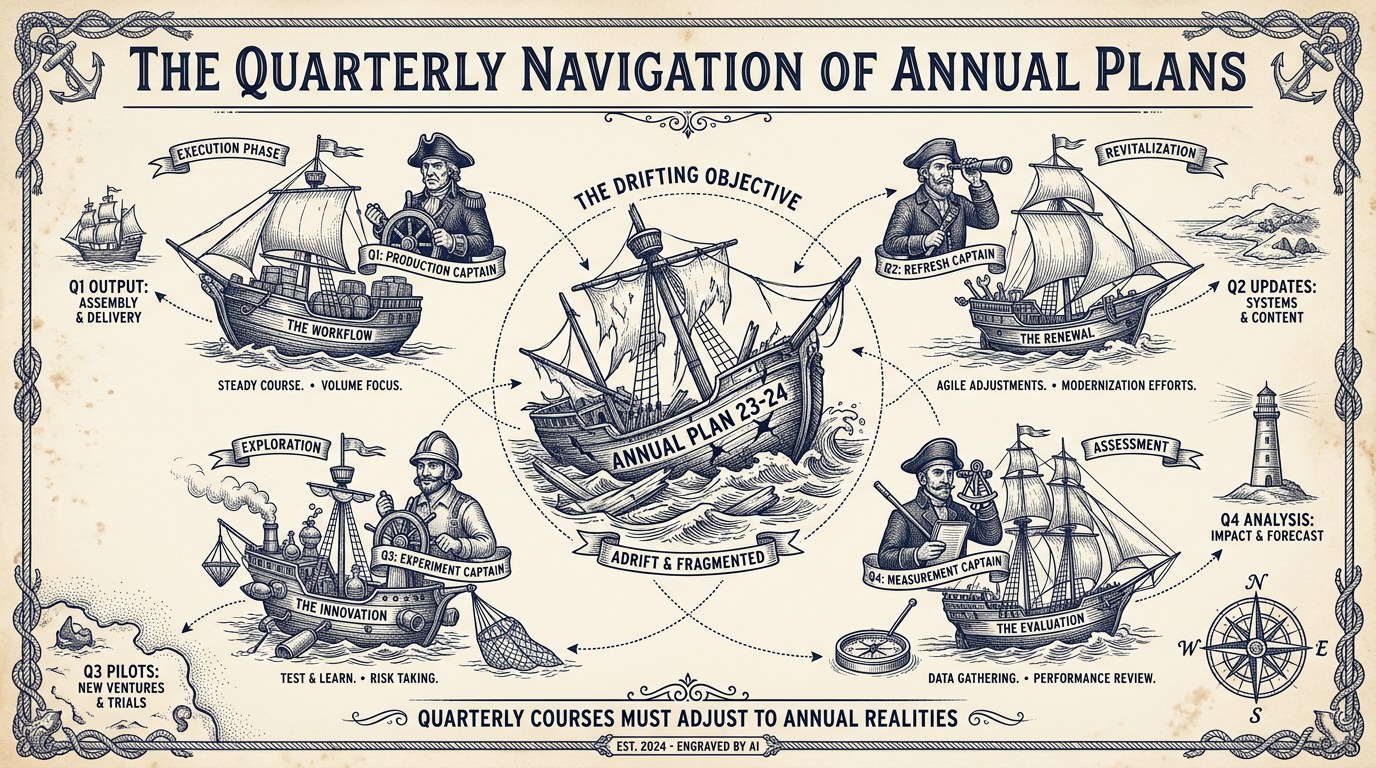
Annual plans assume a stability that does not exist for B2B SaaS. Product priorities shift, ICP refinements happen mid-year, AI Search behavior evolves quarterly, and competitor moves force reallocation. Programs running annual plans either ignore the plan when reality changes (and lose the discipline) or follow the plan when reality changes (and lose the relevance). The quarterly framework solves this by making re-planning a built-in operating cadence rather than an exception.
02The four-quarter content marketing plan framework
The four-quarter framework sequences content investment so each quarter builds on the previous one. The pattern works because B2B SaaS topical authority compounds over quarters, not within quarters.
The four-quarter framework
Q1: foundation cluster and topical authority build
The first quarter establishes the topical-authority foundation. Investment focuses on the priority sub-pillar's Tier 1 page (the sub-pillar landing page itself) plus 3 to 5 foundational cluster posts. The quarter ends with one sub-pillar substantially complete and rankings improving on the head terms.
Q2: depth expansion and AI Search positioning
The second quarter expands depth in the priority sub-pillar (Tier 2 and Tier 3 cluster posts), plus begins coverage of a second sub-pillar. AI Search citation work begins now, not Q1, because foundational content must exist before AI engines have something to cite. Position.digital documents that B2B SaaS sites with original research see 29.7 percent organic traffic versus 9.3 percent for sites without. Q2 is the right quarter to publish that original research.
Q3: conversion-asset production and comparison content
The third quarter produces conversion assets: comparison pages, alternative pages, ROI calculators, pricing-page SEO work (covered in the four-zone pricing page SEO architecture), and case studies. These assets convert the organic traffic the Q1/Q2 content produced. Investment shifts from awareness to conversion.
Q4: optimization, refresh, and next-year planning
The fourth quarter optimizes existing content (refresh high-priority pages, update statistics, expand thin posts), measures full-year outcomes, and plans the next year. Investment in new content drops to 30 to 50 percent of normal; the other 50 to 70 percent goes to optimization and planning. Content Marketing Institute's annual B2B research documents that top-performing programs allocate 20 to 30 percent of annual production capacity to refresh and optimization, which is the pattern Q4 institutionalizes.
03Quarterly content allocation across pillars and sub-pillars
Within each quarter, content investment must be allocated across the pillar's sub-pillars. Three approaches dominate B2B SaaS programs.
Three allocation approaches
Allocation 1: depth-first (one sub-pillar at a time)
The program invests one full quarter in a single sub-pillar before moving to the next. Q1 is sub-pillar A, Q2 is sub-pillar B, Q3 is sub-pillar C. Best for: programs with $50K to $100K annual content budgets where breadth would dilute quality. Produces fastest topical authority on individual sub-pillars; slower full-pillar coverage.
Allocation 2: breadth-first (one cluster post per sub-pillar)
The program invests in one cluster post per sub-pillar each quarter, ensuring all sub-pillars receive equal coverage. Best for: programs with $200K+ annual content budgets where the team can sustain breadth without sacrificing depth. Produces broader coverage faster; slower individual sub-pillar authority.
Allocation 3: hybrid (priority sub-pillar plus supporting)
The program invests 60 to 70 percent in a priority sub-pillar each quarter and 30 to 40 percent across the others. Best for: programs with $100K to $250K annual content budgets, which is the most common B2B SaaS range. Produces strong depth on the priority sub-pillar with sustained breadth across the others. If you want to map your content investment against the three allocation approaches and identify which fits your program, book a 30-minute content plan audit with our team.
04Translating the quarterly plan into an editorial calendar
The quarterly plan is the strategic document. The editorial calendar is the operational tool that translates the plan into specific publication dates, writer assignments, and review milestones.
From quarterly plan to calendar
The plan names the topics (e.g., "Q1 produces 4 cluster posts in the technical SEO sub-pillar plus the sub-pillar landing page"). The editorial calendar names the specific weeks, writers, brief due dates, and publication dates. The plan-to-calendar translation usually happens in week 1 of the quarter. Programs that skip the calendar produce missed deadlines; programs that skip the plan produce calendars disconnected from strategic priorities.
Sequencing within the quarter
The pattern that works: sub-pillar landing page first (anchors the cluster), then Tier 2 cluster posts in priority order, then Tier 3 long-tail posts to fill out coverage. Each piece links to the previously-shipped ones, which strengthens internal linking density progressively. The 8-field content brief framework covered in the content brief templates framework for B2B SaaS operationalizes each piece in the calendar.
05Resource and budget planning at the plan level
Plans without resource allocation are wishlists. The framework includes specific headcount and budget expectations by program size.
Headcount and budget by program size
Early-stage programs (Series A to early Series B, $50K to $100K annual content budget) operate with 1 to 2 FTE roles plus fractional editor. Production target: 3 to 5 cluster posts per month. Mid-stage programs ($100K to $250K, most common B2B SaaS range) operate with 3 to 5 FTE roles plus fractional design and SEO support. Production target: 6 to 10 cluster posts per month. Scale programs ($250K+ annual budget) operate with 5 to 8 FTE plus dedicated specialists. Production target: 8 to 12 cluster posts per month plus original research, video, and podcast surfaces. HubSpot's State of Marketing report documents that B2B content programs at scale typically allocate 26 to 30 percent of marketing budget to content production, with team composition shifting from generalist to specialist as budget grows.
Outsourcing decisions
Programs at any scale benefit from outsourcing specific functions: technical SEO specialists, original research conducting, design and illustration, AI Search optimization. The decision is which functions to in-house versus outsource based on production volume and quality bar. Early-stage programs typically outsource most specialist work; scale programs in-house most but still outsource peak-volume production.
06The plan as a leadership communication tool
The plan's strategic value comes from leadership engagement. Without quarterly review with the CMO or founder, plans drift within 60 days.
What leadership needs to see in the plan
Three things: the specific topical-authority targets (which queries will the program own by end of quarter), the resource allocation (where the money goes), and the measurable outcomes (what KPIs the quarter is measured against). Leadership cannot fund a plan they cannot understand and cannot adjust a plan they cannot measure. The communication structure integrates with the three-tier board SEO scorecard for board-level reporting.
The quarterly review cadence
The 90-minute quarterly review covers: what shipped versus plan, what the leading and lagging indicators show, what changed in priority since planning, and what the next quarter's allocation should be. The output is the next quarter's plan with leadership sign-off. Programs that skip the review run plans on autopilot until they fail.
07Measuring against the plan: what changes mid-cycle
Plans must adjust to reality. The framework distinguishes between mid-quarter adjustments (operational) and mid-year adjustments (strategic).
What changes mid-quarter versus mid-year
Mid-quarter changes happen when production runs ahead or behind, when a specific piece performs unexpectedly well or poorly, or when a competitor publishes content that needs response. The operational adjustment is reallocating production within the quarter without changing the strategic direction. Mid-year changes happen when product priorities shift, ICP refines, or AI Search behavior changes materially. The strategic adjustment is replanning the remaining quarters from scratch based on the new context.
When to scrap the plan versus adjust
Adjust when reality differs from the plan by 20 percent or less on any dimension (production cadence, ICP, topic priority). Scrap when reality differs by 50 percent or more. The 20 to 50 percent range requires judgment; default to scrapping if confidence in the original plan has eroded. Plans are operational documents, not promises.
08Common failures and the plan-as-document trap
Three failure patterns account for most underperforming B2B SaaS content marketing plans. Each has a specific corrective discipline.
Three failure patterns
Failure 1: plan as document, not operating discipline
The most common failure is writing a beautiful 40-page content plan in January, presenting it once, then running production from the editorial calendar without referencing the plan again. The fix is treating the plan as a quarterly operating discipline with reviews, adjustments, and explicit re-allocations rather than as a one-time strategic document.
Failure 2: annual plans that ignore quarterly reality
The reverse failure is committing to annual plans that cannot survive the realities of B2B SaaS production. Product priorities shift, ICP refinements happen, AI Search evolves. Annual plans either become irrelevant or become procrustean. The fix is the four-quarter framework that builds re-planning into the operating cadence.
Failure 3: plans without resource allocation
The third failure is plans that name topics without naming who writes them, when, at what cost, and against what KPI. These plans cannot survive production reality because they lack the operational specifics that turn strategy into execution. The fix is including headcount, budget, and KPI allocation in every plan from the start.
09FAQ
Seven questions covering the topics most commonly searched on content marketing plans for B2B SaaS.
What is a B2B SaaS content marketing plan?
A B2B SaaS content marketing plan is the operating document that converts content strategy into a quarterly cadence with topics, owners, resources, KPIs, and review checkpoints. It is the bridge between strategy (what we believe about content) and execution (what gets shipped this quarter). The plan answers four questions: which content surfaces get investment, who owns production, what the success criteria are, and when the next review checkpoint happens.
Why is the four-quarter framework better than annual planning?
Annual plans assume a stability that does not exist for B2B SaaS. Product priorities shift, ICP refinements happen mid-year, AI Search behavior evolves quarterly, and competitor moves force reallocation. Programs running annual plans either ignore the plan when reality changes (and lose the discipline) or follow the plan when reality changes (and lose the relevance). The four-quarter framework solves this by making re-planning a built-in operating cadence rather than an exception.
What does each quarter in the four-quarter framework cover?
Q1 establishes foundation clusters and topical authority through sub-pillar landing pages and core cluster posts. Q2 expands depth in the priority sub-pillar and positions for AI Search citation. Q3 produces conversion assets: comparison pages, alternative pages, ROI calculators, pricing-page SEO. Q4 optimizes existing content, refreshes high-priority pages, measures full-year outcomes, and plans the next year. The sequence compounds because each quarter builds on the previous one.
What are the three allocation approaches across sub-pillars?
Depth-first allocation invests one full quarter in a single sub-pillar before moving to the next. Best for $50K to $100K annual content budgets. Breadth-first allocation invests in one cluster post per sub-pillar each quarter, ensuring equal coverage. Best for $200K+ budgets. Hybrid allocation invests 60 to 70 percent in a priority sub-pillar plus 30 to 40 percent across others. Best for $100K to $250K budgets, the most common B2B SaaS range.
How many content roles does each program size need?
Early-stage programs ($50K to $100K annual content budget): 1 to 2 FTE plus fractional editor; 3 to 5 cluster posts per month. Mid-stage programs ($100K to $250K): 3 to 5 FTE plus fractional specialists; 6 to 10 cluster posts per month. Scale programs ($250K+): 5 to 8 FTE plus dedicated specialists; 8 to 12 cluster posts per month plus original research, video, and podcast surfaces.
What does leadership need to see in a content marketing plan?
Three things: the specific topical-authority targets (which queries will the program own by end of quarter), the resource allocation (where the money goes), and the measurable outcomes (what KPIs the quarter is measured against). Leadership cannot fund a plan they cannot understand and cannot adjust a plan they cannot measure. The 90-minute quarterly review with leadership is what keeps the plan alive.
What is the plan-as-document trap?
The plan-as-document trap is the most common failure pattern in B2B SaaS content marketing. Programs write a beautiful 40-page content plan in January, present it once, then run production from the editorial calendar without referencing the plan again. The result is plans that drift by month 2, get forgotten by month 4, and produce content that does not match strategic priorities by year-end. The fix is treating the plan as a quarterly operating discipline with reviews, adjustments, and explicit re-allocations.
This sits inside the content strategy sub-pillar.
The content strategy sub-pillar covers the broader playbook including the four-constraint framework, content briefs, editorial calendars, and content distribution.