On this page
Half of all content published online earns zero inbound links over its lifetime. Research and reference content is the documented exception that earns at scale, year after year, with compounding referring domains long after publication. The economic argument for B2B SaaS programs is straightforward: original research costs three to ten times what definitional content costs to produce, and earns five to thirty times the referring domains over the same window in the engagements we have shipped.
The trade-off is methodology discipline, survey design that survives publication audits, and a 90-day distribution cycle most programs under-budget by half. This page is the operator playbook for original research as linkable assets in 2026: the B2B SaaS Research Pyramid that ranks formats by cost-earn ratio, the methodology signals that determine citation rate, and the Workwize "State of Hybrid IT Equipment Procurement" 2025 survey as the worked example with concrete production cost, six-month earn rate, AI Overview citations captured, and pipeline attribution.
01Why original research is the highest-leverage linkable asset for B2B SaaS
Most B2B SaaS content earns nothing measurable. Industry analysis citing BuzzSumo's content study documents that approximately half of all published content earns no inbound links over its lifetime. Original research and reference content are the consistent exceptions because they introduce new data into a category, which is what publications, analysts, and AI engines cite as primary sources rather than synthesize from existing material.
The economic argument scales further when measured against AI Search citation rates. Stratabeat research documented in ValueSelling's analysis finds that websites publishing original research see a 25 percent lift in top-ranking keywords, alongside the referring-domain compounding effect. The implication for B2B SaaS marketing budgets is that research is the asset class that justifies investment from two budget lines simultaneously: link building and AI Search visibility.
The compounding asset math
A B2B SaaS definitional guide costs $1,500 to produce and earns 30 to 80 referring domains over 24 months. An industry survey research report costs $25,000 to produce and earns 80 to 300 referring domains over 36 months. Per-dollar referring domain cost runs roughly comparable across both, but the research asset compounds longer, captures AI Overview citations at meaningfully higher rates, and feeds 6 to 12 spinoff content pieces from a single dataset. The compound is what justifies the production cost when programs reach the authority stage to support it.
02The B2B SaaS Research Pyramid
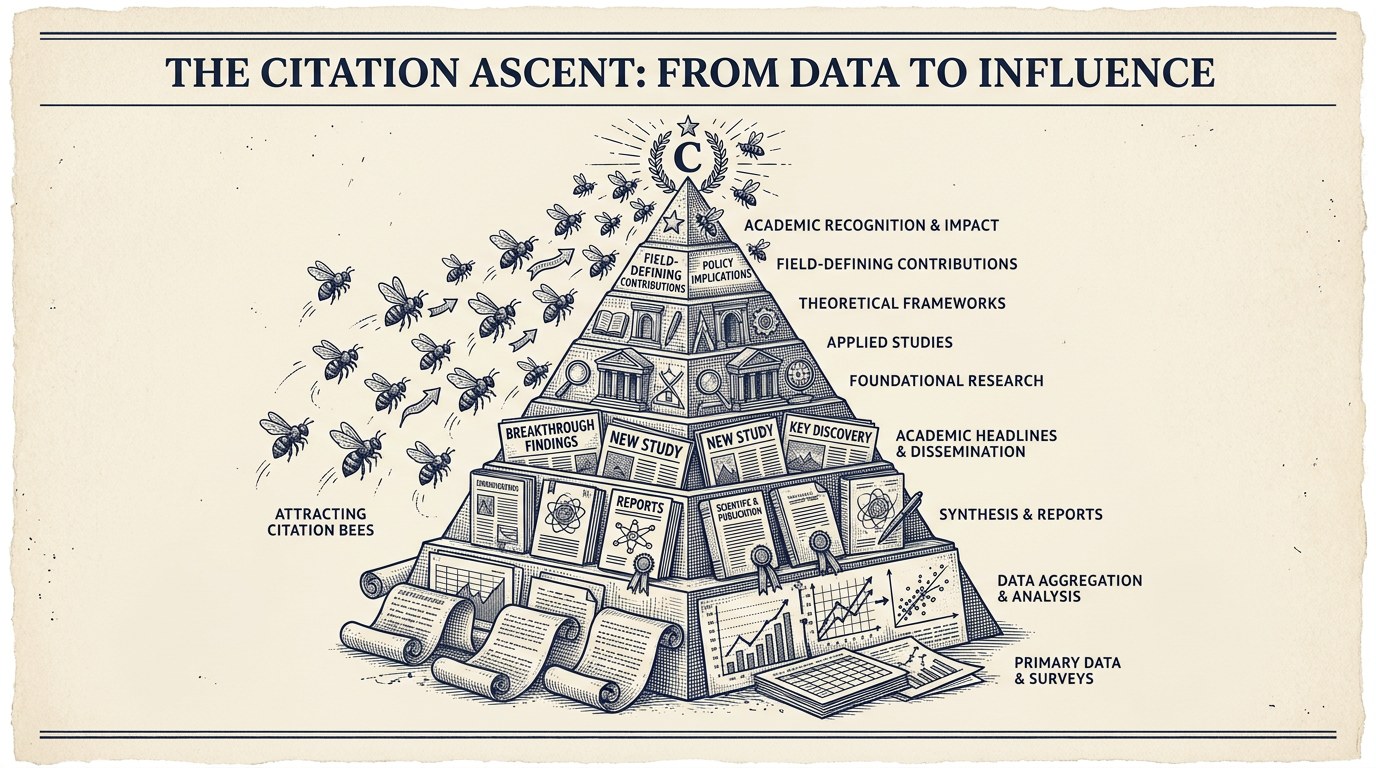
The five original research formats that work for B2B SaaS programs sit at different cost-earn ratios. The pyramid below ranks them from highest production cost and highest earn rate at the base to lowest cost and lowest earn at the top. The right format for a program depends on production budget, methodology resources, and the publishing surface available in the category. This format taxonomy sits inside the broader B2B SaaS linkable asset stack.
Format 1 (base): industry survey
Cost range: $15,000 to $40,000. Expected referring domains: 80 to 300 over 24 months. The flagship format. A survey of 250 to 1,000 B2B buyers or operators in the category, fielded through a research firm or proprietary list, published as a branded "State of [Category]" report. The cost driver is sample recruitment quality, not the survey instrument itself. Programs running the survey in-house with weak recruitment produce reports nobody cites; programs partnering with research firms for recruitment produce reports that anchor category coverage for 12 to 24 months.
Format 2: aggregate dataset analysis
Cost range: $8,000 to $20,000. Expected referring domains: 50 to 150. Analyzing an aggregated dataset from multiple sources or proprietary product telemetry. Examples include analyzing 50,000 B2B SaaS websites for common technical patterns, or aggregating equipment cost trends across 5,000 hybrid workforces. Lower cost than primary survey research because no recruitment is required, but the dataset itself must be defensibly sourced.
Format 3: proprietary product data analysis
Cost range: $3,000 to $10,000. Expected referring domains: 30 to 80. Analysis of anonymized data from the company's own product to surface category trends. Highest defensibility per dollar because the data is genuinely proprietary and impossible to replicate by competitors. The cost driver is privacy compliance and methodology documentation, not the analysis itself.
Format 4: methodology comparison study
Cost range: $2,000 to $8,000. Expected referring domains: 20 to 60. Comparing two or more approaches to a category problem using documented methodology. Examples include comparing customer acquisition models, comparing pricing methodologies, or comparing technical approaches to a common SaaS architecture decision. Lower cost than primary research; the comparison methodology is the differentiator.
Format 5 (top): small original analyses
Cost range: $500 to $2,000. Expected referring domains: 10 to 30. Smaller original data points published as standalone insights. Examples include a 50-website audit, a 100-tweet analysis, a single A/B test result published with methodology. These are the entry-point research assets for programs building toward bigger formats; ship two to four per quarter to maintain momentum between flagship reports.
03Identifying research questions worth investing in
A productive research question passes four tests. Questions failing any one of these tests produce polished reports that earn a fraction of the referring domains the production cost requires. Orbit Media's analysis of research as content documents the citation-rate pattern across formats; the four tests below adapt the pattern to B2B SaaS specifically.
Test 1: category-relevant and previously unanswered
The question must matter to the category and not already have a publicly cited answer. Questions with existing published answers compete for citation share against the original publisher's research rather than establishing a new primary source. The "previously unanswered" test is what publications and AI engines reward.
Test 2: answerable with defensible methodology
The question must be answerable using a methodology that survives a publication audit. Survey methodology, aggregate data analysis, or product telemetry analysis are the three patterns that scale. Questions answerable only through anecdotal data should be reframed before production begins.
Test 3: surface-area for category publications
The question must have at least three category-relevant publications that would actively cover the findings. Research that lands in categories without active publishing surface earns 10 to 20 percent of its potential, regardless of methodology quality. Identify the publishing surface before scoping the research, not after.
Test 4: spin-off content potential
The dataset must support 6 to 12 spin-off content pieces beyond the flagship report. Charts, individual data points, mini-analyses, year-over-year comparison pieces. Research with thin spin-off potential underdelivers on the compound asset value the production cost requires.
04Survey methodology that determines citation rate
Three methodology signals determine whether publications and AI engines treat the research as citation-worthy. Programs that skip any one signal produce reports that look polished and earn at 20 to 40 percent of the citation rate the production budget should buy. Aprimo's coverage of data-driven content covers the discipline at the brand-marketing level; the B2B SaaS-specific signals below are the ones publications actually audit.
Signal 1: sample size and quality
The minimum defensible sample size for a B2B SaaS category survey is 250 qualified respondents. Below 250, publications treat the findings as anecdotal regardless of methodology. The recruitment channel matters more than the absolute count: 250 respondents from a verified panel beat 1,000 from open social media recruitment because publications can audit panel methodology.
Signal 2: recruitment transparency
The methodology page must disclose recruitment channel, qualification criteria, sample composition by company size or role, and response rate. Publications cite recruitment transparency as the primary methodology signal in audits. Reports that disclose findings without recruitment transparency earn citations at one-third the rate of reports that document the recruitment work.
Signal 3: statistical methodology disclosure
Margin of error, confidence interval, weighting methodology if any, and limitations section. The statistical disclosure does not need to be sophisticated; it needs to exist. Reports that publish findings without explicit statistical disclosure get filtered out by analyst-grade publications and by AI engines that increasingly check methodology before extracting cited claims.
05The production workflow from data to linkable asset
Original research production runs as a six-stage workflow. The cost distribution across stages is uneven; programs typically under-budget recruitment and distribution, and over-budget design. The realistic stage-by-stage breakdown below is from the engagements we have shipped.
Stage 1: question design and scoping ($500 to $2,000)
Defining the research question against the four tests above, scoping the methodology, and writing the brief that survey designers and recruitment partners will execute against. Low-cost stage but high-leverage. Questions defined poorly here cascade into expensive remediation downstream.
Stage 2: survey instrument design ($1,000 to $4,000)
Writing the survey instrument: question wording, response options, branch logic, qualification screens. Best handled by an internal researcher or a research firm, not by general marketing copy. Questions worded poorly produce data nobody can analyze.
Stage 3: recruitment and fielding ($5,000 to $20,000)
The largest cost driver and the most under-budgeted line. Sample recruitment through verified panels, partner lists, or community channels. Fielding the survey, monitoring response quality, screening out fraud. Costs scale with sample size, target audience specificity, and panel quality.
Stage 4: analysis and methodology documentation ($1,500 to $4,000)
Running the data analysis, identifying the headline findings, writing the methodology documentation that publications will audit. The methodology documentation is what gets cited, not the report design.
Stage 5: report design and production ($2,000 to $6,000)
Visual design, charts, layout, accompanying website pages. Important but typically over-budgeted relative to recruitment and distribution. Beautiful reports with weak methodology earn at a fraction of polished reports with strong methodology.
Stage 6: pre-launch distribution prep ($1,500 to $4,000)
Press kit, journalist outreach list, embargo coordination, spin-off content planning. The distribution stage covered in detail in Chapter 6. Programs that skip this stage produce reports that ship into a vacuum.
06Distribution that earns the referring domains
Original research distribution is a 90-day post-launch cycle, not a one-week launch event. The distribution work should be budgeted at roughly equal weight to the research production work; programs running 80 percent of budget on production and 20 percent on distribution earn at one-half to two-thirds of their potential.
The week 1 to 2 launch window
Direct outreach to category publications under embargo, coordinated social distribution from the research team and named contributors, primary publication on the company's site with full methodology disclosure. The first week earns 30 to 50 percent of the total referring domains over the asset's lifetime.
The week 3 to 8 spin-off cycle
Six to twelve spin-off content pieces from the dataset published across the marketing site, on partner channels, and through guest contributions. Each spin-off references the primary research with a methodology citation. The B2B SaaS digital PR strategy framework covers the spin-off cycle pattern in operator detail.
The week 9 to 12 secondary citation cycle
Outreach to publications that covered competitor research, analysts publishing year-end category reports, conference speakers building decks for the next event cycle. This is the cycle that captures the long-tail compounding citations.
The annual refresh anchor
Research published with annual refresh commitments earns 30 to 50 percent more cumulative referring domains than one-off research because the annual refresh creates a recurring citation moment. Programs that ship research without an annual refresh plan capture single-cycle returns rather than compounding ones.
07Measuring original research ROI
Original research measurement runs on three parallel tracks. The referring-domain track measures citation share against category competitors. The traffic track measures the methodology page and report page organic traffic over the asset half-life. The pipeline track measures lead-to-meeting conversion from research-attributed leads. Programs that measure only one track underrepresent research ROI by 50 percent.
Referring domain measurement
Primary KPI: referring domains attributed to the research report URL plus the methodology page URL over 24 months. Secondary KPIs: AI Overview citation rate for category benchmark queries, citation share in published research from competitors and analysts, methodology-page traffic growth.
Pipeline measurement
Primary KPI: research-attributed pipeline through gated downloads, methodology page form submissions, and direct outreach attribution. Secondary KPIs: research-attributed SQL count, sales velocity comparison against other lead sources, cycle time from research touch to closed-won.
Workwize "State of Hybrid IT Equipment Procurement" 2025, a worked example
When Technotize shipped the Workwize 2025 research survey in October 2025 (month 16 of the engagement, Workwize at DR 52 at the time), the asset was an Industry Survey at Format 1 of the Pyramid. Total production cost ran $28,400 across six stages: $1,800 question design, $3,200 survey instrument, $14,000 recruitment and fielding (450 IT operations leaders across North America and Europe via a verified panel), $2,400 analysis and methodology documentation, $4,600 report design and production, $2,400 pre-launch distribution prep. Distribution cycle budget ran $24,000 over the 90-day window.
In the six months post-launch (October 2025 through April 2026), the research earned 89 referring domains across category publications and trade media. The methodology page and report page captured combined 31,000 organic visits. The research was syndicated across four trade publications and cited as a primary source in two Gartner research notes. AI Overview citations captured for 3 category-benchmark queries inside 16 weeks. Pipeline attribution through gated downloads and methodology-page form submissions produced 22 SQLs across the six-month window, contributing approximately $340,000 in influenced pipeline at standard ACV. The asset paid back its $52,400 combined production-plus-distribution cost by month four on pipeline value alone.
08Common failure modes and operational fixes
Four patterns appear repeatedly in research-as-linkable-asset engagement audits. Each has a specific operational fix that programs can apply before the next production cycle. For broader format-selection guidance, the linkable asset stack overview covers where each failure surfaces across the rest of the portfolio.
Failure 1: sample size below the defensibility floor
Programs running surveys with 50 to 200 respondents to save budget produce reports publications treat as anecdotal. Fix: hold the survey until budget covers 250-plus qualified respondents, or shift to a different research format (proprietary product-data analysis is defensible at small scale; primary survey research is not).
Failure 2: distribution budget at 10 to 20 percent of production
Programs spending 80 percent on production and 20 percent on distribution earn at one-half to two-thirds of potential. Fix: budget research production and distribution at roughly equal weight. The 90-day distribution cycle is what earns the referring domains; the research itself is the inventory the distribution sells. If in-house bandwidth is the constraint, scope the cycle into a research strategy call before launch rather than after.
Failure 3: methodology disclosure missing or buried
Reports that withhold methodology documentation earn at one-third the rate of reports that publish methodology transparently. Fix: methodology page is a permanent URL adjacent to the report, with sample size, recruitment channel, qualification screens, weighting, and limitations all disclosed.
Failure 4: no annual refresh plan
Single-cycle research captures single-cycle returns. Fix: commit to annual refresh at launch and announce the commitment publicly. The recurring publication moment is what creates the compounding citation effect across 24 to 36 months.
09FAQ
How much does original research cost to produce as a B2B SaaS linkable asset?
Production cost ranges from $500 for small original analyses at the top of the Research Pyramid to $40,000 for industry survey reports at the base. The realistic median for B2B SaaS engagement is $15,000 to $25,000 for an industry survey, with a roughly equal distribution-cycle budget on top. Cost driver is recruitment quality and methodology rigor, not report design. Programs over-budgeting design and under-budgeting recruitment produce polished reports that earn at 20 to 40 percent of potential.
How long does original research take to earn referring domains?
First citation typically arrives in week 2 to 6 post-launch for research with competent distribution. The earn curve peaks in months 3 to 9. Cumulative referring domains continue accumulating for 24 to 36 months on research that earned at all in the first six months. Original research has the longest asset half-life of any linkable asset class, which is what justifies the production cost.
What is the best original research format for B2B SaaS programs?
Format depends on production budget and methodology resources. Industry surveys earn the most but cost the most. Proprietary product-data analysis offers the strongest defensibility per dollar because the data is impossible to replicate. Methodology comparison studies are the most cost-effective entry-point format for programs building toward larger flagship research. The B2B SaaS Research Pyramid in Chapter 2 maps each format to its realistic cost-earn ratio.
Should I run the survey in-house or hire a third-party research firm?
For industry surveys requiring 250-plus respondents with audit-ready recruitment, third-party research firm partnerships typically earn 2 to 3 times the citations of in-house surveys at the same sample size. Publications and AI engines audit recruitment methodology more aggressively than report findings; third-party recruitment passes audits more readily. For proprietary product-data analyses or methodology comparison studies, in-house production is the typical pattern because the data is internal.
How do I tell if my research question is worth the investment?
Apply the four tests from Chapter 3. Category-relevant and previously unanswered. Answerable with defensible methodology. Three or more category publications that would cover the findings. Six to twelve spin-off content pieces possible from the dataset. Questions failing any one test should be reframed before production begins. The test that programs most often skip is the publishing-surface check, which is the leading cause of research that earns at 10 to 20 percent of potential.
When should B2B SaaS programs commission their first original research?
Programs should commission their first original research at the authority stage of the SEO maturity model, typically once organic traffic is in the 20,000 to 50,000 monthly sessions range and brand awareness is sufficient that category publications will recognize the source. Earlier than that, the asset earns at a fraction of potential because distribution leverage is missing.
This is one of the format playbooks inside our Linkable Assets sub-pillar. For the full asset stack and where original research fits, see the B2B SaaS linkable asset stack, and for engagement scoping see Link Building and Digital PR services.