On this page
Random pitch responses are not a strategy. Programs without a documented strategic framework cap at 4 to 8 annual placements regardless of platform investment, pitching effort, or agency budget. The framework below is the four-layer strategy stack that separates compounding programs from stalled ones.
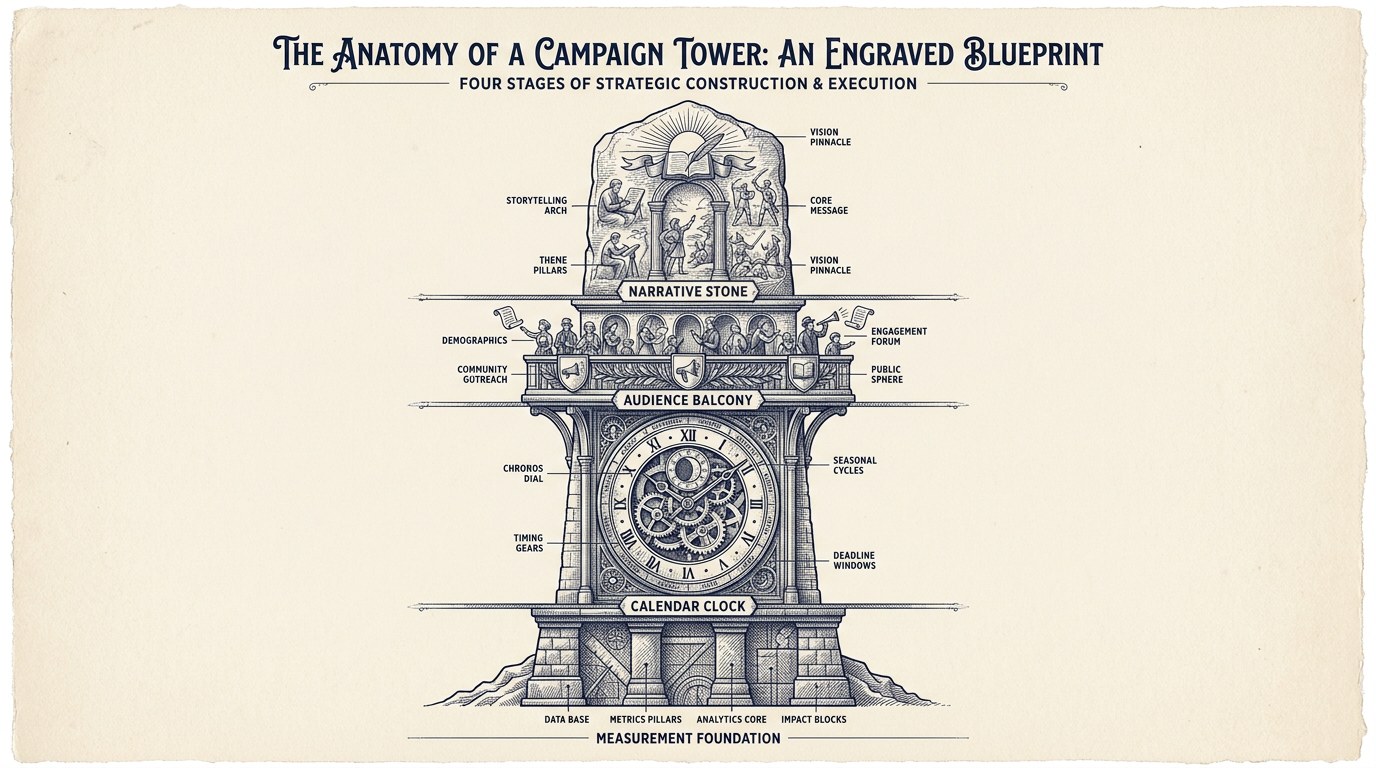
Narrative angles establish what story the brand consistently advances. Audience mapping assigns proportional effort across publication tiers. Calendarization sequences placements around quarterly themes and product moments. Strategic measurement tracks the compounding metrics that justify the investment to leadership.
The four layers work as a system. Cut any one and the program reverts to pitching, which produces volume without compounding.
01What a digital PR strategy actually is (versus random pitch responses)
A digital PR strategy is the documented system that turns daily pitching into compounding placement. Without a strategy, pitching produces volume but not compounding. With a strategy, the same pitching effort produces a portfolio of placements that builds category authority, AI Search citation share, and SEO domain rating over 18 to 24 months. The sections below establish the working definition, explain why pitching without strategy produces a hard ceiling, and detail what the strategic layer adds operationally.
A working definition
A digital PR strategy for B2B SaaS is the documented four-layer system that designs what the brand consistently says across the year, which publications and journalists hear those messages first, when each message lands relative to product launches and industry events, and how the resulting coverage gets measured against business outcomes. The four layers are narrative angles, audience mapping (publication tiers), calendar, and strategic measurement. Each layer is documented as a reference artifact the team operates against.
The discipline matters because pitching without strategy produces unpredictable outcomes. Some quarters produce 8 placements; others produce 2. The portfolio reads as a collection of one-off mentions rather than a coordinated category presence. With strategy, the portfolio reads as a coherent brand narrative supported by quarterly thematic moments, sustained over 12 to 24 months. The implementation operates within our complete digital PR playbook for B2B SaaS programs at the sub-pillar level and connects to the full link-building reference for B2B SaaS at the pillar level.
Why pitching without strategy caps at 4-8 annual placements
The hard ceiling has two causes. The first is signal fragmentation: without documented narrative angles, every pitch positions the brand differently, which means journalists who cover the brand across multiple stories cannot build a coherent mental model of what the brand stands for. The second is calendar fragmentation: without quarterly thematic anchors, pitches respond to whatever platform queries appear that day, which means the program's coverage reflects journalist demand rather than brand strategic intent.
The compound effect is a placement portfolio that journalists, readers, and AI Search engines treat as background noise rather than category authority signal. Programs run this pattern for 12 to 24 months, observe the placement ceiling, conclude "digital PR doesn't work for our category," and either disinvest or churn through agencies looking for a tactical fix. The actual fix is strategic, not tactical.
What strategy adds that pitching alone cannot
Strategy adds four operational disciplines that compound. First, narrative consistency that lets journalists position the brand as a category expert on documented topics rather than a vendor with quotable representatives. Second, audience prioritization that concentrates effort where placements compound (Tier 1 publications, journalists with sustained coverage in the category). Third, calendar leverage that puts the program ahead of journalist demand by being early on quarterly themes. Fourth, measurement infrastructure that surfaces compounding signal (category authority, share of voice, AI Search citation share) that operational metrics like "placements per month" cannot.
The four disciplines work as a system. Programs that adopt one or two layers see incremental improvement. Programs that adopt all four see the compounding curve that separates strategic digital PR programs from tactical ones, which PR Week's industry coverage has tracked across the post-HARO landscape: the agencies and in-house teams producing sustained placement growth in 2025 and 2026 all run some version of the four-layer stack rather than tactical pitching alone.
02The four-layer strategy stack: narrative, audience, calendar, measurement
The strategy framework has four layers that build on each other. Skipping any layer breaks the stack: a program with narrative but no audience mapping produces consistent messaging that reaches the wrong publications; a program with calendar but no narrative produces well-timed pitches that lack coherent brand positioning. The four-layer summary below previews chapters 03 through 06, each of which covers one layer in operational depth.
Layer 1 in summary: narrative
Narrative is the 2 to 4 angles your brand consistently advances across the year. Each angle is a documented position the brand has unique authority on, supported by 8 to 15 sub-themes journalists can extract specific story angles from. Programs without documented narrative produce placement portfolios that read as disconnected. Programs with documented narrative build category authority that compounds across 18 to 24 months. Chapter 03 covers the narrative angle layer in operational depth.
Layer 2 in summary: audience
Audience is the publication tier map that assigns proportional program effort across Tier 1 (industry-leading), Tier 2 (vertical industry), and Tier 3 (emerging or niche) publications. The mapping prevents two failure patterns: spreading effort uniformly across all tiers (produces volume without authority) and concentrating effort exclusively on Tier 1 (produces sporadic high-value placements with no base coverage). Chapter 04 covers the publication tier layer with specific Tier 1 to Tier 3 examples for B2B SaaS programs.
Layer 3 in summary: calendar
Calendar is the year-long sequence of 4 to 6 quarterly themes that anchor when each narrative angle gets primary push. The calendar aligns with product launches, industry events, and content marketing programs to multiply leverage. Programs without calendarization react to platform query flow; programs with calendarization shape journalist coverage by being early on themes journalists will write about next quarter. Chapter 05 covers calendar design and the alignment patterns.
Layer 4 in summary: measurement
Measurement is the strategic scorecard that tracks compounding metrics (category authority, share of voice in industry coverage, AI Search citation share by topic cluster) at quarterly cadence, and the trust-signal data underlying each metric is well documented in Edelman's annual Trust Barometer, which tracks how third-party editorial mentions compound brand trust differently than owned content does. The strategic measurement layer is distinct from the operational measurement layer covered in the operational digital PR playbook for the post-HARO landscape, which tracks weekly placements and monthly placement quality. Both measurement layers run in parallel. Chapter 06 covers the strategic layer with the quarterly scorecard format.
03Layer 1: defining the narrative angles your brand consistently advances
The narrative layer is foundational because it constrains the other three layers. Audience mapping selects publications that align with the narrative. Calendar sequences when each narrative angle gets primary push. Measurement tracks coverage against the narrative themes. Programs that define narrative angles carefully produce strategic clarity for the entire framework. Programs that skip the narrative work or define angles too loosely undermine everything downstream.
What a narrative angle is
A narrative angle is a specific position the brand has unique authority on, supported by enough sub-themes that journalists can extract distinct story angles across 12 to 18 months of coverage without the messaging becoming repetitive. An angle is not a marketing message. "We are the best B2B SaaS content marketing agency" is a marketing message; it cannot sustain coverage. "Content marketing programs that segment without prioritizing produce spreadsheets nobody acts on; the 90-day execution clock with named owners is the fix" is a narrative angle; journalists can extract multiple stories from it.
The test for a candidate narrative angle: can the brand support 8 to 15 distinct sub-themes from it without repetition over a 12-month period. Angles that pass produce sustained coverage; angles that fail produce 2 to 3 placements before journalists exhaust the angle.
Selecting the 2-4 angles for a B2B SaaS program
Programs work with 2 to 4 narrative angles concurrently. Fewer than 2 produces messaging fatigue because journalists who cover the brand repeatedly hear the same angle. More than 4 produces fragmentation because no single angle accumulates enough coverage to compound. The 2-to-4 range is the empirically tested sweet spot from B2B SaaS engagements at $5M to $100M ARR.
Selection criteria for the angles. First, each angle must be defensible with proprietary evidence (case study data, portfolio observations, internal research that the brand can quote authoritatively). Second, each angle must address a tension or contested point in the category that journalists find worth writing about. Third, the angles together must cover the brand's strategic positioning without overlapping so much that journalists confuse one with another. Programs that satisfy all three criteria produce narrative angles that sustain coverage for 18 to 24 months before requiring refresh.
Documenting and operationalizing the angles
The angles are documented as a 1-to-2-page reference that pitch authors operate against when responding to platform queries. The reference includes the angle statement (one sentence), the supporting evidence (3 to 5 specific data points or case examples per angle), the sub-themes (8 to 15 per angle), and the journalists and publications most likely to cover each angle.
Operationalizing the angles means every pitch fits one of the documented angles. Pitches that don't fit get declined regardless of how relevant the platform query appears. The discipline produces placement portfolios that build category authority because every published piece reinforces one of the 2 to 4 angles, which mirrors the pattern Muck Rack's State of Journalism research has documented: journalists return to sources who maintain consistent angle authority across multiple stories rather than to sources who pitch on every topic. Programs that allow off-angle pitches see angle dilution that erodes category authority over time.
04Layer 2: mapping target publication tiers for B2B SaaS
The audience layer turns narrative into directed effort. Not all placements compound equally. A Forbes placement carries different SEO weight, AI Search citation weight, and brand authority weight than a niche industry blog placement. Publication tier mapping assigns proportional program effort across three tiers, which prevents the two most common failure patterns: spreading effort uniformly (produces volume without authority) and concentrating exclusively on Tier 1 (produces sporadic high-value placements without base coverage).
Tier 1 publications for B2B SaaS
Tier 1 publications carry industry-leading authority and broad audience reach. For B2B SaaS, the Tier 1 set includes Forbes, Inc., Business Insider, Harvard Business Review, TechCrunch, Fast Company, Fortune, Wall Street Journal, MIT Sloan Management Review, and category leaders like SaaStr. Placements in Tier 1 publications typically come from DR 85+ domains with substantial editorial scrutiny.
The placement rate for Tier 1 is low (4 to 12 placements per year for a sustained program). The compounding value per placement is high. A single Tier 1 placement produces backlink authority equivalent to 8 to 15 Tier 2 placements, AI Search training corpus signal that surfaces in ChatGPT and Perplexity responses for category queries, and brand authority signal that journalists at other publications notice and reference. Programs target Tier 1 with high-effort campaigns built around the documented narrative angles.
Tier 2 publications for B2B SaaS
Tier 2 publications carry vertical industry authority within specific categories. For B2B SaaS, the Tier 2 set varies by category but typically includes industry-specific outlets (MarketingProfs and Demand Gen Report for marketing SaaS, Devops.com and InfoQ for developer tooling SaaS, HR Brew and HR Executive for HR SaaS, etc.). Placements typically come from DR 65 to 85 domains with focused editorial scope.
Tier 2 placement rate is moderate (15 to 30 placements per year for a sustained program). The compounding value per placement is moderate. Tier 2 placements build vertical-specific authority that translates more directly to pipeline contribution than Tier 1 placements do, because the audience overlap with the buyer ICP is higher. The strategic role: Tier 2 sustains pipeline-relevant brand presence across the year while Tier 1 anchors quarterly authority moments.
Tier 3 publications for B2B SaaS
Tier 3 publications are emerging publications, niche newsletters, podcasts, and category-specific blogs. For B2B SaaS, the Tier 3 set includes operator-led newsletters (Lenny's Newsletter, The Information, Sacra, Sahil Bloom), category-specific podcasts (Acquired, How I Built This, Lenny's Podcast, The SaaS Podcast), and emerging publications building audience in adjacent categories.
Tier 3 placement rate is high (20 to 40 placements per year for a sustained program). Compounding value per placement is lower than Tier 1 or 2 in traditional SEO terms but disproportionately high in AI Search citation terms because Tier 3 publications often produce content that AI engines retrieve heavily for category queries. The strategic role: Tier 3 fills the calendar between Tier 1 and Tier 2 moments, builds operator-community authority, and produces ambient citation signal that compounds across AI Search training cycles. This connects to the broader AI Search positioning work covered in the operator's guide to how AI Search engines rank and cite content.
The proportional effort split across tiers
A sustained B2B SaaS digital PR program at $5M to $20M ARR runs roughly 20 percent effort on Tier 1, 50 percent on Tier 2, 30 percent on Tier 3. The split produces 4 to 8 Tier 1 placements, 15 to 25 Tier 2 placements, and 20 to 35 Tier 3 placements annually, totaling 39 to 68 placements with strong compounding across all three tiers. Programs that invert the split (50 percent Tier 1, 30 percent Tier 2, 20 percent Tier 3) produce fewer total placements with lower compounding because Tier 1 placements require disproportionate effort per placement.
05Layer 3: calendarizing the year-long PR cadence
The calendar layer transforms reactive pitching into proactive sequencing. Programs without a calendar respond to whatever platform queries appear that day, which means coverage reflects journalist demand rather than brand strategic intent. Programs with calendarization shape what journalists write about by being early on quarterly themes journalists will cover next. The sections below cover the quarterly anchor structure, the monthly cadence within each quarter, and the alignment patterns to product launches and industry events.
Quarterly thematic anchors
The year-long calendar anchors to 4 to 6 quarterly themes that map to the documented narrative angles from Chapter 03. Each quarter advances one or two primary narrative angles with thematic depth that journalists can build sustained coverage around. Q1 might anchor on the brand's primary annual narrative thesis. Q2 might anchor on a category-shaping observation tied to industry trends. Q3 might anchor on a product-launch-adjacent narrative. Q4 might anchor on year-in-review and forward-looking commentary.
The quarterly anchor produces operational clarity for the team. Every pitch in the quarter ties to the quarterly theme. Every press release supports the theme. Every podcast appearance reinforces the theme. The discipline produces 12 to 18 weeks of concentrated narrative push that compounds because journalists hear the same angle from multiple touchpoints during the quarter. Programs without quarterly anchors spread narrative across 52 weeks of fragmented pitching that produces no concentrated moment for journalists to notice.
Monthly cadence within each theme
Within each quarterly anchor, the monthly cadence sequences specific placements and amplification moments. Month 1 of the quarter typically launches the theme with a flagship Tier 1 placement attempt and supporting Tier 2 placements. Month 2 builds on the theme with Tier 2 placements that reference the flagship and Tier 3 placements that extend the narrative into operator communities. Month 3 closes the theme with synthesis content, retrospective placements, and forward-looking commentary that bridges to the next quarterly theme.
The monthly cadence is a working calendar, not a rigid template. Programs adjust based on platform query flow, journalist relationship readiness, and unforeseen news cycles. The discipline is the underlying structure (quarterly anchor, monthly sequence, weekly execution), not rigid adherence to a fixed schedule.
Aligning the calendar to product launches and industry events
The strongest calendar alignment patterns tie quarterly themes to product moments and industry events. A product launch in Q2 anchors the Q2 quarterly theme around the launch's broader category narrative (not the product itself, which is messaging). An industry event in Q3 (SaaStr Annual, Inbound, Web Summit) anchors the Q3 quarterly theme around the event's editorial topic. A major industry research release timed to Q4 anchors the year-end narrative.
The alignment compounds two ways. Internally, the marketing function gains predictable rhythm where digital PR, content marketing, and product marketing share the same quarterly thematic anchor. Externally, journalists encounter the brand consistently around moments they are already writing about, which produces placement rates 2 to 4 times higher than calendar-disconnected pitching for the same theme, and the alignment effect is one of the most consistent patterns CMI's annual B2B content marketing research has tracked across the discipline: integrated content-and-PR programs produce 2 to 3 times the placement volume of programs running each discipline independently across the same 12-month window.
06Layer 4: strategic measurement that drives compounding placement
The measurement layer is what separates programs that compound from programs that stall. Operational measurement (weekly placements, monthly placement quality, the metrics covered in the operational playbook covering platforms, pitch patterns, and daily discipline) tracks program execution. Strategic measurement tracks program outcomes. Both layers run in parallel. Programs that only track operational metrics see weekly activity but cannot identify whether the activity is producing compounding outcomes. The sections below distinguish the two layers, present the quarterly strategic scorecard format, and identify the compounding metrics that justify sustained investment to leadership.
Strategic metrics versus operational metrics
Operational metrics measure program execution. Pitches sent per week. Placements earned per month. Average response time to platform queries. Placement quality scored on a defined rubric. Operational metrics drive weekly program management and identify execution gaps within days.
Strategic metrics measure program outcomes. Category authority share (the percentage of category-defining coverage that includes the brand). Share of voice in industry publications (the brand's mention rate compared to top 3 to 5 competitors). AI Search citation share by topic cluster (the brand's citation rate in ChatGPT, Perplexity, and Google AI Overviews for priority queries). Backlink authority growth from digital PR specifically (referring domains earned through editorial mentions versus other link sources).
Strategic metrics compound over 60 to 180 days. The same week-over-week reporting cadence that works for operational metrics produces noise when applied to strategic metrics because the signal develops too slowly to show meaningful movement weekly.
The quarterly strategic scorecard
The strategic scorecard runs at quarterly cadence with three sections on a single page. Compounding metrics scorecard: category authority share, share of voice in industry publications, AI Search citation share by topic cluster, backlink authority growth attributable to digital PR. Each metric shows current quarter, prior quarter, and year-over-year trend. Narrative section: three to five sentences explaining the quarter's strategic results, the placements that produced disproportionate impact, the calendar themes that worked. Forward-looking section: the next quarter's planned strategic moves, anticipated calendar themes, any pivots from the original strategy.
The quarterly cadence aligns with the actual signal-to-action loop for digital PR work and pairs with the broader content marketing measurement framework for B2B SaaS programs that operates on the same quarterly cadence for compounding metrics. Programs that report strategic metrics monthly produce panic; programs that report quarterly produce decision velocity.
Compounding metrics that justify the investment
The compounding metrics produce the business case that justifies sustained digital PR investment to leadership. Category authority share growing from 8 percent to 24 percent over 18 months tells the executive team the program is building defensible category position. Share of voice growing from 12 percent to 30 percent compared to top 3 competitors tells the team the program is winning competitive coverage. AI Search citation share growing from 5 percent to 35 percent on priority topic clusters tells the team the program is winning the new buyer discovery channel.
These metrics produce sustained budget defense across multiple budget cycles. Programs that track only placement counts produce reports that get questioned ("are these placements producing pipeline"). Programs that track compounding metrics produce reports that answer the executive-level questions before they get asked.
07Integrating digital PR with content marketing, product launches, and ABM
The integration layer multiplies the impact of the four strategy layers. Standalone digital PR programs at $5M to $20M ARR earn 30 to 60 annual placements. Integrated digital PR programs at the same ARR range earn the same placement volume but produce 2 to 4 times the business impact because each placement amplifies through content marketing, product launches, and ABM channels simultaneously. The sections below cover each integration pattern and the operational coordination it requires.
Digital PR and content marketing integration
The strongest integration pattern is content marketing producing the proprietary research and operator-grade frameworks that digital PR pitches surface to journalists. The flow: content marketing publishes a cluster post with proprietary data and a defensible framework, digital PR pitches journalists with the data and framework as expert commentary, the resulting placements drive referral traffic back to the cluster post, the cluster post earns backlinks from the journalist-written articles, the backlinks improve organic ranking, which produces sustained organic traffic that the digital PR placements alone could not generate.
Programs running the integration pattern see content marketing ROI multiples 1.4 to 2.2 times higher than content programs without integrated digital PR, and digital PR placement quality improving because the content marketing assets give journalists substantive material to quote. The integration requires content marketing and digital PR functions to coordinate on the quarterly thematic calendar, the same theme that anchors the digital PR quarter anchors the content marketing publishing cadence for that quarter.
Digital PR and product launch integration
Product launches produce concentrated PR moments that work when integrated with the broader strategic framework and fail when treated as standalone press releases. The integrated pattern: the product launch fits within a documented narrative angle (Layer 1), the launch timing aligns with a quarterly thematic anchor (Layer 3), the journalist outreach concentrates on publications that align with the narrative tier map (Layer 2), and the resulting coverage feeds the strategic measurement scorecard (Layer 4).
The standalone pattern (a press release goes out, the PR function pitches journalists with no broader framework, some placements happen, results get measured by press release pickup rate) produces unpredictable outcomes that look like luck rather than strategy. The integrated pattern produces predictable outcomes that compound across multiple launches because each launch reinforces the documented narrative angles and quarterly themes.
Digital PR and ABM integration
The ABM integration pattern surfaces in B2B SaaS programs targeting enterprise accounts. The pattern: digital PR placements appear in publications that target account executives read regularly, the placements reinforce the account-specific narrative the ABM program is advancing, the combined coverage produces account-level signal that the brand is gaining category authority. Account executives notice the cumulative effect across 6 to 12 months even when no individual placement directly targets them.
The operational coordination is identifying the publications target accounts consume (which often differ from the publications generic ICP buyers consume), tracking placement appearances in those specific publications, and reporting account-level brand authority signal as a strategic metric in the quarterly scorecard. Programs running this pattern see ABM program effectiveness improving 30 to 60 percent against targets that include named accounts the brand could not previously reach. If you want to scope the right integration patterns for your specific program, book a 30-minute conversation about your PR strategy and we will design the integration model against your current marketing structure.
08In-house versus agency: the build-versus-buy decision for B2B SaaS digital PR
The build-versus-buy decision shapes program economics, execution speed, and strategic flexibility. There is no universally correct answer; the right model depends on company stage, marketing maturity, growth rate, and the strategic role digital PR plays in the broader marketing function. The sections below cover the three patterns with the specific conditions each one fits, so the decision becomes an operational choice rather than a default assumption.
When in-house digital PR works
In-house digital PR works at $20M+ ARR with the budget for dedicated headcount and the marketing leadership maturity to define the strategic framework internally. The minimum viable in-house team is one full-time digital PR specialist (responsible for daily platform monitoring and pitch execution) plus one fractional or part-time strategic lead (responsible for narrative angle definition, publication tier mapping, and quarterly calendar design). Total annual cost: $120,000 to $220,000 fully loaded.
The pattern fits programs where digital PR represents a sustained strategic priority (not an experimental initiative), where leadership has clear views on narrative angles (not delegating strategic thinking to an agency), and where the company can support the talent acquisition challenge of finding qualified digital PR specialists in a tight talent market. Programs that satisfy all three conditions produce in-house programs that compound efficiently. Programs that satisfy only one or two typically underperform agency engagement at equivalent budget.
When agency engagement works
Agency engagement works at $5M to $20M ARR or when scaling rapidly during stages where building in-house capacity would slow the program by 4 to 8 months. The agency typically provides strategic framework definition, monthly campaign execution, and quarterly strategic measurement. Total annual cost: $60,000 to $180,000 depending on agency tier and scope.
The pattern fits programs where digital PR is a new investment that needs strategic structure before in-house build-out, where the company needs to test placement viability before committing to dedicated headcount, or where the company is scaling so quickly that in-house hiring cannot keep pace with marketing demand. Programs that satisfy any of these conditions typically see agency engagement producing 30 to 60 annual placements within 6 months of engagement start, which is faster than most in-house programs at the same maturity stage.
The hybrid model and when it applies
The hybrid model combines in-house strategic leadership with agency execution capacity. The in-house lead defines narrative angles, owns the quarterly calendar, and runs strategic measurement. The agency handles daily platform monitoring, pitch execution, and Tier 2 to Tier 3 placement volume. Total annual cost: $100,000 to $250,000 depending on the in-house lead's seniority and the agency scope.
The pattern fits established programs at $20M to $80M ARR scaling beyond in-house capacity, programs where leadership has strong opinions on strategy but needs execution scale beyond what one in-house specialist can deliver, and programs running multi-quarter campaigns that exceed a single full-time hire's bandwidth during peak quarters. The hybrid model is the empirically tested sweet spot for B2B SaaS programs at scale because it preserves strategic ownership while accessing agency execution capacity. Programs running the hybrid model typically see 50 to 100 annual placements with strategic measurement infrastructure that produces compounding metrics across multiple budget cycles.
09FAQ
Seven questions covering the topics most commonly searched at the digital PR strategy framework intersection, each with a self-contained answer designed for direct citation extraction by ChatGPT, Perplexity, and Google AI Overviews. The Q and A structure feeds the FAQPage schema that publishes alongside this post.
What is a digital PR strategy?
A digital PR strategy is the documented four-layer system that designs what the brand consistently advances across the year (narrative angles), which publications hear those messages first (audience tier mapping), when each message lands relative to product launches and industry events (calendar), and how the resulting coverage gets measured against business outcomes (strategic measurement). The four layers work as a system. Programs without the documented framework cap at 4 to 8 annual placements; programs with the framework compound to 30 to 60 annual placements at equivalent operational effort.
How is a digital PR strategy different from a digital PR campaign?
A digital PR strategy is the year-long documented system that designs the program. A digital PR campaign is a quarter-long execution within the strategic framework, anchored to one of the quarterly themes the strategy defines. The strategy contains 4 to 6 campaigns across the year, each campaign advancing one or two narrative angles around a specific quarterly thematic anchor. Campaigns without strategy produce unpredictable outcomes; strategy without campaigns produces planning artifacts that never reach execution.
How many narrative angles should a B2B SaaS digital PR program have?
Two to four concurrent narrative angles is the empirically tested range for B2B SaaS programs at $5M to $100M ARR. Fewer than two produces messaging fatigue across journalists who cover the brand repeatedly. More than four produces fragmentation where no single angle accumulates enough coverage to compound. Each angle must be defensible with proprietary evidence, address a contested point in the category, and support 8 to 15 distinct sub-themes over 12 to 18 months without becoming repetitive.
How should B2B SaaS programs prioritize Tier 1 versus Tier 2 versus Tier 3 publications?
The recommended proportional effort split is 20 percent Tier 1, 50 percent Tier 2, 30 percent Tier 3. The split produces 4 to 8 Tier 1 placements, 15 to 25 Tier 2 placements, and 20 to 35 Tier 3 placements annually for a sustained program, totaling 39 to 68 total placements with strong compounding across all three tiers. Tier 1 anchors quarterly authority moments. Tier 2 sustains pipeline-relevant brand presence. Tier 3 builds operator-community authority and AI Search ambient citation signal.
How long does it take to build a digital PR strategy framework?
The initial framework documentation takes 4 to 8 weeks for a B2B SaaS program at $5M to $20M ARR. The work includes narrative angle definition (2 to 3 weeks of stakeholder interviews and positioning workshops), publication tier mapping (1 to 2 weeks of audience research), calendar design (1 to 2 weeks of cross-functional coordination with content marketing and product), and strategic measurement infrastructure deployment (1 to 2 weeks of tool selection and baseline measurement). Programs that try to compress to 2 to 3 weeks typically produce frameworks that miss strategic depth and require rework within 6 months.
Should I build digital PR in-house or hire an agency?
In-house digital PR works at $20M+ ARR with dedicated headcount and marketing leadership maturity to define strategy internally. Agency engagement works at $5M to $20M ARR or when scaling rapidly during stages where in-house build-out would slow the program. The hybrid model (in-house strategy plus agency execution) works for established programs at $20M to $80M ARR scaling beyond internal capacity. Programs that get the build-versus-buy decision wrong typically waste 6 to 12 months before correcting course, so the upfront decision matters more than the specific execution model chosen.
What is the difference between strategic and operational digital PR measurement?
Operational measurement tracks weekly execution (pitches sent, placements earned, response times, placement quality scoring). Strategic measurement tracks quarterly outcomes (category authority share, share of voice in industry coverage, AI Search citation share by topic cluster, backlink authority growth from digital PR specifically). Operational metrics drive weekly program management. Strategic metrics justify sustained investment to executive leadership across multiple budget cycles. Both layers run in parallel; programs reporting only one layer miss the diagnostic signal the other layer provides.
Part of the digital PR playbook
This is the strategic framework under digital PR.
The operational playbook covering the post-HARO platform landscape, pitch patterns, and daily execution discipline is the operational sibling to this strategic framework.
For the tactic-level execution that complements this strategic framework, see the resource page outreach playbook for B2B SaaS programs.