On this page
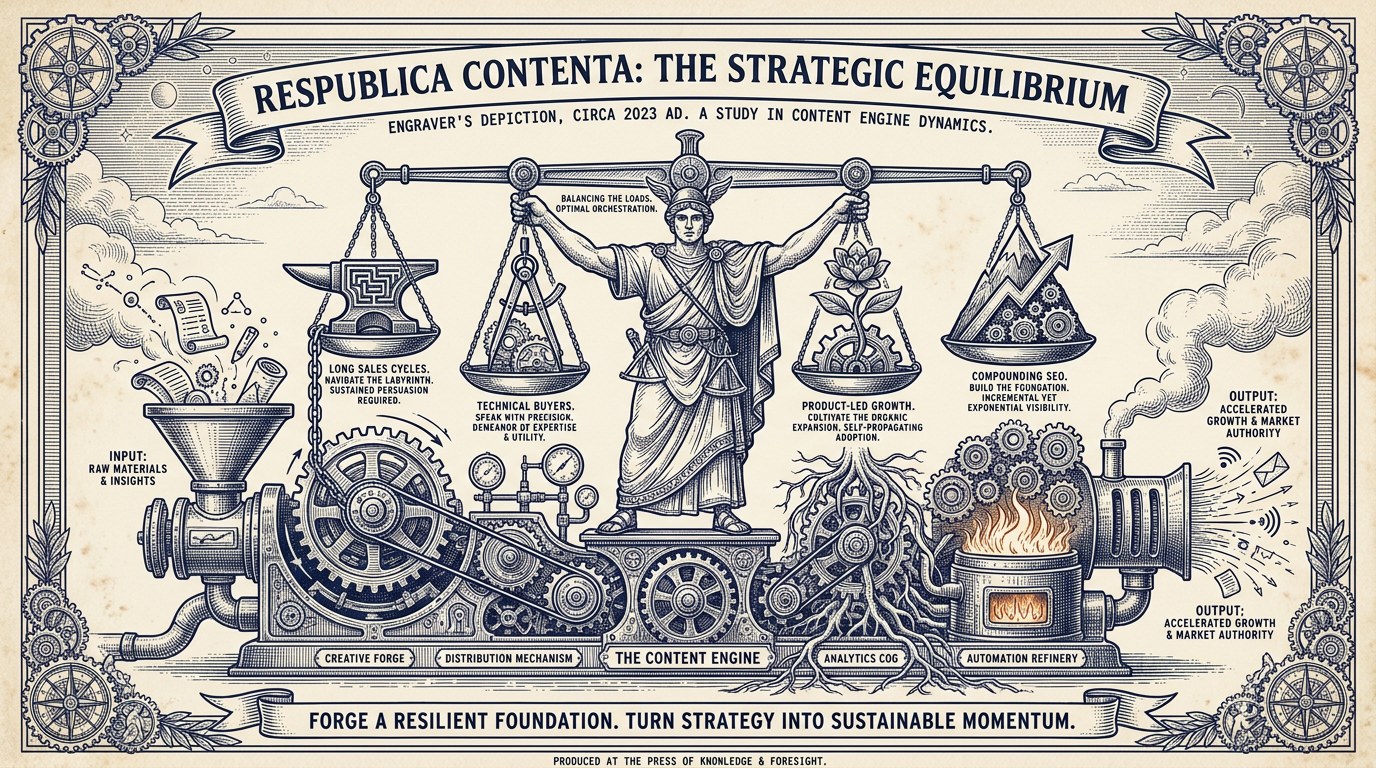
Most B2B content marketing strategy advice describes a generic five-step framework: define the audience, set goals, produce content, distribute, measure. For B2B SaaS programs, that framework is incomplete. Four constraints shape B2B SaaS content marketing in ways that generic B2B does not: sales cycles of 6 to 18 months, technical buyers who reject marketing copy, product-led growth dynamics that pull content into the activation loop, and SEO economics that compound for years when done right.
Programs that ignore these constraints produce activity (lots of blog posts) without producing assets (compounding pipeline contribution). This post covers the operator framework that integrates the four constraints, the five disciplines that turn strategy into production, the buyer-journey mapping that aligns content to commercial intent, and the measurement structure that ties content output to revenue. The output is a content strategy a CMO can take to leadership with realistic resource and timeline expectations.
01What B2B SaaS content marketing strategy actually is
B2B SaaS content marketing strategy is the operator discipline of designing, producing, and measuring content that compounds pipeline contribution over a 6 to 18 month buyer cycle. The discipline integrates strategy, writing, production, optimization, and measurement into a single coherent function rather than treating content as an activity separate from SEO, sales enablement, or product marketing.
What B2B SaaS content marketing strategy actually means
The discipline covers four elements: audience and constraint mapping (who buys, what shapes the buying decision), content surface design (which pages exist and what each serves), production discipline (cadence, quality bar, editorial process), and measurement (asset value over time, pipeline attribution). The Content Marketing Institute's annual B2B research documents that top-performing B2B content programs treat content as a strategic asset rather than an activity output.
This post operates within the content strategy sub-pillar at the discipline level.
Why it differs from generic B2B content strategy
Generic B2B content advice assumes consumer-like sales cycles (weeks to months), business buyers who consume marketing content the way consumers do, and a marketing function separate from product. None of those assumptions holds for B2B SaaS. Sales cycles run 6 to 18 months, buyers are typically technical and reject marketing copy, and product-led growth pulls content into the activation loop. The strategy that wins for B2B SaaS is operator-grade by design, not by accident.
02The four constraints that shape B2B SaaS content
B2B SaaS content marketing is shaped by four constraints that generic B2B content frameworks ignore. Programs that design around the constraints produce assets. Programs that ignore them produce activity.
Constraint 1: long sales cycles (6 to 18 months)
B2B SaaS sales cycles run 6 to 18 months from first content touch to closed-won, with enterprise cycles often longer. Content must compound across that window, not spike for a quarter. The implication: optimize for content that ranks and produces traffic for years, not content tied to short-term campaigns. Gartner's B2B buying journey research documents that buyers consume many distinct content interactions on average before reaching a vendor selection, often across 6+ months.
Constraint 2: technical buyers who reject marketing copy
B2B SaaS buyers are typically technical: engineers, technical product managers, platform leads, CIOs. They scan for specifics, proof points, and operator credibility. Marketing copy ("transform your business with our AI-powered platform") triggers immediate trust erosion. The implication: content quality bar runs higher than generic B2B; depth, specifics, and proof points win.
Constraint 3: product-led growth dynamics
For B2B SaaS programs running product-led growth (PLG), content does not stop at the marketing funnel. Documentation, tutorials, and educational content pull users through activation. The implication: content strategy includes the activation loop, not just the awareness-to-conversion path. This is covered in depth in the API documentation SEO framework for developer-focused B2B SaaS.
Constraint 4: compounding SEO economics
For B2B SaaS, organic search compounds when content is operator-grade. A single well-written cluster post can produce traffic and pipeline for 3 to 5 years before requiring refresh. Animalz's research on the compounding effect documents the pattern: each evergreen post generates a small spike on day one and continues producing daily visits a year later, which compounds into hundreds of thousands of monthly visitors over time. The implication: depth-over-volume tradeoffs win. Programs producing 20 posts per month at thin quality lose to programs producing 4 posts per month at operator depth.
03The B2B SaaS content marketing operator framework
The operator framework converts the four constraints into operational practice through five disciplines. Each discipline is a function within content marketing, not a step in a process.
The five disciplines in the operator framework
The disciplines are: Strategy (mapping content to the four constraints, defining surfaces and topics), Writing (producing operator-grade content with depth and specifics), Production (sustaining cadence through editorial process), Optimization (keeping published content current), and Measurement (tying output to asset value and pipeline). Each discipline has its own sub-pillar in the broader content marketing playbook covered in the B2B SaaS content marketing pillar.
How the framework integrates the four constraints
Strategy maps content surfaces to the long-sales-cycle constraint by prioritizing compounding assets over campaign content. Writing applies the technical-buyer constraint through depth and proof-point density. Production sustains the PLG-and-activation constraint by treating documentation and tutorials as production targets, not just marketing pages. Measurement applies the compounding-SEO-economics constraint by measuring asset value across years, not output across months. The framework is the bridge between abstract constraint awareness and operational practice. If you want to map your current content program against the four-constraint framework, book a 30-minute content strategy audit with our team.
04Mapping content to the B2B SaaS buyer journey
B2B SaaS content maps to three buyer-journey stages, not five. Generic frameworks (Awareness, Consideration, Decision, Retention, Advocacy) add stages with low SEO value for B2B SaaS. The three-stage model captures the surfaces that drive pipeline.
Stage 1: problem-aware (awareness)
The buyer recognizes a problem but does not yet know solution categories. Content surfaces: long-form educational posts, industry trend pieces, in-depth problem analyses. Search intent: informational queries with broad terms ("how to manage remote teams," "what is product-led growth"). SEO outcome: topical authority signal, brand awareness, top-of-funnel pipeline.
Stage 2: solution-aware (evaluation)
The buyer knows the solution category exists and evaluates approaches. Content surfaces: category overview pages, framework posts, comparison-style content that does not yet name vendors. Search intent: category queries with solution language ("best CRM for SaaS," "marketing automation alternatives"). SEO outcome: category authority, mid-funnel pipeline at higher conversion rates than awareness content.
Stage 3: vendor-aware (decision)
The buyer compares specific vendors. Content surfaces: comparison pages ("[Product] vs [Competitor]"), alternative pages, pricing pages, case studies. Search intent: branded and commercial-intent queries. SEO outcome: pipeline attribution at the highest conversion rates on the site. The stage integrates with the four-zone pricing page SEO architecture covering the conversion endpoint pattern.
05Connecting content strategy to SEO and AI Search
Content strategy and SEO are the same discipline for B2B SaaS, not separate functions. Programs that build them as separate functions produce content that no one finds or pages that buyers reject.
Content strategy and SEO are the same discipline
Content strategy without SEO produces content surfaces with no discoverability path. SEO without content strategy produces optimized pages with no operator credibility. The operator framework integrates both: keyword research informs content surface design, search intent informs content depth, and content quality determines whether SEO compounds. Programs that separate the functions produce friction at every handoff between strategy and execution.
AI Search citation as the new measurement dimension
In 2026, AI Search engines (ChatGPT, Perplexity, Gemini, Google AI Overviews) cite content at growing rates for buyer research queries. The mechanism that determines whether content gets cited is structural: clear definitional openings, specific operator claims, citation-friendly statistics, and structured data. The mechanism is covered in depth in the B2B SaaS technical SEO sub-pillar including the AI Search reference framework.
06Resource planning: what a B2B SaaS content program actually costs
Most B2B SaaS programs underinvest in content marketing relative to what an operator-grade program requires, then conclude that "content does not work for us." The realistic resource expectations matter.
Team and freelance composition
A sustainable B2B SaaS content program requires: 1 to 2 full-time content strategists (own the strategy, briefs, and measurement), 1 to 3 staff or contract writers with B2B SaaS domain knowledge, 1 part-time editor (line edit + voice consistency), and 1 part-time SEO specialist (keyword research + on-page optimization + technical alignment). At early stage, this can collapse into 1 to 2 hybrid roles plus a fractional editor. At scale, the team grows to 5 to 8 roles. CMI's B2B research documents that top-performing programs spend a meaningful share of marketing budget on content.
Production cadence: monthly output expectations
The sustainable production zone is 4 to 8 cluster posts per month plus 1 to 2 sub-pillar or pillar pages per quarter. Programs trying to produce 15 to 25 posts per month produce thin content. Programs producing 1 to 2 posts per month never reach the topical-authority threshold required for SEO to compound. The 4 to 8 monthly rate is the operator zone.
07Measuring B2B SaaS content marketing outcomes
Content measurement separates programs producing assets from programs producing activity. The KPIs that matter for B2B SaaS content marketing are different from generic B2B content metrics.
Content-specific KPIs by funnel stage
Problem-aware content KPIs: organic search traffic, ranking positions on target informational queries, AI Search citation share. Solution-aware content KPIs: category page traffic, time-on-page, internal navigation to vendor-aware content. Vendor-aware content KPIs: conversion rate, demo bookings, trial starts, pipeline attribution. Programs that apply problem-aware KPIs (volume) to vendor-aware content (which should be measured on conversion) produce strategic confusion.
Pipeline attribution for content programs
The measurement framework that survives board scrutiny is multi-touch attribution at the content-piece level: which cluster posts appear in the buyer journey for closed-won deals, what is the average influence rate per piece, what is the pipeline contribution per piece per quarter. The framework integrates with the three-tier board SEO scorecard for compounding-investment defense for executive reporting.
08Common failures and the content-as-activity trap
Three failure patterns account for most underperforming B2B SaaS content programs. Each has a specific corrective discipline.
Failure 1: content as activity, not asset
The most damaging failure is measuring content output (posts per month, words per post) instead of content asset value (compounding traffic, AI Search citation share, pipeline attribution per piece). Programs in this trap chase volume targets, produce thin content, and conclude content marketing does not work. The fix is shifting the measurement framework to asset value before the production target, then designing production around it.
Failure 2: ignoring the technical-buyer constraint
The reverse failure is producing marketing copy for technical audiences. Generic value statements ("transform your business," "world-class platform") trigger immediate trust erosion in technical buyers. The fix is operator-grade content with depth, specifics, named examples, and proof points. The cost is higher production effort per piece, offset by the compounding asset value when done right.
Failure 3: no link between content and SEO
The third failure is treating content strategy and SEO as separate functions. Content gets produced without keyword research; SEO optimizes pages without understanding the content strategy. The friction at every handoff produces content that does not rank or pages that buyers reject. The fix is integrating both into a single operator discipline as described in this framework.
09FAQ
What is B2B SaaS content marketing strategy?
B2B SaaS content marketing strategy is the operator discipline of designing, producing, and measuring content that compounds pipeline contribution over a 6 to 18 month buyer cycle. The discipline integrates strategy, writing, production, optimization, and measurement into a single coherent function rather than treating content as an activity separate from SEO, sales enablement, or product marketing. The strategy is shaped by four constraints unique to B2B SaaS: long sales cycles, technical buyers, product-led growth dynamics, and compounding SEO economics.
What are the four constraints that shape B2B SaaS content marketing?
The four constraints are: (1) long sales cycles of 6 to 18 months that require content to compound for years rather than spike for quarters; (2) technical buyers who reject marketing copy and reward operator-grade depth; (3) product-led growth dynamics that pull content into the activation loop, not just the awareness funnel; and (4) compounding SEO economics where a single well-written cluster post produces traffic and pipeline for 3 to 5 years. Programs that design around these constraints produce compounding assets. Programs that ignore them produce activity that does not convert.
How does B2B SaaS content marketing differ from generic B2B?
Three differences. First, sales cycles run 6 to 18 months versus weeks to months for generic B2B, which requires content to compound rather than spike. Second, technical buyers reject marketing copy in ways that generic business audiences tolerate, which raises the content quality bar significantly. Third, product-led growth pulls content into the activation loop rather than ending at the marketing funnel, which means documentation, tutorials, and onboarding content are content marketing surfaces. Generic B2B frameworks ignore these differences and produce strategies that underperform for SaaS.
What are the three buyer-journey stages for B2B SaaS content?
The three stages are: problem-aware (the buyer recognizes a problem but does not yet know solution categories; content surfaces include educational posts and industry trend pieces); solution-aware (the buyer knows the category exists and evaluates approaches; content surfaces include category overviews and framework posts); and vendor-aware (the buyer compares specific vendors; content surfaces include comparison pages, alternative pages, and pricing pages). The three-stage model is more useful for B2B SaaS than the generic five-stage funnel because it captures the surfaces that actually drive pipeline.
How many content roles does a B2B SaaS program need?
A sustainable program requires 1 to 2 full-time content strategists, 1 to 3 staff or contract writers with B2B SaaS domain knowledge, 1 part-time editor, and 1 part-time SEO specialist. At early stage, this can collapse into 1 to 2 hybrid roles plus a fractional editor. At scale, the team grows to 5 to 8 roles. The sustainable production zone is 4 to 8 cluster posts per month plus 1 to 2 sub-pillar or pillar pages per quarter.
Should content strategy and SEO be separate functions?
No. For B2B SaaS, content strategy and SEO are the same discipline. Content strategy without SEO produces content surfaces with no discoverability path. SEO without content strategy produces optimized pages with no operator credibility. The operator framework integrates both: keyword research informs content surface design, search intent informs content depth, and content quality determines whether SEO compounds.
What is the content-as-activity trap?
The content-as-activity trap is the most damaging failure pattern in B2B SaaS content marketing. Programs measure content output (posts per month, words per post) instead of content asset value (compounding traffic, AI Search citation share, pipeline attribution per piece). The result is volume targets that produce thin content, which fails to compound, which leads to the conclusion that content marketing does not work. The fix is shifting the measurement framework to asset value before the production target.
This is the operator framework under content strategy.
The content strategy sub-pillar covers the broader playbook for B2B SaaS content strategy including content briefs, editorial calendars, distribution, and topic clusters.
Read the content strategy sub-pillar →