On this page
Jobs-to-be-Done (JTBD) is a customer research framework that identifies the underlying job a buyer is trying to get done rather than the surface query they happen to run. Generic keyword research tools surface what buyers type into search engines; JTBD lens extraction catches the keywords buyers would search for if they expressed their job in search-engine-shaped language but currently express in operator language.
The framework below covers what JTBD means for keyword research specifically, the JTBD statement structure that maps onto buyer queries, the extraction workflow from customer interviews, the translation process from JTBD statements to keyword targets, where JTBD sourcing fits in the broader keyword research methodology, and the four common application failures that produce wasted extraction effort.
01What Jobs-to-be-Done means for keyword research specifically
JTBD theory developed in two streams. Clayton Christensen's stream (Harvard Business School, then the Christensen Institute) framed JTBD as a theory of disruption and innovation. Tony Ulwick's stream (Strategyn) developed JTBD into Outcome-Driven Innovation with prescriptive customer research methods. Both streams agree on the core insight: customers do not buy products, they hire products to make progress on a specific job in a specific situation.
For keyword research specifically, the JTBD insight produces an operator implication that generic keyword research methodology misses. Buyers running queries in search engines have already translated their underlying job into search-engine-shaped language by the time the query happens. The translation step is lossy: the buyer's full job context compresses into 2 to 6 words that the search engine can parse. Traditional keyword research tools see only the compressed surface; JTBD extraction recovers the underlying job and surfaces additional keyword candidates that the compression step dropped.
This sits inside the keyword research operator playbook for B2B SaaS and connects to the end-to-end keyword research methodology operator playbook for B2B SaaS programs where JTBD is Source 5 of the five-source framework. It also connects to the broader B2B SaaS SEO operator reference at the pillar level.
02The JTBD statement structure and how it maps onto buyer queries
The canonical JTBD statement format runs: "When [situation], I want to [desired progress], so I can [outcome]." For B2B SaaS programs, a strong JTBD statement example: "When my marketing team is preparing the quarterly board report, I want to consolidate pipeline data from three sources, so I can present attribution numbers I can defend."
The three components map onto buyer queries differently. The situation component ("preparing the quarterly board report") maps onto context-specific queries that surface when buyers describe their use case. The desired progress component ("consolidate pipeline data from three sources") maps onto solution-shaped queries (workflow consolidation, data integration, multi-source pipeline). The outcome component ("present attribution numbers I can defend") maps onto outcome-shaped queries (attribution defensibility, board-ready pipeline reporting, CFO-credible attribution). A single JTBD statement with all three components produces 3 to 5 distinct keyword translations across the three mapping types. ... and the discipline framing matches what Moz's Beginner's Guide to SEO keyword research has documented as the foundational practice: keywords are proxies for buyer intent, not topic labels, and the research discipline is about identifying which intents the program can credibly satisfy at scale.
03Extracting JTBD statements from customer interviews
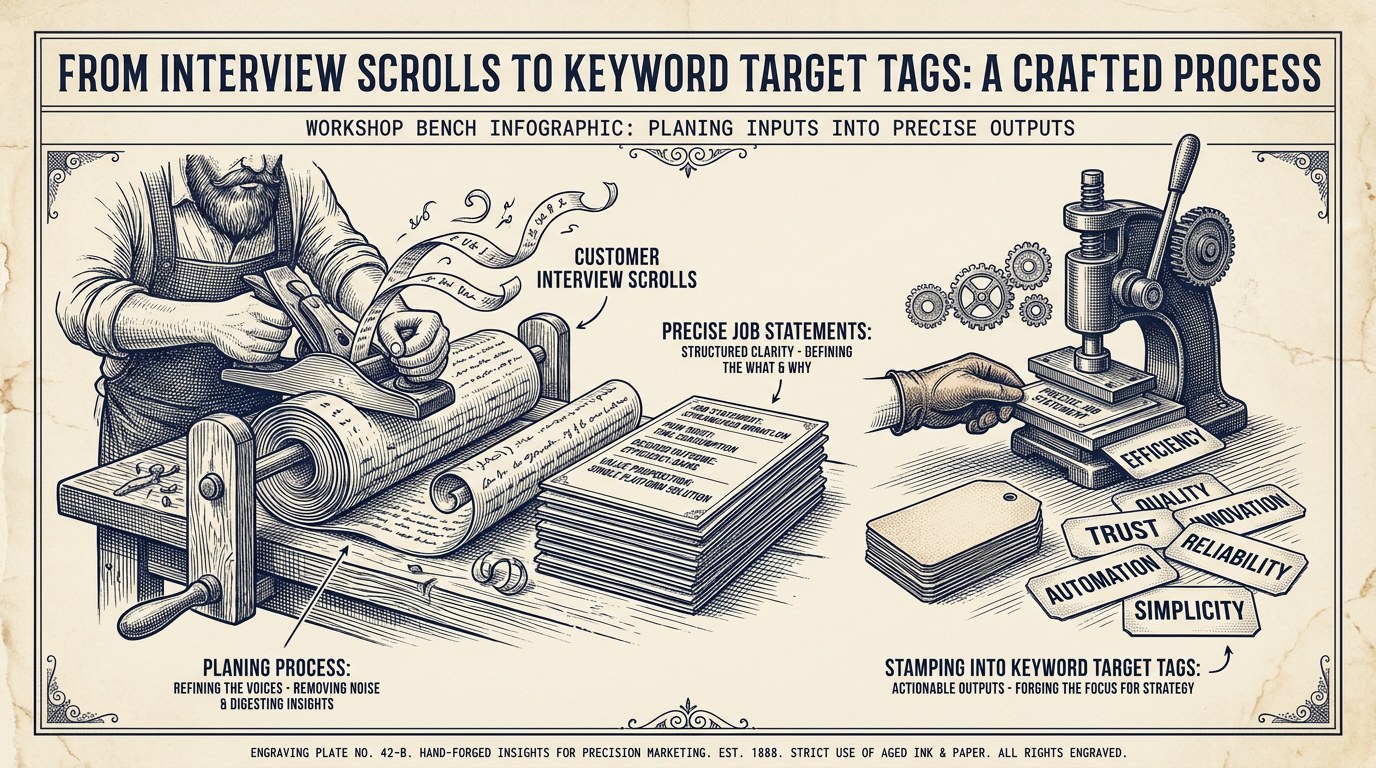
The extraction workflow runs in three operational steps. Step 1: conduct 8 to 15 customer interviews per quarter using JTBD interview methodology (covered in detail by the Re-Wired Group and Bob Moesta's When Coffee and Kale Compete. Programs new to JTBD interviews should study these sources for technique). Interviews focus on buyers who recently switched to or from the product, because the switch moment surfaces the underlying job most clearly. Step 2: transcribe interviews and review for JTBD statement candidates. Step 3: refine candidates into the canonical statement format, ensuring all three components are present.
Output per quarter: 12 to 25 well-formed JTBD statements covering the buying committee personas. The statement library compounds across quarters because customer jobs are relatively stable over multi-year periods, even as specific keywords evolve. This pairs with the sales-call mining operator playbook that complements JTBD extraction.
04Translating JTBD statements into keyword targets
The translation workflow turns each well-formed JTBD statement into 3 to 5 keyword candidates across the three mapping types from chapter 02. The discipline is brainstorming the search-engine-shaped query a buyer would run if they translated each component into search syntax. Translation works better as a collaborative exercise (2 to 3 marketing-team members together) than as a solo exercise because the translation requires fluency in both the buyer's operator vocabulary and the search-engine query vocabulary.
Translated candidates go through Stage 2 enrichment in the broader methodology (search volume, KD, intent, commercial signal). Many JTBD-sourced keywords show low search volume because the buyer-specific language has not yet aggregated into a high-volume query head. Low volume does not disqualify the keyword: JTBD-sourced keywords often have very high commercial intent because they target the buying moment with operator-specific language that signals genuine buyer engagement. ... and the buyer-mindset framing is consistent with Gartner's research on the B2B buying journey, which describes the "complex or difficult" experience B2B buyers report at high rates, language that signals exactly the JTBD-style frustration the keyword research is designed to surface.
05Where JTBD sourcing fits in the broader keyword research methodology
JTBD sourcing is Source 5 in the five-source framework, sitting alongside customer interviews / sales calls (Source 1), in-product search data (Source 2), competitor gap analysis (Source 3), and traditional keyword research tools (Source 4). JTBD differs structurally from Source 1 because Source 1 extracts buyer-language phrases directly from interviews; JTBD extracts the underlying job statement and then translates it into multiple keyword candidates. The two sources are complementary rather than substitutable.
Programs running JTBD as a standalone source see 100 to 300 raw keyword candidates per quarter concentrated in MOFU and BOFU buyer stages. The MOFU/BOFU concentration is structurally produced because well-formed JTBD statements describe specific situations and outcomes that map onto evaluation-stage queries. Programs running JTBD without the broader methodology miss the TOFU keyword surface that traditional research tools dominate.
06Common JTBD application failures and how to fix them
Four failure patterns recur. Failure 1: confusing user stories with JTBD statements. User stories ("As a marketing manager, I want to consolidate data, so I can save time") describe the user role; JTBD statements describe the situation and progress. The fix is rigorous statement-format discipline. Failure 2: extracting from too few interviews. Programs running 3 to 4 interviews per quarter produce JTBD libraries that miss persona variation. The fix is 8 to 15 interviews per quarter. Failure 3: translating without buyer journey stage calibration. Translations that ignore where in the buyer journey the keyword surfaces produce keyword targets that mismatch the content format. The fix is explicit stage tagging during translation. Failure 4: treating JTBD as a one-time research artifact. Customer jobs evolve as the product, category, and buyer expectations evolve. The fix is quarterly JTBD library refresh integrated with the broader keyword research operating cadence.
If you want to scope a JTBD interview program calibrated to your B2B SaaS category, book a 30-minute conversation about your JTBD keyword research workflow and we will design the interview cadence against your current customer research operating model.