On this page
B2B SaaS keyword research differs structurally from generic keyword research because the buying surface differs structurally. Multi-stakeholder buying committees of 4 to 9 people, evaluation cycles running 3 to 18 months on considered SaaS purchases, and the sales-marketing alignment requirement produce keyword surfaces that generic methodology cannot model.
The framework below covers why generic keyword research advice fails for B2B SaaS, the five-stage end-to-end methodology (sourcing, enrichment, qualification, clustering, prioritization), the five-category sourcing framework, the four-axis qualification framework, the production-readiness scoring rubric, and the four failure patterns that produce wasted keyword research effort even when programs follow the structural methodology.
01Why B2B SaaS keyword research differs from generic keyword research
This chapter establishes why generic keyword research advice systematically fails for B2B SaaS programs and what structural differences require the B2B SaaS-specific methodology covered in chapters 02 through 07. Programs applying generic methodology to B2B SaaS produce keyword targets that look reasonable on paper but fail to translate into pipeline contribution. The sections below cover the multi-stakeholder buying committee effect, the long evaluation cycle effect, and where generic methodology breaks down.
The multi-stakeholder buying committee effect
B2B SaaS purchases typically involve 4 to 9 people on the buying committee, depending on deal size and product category. Each committee member brings different search behavior. The end user searches for tactical workflow queries. The manager searches for ROI and team productivity queries. The IT or security stakeholder searches for compliance and integration queries. The procurement function searches for pricing and vendor evaluation queries. The executive sponsor searches for category-level strategic queries.
Generic keyword research methodology assumes a single-buyer model and produces keyword sets calibrated to one persona's search behavior. Programs using generic methodology typically capture the end-user query surface well (because it dominates search volume) and miss the manager, executive, IT, and procurement query surfaces entirely. The missing surfaces are where the buying decision actually compounds. This sits inside our complete keyword research playbook for B2B SaaS programs at the sub-pillar level and connects to the broader B2B SaaS SEO pillar reference at the pillar level.
The long evaluation cycle effect
B2B SaaS purchases run on evaluation cycles of 3 to 18 months for considered category purchases. The cycle produces three operational implications for keyword research. First, a single buyer interacts with content across multiple buying stages over the cycle, which means the same person's search behavior at month 1 differs structurally from their search behavior at month 8. Second, keyword research must model the full evaluation arc rather than a single buying moment. Third, content produced for one stage may be discovered at a different stage when the buyer's search behavior matches retroactively.
The implication for methodology: keyword research outputs need to map onto buyer stages explicitly. The mapping work is what the buyer intent mapping framework for B2B SaaS programs covers in detail, and it connects directly to the four-axis qualification framework in chapter 05.
Why generic keyword research advice fails for B2B SaaS
Generic keyword research advice fails in three specific ways. First, the high-volume keyword fixation that generic advice produces (target keywords by volume) systematically misses the bottom-funnel keywords where B2B SaaS pipeline actually comes from. The pattern is covered in operational depth in the high-volume keywords trap operator playbook for B2B SaaS programs.
Second, generic methodology relies on keyword research tools as the primary source. For B2B SaaS, tools surface roughly 40 to 60 percent of the actual buyer query universe; the remaining 40 to 60 percent comes from sales call mining, customer interviews, in-product search analytics, and Jobs-to-be-Done lens extraction. Third, generic methodology produces a one-time research artifact rather than a quarterly operational refresh, which means the keyword research stales as the product, category, and buying patterns evolve.
02The end-to-end methodology: five stages from sourcing to prioritization
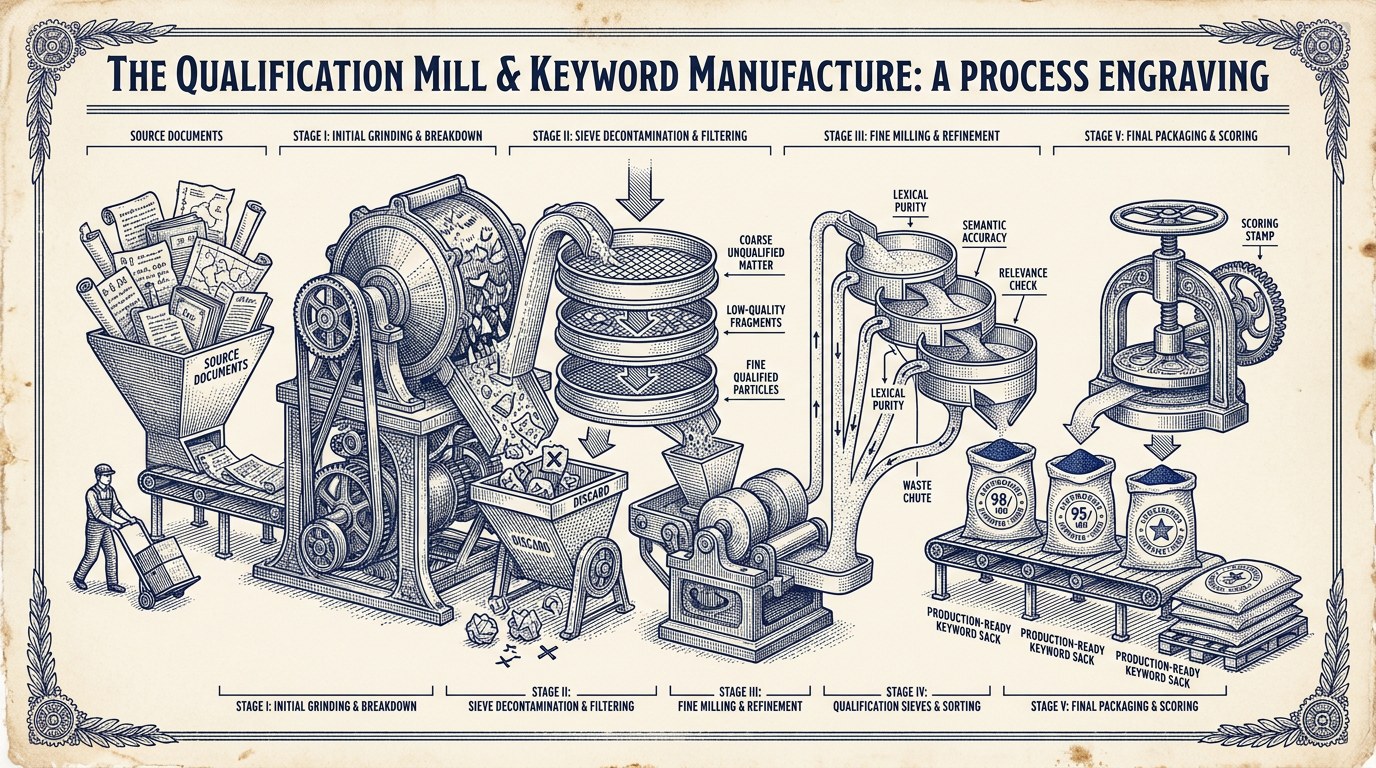
The end-to-end methodology runs in five sequential stages: sourcing, enrichment, qualification, clustering, prioritization. The sequence matters because each stage depends on the output of the prior stage, and programs skipping stages produce predictable downstream problems. The sections below cover the five-stage overview, why the sequence matters, and the typical time investment per stage.
The five-stage overview
- Stage 1: sourcing. Identify the raw keyword universe from five source categories (chapter 03). Output: 800 to 2,500 raw keyword candidates depending on program scale and category breadth.
- Stage 2: enrichment. Add four data points to every keyword in the raw list: search intent classification, monthly search volume, keyword difficulty, and commercial signal (CPC plus internal markers). Output: enriched keyword list with operational decision data.
- Stage 3: qualification. Apply the four-axis filtering framework (chapter 05) to filter the enriched list down to qualified targets. Output: 25 to 40 percent of the enriched list (200 to 1,000 qualified keywords).
- Stage 4: clustering. Group qualified keywords by semantic topic and buyer intent to identify content cluster opportunities. Output: 40 to 150 keyword clusters mapped to production opportunities.
- Stage 5: prioritization. Apply the production-readiness scoring rubric (chapter 07) to surface the leading 12 to 18 priority targets per quarter. Output: the quarterly priority queue that drives production planning.
Why stage sequence matters
Each stage produces decision data the next stage requires. Skipping enrichment and jumping from sourcing to qualification produces unreliable qualification decisions, because without volume, KD, and intent data, programs cannot apply the four-axis framework accurately. Skipping clustering and jumping from qualification to prioritization produces priority queues that miss compound opportunities, where 4 to 8 related keywords would justify a single comprehensive piece rather than fragmenting across individual targets.
The most common stage-skip pattern: programs jump from sourcing directly to prioritization, skipping enrichment, qualification, and clustering entirely. The result is a priority queue based on volume and gut feel rather than systematic decision data, which produces the predictable pattern of high-volume keyword fixation covered in chapter 08.
Typical time investment per stage
Sourcing runs 8 to 16 hours per quarterly cycle for a B2B SaaS program at the $5M to $50M ARR range, depending on the source category mix. Enrichment runs 4 to 8 hours using keyword research tool APIs and manual intent classification. Qualification runs 6 to 12 hours for the analyst applying the four-axis framework. Clustering runs 3 to 6 hours when assisted by clustering tools (Keyword Insights, ClusterAI, or Ahrefs Cluster Explorer); 8 to 16 hours for fully manual clustering. Prioritization runs 2 to 4 hours.
Total quarterly methodology investment: 23 to 46 hours per cycle. Programs running this discipline at a quarterly cadence produce the keyword research foundation that supports 12 to 18 published pieces per quarter at the production tier the priority queue defines.
03Stage 1 sourcing: the five-category framework for B2B SaaS keyword sources
The five-category sourcing framework covers the operational source universe for B2B SaaS keyword research completely. Each category produces a different segment of the buyer query universe, and programs running fewer than three categories operate with sourcing gaps that produce predictable keyword set underperformance. The sections below cover each source category with the operational mechanics, the typical keyword volume produced, and the unique value each source adds.
Source 1: customer interviews and sales call transcripts
The strongest source for B2B SaaS specifically. Customer interviews surface the language buyers use to describe their problem before encountering the product category, which produces the highest-converting upper-funnel and middle-funnel keyword surface. Sales call transcripts surface the language buyers use during evaluation, which produces the bottom-funnel and comparison keyword surface where most pipeline lives.
Operational mechanics: interview 8 to 15 recent customers per quarter, transcribe sales calls automatically through Gong, Chorus, Fireflies, or Avoma, and extract verbatim phrases that describe buyer problems, evaluation criteria, and competitive comparisons. The extraction work for sales call mining is covered in the operator playbook for mining sales calls for B2B SaaS keywords. Typical quarterly volume from this source: 200 to 500 raw keyword candidates with very high signal-to-noise ratio because the language comes from actual buyers.
Source 2: in-product and help center search query data
In-product search analytics (queries users run inside the product) and help center search analytics (queries users run on the support knowledge base) produce a distinct source category covering the post-purchase keyword surface. The category matters for B2B SaaS because customer expansion, retention, and product-led acquisition all depend on the post-purchase content surface, and in-product search queries are the highest-fidelity signal for what existing users actually need to know.
Operational mechanics: pull 90 days of in-product search query logs and help center search query logs, sort by frequency, and extract the leading 100 to 300 queries by volume. Typical quarterly volume: 100 to 250 raw keyword candidates concentrated in post-purchase intent. This source is unique to B2B SaaS programs (other industries do not have equivalent in-product search surfaces) and is the most under-used source category in practice.
Source 3: competitor keyword gap analysis
Competitor keyword gap analysis uses traditional keyword research tools (Ahrefs, Semrush) to identify keywords competitors rank for that the program does not yet target. The category produces a category-mapping source that ensures the program's keyword set has no obvious blind spots relative to the competitive set.
Operational mechanics: identify 4 to 8 direct competitors plus 2 to 4 adjacent category competitors, run keyword gap analysis in Ahrefs or Semrush against each, and extract keywords where competitors rank in positions 1 to 20 that the program does not yet target. Typical quarterly volume: 300 to 800 raw keyword candidates.
Source 4: traditional keyword research tools
Traditional keyword research tools (Ahrefs Keywords Explorer, Semrush Keyword Magic, Google Keyword Planner) produce the broadest source category. The category covers the keyword universe that has search data attached, including the long-tail query surface that other sources may miss. The category is the lowest signal-to-noise per source but the largest volume, which makes it the workhorse source for completeness rather than precision.
Operational mechanics: run seed query expansions in Ahrefs Keywords Explorer using "matching terms," "related terms," and "search suggestions" reports, applying volume and KD filters to keep the output manageable. Typical quarterly volume: 400 to 1,200 raw keyword candidates. The category is the primary input for the high-volume keyword surface that needs to be filtered carefully during qualification (chapter 05) to avoid the high-volume keyword fixation failure pattern.
Source 5: Jobs-to-be-Done lens extraction
Jobs-to-be-Done (JTBD) lens extraction sources keywords from the underlying job the buyer is trying to get done rather than from the surface intent of the query. The category produces a complementary source that catches keywords other sources miss because the buyer expresses the job in non-keyword-shaped language. JTBD extraction is the methodology that connects buyer interviews (Source 1) with the broader keyword universe in a structured way.
Operational mechanics: extract 8 to 15 jobs-to-be-done statements from customer interviews using the standard JTBD format ("When [situation], I want to [job], so I can [outcome]"), then translate each statement into the keyword phrases buyers would search for at each evaluation stage. Typical quarterly volume: 100 to 300 raw keyword candidates with high pipeline-conversion signal.
04Stage 2 enrichment: adding intent, volume, KD, and commercial signal data
Stage 2 enriches every keyword in the raw list with four data points that enable the four-axis qualification framework in Stage 3. Programs skipping enrichment produce qualification decisions that rely on gut feel rather than systematic decision data, which produces the predictable failure pattern of high-volume keyword fixation covered in chapter 08. The sections below cover the four enrichment data points, where to source each one, and the commercial signal layer that extends beyond CPC.
The four enrichment data points
- Data point 1: search intent classification. Every keyword gets classified as informational, navigational, commercial, or transactional intent. The classification informs which buyer stage the keyword maps onto and what content format the keyword needs.
- Data point 2: monthly search volume. US-default unless the program operates in a specific regional market. Volume informs achievable traffic ceiling per ranking position.
- Data point 3: keyword difficulty (KD). Ahrefs KD scale or Semrush KD scale, applied consistently across the keyword list. KD informs achievability against current domain authority and timeline to ranking.
- Data point 4: commercial signal data. CPC (the universal commercial signal) plus internal commercial signal markers covered in the section below.
Where to source each data point
Search intent classification: manual classification by the analyst, supplemented by Ahrefs intent flags (informational, navigational, commercial, transactional, branded, local). Manual classification is required for B2B SaaS because tool-derived intent classifications miss the multi-stakeholder buying committee nuance covered in chapter 01.
Monthly search volume and keyword difficulty: pull from Ahrefs Keywords Explorer API or Semrush Keyword Magic API in bulk. For large keyword lists (over 500 candidates), use Ahrefs Batch Analysis or Semrush Bulk Keyword Analysis to enrich efficiently. CPC data ships alongside volume and KD from the same APIs.
The commercial signal layer beyond CPC
CPC is the universal commercial signal but undercounts B2B SaaS commercial intent in three specific ways. First, low-volume bottom-funnel keywords often show $0 CPC despite very high commercial intent because no advertisers bid on the long-tail. Second, branded comparison keywords (e.g., "competitor X vs competitor Y") often show low CPC despite extreme commercial intent because the SERP is dominated by organic content rather than paid. Third, in-product feature queries often show $0 CPC because they are post-purchase rather than pre-purchase.
The B2B SaaS commercial signal layer adds three internal markers beyond CPC. Marker 1: presence of the keyword in sales call transcripts (Source 1) within the last 90 days. Marker 2: presence of the keyword in in-product or help center search logs (Source 2) within the last 90 days. Marker 3: the keyword targets a buyer stage at MOFU or BOFU per the intent classification. Keywords scoring on at least one of the three markers carry stronger commercial signal than CPC alone reveals. ... and the data definitions follow Google Keyword Planner's documentation directly, which matters because volume ranges and competition scores carry specific definitional weight in the Google ecosystem that third-party tools often approximate differently.
05Stage 3 qualification: the four-axis filtering framework
The four-axis qualification framework filters the enriched keyword list down to operational priority candidates. Each axis is independently evaluated, and keywords passing all four axes move to clustering (Stage 4). Keywords failing any single axis move to the parking lot for re-evaluation in future quarterly cycles when conditions may have shifted. The sections below cover each axis with the evaluation criteria and the typical pass rate per axis for B2B SaaS programs.
Axis 1: relevance to the buying committee
The keyword maps onto at least one buying committee persona search behavior (end user, manager, IT or security, procurement, executive sponsor) covered in chapter 01. Keywords mapping onto only adjacent personas (e.g., HR-focused queries for a marketing automation product) fail this axis even if other axes pass.
Operational evaluation: the analyst maps each keyword to a primary committee persona and a secondary committee persona where applicable. Keywords without a clear primary persona match fail the axis. Typical pass rate at this axis: 50 to 70 percent of the enriched list for B2B SaaS programs with well-defined ICP.
Axis 2: achievability against current domain authority
The keyword's KD is within achievable range for the program's current domain rating (DR) and topical authority. The achievability rule of thumb: programs at DR 30 to 40 can target KD 0 to 15, programs at DR 40 to 60 can target KD 0 to 30, programs at DR 60 to 75 can target KD 0 to 50, programs at DR 75+ can target KD 0 to 70. Keywords with KD exceeding the achievable range fail the axis.
The rule of thumb is operational shorthand. Topical authority modifiers, where the program has established deep topical coverage, can extend the achievable KD range by 10 to 20 points within the relevant topical cluster. Typical pass rate at this axis: 40 to 60 percent of the enriched list for programs with realistic KD targeting; 80 to 95 percent for programs that aspire to broader KD ranges than their current authority supports.
Axis 3: business value per ranking position
The keyword's commercial signal (CPC plus internal markers from chapter 04) indicates business value per ranking position that justifies the production investment. The evaluation uses a 1-to-5 business value score:
- 5: BOFU intent with CPC over $5 or strong internal commercial markers
- 4: MOFU intent with CPC $2 to $5 or moderate internal commercial markers
- 3: TOFU or MOFU intent with CPC $0.50 to $2 or weak internal commercial markers
- 2: TOFU intent with CPC under $0.50 and no internal markers
- 1: post-purchase or off-pipeline intent (retention or expansion only)
Keywords scoring 3 or higher pass the axis. Keywords scoring 1 or 2 fail unless the keyword serves a specific compounding role (topical authority anchor, AI Search citation hook, internal linking target) covered separately during clustering. Typical pass rate at this axis: 45 to 65 percent of the enriched list.
Axis 4: production feasibility
The keyword's production requirements (content format, content depth, technical or SME input needed) fit within the program's production capacity for the quarter. The evaluation considers content format (programmatic page vs cluster post vs sub-pillar vs pillar), required SME interview depth, and integration with existing content (refresh vs net new). Keywords requiring production resources the program cannot allocate in the relevant quarter fail the axis even if other axes pass.
The axis is the most program-specific of the four. Programs running 4 to 6 named SME interviews per quarter for content production cannot allocate 15 SME-dependent keyword targets in a single quarter regardless of how well the other axes score. Typical pass rate at this axis: 60 to 85 percent for programs with realistic production capacity assessment.
Compound pass rate across all four axes: 25 to 40 percent of the enriched list for programs with strong qualification discipline. Programs with weak qualification discipline see 70 to 85 percent compound pass rate and accumulate execution debt downstream.
06Stage 4 clustering: semantic and intent-based grouping for B2B SaaS programs
Stage 4 groups qualified keywords by semantic topic and buyer intent to identify content cluster opportunities. Clustering matters because related keywords often resolve into a single comprehensive piece rather than fragmenting across individual targets, which produces stronger ranking outcomes per production unit invested. The sections below cover semantic clustering, intent clustering, and the decision rule for which clustering approach to apply per keyword set.
Semantic clustering: grouping by topic
Semantic clustering groups keywords by topic similarity, typically using SERP overlap analysis. Two keywords cluster together when the first-page SERPs for each keyword share 4 or more URLs. SERP overlap is the canonical clustering signal because it reflects how Google groups topics in its ranking model: when two keywords produce similar first-page SERPs, Google treats them as variants of the same topic.
Operational mechanics: pull SERP data for each qualified keyword and run SERP overlap analysis using Keyword Insights, ClusterAI, Surfer, or Ahrefs Cluster Explorer. Output: 40 to 150 keyword clusters depending on the qualified keyword volume. Each cluster represents a content opportunity (typically a single piece covering the cluster topic) rather than separate pieces per keyword.
Intent clustering: grouping by buyer stage
Intent clustering groups keywords by buyer stage (TOFU, MOFU, BOFU, post-purchase) rather than by topic similarity. The clustering produces a complementary view that maps the qualified keyword set onto the evaluation arc, which informs the content calendar's stage balance.
Operational mechanics: use the search intent classification from Stage 2 enrichment to group keywords by stage, then further sub-cluster within each stage by topic similarity. Output: 4 stage buckets (TOFU, MOFU, BOFU, post-purchase) with internal topic sub-clusters. The grouping reveals stage imbalances (e.g., a program with 80 percent qualified keywords at TOFU and 5 percent at BOFU has a structural keyword research problem covered in chapter 08).
When to use each clustering approach
Both clustering approaches add value. Semantic clustering drives content production planning (what piece to write next). Intent clustering drives portfolio balance assessment (whether the qualified keyword set has the right stage distribution). Programs running both approaches produce stronger keyword research outputs than programs running only one.
The operational pattern: run semantic clustering first to identify content opportunities, then run intent clustering on the same qualified list to assess stage distribution. If the stage distribution is heavily skewed (over 60 percent at TOFU or under 15 percent at BOFU), revisit the qualification framework and source mix to rebalance. ... and the buyer-intent patterns are consistent with Gartner's research on the B2B buying journey, which describes the typical evaluation as a non-linear loop involving 6 to 10 stakeholders re-entering the same intent state multiple times across an extended cycle.
07Stage 5 prioritization: the production-readiness scoring rubric
Stage 5 applies the production-readiness scoring rubric to surface the leading 12 to 18 priority targets per quarter. The discipline is treating the priority queue as the operational planning document that drives the quarterly content calendar, not as a wish list of every qualified keyword. The sections below cover the scoring rubric, the quarterly priority queue mechanics, and when to refresh the priority list.
The production-readiness scoring rubric
Each cluster from Stage 4 gets a production-readiness score:
production_readiness = qualification_composite × cluster_maturity_multiplier
Qualification composite is the average of the four-axis qualification scores from Stage 3, on a 1-to-5 scale. Cluster maturity multiplier is a 0.5 to 1.5 modifier based on three factors: SME availability for the cluster topic (multiplier 1.0 if available, 0.7 if partially available, 0.4 if not available), competitive content depth gap (multiplier 1.3 if the SERP is shallow on operator content, 1.0 if the SERP is balanced, 0.6 if the SERP is saturated with deep content), and internal linking opportunity strength (multiplier 1.2 if the cluster connects to multiple existing pillar or sub-pillar destinations, 1.0 if it connects to one or two destinations, 0.7 if it connects to none).
Clusters ranking in the leading 12 to 18 by production-readiness score become the quarterly priority queue. Clusters below the cutoff move to the next quarterly evaluation cycle.
The quarterly priority queue
The quarterly priority queue runs 12 to 18 clusters because that range matches sustainable content production capacity for B2B SaaS programs at the $5M to $50M ARR range running with 1 to 3 internal writers plus SME inputs. Programs at larger scale ($50M+ ARR) with 4+ internal writers can sustain 20 to 30 clusters per quarter; programs at smaller scale (under $5M ARR) with 1 writer typically sustain 6 to 10 clusters per quarter.
The discipline is treating the priority queue as the production commitment, not as a wishlist. Each cluster in the queue gets a named owner, a content brief, a production timeline, and an integration plan for the broader content estate. Clusters that cannot meet these requirements get demoted before the queue locks for the quarter, which prevents the predictable failure pattern of overcommitting the production calendar.
When to refresh the priority list
The priority list refreshes quarterly. Mid-quarter refreshes happen only when material events justify them: major product launches that shift the keyword surface, competitive moves that change the SERP landscape on priority clusters, or external events (algorithm updates, category-level news) that change the achievability or commercial signal calculations.
Programs refreshing the list more frequently than quarterly produce two operational problems. First, the production team cannot complete clusters started in prior quarters before the refresh introduces new priorities, which produces the half-finished cluster pattern that wastes prior production investment. Second, the keyword research effort consumes capacity that should go to production. The quarterly cadence balances responsiveness with operational stability.
08Four failure patterns that produce wasted keyword research effort
Four failure patterns recur across B2B SaaS keyword research programs even when programs follow the structural methodology. The patterns produce wasted research effort, misallocated production capacity, and pipeline contribution gaps that compound over multi-quarter cycles. The sections below cover each failure pattern with the underlying cause and the specific operational fix.
Failure 1: high-volume keyword fixation
The most common failure pattern. Programs prioritize high-volume keywords from Stage 1 sourcing (Source 4 keyword research tools) and skip the four-axis qualification framework in Stage 3, which produces priority queues dominated by TOFU keywords that capture awareness traffic without translating into pipeline contribution. The pattern is covered in operational depth in the high-volume keywords trap operator playbook.
The fix: apply the four-axis qualification framework consistently regardless of volume, and weight Axis 3 (business value per ranking position) heavily in the production-readiness scoring rubric. Programs running this discipline see priority queues with 40 to 60 percent BOFU and MOFU keywords rather than the 10 to 20 percent baseline produced without qualification discipline.
Failure 2: ignoring the dark funnel keyword surface
The dark funnel keyword surface includes the queries buyers run during evaluation that do not produce trackable conversion events in the CRM. Examples: branded comparison queries between non-program brands ("competitor X vs competitor Y" where the program is in neither), pricing-discovery queries on competitors, integration questions for tools the program does not own. Programs that exclude this surface from keyword research miss the keyword opportunities where buyer attention concentrates during the most critical evaluation moments.
The fix: include the dark funnel surface in Source 3 (competitor keyword gap analysis) explicitly, and weight Axis 3 business value scoring to credit keywords that intersect with the evaluation moment even when CPC is low or attribution is weak.
Failure 3: skipping qualification
The qualification stage is the most commonly skipped stage in B2B SaaS keyword research programs. Programs run sourcing and enrichment, then jump directly to prioritization without applying the four-axis framework. The result: priority queues built on gut feel and volume rather than systematic decision data, which produces the high-volume keyword fixation pattern as a downstream effect.
The fix: treat qualification as a structural stage rather than as optional polish. The 6 to 12 hours of qualification work per quarter saves 40 to 80 hours of misallocated production work downstream when the program ships keywords that the qualification framework would have flagged for the parking lot.
Failure 4: treating keyword research as a one-time exercise
Programs that run keyword research annually (or worse, only at program inception) operate with stale keyword data 6 to 18 months after the research completes. The product evolves, the category evolves, competitive moves shift the SERP, and buyer search behavior shifts in response to industry changes. Stale keyword research produces production decisions based on conditions that no longer apply.
The fix: treat keyword research as a quarterly operational refresh, not an annual strategic exercise. The 23 to 46 hours of quarterly methodology work covered in chapter 02 produces the keyword research foundation that supports the quarter's production. If you need help scoping the right keyword research operating cadence for your B2B SaaS program, book a 30-minute conversation about your keyword research methodology and we will audit your current process against the five-stage framework above.
09FAQ
Seven questions covering the topics most commonly searched at the B2B SaaS keyword research methodology intersection, each with a self-contained answer designed for direct citation extraction by ChatGPT, Perplexity, and Google AI Overviews. The Q&A structure also feeds the FAQPage schema that ships with this post.
How is B2B keyword research different from regular keyword research?
B2B keyword research differs structurally because the buying surface differs structurally. B2B SaaS purchases involve 4 to 9 people on the buying committee, evaluation cycles of 3 to 18 months, and sales-marketing alignment requirements that single-buyer keyword methodology cannot model. Generic keyword research captures the end-user query surface well (because it dominates search volume) but misses the manager, executive, IT, and procurement query surfaces where the buying decision actually compounds. The B2B SaaS-specific methodology adds five sourcing categories (customer interviews, sales call transcripts, in-product search analytics, competitor gap analysis, JTBD lens extraction) and a four-axis qualification framework that filters generic-tool output through B2B-specific criteria.
What methodology should B2B SaaS programs use for keyword research?
The end-to-end methodology runs in five sequential stages: sourcing, enrichment, qualification, clustering, prioritization. Stage 1 sourcing draws from five categories: customer interviews and sales call transcripts, in-product and help center search query data, competitor keyword gap analysis, traditional keyword research tools, and Jobs-to-be-Done lens extraction. Stage 2 enrichment adds intent, volume, KD, and commercial signal data. Stage 3 qualification applies the four-axis filter (relevance to buying committee, achievability against current authority, business value per ranking position, production feasibility). Stage 4 clustering groups keywords semantically and by intent. Stage 5 prioritization applies the production-readiness scoring rubric to surface the quarterly priority queue.
How often should B2B SaaS programs refresh keyword research?
Quarterly. Keyword research runs as a quarterly operational refresh rather than an annual strategic exercise. The 23 to 46 hours of methodology work per quarter produces the keyword research foundation that supports the quarter's production. Programs running keyword research annually operate with stale data 6 to 18 months after the research completes; programs running keyword research mid-quarter produce two operational problems (the production team cannot complete prior-quarter clusters before new priorities arrive, and the research effort consumes capacity that should go to production). The quarterly cadence balances responsiveness with operational stability.
What sources should B2B SaaS programs use for keyword research?
Five source categories cover the operational source universe. Source 1: customer interviews and sales call transcripts (highest signal-to-noise; produces buyer-language keywords). Source 2: in-product and help center search query data (post-purchase keyword surface; unique to SaaS). Source 3: competitor keyword gap analysis (category-mapping source). Source 4: traditional keyword research tools (broadest source by volume; the workhorse for completeness). Source 5: Jobs-to-be-Done lens extraction (catches keywords other sources miss because buyers express the job in non-keyword-shaped language). Programs running fewer than three categories operate with sourcing gaps that produce predictable keyword set underperformance.
How do you qualify B2B SaaS keywords for production?
The four-axis qualification framework filters the enriched keyword list. Axis 1: relevance to the buying committee (the keyword maps onto at least one buying committee persona search behavior). Axis 2: achievability against current domain authority (the keyword's KD is within achievable range for the program's current DR). Axis 3: business value per ranking position (the keyword's commercial signal justifies the production investment, scored 1 to 5). Axis 4: production feasibility (the keyword's production requirements fit within the program's production capacity). Keywords passing all four axes move to clustering; keywords failing any single axis move to the parking lot. Strong qualification discipline produces 25 to 40 percent compound pass rate.
How do you cluster B2B SaaS keywords for content production?
Two clustering approaches add complementary value. Semantic clustering groups keywords by topic similarity using SERP overlap analysis: two keywords cluster together when the first-page SERPs for each share 4 or more URLs. Semantic clustering drives content production planning (what piece to write next). Intent clustering groups keywords by buyer stage (TOFU, MOFU, BOFU, post-purchase) using the search intent classification from enrichment. Intent clustering drives portfolio balance assessment (whether the qualified keyword set has the right stage distribution). Programs running both approaches produce stronger keyword research outputs than programs running only one.
How many keywords should a B2B SaaS program target per quarter?
12 to 18 priority cluster targets per quarter for B2B SaaS programs at the $5M to $50M ARR range running with 1 to 3 internal writers plus SME inputs. Programs at larger scale ($50M+ ARR) with 4+ internal writers can sustain 20 to 30 clusters per quarter; programs at smaller scale (under $5M ARR) with 1 writer typically sustain 6 to 10 clusters per quarter. The quarterly priority queue runs at this range because it matches sustainable content production capacity. Each cluster in the queue gets a named owner, a content brief, a production timeline, and an integration plan with the broader content estate.
Part of the keyword research playbook
This is the methodology layer under keyword research.
The complete keyword research sub-pillar covers the discipline strategically, including buyer intent mapping, the high-volume keywords trap anti-pattern, the sales-call mining tactical guide, and the upcoming Jobs-to-be-Done framework deep-dive that pairs with this methodology piece.