On this page
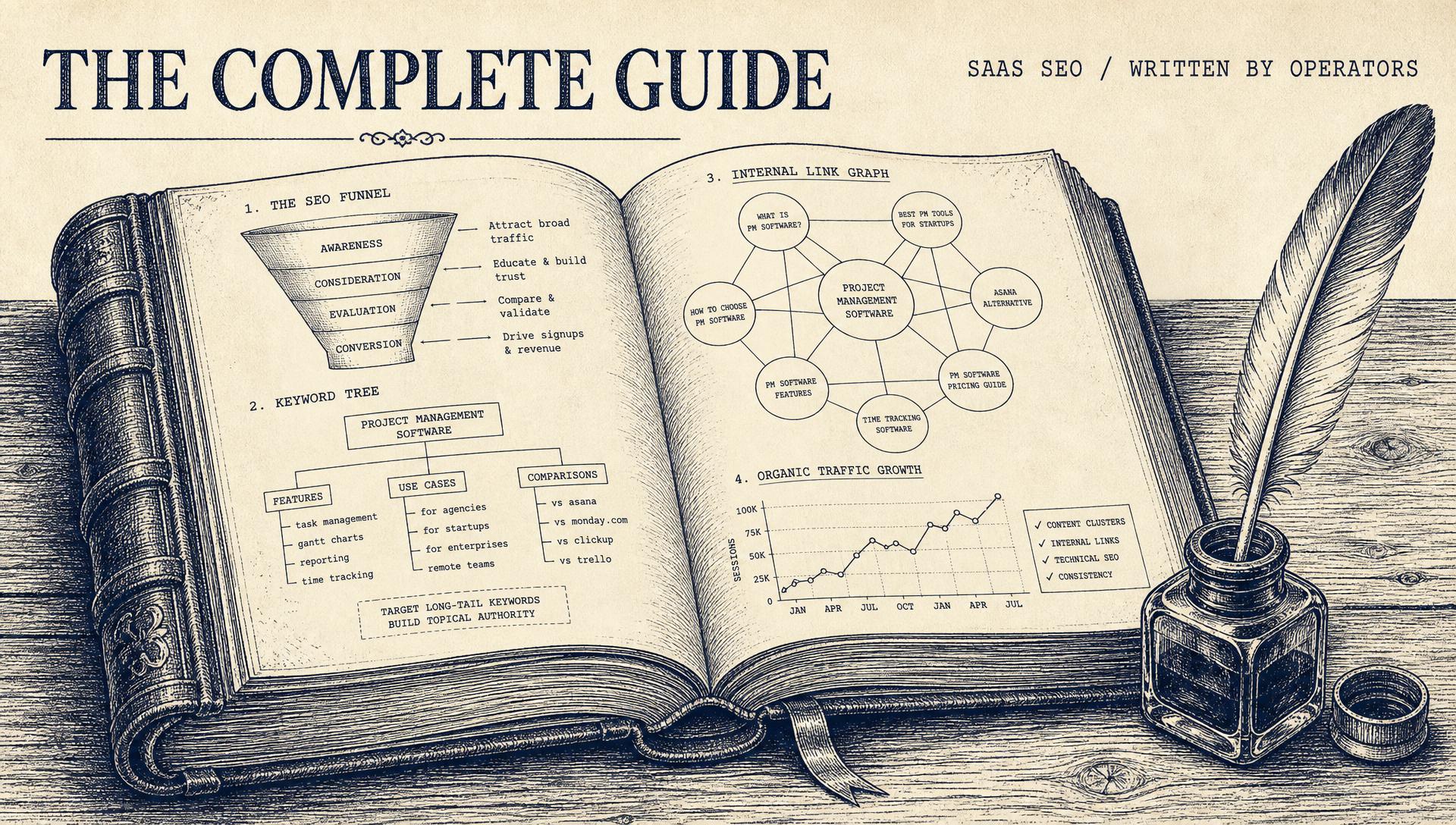
Most B2B SaaS content programs produce one piece per keyword. The result is thin content that fragments ranking signal across the topical surface, leaving every piece weaker than it could be. Keyword clustering inverts the pattern. One piece per cluster concentrates ranking signal on a single URL and produces stronger rankings per production unit invested.
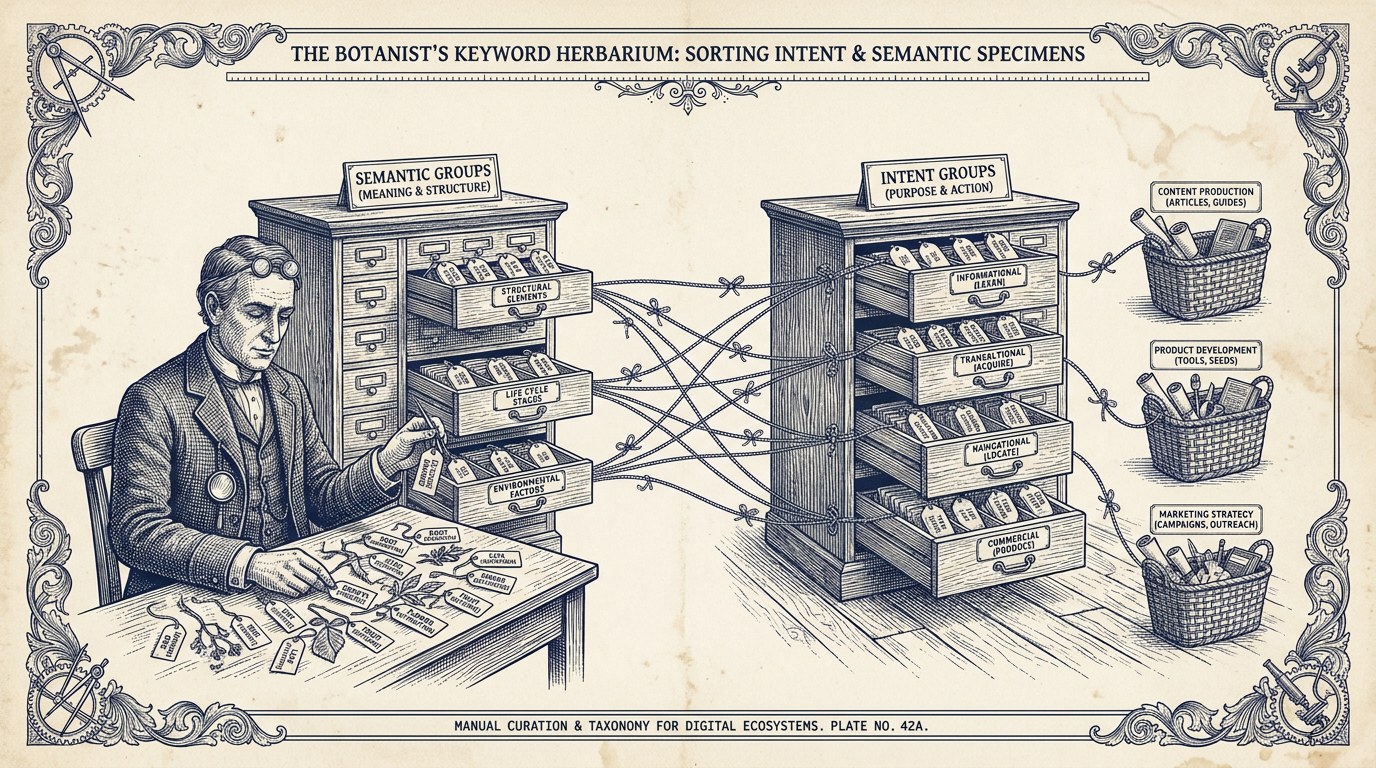
The discipline splits into two complementary methods with different operational uses. Semantic clustering groups keywords by topic similarity using SERP overlap analysis and drives content production planning. Intent clustering groups keywords by buyer journey stage and drives portfolio balance assessment. This is the operator framework for running both inside a B2B SaaS program: when to apply each, the four-URL SERP overlap threshold, the 2026 tooling landscape, and the cluster-to-brief production handoff that turns clustering work into shipped content.
01The problem keyword clustering actually solves for B2B SaaS
The binding constraint for most B2B SaaS content programs at $5M to $50M ARR is production capacity. A program with 1 to 3 internal writers ships 12 to 18 cluster pieces per quarter. Targeting 12 to 18 individual keywords with that capacity produces two failure patterns. The team ships 12 to 18 thin pieces and each ranks weakly because the topical surface is fragmented across them. Or the team ships 6 to 8 deep pieces and 4 to 12 keywords remain un-targeted.
Clustering reconciles the constraint. One deep piece targets a cluster of 5 to 15 related keywords and ranks across all member keywords rather than ranking for each one individually. The production team ships the same 12 to 18 pieces per quarter but targets 60 to 200 qualified keywords instead of 12 to 18. This is why clustering matters for B2B SaaS production specifically and why it sits inside the broader keyword research methodology covered at the B2B keyword research methodology playbook, where clustering is the production-planning stage of the five-stage workflow.
02Semantic clustering, the SERP overlap method
Semantic clustering groups keywords by topic similarity using SERP overlap analysis as the canonical signal. Two keywords cluster together when the top 10 organic Google SERP results for each share 4 or more URLs. The threshold reflects how Google's ranking model groups topic variants. When two keywords produce substantially similar top 10 SERPs, Google treats them as variants of the same topic, which means a single piece targeting the cluster ranks across all member keywords.
The operational mechanics
Pull SERP data for each qualified keyword from a SERP API like Ahrefs, Semrush, or DataForSEO, or use a clustering tool that handles the fetch automatically. Run pairwise SERP overlap comparison across the qualified keyword list. Build clusters from keywords that meet the four-URL threshold against at least one other cluster member.
Why SERP overlap beats embedding similarity
Pure embedding-distance clustering using OpenAI embeddings or sentence-transformers groups keywords by semantic relatedness in embedding space. That is necessary but not sufficient for search intent equivalence. Two keywords can be semantically related (high cosine similarity) but produce dissimilar SERPs (different intent). SERP overlap captures intent directly because the SERP is Google's own grouping verdict. The OpenAI embeddings guide documents the underlying mechanic that makes pure embedding clustering miss intent: cosine similarity in embedding space does not capture the user's actual destination.
03Intent clustering, the buyer-stage method
Intent clustering groups keywords by buyer journey stage rather than topic similarity. The four stages most B2B SaaS programs use are TOFU (problem awareness), MOFU (solution consideration), BOFU (vendor evaluation), and post-purchase (implementation and expansion). The output is a stage distribution view across the qualified keyword set.
For B2B SaaS specifically, intent clustering surfaces the buying committee persona shift across stages. TOFU is end-user-dominant with tactical workflow queries. MOFU shifts to manager-dominant with ROI and team productivity queries. BOFU adds executive-sponsor and procurement personas with pricing and vendor evaluation queries. Post-purchase returns to end-user with in-product and expansion queries. Intent clusters that ignore this persona shift produce content calendars that capture awareness traffic without translating into pipeline.
This sits inside the broader buyer intent mapping framework that calibrates the persona-shift across stages and pairs with the search intent calibration framework for B2B SaaS buying committees.
04When to apply semantic, intent, or both
Semantic clustering applies when the goal is identifying production opportunities. The output is a cluster list ranked by traffic potential, where each cluster maps to one content piece. Intent clustering applies when the goal is assessing portfolio balance. The output is a stage distribution across the qualified set, which informs whether the program is over-investing in TOFU at the expense of BOFU.
The operational pattern that works for most programs: run semantic clustering first on the qualified keyword list to identify content opportunities. Then run intent clustering on the same list to assess stage distribution. If the distribution is balanced (roughly 40% TOFU, 30% MOFU, 20% BOFU, 10% post-purchase), proceed to prioritization. If the distribution is skewed (over 60% TOFU or under 15% BOFU), return to qualification with stage targeting as an additional axis weight.
Running both methods takes 30 to 60 percent more clustering effort than running either alone. The trade-off is that programs running only semantic clustering produce calendars optimized for production efficiency without portfolio balance. Programs running only intent clustering produce stage-balanced calendars without production efficiency.
05The four-URL threshold, and when to break the rule
The four-URL threshold is the operational setting that fits most B2B SaaS categories. Programs run lower or higher thresholds in three specific cases.
Three-URL threshold for emerging or fragmented categories
Categories where the SERP is still consolidating (newer software verticals, niche B2B sub-categories) often have lower base SERP overlap because Google has not yet settled on the canonical results. A three-URL threshold widens clusters in these categories to capture keyword groupings that the five-URL setting would split artificially.
Five-URL threshold for highly commercial consolidated SERPs
Categories where the top 10 is dominated by the same 5 to 7 brands across many related keywords (CRM, project management, accounting software) have high base SERP overlap. The four-URL threshold pulls keywords together that should be separate pieces. A five-URL or six-URL setting tightens clusters and prevents over-consolidation.
When to override entirely
Manual review of borderline clusters catches cases where the SERP overlap signal is misleading. A keyword pair with five-URL overlap but where one keyword's intent is buyer-evaluation and the other's is technical-implementation should be split despite the signal. The threshold is a default, not a hard rule.
06Clustering tooling, the 2026 landscape
Three buy options dominate the B2B SaaS clustering tool market as of mid-2026. Pricing details below are accurate as of this writing but tools update frequently. Verify on the vendor pricing pages before commitment.
Keyword Insights
Universal Credits pricing model with monthly subscription tiers, as detailed on the official pricing page. Strong SERP overlap clustering with intent classification built in. Best for programs at $5M to $25M ARR running clustering as the primary keyword research workflow.
Ahrefs
Keyword Explorer plus Cluster Explorer functionality is included in Ahrefs subscriptions starting at the Starter tier, as detailed on the official Ahrefs pricing page. Best for programs already running Ahrefs as their primary keyword research stack, since native integration with Ahrefs keyword data and SERP analysis avoids the data-export-and-re-import workflow that separate clustering tools require.
Semrush
Keyword Magic Tool plus the Topic Research workflow handles clustering at the topical-grouping level, as detailed on the Semrush pricing page. The clustering granularity is coarser than Keyword Insights or Ahrefs Cluster Explorer, which is a trade-off for the broader workflow integration with content production and competitive analysis.
Build options for agencies
Custom Python implementations using a SERP API plus clustering libraries like scikit-learn produce capability the tools already provide at higher monthly cost than the tools themselves. The exception is multi-client agency operations: a single custom clustering pipeline amortizes across many client projects in a way that per-seat tool pricing does not.
07Clustering at scale, the 1000+ keyword case
Clustering 100 to 300 qualified keywords runs in minutes on any of the tools above. Clustering 1,000+ keywords is a different operational problem because the pairwise SERP comparison scales quadratically. Three patterns handle scale.
Pattern 1, pre-segment by category before clustering
Programs running clustering on keyword lists that span multiple product lines or multiple ICPs run separate clustering passes per segment. The segments share no expected SERP overlap, so running them together wastes computation and produces noisier clusters.
Pattern 2, raise the threshold for tight clusters at scale
At 1,000+ keywords, the four-URL threshold can produce a few very large clusters that mix sub-topics. Moving to a five-URL or six-URL threshold splits the mega-clusters into production-sized units of 5 to 15 keywords each.
Pattern 3, batch clusters into production cohorts
A 1,000-keyword qualified list typically produces 80 to 150 clusters. The production team cannot ship 150 pieces in the next quarter. Batch the clusters into cohorts of 12 to 18 (one quarter's production capacity) ordered by priority score, then re-cluster the remaining backlog quarterly as new keywords are added.
08From clusters to briefs, the production handoff
The discipline that converts clustering work into shipped content runs in three steps. Without all three, clustering produces a detailed keyword research document that accumulates in the backlog without producing pipeline contribution.
Step 1, named owner per cluster
Every cluster gets a named owner from the content team. The owner is responsible for the brief, the production timeline, and the quality check before publication. Clusters without a named owner do not produce shipped content, full stop.
Step 2, brief per cluster
Every cluster gets a content brief specifying piece format (cluster post, comparison page, pillar page), depth (target word count and chapter count), the primary keyword from the cluster, the 3 to 8 supporting keywords that the piece must address, the internal linking targets, and the output specs. Brief format follows the content brief template framework for B2B SaaS.
Step 3, production timeline per cluster
Every cluster gets a production timeline with research, draft, review, and publish milestones. The timeline lives in the same project management system as the rest of the content production workflow, not in a separate clustering doc that no one looks at after the brief is written.
09FAQ
These are the questions B2B SaaS marketing leaders ask most often about keyword clustering. The answers reflect what operators see in practice, not what tool vendors recommend in their documentation.
What is the difference between keyword clustering and topic clustering?
Keyword clustering groups individual search queries that produce similar SERPs. Topic clustering groups broader topical areas across many keywords. The two are related but operate at different granularities. Keyword clustering output is "these 8 keywords belong in one piece"; topic clustering output is "these 14 pieces belong to one topical hub." Most B2B SaaS programs run both, with keyword clustering feeding piece-level production and topic clustering feeding pillar-and-cluster architecture decisions.
How often should we re-cluster the keyword set?
Quarterly for the qualified keyword list during active production. SERPs shift, new keywords enter the qualified set, and old clusters sometimes need to split or merge based on new SERP data. Annual re-clustering is too slow for fast-moving categories. Monthly is overkill for most programs because cluster membership is reasonably stable within a 90-day window.
Can AI fully automate keyword clustering?
Clustering itself is already automated. The judgment work that AI cannot replace is the qualification step before clustering (which keywords belong in the qualified set) and the production handoff step after clustering (which clusters to ship next quarter). Programs that try to fully automate the end-to-end keyword research workflow produce keyword lists optimized for tool output rather than pipeline contribution.
What is the right cluster size for a B2B SaaS cluster post?
Five to fifteen member keywords per cluster is the typical operating range. Clusters under five members produce pieces that target insufficient topical surface and rank weakly. Clusters over fifteen members produce pieces that try to cover too many sub-topics and fragment the argument. Cluster size correlates with piece length: five-member clusters produce 1,500-word pieces; fifteen-member clusters produce 3,500-word pieces.
How do we handle keyword cannibalization that clustering surfaces?
Clustering frequently surfaces existing pages on the site that target overlapping clusters, which is the keyword cannibalization diagnostic. The four repair patterns are merge (consolidate two weak pages into one strong page), differentiate (narrow each page's intent so they no longer overlap), retire (delete the weaker page and redirect to the stronger one), or split (separate a single page serving multiple intents into multiple intent-specific pages). The full framework lives at the keyword cannibalization repair guide.
When should we cluster manually instead of using a tool?
For qualified keyword lists under 30 keywords, manual clustering inside a spreadsheet often produces better output than tool-based clustering because the judgment overhead per keyword is manageable at that scale. For lists over 100 keywords, manual clustering becomes intractable and tools dominate. The 30-to-100 range is the mixed zone where either approach works depending on team preference.