On this page
International SEO covers the technical and content requirements for B2B SaaS programs targeting multiple language or country markets. The discipline divides into three operational halves: URL architecture decisions (subdirectory vs subdomain vs ccTLD), hreflang implementation (tags, headers, sitemaps), and content localization decisions (translation vs full localization). For B2B SaaS programs specifically, international SEO connects to regional pricing, sales coverage, GDPR compliance, and multi-language documentation operations that generic international SEO advice does not address. The framework below covers when B2B SaaS programs need international SEO, the URL architecture decision matrix, the hreflang implementation patterns with operational error checks, the localization vs translation decision for B2B SaaS content, the regional operational considerations that determine whether international expansion produces pipeline, and the four common international SEO failures B2B SaaS programs encounter.
01When B2B SaaS programs need international SEO
B2B SaaS programs need international SEO when international revenue exceeds the threshold where English-only content stops serving non-English-primary markets adequately. The threshold typically sits at 15 to 25 percent of total ARR coming from non-English-primary markets, though the specific percentage depends on category and competition.
Below the threshold, English-only content serves international buyers adequately because B2B SaaS buying committees in non-English-primary markets (DACH, France, Spain, Italy, Japan, Korea) typically include at least one English-comfortable committee member, and the technical and product content the committee evaluates often references English-language documentation, integration partners, and industry sources. Above the threshold, the proportion of buying committees that prefer or require local-language content reaches the point where English-only content produces measurable pipeline drag.
This sits inside the technical SEO methodology hub for B2B SaaS programs and connects to the foundational B2B SaaS SEO pillar at the pillar level.
02URL architecture decisions: subdirectory vs subdomain vs ccTLD
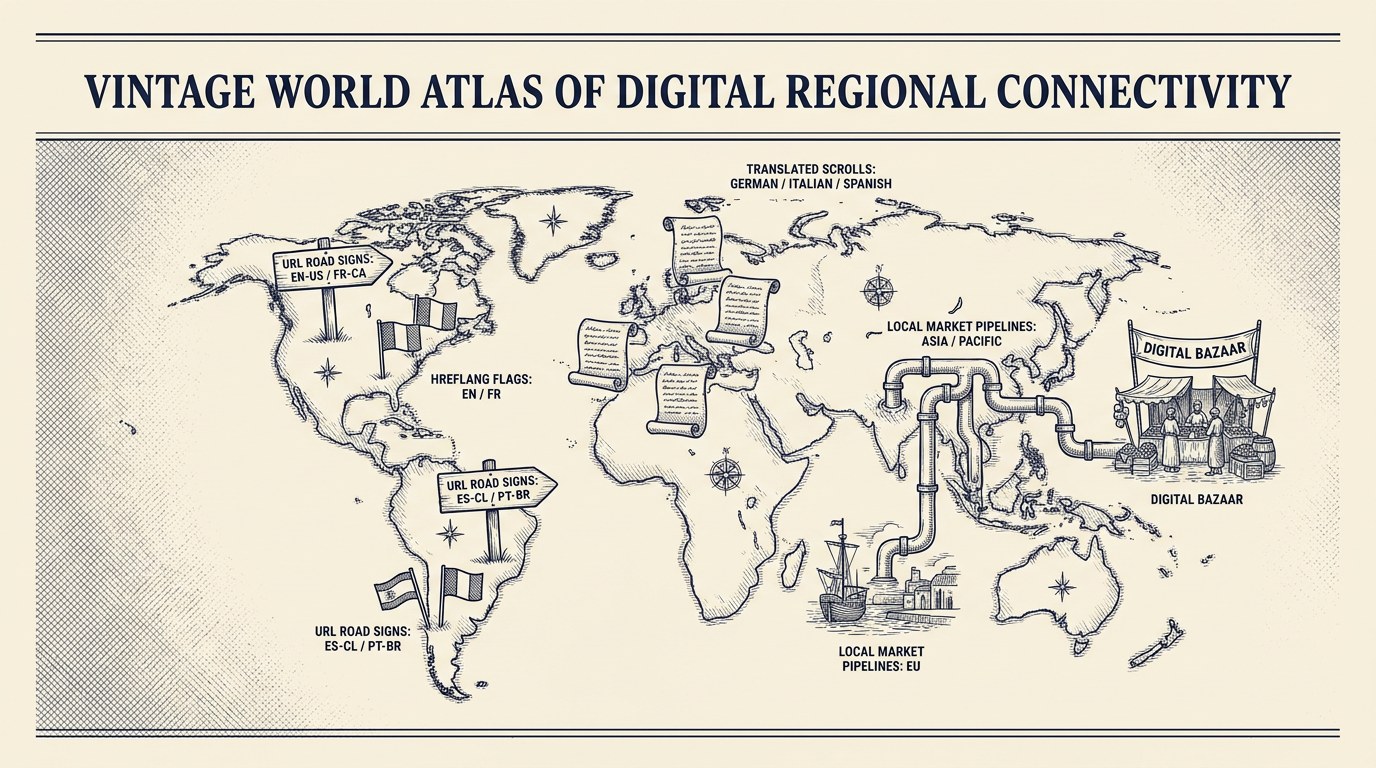
Three URL architecture options exist. Option 1: subdirectory (example.com/de/, example.com/fr/, example.com/ja/). Consolidates SEO signal across language variants on a single domain. Simpler technical setup and link-building economics. Recommended default for most B2B SaaS programs. Option 2: subdomain (de.example.com, fr.example.com). Separates SEO signal but enables independent technical setups. Useful when regional teams need significant autonomy in technical decisions. Option 3: ccTLD (example.de, example.fr, example.jp). Maximizes regional ranking signal because country-specific top-level domains carry strong geographic ranking weight in Google's ranking model. Requires per-country domain registration, management, and link-building operations.
For B2B SaaS programs at the $5M to $100M ARR range, subdirectory is the recommended default because the simpler technical setup and consolidated link-building economics outweigh the marginal regional ranking benefit of subdomain or ccTLD. Programs at $100M+ ARR with substantial regional sales operations and dedicated regional marketing teams may justify subdomain or ccTLD setups.
The decision has long-term consequences that resist change. Switching from subdirectory to ccTLD typically takes 12 to 24 months to recover full SEO signal because the new domain needs to accumulate backlink authority and indexation history. Programs should make the architecture decision deliberately at the start of international expansion rather than discovering the wrong choice 18 months in. Implementation requirements at the spec level follow Google's documentation on localized versions and hreflang, which specifies the three valid implementation methods (HTML link elements, HTTP headers, sitemap entries) and the consistency rules across them.
03Hreflang implementation: tags, headers, sitemaps
Hreflang tells Google which language and region variant to show in which SERP. Three placement options exist. Option 1: HTML head tags. Each page includes <link rel="alternate" hreflang="..." href="..." /> tags for every language variant of that page. Most common approach, applies per-page. Option 2: HTTP headers. Used for non-HTML resources (PDFs, documents). Less common but necessary for documents with language variants. Option 3: XML sitemap entries. Centralizes hreflang management for sites with many language variants by declaring the hreflang relationships in the XML sitemap rather than per-page in head tags.
Operational error checks. Check 1: bidirectional confirmation. Every hreflang tag pointing FROM page A TO page B must have a matching tag pointing FROM page B TO page A. Missing bidirectional confirmation causes Google to ignore the entire hreflang setup for the page. Check 2: x-default declaration. Every set of language variants needs an x-default declaration indicating the fallback page when no specific language matches. Check 3: language code accuracy. Use ISO 639-1 language codes (en, de, fr) optionally combined with ISO 3166-1 Alpha 2 country codes (en-US, en-GB, de-DE, de-AT). Combinations using non-standard codes cause hreflang to fail silently. Parallel requirements on Bing are documented in Bing's Webmaster Guidelines, which matters for B2B SaaS programs because Bing's index path feeds ChatGPT and a meaningful share of enterprise IT search traffic.
04Content localization vs translation: the B2B SaaS distinction
Translation converts the words; localization adapts the references, examples, pricing, regulatory references, and case study selection to the regional market. For B2B SaaS specifically, the distinction matters operationally because translated-only content produces measurable conversion drag even when search ranking improves.
Localization for B2B SaaS includes five elements beyond translation. Element 1: regional pricing display. The DACH version shows EUR pricing; the UK version shows GBP pricing; the US version shows USD pricing. Element 2: regional case studies. The DACH version features DACH customer case studies; the US version features US customer case studies. Element 3: regional compliance references. The EU versions reference GDPR; the US versions reference SOC 2 and HIPAA where relevant; the AU versions reference Australian Privacy Principles. Element 4: regional sales coverage indication. The page indicates whether regional sales support is available, with regional contact information for buyers in that region. Element 5: regional payment methods. Reference to the payment methods accepted in the region (SEPA in EU, ACH in US, etc.).
Programs running translation-only content see 20 to 40 percent of the conversion lift that localized content produces. The cost difference between translation and localization is typically 30 to 60 percent more for localization, which is justified by the substantially higher conversion. The keyword research for the localized content connects to the end-to-end B2B keyword research methodology playbook where regional keyword surfaces enter the sourcing stage. The hreflang validation workflow itself is covered in Screaming Frog's user guide, which surfaces hreflang return-tag failures, missing reciprocal references, and language-region mismatches that programs miss without a dedicated crawler audit.
05Regional operational considerations: pricing, support, sales coverage, GDPR
International rankings without regional operations produce traffic that does not convert. The operational considerations need integration with the international SEO work from the start.
Operational area 1: regional pricing. B2B SaaS programs operating in multiple regions need pricing displayed in the local currency on the localized pages. Pricing strategy decisions (whether to maintain price parity across regions, apply regional purchasing power adjustments, or run market-specific pricing) interact with the localization decisions. Operational area 2: regional support coverage. Pages localized for regions where the program does not yet have support hours produce buyer frustration when the buyer engages and discovers support is only available during US business hours.
Operational area 3: regional sales coverage. Localized pages should indicate whether regional sales support is available. Programs running localized content without regional sales coverage see pipeline that stalls at the sales engagement stage. Operational area 4: GDPR and regional privacy compliance. EU-localized pages need GDPR compliance integrated into the cookie consent, data processing disclosures, and contact form data handling. Programs running EU-localized content without GDPR-compliant operational backend produce compliance risk that exceeds the SEO benefit.
06Common international SEO failures for B2B SaaS
Four failures recur. Failure 1: choosing the wrong URL architecture and discovering it 18 months in. The fix is making the architecture decision deliberately at the start of international expansion. Failure 2: implementing hreflang without bidirectional confirmation. The fix is hreflang validation tooling (Ahrefs, Semrush, Screaming Frog all include hreflang validators) run after every meaningful site change.
Failure 3: shipping translation-only content without localization. The fix is treating localization as the discipline and translation as one input to localization. Failure 4: launching international content without regional operational integration. The fix is requiring regional operational readiness (pricing, support, sales coverage, compliance) as a precondition for localized content launch rather than as a follow-up.
If you want to scope international SEO for your B2B SaaS program, book a 30-minute conversation about your international expansion plans and we will assess your readiness across the URL architecture, hreflang implementation, localization, and regional operations dimensions.