
On this page
"Best CRM software" gets roughly 18,000 monthly searches in the United States. The first three results combined produce somewhere in the low thousands of monthly demos for the companies that own them. The companies that do not rank in the top three (which is everyone reading this) get a vanishingly small piece of that traffic, almost none of which converts.
This is the math that nobody in the SEO industry will say out loud, because the SEO industry sells keyword research deliverables that look impressive when sorted by volume. A spreadsheet with "Best CRM Software (18,000 monthly searches)" at the top of the list is sellable. A spreadsheet with "Switching from Salesforce because reporting is broken (40 monthly searches)" at the top is harder to sell. The second one produces more pipeline.
Below: the four reasons high-volume B2B SaaS keywords are usually wrong, the cases where they are actually right, the keyword categories that look great and are not, and what to chase instead.
01What "high volume" actually means in B2B SaaS
A keyword with 5,000 monthly searches in B2B SaaS is high volume. A keyword with 50,000 is unusual. A keyword with 500,000 is rare and almost always informational head terms ("CRM" with roughly 165K, "project management" with 90K, "marketing automation" with 27K).
The volume distribution is bimodal. There is a cluster of head terms with massive volume and almost no buyer intent. There is a long tail of specific, low-volume queries with high buyer intent. There is very little in between. Programs that target the head terms because the volume looks impressive end up competing with G2, Gartner, Capterra, and the Wikipedia of B2B software, all of whom rank for those terms with content built specifically to capture aggregator traffic.
Most B2B SaaS companies do not beat G2 on "best CRM software." They should not try.
02The four reasons the volume is usually a trap
This section establishes four critical reasons why pursuing high-volume keywords often proves detrimental for B2B SaaS. We dissect how searcher intent misalignment, insurmountable SERP competition, unfavorable conversion economics, and content contamination collectively undermine high-volume strategies. Understanding these pitfalls is essential for effective keyword targeting.
Reason one: the searchers are not your buyers
Volume on B2B SaaS head terms is dominated by students researching for assignments, junior marketing employees getting up to speed in their first job, freelancers writing content about the category for their own clients, and curious people who heard a term on LinkedIn. None of them buy software. The volume of qualified buyers searching head terms is a small fraction of total volume, and that fraction is fully captured by the top 1 or 2 results.
Reason two: the SERP is a citadel
Top 3 results for almost every B2B SaaS head term are owned by aggregators (G2, Capterra, Software Advice, TrustRadius), which have hundreds of thousands of backlinks accumulated over a decade and a half. You do not out-link them in two years. You can sometimes flank them with niche-specific content, but that is a different keyword strategy. Trying to displace G2 on "best CRM" with a 2,500-word blog post is a project that has never worked for any client we have audited.
Reason three: even if you rank, the conversion math is brutal
A page ranking #4 for "best CRM software" might capture 1.5 percent of the SERP's traffic. Of those visitors, the ones who are actual qualified buyers run between 8 and 20 percent. Of those qualified buyers, the conversion to demo on a head-term landing page typically runs under 1 percent because the searcher is in browse mode, not buy mode. Net: 18,000 monthly searches × 1.5 percent CTR × 15 percent qualified × 0.8 percent demo conversion is roughly 0.3 demos per month. The cluster post targeting "switching from Salesforce" produces 4 to 8 demos per month at one one-hundredth the search volume.
Reason four: writing for the head term contaminates your cluster
Pages that target head terms become the most-linked pages internally because everyone wants to point to "the comprehensive guide." The result is that PageRank flows to a page that converts terribly, away from pages that would convert well. The cluster's structural advantage gets undermined by the wrong piece sitting at the top of the architecture.
03The specific keywords that look great and are not
Some example traps. These are the categories of keywords we have seen Series B SaaS companies waste 12 months on.
"Best [category] software." High volume. Aggregator-dominated. Conversion math does not work.
"What is [category]?" Massive volume. Pure stage 1 awareness. Almost zero buyer intent. Wikipedia and Investopedia rank, plus aggregators.
"Top 10 [category] companies." Roundup territory. Built for affiliate publishers who pay G2 and Capterra for placement. You are outside the consideration set unless you pay your way in.
"[Category] software pricing." Looks like commercial intent. Actually mostly informational ("how much should I budget for X"). Aggregators rank with comparison tables. Searchers are research-shopping, not buying.
"How to choose a [category] tool." Stage 3 keyword that looks higher-intent than it is. The searcher is at the start of evaluation, not the end. Conversion is a third of vendor-named queries.
"[Category] vs [adjacent category]." "CRM vs ERP." Educational query. Searchers are figuring out the category boundaries, not buying anything.
The pattern: anything that does not name a vendor and does not describe a specific buyer scenario tends to be pre-buying. Pre-buying queries produce traffic. They produce some pipeline at scale. They almost never produce pipeline efficiently.
04The exception cases (when high volume is actually right)
To be fair, sometimes you do want to chase the volume. Four conditions justify it.
You are at DR 70 with 50,000 monthly sessions or more
The maturity model treats stage 4 companies differently. At that scale, capturing even 0.5 percent of a 100K-volume head term produces meaningful brand authority and feeds the cluster. The math works at scale that does not work at smaller programs.
The head term is genuinely your category and you have the brand to own it
Notion can rank for "note-taking app" and the conversion math works because the brand recall is doing half the work. A company without that brand recall cannot replicate the trick.
You are targeting stage 2 buyers deliberately, with downstream conversion built into the cluster
A high-volume problem-aware keyword can pay back if and only if you have stage 3 and 4 content already ranking that captures the buyer when they progress. Without the downstream cluster, the stage 2 traffic leaks out through the funnel. The four-stage buyer intent framework is how you tell whether you have that downstream coverage in place.
You can accept a 12 to 24 month payback timeline
Some programs deliberately target head terms early to signal topical relevance to Google, knowing the conversion will be terrible at first. This is valid if and only if the budget supports the long timeline, which most B2B SaaS programs do not.
If none of these four conditions apply, head terms are a distraction. Skip them.
05What to chase instead
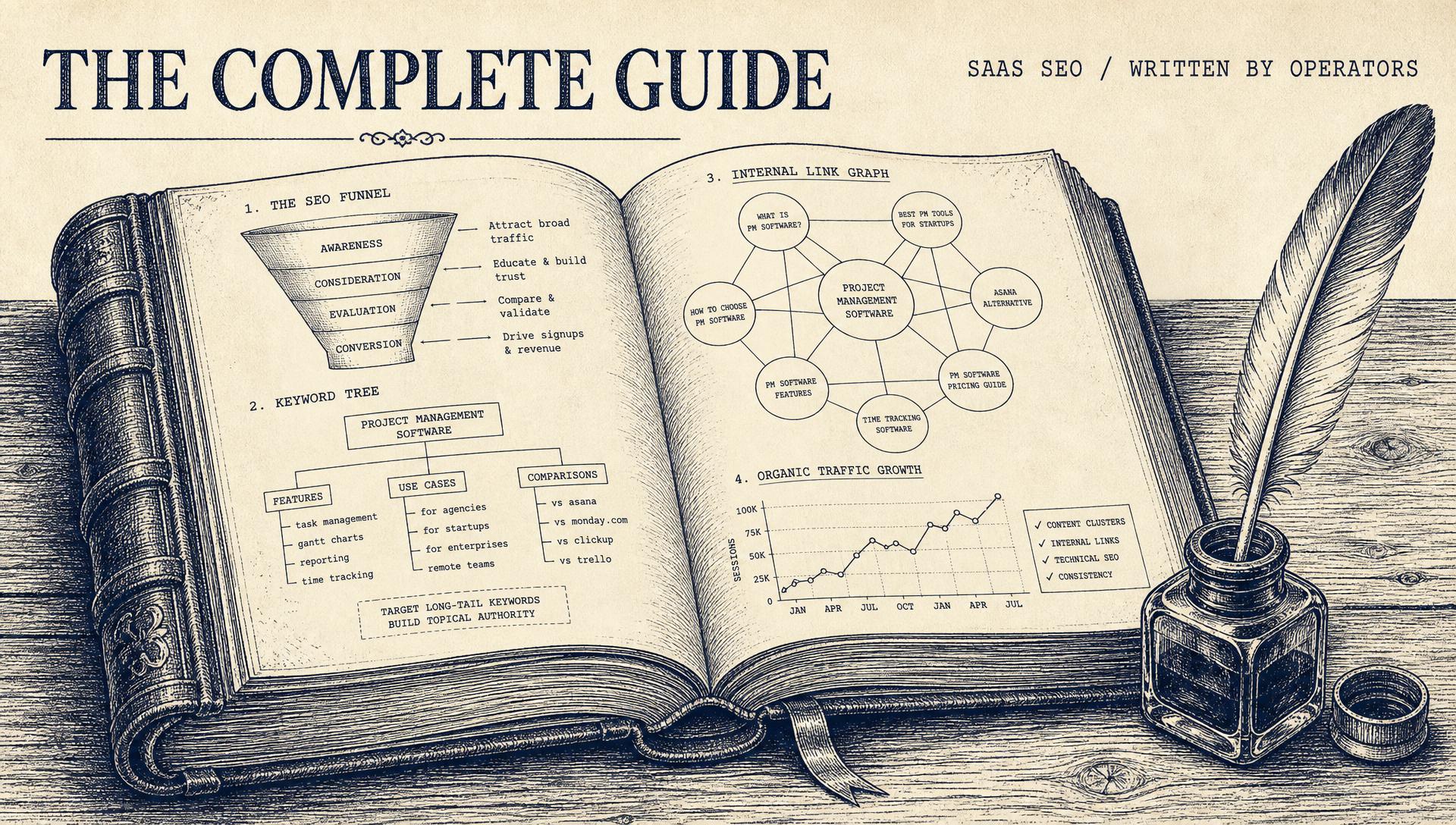
The B2B SaaS keyword research playbook covers the full taxonomy. The short version: chase the four query categories that actually convert. Comparison ("Pipedrive vs HubSpot for outbound"). Migration ("switching from Salesforce to Pipedrive"). Integration ("HubSpot Slack integration"). Problem-aware mined from sales calls (the kind nobody else has).
These categories all share three properties:
- Lower volume than head terms (often 50 to 500 monthly)
- Higher buyer intent (often 4 to 8 times the conversion rate)
- Less competitive SERPs (often beatable at DR 30, sometimes DR 20)
A program that targets these categories produces pipeline 6 to 18 months faster than a program that chases volume. The Workwize program (DR 27 to 71 over 22 months, $360K to $1.16M monthly pipeline) targeted exactly this mix. The previous agency had been chasing "IT asset management software" for 18 months and produced approximately zero pipeline. Full numbers in the Workwize case study.
For the specific commercial-intent categories, see migration and switching keywords for the highest-converting commercial query type, and the B2B SaaS SEO playbook for how the cluster fits into the broader program.
06Why agencies push high volume anyway (the politics)
The frustrating answer: traffic-up looks better in monthly reports than pipeline-up takes to materialize.
A program targeting low-volume buyer-intent queries shows traffic flat for months 1 through 6 while content is published and ranks slowly. The pipeline lift starts month 6 to 9 and accelerates from there. By month 12 the pipeline math justifies the program. By month 14 to 16 it is defensible to a CFO.
A program targeting head terms shows traffic going up earlier because head terms have volume that scales with rankings. By month 3, the traffic graph looks like a hockey stick. The CMO is pleased. The agency renewal is signed.
Eight months later, the CMO realizes the pipeline graph is flat and the head-term traffic is mostly low-intent. The agency is fired. The company concludes "SEO does not work for our business." It does. The agency just optimized for the metric that secures their renewal, not the metric that runs the company.
This is also why the same agencies keep producing the same outcome at company after company. The incentives are misaligned in a way that is invisible until month 12, by which point the budget cycle has already closed.
07The honest version of "we don't chase volume"
Most B2B SaaS SEO agencies say they do not chase volume. Almost all of them do anyway, because volume is what the spreadsheets show and what the dashboards report. The honest version of "we chase intent, not volume" is a process, not a tagline.
The keyword research process produces a list dominated by sub-1,000-volume queries. The publishing calendar shows mostly long-tail commercial intent pieces. The reporting dashboard leads with pipeline, not sessions. The QBR conversation references specific buyers and specific deals, not aggregate traffic numbers. The agency's case studies show pipeline math, not traffic charts.
If your SEO agency's reports show traffic on slide 1, sessions on slide 2, and pipeline on slide 6, they are chasing volume regardless of what they say in the strategy deck. Push them to lead with pipeline. The conversation that follows will tell you whether you have a strategy or a tagline.
Want a second opinion on whether your current keyword list is volume-trap-affected? Book a 30-minute call.
Where this fits in the broader playbook
This piece sits inside the buyer-intent keyword research playbook, which is one chapter of the operator's view of how B2B SaaS SEO actually works. For deeper framing on the same discipline, see the keyword research discipline for B2B SaaS.
Closely related reading from the same sub-pillar
- the buyer-intent mapping framework , how to map keywords to buyer intent instead of volume.
- how to mine call transcripts for keywords , where the real buyer language lives.
- the switching-keyword cluster , high-intent low-volume clusters worth targeting.
From other corners of the program
- our content writing framework , the cross-cluster discipline that compounds this work.
- the discipline of B2B SaaS content marketing, mapped end to end , the upstream pillar this connects to.
When you're ready to put this into a program, book your call or see how we structure pricing. Average response time: under 4 business hours.