On this page
Most B2B SaaS content programs in 2026 use AI somewhere in the production workflow. The programs that compound rankings and pipeline use AI in specific ways with specific boundaries. The programs that lose rankings to the Helpful Content signal use AI without boundaries, treating it as a writer substitute rather than a workflow accelerator.
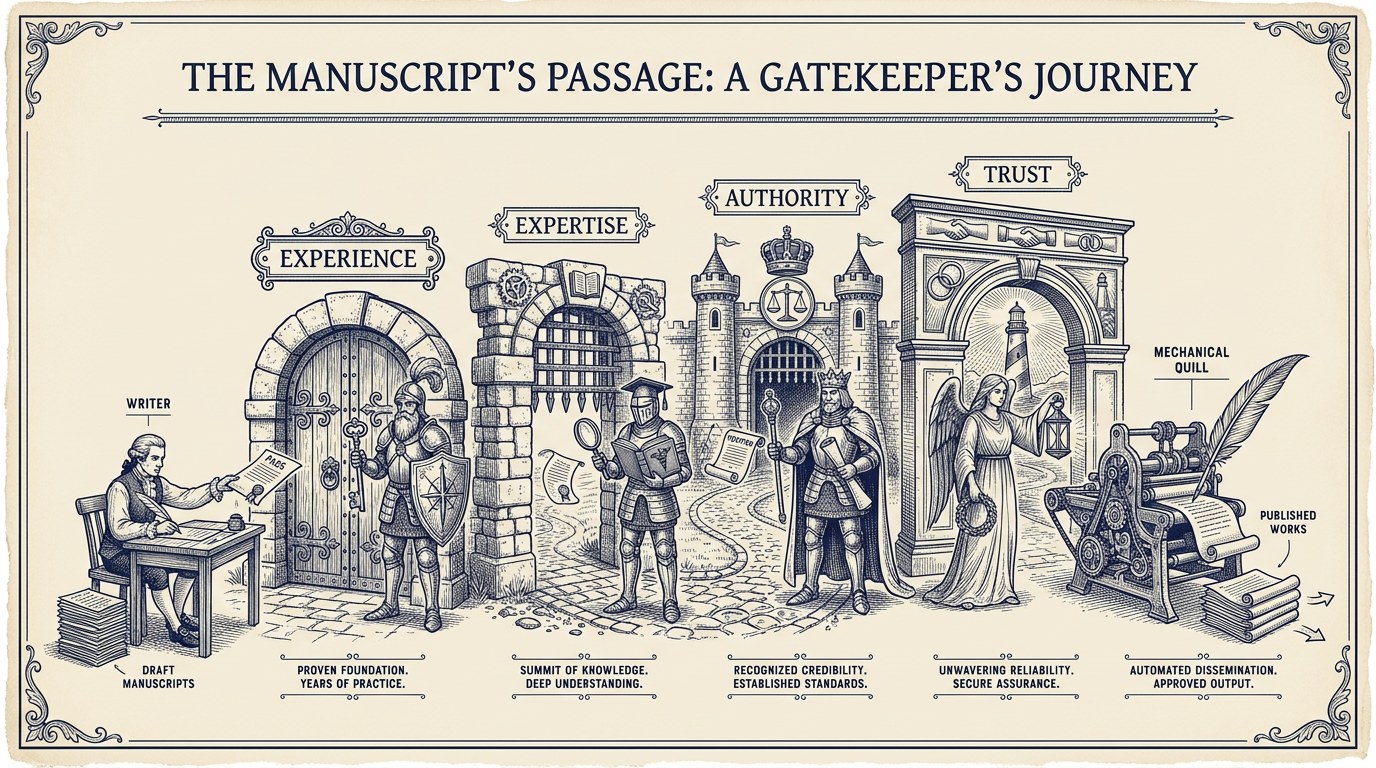
E-E-A-T (Experience, Expertise, Authoritativeness, Trustworthiness) is the framework Google uses to evaluate content quality. Each letter captures a signal that AI-generated content systematically fails on, and each requires a specific human layer to restore. This is the operator framework for AI content workflows in 2026: what AI handles reliably, where it breaks E-E-A-T, the handoff pattern between AI and human layers, the provenance discipline, the quality gates that catch AI weakness before publication, and the five-stage workflow that actually works across B2B SaaS programs at scale.
01What E-E-A-T actually means in 2026
E-E-A-T was updated by Google in late 2022 with the addition of the first E (Experience) to the original E-A-T framework. In 2026, after multiple Helpful Content updates and the integration of AI Search into the core ranking system, the framework matters more than at any point since its introduction.
The four dimensions
Experience covers first-person knowledge of the topic. Did the author actually do the thing being described? Have they implemented the framework, run the campaign, written the code, made the decision? Experience is the dimension AI fails on most clearly because it has no first-person experience to draw on.
Expertise covers credentialed or demonstrable knowledge. Industry certifications, published research, recognized professional roles. This is the dimension where author bios, LinkedIn profiles, and schema markup matter operationally. Google's helpful content documentation emphasizes that author expertise visibility affects how the algorithm evaluates content quality.
Authoritativeness covers the recognized standing of the author or publication in the topical area. Backlinks from authoritative sites, mentions in industry publications, citations by other recognized operators. This is the dimension link-building and digital PR programs directly influence.
Trustworthiness covers transparency, accuracy, and editorial integrity. Accurate citations, transparent author attribution, clear correction policies, defensible factual claims. AI-generated content fails on this dimension when claims are unverified, citations are fabricated, or attributions are unclear.
02Where AI helps in B2B SaaS content production
AI handles specific production tasks reliably across B2B SaaS content programs. These are the tasks where AI involvement compounds production capacity without degrading E-E-A-T.
Research and synthesis
AI synthesizes research input (transcripts, customer interviews, sales call notes, competitive content, internal documentation) into structured form faster than human researchers. The output is a research brief, not finished content. The human writer takes the research brief and produces the actual content layer.
Outline and structure
AI generates content outlines from a research brief plus target query. The outline structure (chapter headings, sub-section sequence, FAQ question candidates) is a mechanical task where AI accelerates production. The human editor reviews the outline for operator framing that AI alone cannot produce.
First-draft prose for non-Experience sections
AI generates competent first-draft prose for sections that do not require first-person Experience: definitions, frameworks, technical explanations, comparison tables, mechanical how-to instructions. The human writer revises the draft to add the Experience layer where the chapter structure permits.
Quality assurance and editing
AI handles surface-level quality assurance (grammar, consistency, broken link detection, voice violations against a defined style guide) faster and more consistently than human editors at the surface layer. Deep editorial review still requires the human editor for argument quality, framing, and audience-fit assessment. This integrates with the content production sub-pillar covering the full operational discipline.
03Where AI hurts, the E-E-A-T breaking points
AI degrades content quality in specific ways that map directly to E-E-A-T failure modes. Each breaking point has a corresponding human layer that the workflow must include.
Experience: the unrecoverable gap
AI cannot generate first-person Experience because it has none. The breaking point appears when AI produces prose like "in my experience" or "when we ran this on a B2B SaaS engagement" or "I have seen this fail at four out of five programs." Each of these is a fabrication unless a human operator with that experience generated or verified the claim. Programs that allow AI-generated Experience claims through to publication ship trust-violating content that erodes both reader trust and ranking signal.
Expertise: credential drift
AI prose often drifts toward generic expertise framing that does not reflect the actual credentials of the named author. A piece bylined to a specific senior operator should read in that operator's voice with that operator's specific framings. AI-generated drift toward generic expertise framing reduces the alignment between byline and content, which the Helpful Content signal detects.
Trustworthiness: hallucinated specifics
AI generates plausible-sounding specifics (statistics, study citations, quoted phrases attributed to named experts) without verifying that those specifics exist. Programs publishing these unverified specifics ship content with fabricated authority signals. The Trustworthiness dimension breaks the moment a reader fact-checks one specific and finds it does not exist.
04The handoff pattern, AI to human
The handoff pattern between AI work and human work is the single most important workflow decision. Different handoff points produce different quality profiles and different production rates.
Late handoff
AI generates the full draft, human edits at the end. Fast but produces the highest E-E-A-T risk because the Experience and Trustworthiness layers were never injected by a human. Works for low-risk content (internal documentation, summary content) but fails for primary cluster posts.
Early handoff
Human writes the Experience and Trustworthiness layers first, then AI generates the supporting prose for non-Experience sections. Slower but produces the strongest E-E-A-T profile. The operator pattern for flagship cluster posts and sub-pillar content.
Iterative handoff
Human and AI alternate across the production stages: human outlines, AI drafts, human revises with Experience layer, AI edits for surface quality, human reviews and approves. Slower than late handoff but faster than early handoff while preserving most of the E-E-A-T strength. The operator pattern for the majority of cluster post production.
The choice depends on content tier. Flagship pieces deserve early handoff. Standard cluster posts work with iterative handoff. Low-risk content can use late handoff. Programs applying the same handoff pattern across all content tiers produce either too slowly or too weakly.
05Provenance and attribution, the 2026 discipline
Google's 2024 and 2025 documentation updates clarified that AI-generated content is not penalized per se, but undisclosed and low-quality AI content fails the Helpful Content signal. The operational discipline in 2026 is documenting AI involvement transparently in the production system.
Internal documentation
Every piece of content has an associated production record documenting which sections were AI-drafted, which were AI-edited, and which were fully human. The record lives in the project management system, not necessarily on the published page. The discipline produces auditability for editorial review and protects against the failure mode where AI involvement creeps into pieces that were supposed to be fully human.
Author attribution accuracy
The byline must match the actual author of the substantive contribution. A piece where AI generated 90 percent of the prose and a junior editor reviewed it should not be bylined to a senior operator. Misattribution is the most common Trustworthiness failure in AI-heavy programs.
Citation verification
Every specific claim, statistic, or attributed quote in AI-touched content gets verified against the source before publication. Programs without explicit citation verification ship fabricated citations regularly. The verification step adds 15 to 30 minutes per piece but prevents the Trustworthiness failures that erode rankings over time. This connects to the operator framework for B2B SaaS content production covering the broader production system.
06Quality gates that catch AI weakness
Quality gates are the explicit checkpoints in the production workflow where AI-touched content gets reviewed for specific failure modes. Programs without explicit gates ship AI weakness at the same rate they ship AI value.
Gate 1, Experience check
Before publication, the editor verifies that any first-person Experience claims in the piece are real Experiences the named author had. The check takes 5 to 10 minutes and catches the most common E-E-A-T violation in AI-heavy programs.
Gate 2, fact and citation verification
Every statistic, study citation, and attributed quote gets verified against the named source. The check takes 15 to 30 minutes and prevents the Trustworthiness failures that compound across the content library. Search Engine Journal has documented how citation verification correlates with ranking stability across the post-Helpful-Content-Update era.
Gate 3, voice and operator framing check
The editor reviews whether the piece reads in the voice and operator framing of the named author. AI drift toward generic expertise framing gets caught here and revised back toward the specific author's voice.
Gate 4, hallucination check
The editor reviews any sections that introduce novel claims (rather than restating widely-documented facts) for plausibility. Hallucinated specifics that survive Gate 2 (because they sound plausible) get caught at Gate 4 by an editor who knows the topic area deeply.
07The five-stage workflow
The workflow that works across B2B SaaS programs at scale runs in five stages with explicit AI and human roles at each stage.
Stages 1 through 3
Stage 1 (research), human-led with AI synthesis support. The human operator runs customer interviews, pulls sales call data, reviews competitive content. AI synthesizes the inputs into a structured research brief. Stage 2 (outline), AI-led with human review. AI generates the outline from the research brief plus target query. The human editor revises the outline to add operator framing and ensure chapter sequence serves the audience. Stage 3 (first draft), depends on content tier. Flagship pieces: human-led with AI support. Standard cluster posts: AI-drafts non-Experience sections, human writes Experience sections. Low-risk content: AI-led with human review.
Stages 4 and 5
Stage 4 (revision and Experience injection), human-led. The named author revises the draft to inject Experience claims, operator specifics, and voice alignment. This is where the piece earns its E-E-A-T signal. Stage 5 (quality gates and publication), editor-led with AI support. The editor runs the four quality gates from chapter 06. AI handles surface-level quality assurance (grammar, voice consistency, broken links). The editor handles the deeper checks (Experience, citations, voice, hallucinations). Once gates pass, the piece publishes. This integrates with the content writing operator framework that formalizes the per-stage discipline.
08Common failure patterns
Four failure patterns recur consistently across B2B SaaS programs running AI-heavy workflows. Each has a specific corrective discipline.
Failure 1, treating AI as a writer substitute
The program treats AI as a writer substitute and produces content that fails the Experience and Trustworthiness checks. Rankings decline across the affected content over 3 to 9 months as Google's Helpful Content signal reweights against the program. The fix is re-establishing the human Experience and Trustworthiness layers in every piece going forward, plus refreshing the worst-affected historical content.
Failure 2, applying the same handoff pattern to all tiers
The program uses late handoff (fast, weak E-E-A-T) for flagship content because it works for low-risk content. Flagship rankings underperform their potential. The fix is matching handoff pattern to content tier (early for flagship, iterative for standard, late for low-risk only).
Failure 3, skipping quality gates under deadline pressure
The program runs the quality gates when production capacity allows but skips them when deadlines compress. AI-generated weakness ships disproportionately during compressed cycles. The fix is making quality gates non-negotiable, even if it means missing a deadline.
Failure 4, no provenance documentation
The program treats AI involvement as informal and undocumented. Editorial review cannot audit which pieces are AI-heavy, the attribution layer breaks silently, and Trustworthiness erodes across the content library. The fix is the production-system documentation discipline in chapter 05.
09FAQ
These are the questions B2B SaaS content leaders ask most often about AI workflows that preserve E-E-A-T. The answers reflect what operators see in practice running content programs in 2026.
Does Google penalize AI-generated content?
Not per se. Google's documentation explicitly states that AI-generated content is not against guidelines when it serves the user and demonstrates E-E-A-T. What Google penalizes through the Helpful Content signal is low-quality content regardless of how it was generated. The practical distinction: AI content with Experience and Trustworthiness layers can rank fine; AI content without those layers degrades over time across the Helpful Content updates.
How much of a cluster post should be AI-written?
For flagship cluster posts, AI handles 20 to 40 percent of the prose (non-Experience sections like definitions, frameworks, mechanical explanations) with humans handling the rest. For standard cluster posts, AI handles 40 to 60 percent of the prose with the iterative handoff pattern. For low-risk content like internal documentation, AI can handle 70 to 90 percent. Programs running fixed AI percentages across all content tiers either under-produce flagship quality or over-invest in low-risk content.
Should we disclose AI involvement on the published page?
The practical answer in 2026: not necessary for cluster posts where the human author has substantive Experience and Trustworthiness contribution. Necessary when the piece is primarily AI-generated. The internal documentation discipline matters more than the public disclosure question because the internal record protects editorial integrity and supports auditability.
Which AI models work best for B2B SaaS content production?
Model choice matters less than workflow discipline. GPT-5, Claude, and Gemini all produce competent output in 2026 with appropriate prompt engineering. The differences appear in surface qualities (voice flexibility, citation accuracy, output length consistency) rather than fundamental capability. Programs spending heavily on model selection without fixing workflow discipline see no quality improvement.
How do we detect AI-generated content in our existing library?
Programs auditing their content library for AI involvement typically find: voice inconsistency (pieces that read differently from each other despite bylines suggesting consistency), generic Expertise framing instead of named-author voice, fabricated citations that fail verification, hallucinated specifics like statistics not present in the cited sources. The audit pattern surfaces the affected pieces in the content library, which then enter the refresh queue covered in the B2B SaaS content audit framework.
What changes after each Helpful Content update?
The signal weighting reweights against specific quality failure patterns. Programs with strong E-E-A-T discipline see minor fluctuations. Programs with AI-heavy workflows without quality gates see ranking declines across affected content. The pattern that predicts post-update stability: programs running explicit quality gates and Experience-layer discipline regardless of AI involvement. Search Engine Journal's coverage of recent Google updates tracks the specific signal changes across each release.