On this page
The single biggest leak in most B2B SaaS content programs is the brief. Either there is no brief and the writer guesses, or there is a brief and it is two paragraphs of vague direction copied from a template the agency stopped updating in 2022. Either way, the output is the same: content that costs $1,500 per piece, takes three weeks to publish, and ranks for nothing the buying committee runs.
A good content brief is the difference between a writer producing a useful first draft and a writer producing 2,000 words you have to rewrite. Below is the format we use on every B2B SaaS engagement, what each section is for, and the template you can copy.
01What a brief actually is
A content brief is a contract between an editor and a writer about what the finished piece must do. It is not a wishlist. It is not a Google Doc full of links to competitor articles. It is a specific document that answers: who is this for, what does it need to argue, what proof goes in it, what language does the buyer use, and what does success look like.
Every section of a good brief eliminates a specific failure mode. Take a section out and a corresponding failure mode comes back into the work.
02The eight sections every brief needs
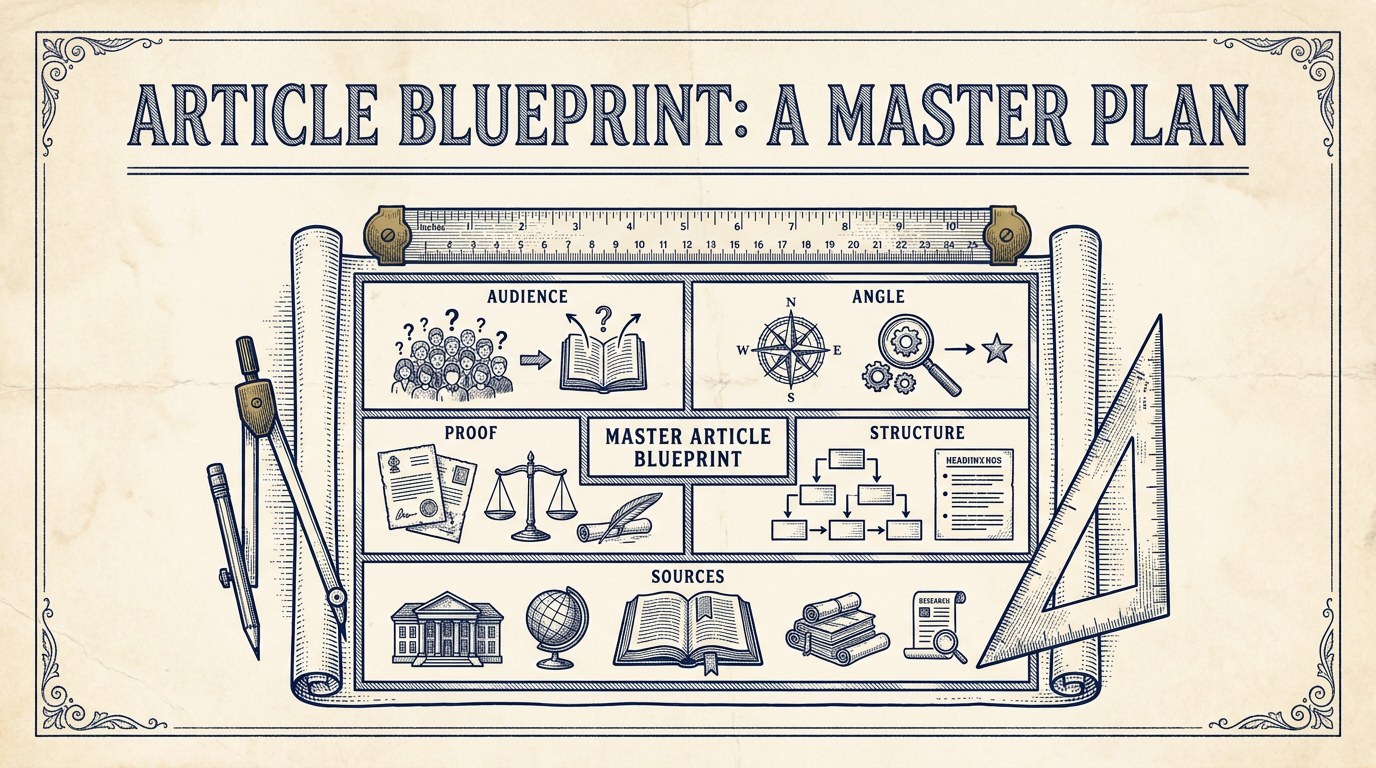
Your content brief is only as good as its constituent parts. We establish the eight essential sections required for every brief to ensure your content consistently delivers on its strategic goals and audience needs. This foundational structure guarantees clarity, measurability, and effective execution for every piece of content you produce.
1. The buyer
One paragraph describing the specific person who will read this and what they are trying to do when they read it. Not "B2B SaaS marketers." Specifically: "VP of Marketing at a Series B SaaS company, 20 to 80 employees, three months into a new role, considering whether to pause the existing SEO agency engagement."
2. The job to be done
One sentence stating what the reader needs to be able to do after reading. "After reading this, the reader should be able to evaluate whether their current SEO program is on track, and what to ask their agency in the next QBR."
3. The primary keyword and search intent
The exact keyword, its monthly volume, and the search intent (informational, commercial, transactional). One sentence describing what searchers want when they type this query. See the B2B SaaS keyword research playbook for the underlying scoring method.
4. The SERP brief
A three-sentence summary of what the top 5 results look like. Format (listicle vs guide vs comparison), average word count, what every top result covers, and what no top result covers. The "no top result covers" item is the article's information gain target.
5. The argument
One paragraph stating the position the article takes. B2B SaaS content that hedges does not rank or convert. Articles need a thesis. The brief states the thesis explicitly.
6. The required proof
Specific data points, quotes, screenshots, or examples that must appear in the piece. Tie the proof to a real interview when possible (see the SME interview process for the workflow that produces it). "Add some examples" is not an instruction.
7. Internal linking targets
Three to seven existing pages on the site this article must link to, with anchor text. Listed explicitly. Without this, writers will avoid linking entirely (the safe choice) or over-link (the noisy choice).
8. Output specs
Word count range (derived from SERP), heading structure, deliverable format, deadline, fee. The boring section that prevents 80 percent of revision arguments.
03What to leave out
A brief is not the place for the writer's research. The writer does the research. The brief tells them where to start.
A brief is not the place for SEO commands the writer cannot understand. "Optimize for E-E-A-T signals throughout the piece" is not actionable. "Quote a named B2B SaaS marketing leader once, by name, with a specific outcome" is. For where AI-assisted research belongs in this workflow, see AI-assisted content workflows.
A brief is not the place for the editor's draft of the article. If the editor is writing 800 words of "here is what to argue and how to argue it," the editor should just write the piece.
04The template (copy and adapt)
TITLE WORKING DRAFT: [editor draft, writer can revise]
URL SLUG: [exact slug]
DEADLINE: [specific date]
WORD COUNT: [range from SERP]
FEE: [agreed amount]

THE BUYER (1 paragraph):
[Specific persona, specific situation]

THE JOB TO BE DONE (1 sentence):
[What reader can do after reading]

PRIMARY KEYWORD: [exact match keyword]
SEARCH VOLUME: [monthly volume, source]
SEARCH INTENT: [informational/commercial/transactional + 1 sentence]

SERP BRIEF (3 sentences):
[Format, average length, what everyone covers, what no one covers]

THE ARGUMENT (1 paragraph):
[The thesis the article will defend]

REQUIRED PROOF:
- [Specific data point or quote 1]
- [Specific data point or quote 2]
- [Specific data point or quote 3]

INTERNAL LINKING TARGETS (3-7 existing pages):
1. /path/to/page ,  anchor: "exact anchor text"
2. /path/to/page ,  anchor: "exact anchor text"

OUTPUT SPECS:
- H2/H3 structure: [outline]
- Image needs: [hero, inline]
- Format: [Google Doc, markdown, etc.]
- FAQ section: [yes/no, # of questions]
That is the entire template. Six hundred to twelve hundred words when filled in for a real piece. Reusable, editable, evolved over time as your engagement matures.
05Common brief failures
Effective content briefs are crucial for B2B SaaS success, but common pitfalls undermine their utility. This section identifies and dissects prevalent brief failures, from unfocused research dumps to overly prescriptive directives. Understanding these missteps is the first step toward crafting truly impactful content guidance.
The "research dump" brief
Twelve hundred words of competitor article links, keyword data screenshots, and SEO tool exports. The writer has to construct an article from raw materials. The brief writer is paying their writer to do their job for them.
The "vibes" brief
Three sentences. "Write a comprehensive guide to [topic]. Include keywords. Make it good." A senior writer can produce something useful from this. Most writers cannot.
The "directorial" brief
The editor outlines every section, every example, every transition. The writer is reduced to filling in sentences. This produces content that sounds like the editor, costs the same as a real brief, and takes the same time to revise.
The "stale template" brief
The agency wrote a template in 2021 and has been using it ever since. Every brief includes "EAT signals," "topical relevance," and "cluster context." None of those phrases mean anything to a writer in 2026.
The fix for all four failure modes is the eight-section brief above. It is specific enough to direct the work and broad enough to leave the writer's craft intact.
06How long does a good brief take to write
Forty-five minutes to ninety minutes for a single piece. Less if the cluster is already mapped and SERP analysis is done in batch. The cost of a thorough brief is paid back the first time a writer produces a draft that does not need a rewrite.
The cost of skipping the brief is paid in revision cycles. A 2,000-word piece that needs two revision passes costs more in editor time than the original brief would have, and produces a worse final article. Do the brief.
07Briefs for AI-assisted writing
The brief becomes more important when AI is in the writing loop, not less. AI accelerates production from a good brief and amplifies failure from a weak one. Programs running AI-assisted writing without rewriting their brief format produce two patterns of output: drafts that read generic because the brief did not lock specificity, or drafts that contradict positioning because the brief did not encode voice.
What changes in the brief
Three sections need more depth when AI is producing the draft. Required proof gets stricter: a brief for AI-assisted writing lists the specific data points, named studies, or proprietary numbers that must appear in the piece, with source URLs. Without this, the AI invents plausible-sounding statistics. Argument scope gets tighter: the brief states the single claim the piece advances and the three sub-claims that support it, in order. Without this, the AI produces a tour of the topic instead of an argument. Voice rules get explicit: the brief lists banned phrases, sentence patterns to avoid, and 2 to 3 reference paragraphs from existing on-brand work. Without this, the AI defaults to its training-data voice.
What stays the same
The buyer persona, job-to-be-done, primary keyword, SERP brief, internal linking targets, and output specs sections are unchanged. The skeleton of a good brief works whether the writer is human or AI-assisted. What changes is the depth of the proof and argument sections, because those are where AI fails predictably.
08Brief libraries by content type
One brief template does not fit every content type. Programs that try to use the same brief format for cluster posts, pillar pages, comparison pages, and case studies produce briefs that are too long for short content and too thin for long content. The fix is a brief library with type-specific templates that share the same skeleton but adjust section depth and section ordering.
Four brief templates that cover most B2B SaaS production
Cluster post brief: 600 to 900 words, all 8 sections present, argument section is the longest. This is the workhorse template covering ~70% of production. Pillar page brief: 1,000 to 1,500 words, all 8 sections plus a 9th section for sub-pillar and cluster post linking architecture. The argument section is shorter because pillar pages cover breadth, not depth on a single claim. Comparison page brief: 800 to 1,200 words, adds a competitor positioning matrix as a required section and tightens the buyer persona to "evaluating us versus a named alternative right now". Case study brief: 500 to 800 words, drops the SERP brief section entirely (case studies do not target ranking keywords) and adds a required-metrics section listing the specific numbers the case study must include with source verification.
How to roll a brief library out
Start with the cluster post template and ship 5 to 10 briefs against it before adapting variants. Programs that try to build all four templates before shipping any briefs end up with libraries that look perfect on paper and never get used. The pattern that works is: ship the cluster post template, run it for 4 to 6 weeks, then fork variants for comparison and pillar work as those production needs come up.
09FAQ
This FAQ section addresses common inquiries about content briefs. Discover optimal brief length, responsible parties for creation, and the necessity of briefs for every content piece.
How long should a content brief be?
Long enough to make a writer's job possible without rewriting half of it, short enough that they will read it. Our briefs run 600 to 1,200 words. Anything under 400 words is incomplete. Anything over 1,500 means the editor is doing the writer's thinking for them.
Who should write content briefs?
An editor with both SEO understanding and product knowledge. Briefs written by SEO specialists alone produce content that ranks but does not convert. Briefs written by product marketers alone produce content that converts but does not rank. The brief writer needs both skill sets, or the brief needs review from both perspectives before it goes to a writer.
Should the brief include word count?
Yes, but as a range derived from the SERP, not an arbitrary number. If the top 10 averages 2,800 words, the brief specifies 2,500 to 3,200. Briefs that say "1,500 words minimum" without SERP context are guessing.
Do we need a brief for every piece of content?
Yes for any piece longer than 800 words or any piece commissioned externally. Internal short-form (LinkedIn posts, social copy, internal updates) does not need a formal brief. Anything that will be published on the site, ranked for, or invoiced for, needs a brief.