On this page
A buyer searching "how to migrate from Pipedrive to HubSpot without breaking pipeline reporting" has decided to leave Pipedrive. They are not deciding whether to buy a CRM. That decision is made. They are deciding which CRM. The article that helps them complete that migration is, often, the article that closes the deal.
Migration content converts at 4 to 8 times the rate of generic informational content for B2B SaaS. The math behind that asymmetry is not subtle. The work to build a migration content portfolio is harder than people expect. The defensibility, once built, is significant. Below: why the conversion rate is what it is, the four types of migration queries, the seven structural elements that separate ranking pages from marketing-copy ones, the maintenance problem nobody mentions, and what this looked like across the Workwize engagement.
01Why migration intent is the highest in B2B SaaS
Three things separate migration queries from every other category.
The buying decision is partially made
A buyer searching for migration paths has already committed to the category, the competitive set, and the move. They are solving for execution, not selection. The conversion gate is much closer.
The content matches the moment
Migration content addresses real anxiety: what data will I lose, how long will this take, what will break in my reporting, what does my IT team need to do. Content that answers these specific anxieties displaces generic "best of" content because it serves a specific need at the specific moment of need.
The searcher is high-skill
Migration queries are run by ops people, IT leaders, senior marketers, and admins. Not interns, not students, not freelancers writing about the category. The qualified-traffic ratio is dramatically higher than head terms.
The combined effect: roughly 4 to 8x the demo conversion rate of stage 3 informational content, and roughly 1.5 to 3x the conversion rate of comparison content. The pipeline per piece is the highest in any B2B SaaS content category.
02The four types of migration queries
Different migration queries have different intents and different content structures.
Direct vendor migrations: "switching from X to Y." The buyer has identified both vendors. They want execution help. Content type: detailed migration guide with data field mapping, timing, risks. Conversion: very high. Examples: "switching from Pipedrive to HubSpot," "moving from Asana to Linear."
General vendor exits: "moving off X" or "alternatives to X." The buyer has decided to leave X but has not picked a destination. They are shopping. Content type: alternatives roundup that is honest about category dynamics, plus a path to your product. Conversion: high. Examples: "alternatives to Salesforce," "moving off HubSpot."
Tooling consolidation: "consolidating X tools" or "replacing X stack." The buyer is rationalizing tool stack. Often a Series B company that grew tactically and is now consolidating. Content type: stack consolidation guide. Conversion: high, often expansion-level deals because the buyer is replacing 2 to 4 tools at once. Examples: "consolidating CRM and marketing automation," "replacing our IT vendor stack."
Manual-to-automated migrations: "moving from spreadsheets to X" or "from Trello to X." The buyer is graduating from a less-sophisticated tool. Content type: graduation guide showing what changes and what gets better. Conversion: medium-high. Often newer companies, smaller deal size. Examples: "moving from Excel to a real CRM," "graduating from Trello to project management software."
A B2B SaaS company can usually identify 4 to 8 migration query targets per main competitor by mining sales calls (where prospects describe what they are moving from), G2 reviews (where customers describe their previous tool), and customer success notes (where existing customers describe what they replaced). For the call mining workflow specifically, see how to mine sales call transcripts for B2B SaaS keywords.
03The seven structural elements that separate ranking pages from marketing copy
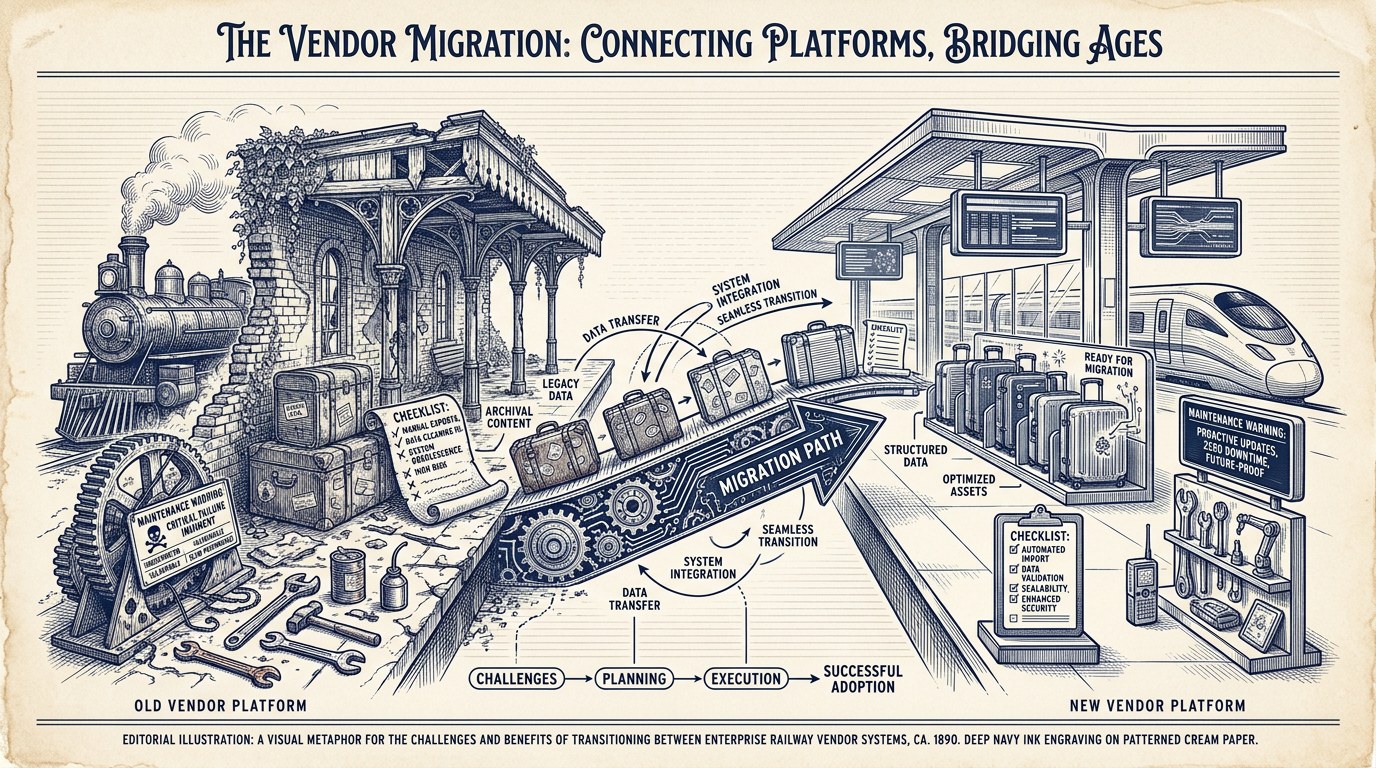
Migration content is not generic content with "migration" in the title. The structural elements that drive conversion:
Data field mapping table
Side-by-side mapping of fields from the old tool to fields in your tool. Specific. Buyers who see this think "they have thought about my actual data." Buyers who see vague descriptions think "they do not really know my old tool."
Time-to-migrate estimate with assumptions
"For a team of 50 with 18 months of historical data, expect 8 to 12 hours of admin time and 2 to 4 weeks of clock time including testing." Specific numbers. The buyer needs to commit to a project timeline and your content de-risks it.
Common gotchas section
"Custom fields with formulas do not migrate cleanly." "Reporting dashboards need to be rebuilt." "API integrations need to be re-authenticated." Buyers who see this think "they understand what goes wrong." Without this section the page reads as marketing copy.
Day-by-day or week-by-week migration plan
Numbered steps with realistic timing. The plan should be detailed enough that a competent ops person could execute it. If a buyer's migration team can use your migration plan as their actual project plan, you have earned the deal.
Rollback contingency
What happens if the migration goes wrong. Most migration content avoids this section because it is uncomfortable. Including it builds trust dramatically. "If you decide in week 2 that this is not working, here is how to revert with minimum data loss."
Real before-and-after
A specific customer's migration with specific numbers. Names redacted is fine. Numbers and timeline real. "A Series B logistics SaaS migrated 22 months of historical data, 14 custom workflows, and 8 active integrations in 16 working days. Their reporting dashboards were rebuilt in week 3."
Specific migration tools or services available
What automation, scripting, or supported services your team provides for the migration. Buyers reading migration content are calculating their internal effort. Knowing your team takes part of the load is a significant conversion lever.
A migration page with all seven elements converts at 4 to 6 percent of organic visitors to demo. A migration page with two of these elements (typically the time estimate and a generic comparison table) converts at 1 to 1.5 percent. The structural depth is the entire difference.
04How to find your migration keywords
Five sources, in priority order.
Sales call transcripts
Specifically: the discovery question "what are you currently using?" and the closing question "why are you looking to switch?". Capture the answers. Each named vendor your prospects mention is a migration query target. Full sales call workflow in how to mine sales call transcripts.
Customer onboarding interviews
Ask: "What were you using before?" and "What made you switch?" Both answers feed the keyword list and the content angle.
Customer success notes
When CS opens a ticket about data import, the data is being migrated from somewhere. Ask which tool. Compile quarterly. This often surfaces tools your sales team has not formally classified as competitors.
G2 and TrustRadius reviews of competitors
Search "switched from" or "migrated from" within review text. Reveals which tools your competitors are pulling customers from. Often surfaces categories you did not realize you compete with.
Reddit threads and LinkedIn posts
"Anyone migrated from X recently?" threads are high-signal. The comments reveal pain points and the language buyers use to describe their migration anxieties.
The deliverable is a migration keyword list with 12 to 25 entries per quarter, each tied to a specific competitor, a specific buyer scenario, and a specific content angle.
05The three migration content traps
This section establishes three common content traps that derail successful user migration. Avoid generic guides, gated content, and thinly veiled marketing copy to ensure your users transition smoothly and adopt your new solution. Implement these strategies to maximize user retention and minimize friction during the migration process.
Trap one: writing one generic migration guide
"How to migrate to [your product]" as a single article. Does not rank because it is not specific to any one buyer's situation. Does not convert because the buyer needs to see their specific old tool addressed. Migration content is per-vendor or per-scenario, not generic.
Trap two: gating the migration guide
"Download our migration guide" with an email gate. Buyers in migration mode are research-heavy. They have read four migration guides this morning. They will not give an email for the fifth. Ungate. The conversion happens after the content, not before.
Trap three: writing migration content that is just disguised marketing copy
"Our product makes migrations easy" without the data field map, without the gotchas, without the realistic timeline, without the rollback plan. Buyers detect this in 30 seconds. Marketing-copy migration pages convert at the same rate as marketing-copy comparison pages: terribly.
06The maintenance problem nobody mentions
Migration content has a quarterly refresh cycle. Both your tool and the competitor's tool ship new features, change pricing, deprecate APIs, and update integrations. A migration guide that is 18 months old is actively misleading.
The maintenance schedule that works: each migration page gets a 30-minute review every quarter (verify pricing, feature claims, API endpoints, screenshots). One full refresh per year (rewrite outdated sections, update field mapping, refresh timing data, update real customer example).
This is a non-trivial content maintenance budget. A program with 12 active migration pages requires roughly 30 hours per year of maintenance work just on migration content. Budget for it from day one. Migration content that goes stale gets penalized in rankings (Google notices when product comparison content drifts from current reality) and stops converting (buyers notice when claims do not match what they see in trial).
07What this looked like for Workwize
Workwize's product replaces a fragmented stack of tools that companies use to manage equipment for distributed workers. The migration angle was not from one named vendor to Workwize. It was from "internal IT plus three SaaS tools plus spreadsheets" to a consolidated platform.
We built three migration content clusters in the first 9 months.
Cluster one: spreadsheet-to-Workwize
Targeting companies tracking IT equipment in Excel or Notion. Lowest deal size on average but highest conversion rate because the buyer has the simplest old setup and the lowest switching anxiety. This cluster contributed roughly 8 percent of total Workwize organic pipeline.
Cluster two: tool-stack-consolidation
Targeting Series B+ companies running 3 to 5 IT tools they want to consolidate. Highest deal size. Migration content covered the full consolidation process across each tool category, with particular emphasis on the calendar week-by-week plan because these migrations were complex. This cluster contributed roughly 22 percent of total Workwize organic pipeline.
Cluster three: outsourced-IT-to-internal-platform
Targeting companies moving from a third-party IT vendor relationship to an internal-managed platform. Specific compliance and data continuity content. Lower volume, but the deals that did close were among the largest in the engagement.
The combined migration content drove approximately 35 percent of Workwize's pipeline contribution from organic over the engagement, on roughly 25 percent of total content production. Per piece, migration content delivered roughly 2.4x the pipeline of non-migration content. Full numbers in the Workwize case study.
Migration sits next to integration content as the two highest-converting commercial query types. For the integration play, see integration page SEO for B2B SaaS. For where migration fits into the wider keyword work, see the B2B SaaS keyword research playbook.
Want help building out a migration content portfolio against your real competitive set? Book a 30-minute call.
Where this fits in the broader playbook
This piece sits inside the keyword research discipline for B2B SaaS, which is one chapter of the full B2B SaaS SEO program structure. For deeper framing on the same discipline, see how we run keyword research for SaaS programs.
Closely related reading from the same sub-pillar
- buyer-intent mapping for SaaS , the intent layer that frames switching keywords.
- the volume trap , why the obvious keywords miss switching buyers.
- mining sales calls for keyword data , where switching language actually originates.
From other corners of the program
- the content strategy discipline , the cross-cluster discipline that compounds this work.
- the full content marketing reference , the upstream pillar this connects to.
When you're ready to put this into a program, talk to our team or see the program pricing. Average response time: under 4 business hours.