On this page
Most B2B SaaS content programs are not bottlenecked on writing talent. They are bottlenecked on process discipline. The writers a program hires are usually competent. The problem is what happens before the writer opens a document, and what happens after they hit submit. This post is the operational workflow that fixes both ends.
Good output does not come from hiring unicorns. It comes from a process around the writing that is structured enough that competent writers consistently produce operator-grade output. The discipline sits inside our content writing approach and extends the four-element operator framework into a repeatable production pipeline.
01What "process" actually means in B2B SaaS content production
Process is the binding constraint in B2B SaaS content production. Not strategy, not talent, not tooling. The programs producing operator-grade content at sustained cadence have a documented workflow with named owners at each stage. The programs producing generic content have a workflow that lives in someone's head and changes per piece.
The cross-industry data in HubSpot's State of Marketing report tracks this: programs publishing at the 80th percentile of output volume are not the programs with the largest content teams. They are the programs with the most structured production pipelines. Volume follows process. Content quality follows process. The teams without process produce neither at scale, regardless of talent on the roster.
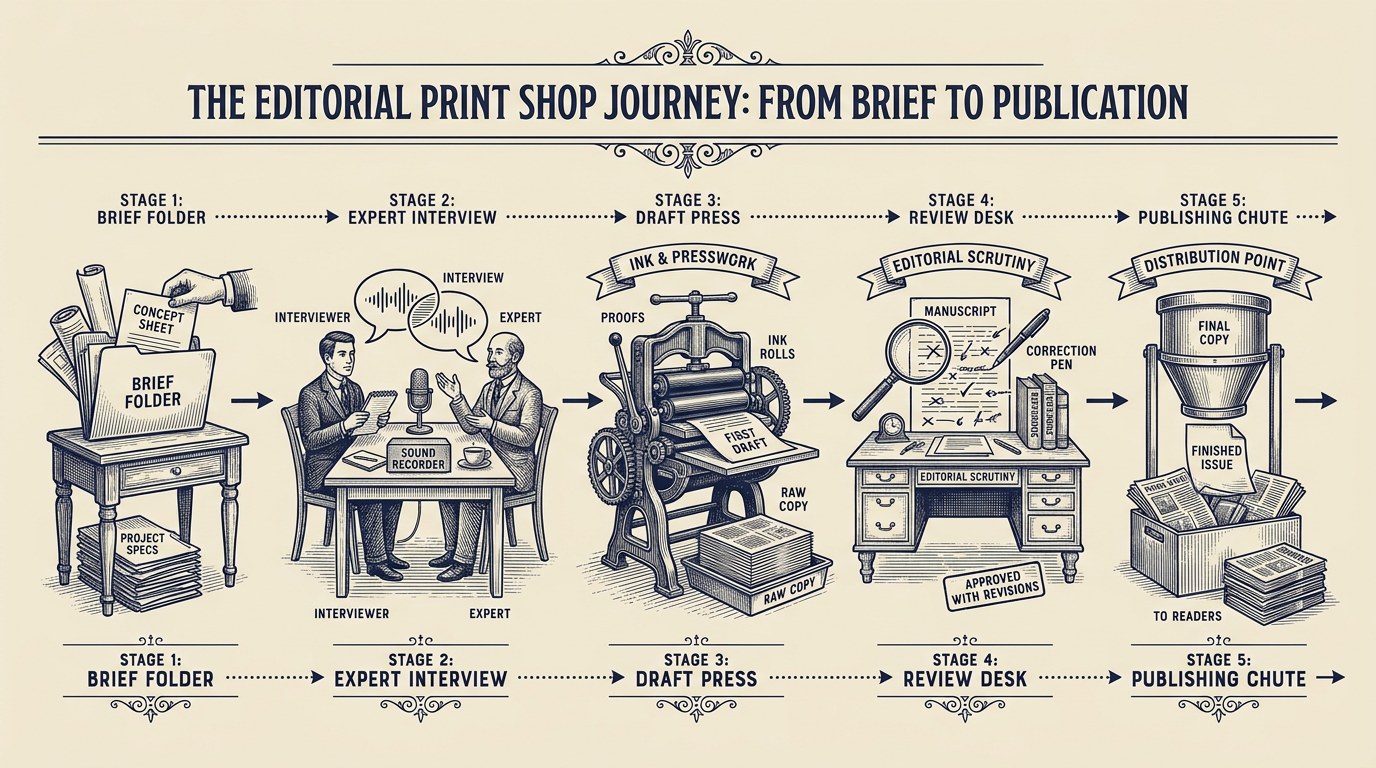
A real B2B SaaS content writing process has five named phases: brief, SME interview, drafting, review, publishing. Each phase has a defined input, a defined output, and one named owner. The rest of this post is what happens inside each phase and where most programs go wrong.
02Phase 1: The brief, what makes one production-ready
A production-ready brief is not a content idea with bullet points. It is the planning document that closes every strategic decision before the writer starts drafting. If the writer has to make strategy decisions during drafting, the brief was not ready. The structural model we follow is documented in our 8-field content brief framework.
The six elements of a production-ready brief
Six elements are non-negotiable. First, the target keyword with documented search intent (commercial, informational, navigational, transactional). Second, the audience job-to-be-done in one sentence: who is reading this and what specific problem they are trying to solve. Third, the H2 chapter outline written as claim-led headlines, not topic labels. Fourth, the source list with specific URLs the writer will cite, vetted for authority and recency. Fifth, the internal links and conversion CTAs with their target pages and anchor text. Sixth, one named operator angle the piece will defend that distinguishes it from the existing top-10 ranking content.
Less than that and the writer ends up doing strategy work. They guess at intent. They write topic-label H2s that do not make claims. They cite whatever shows up in the first Google page. They invent internal links that do not exist. The output reads generic because the brief was generic.
Brief approval as a gate, not a vibe check
The brief approval gate matters as much as the brief content. A senior editor or content strategist signs off on the brief before drafting starts. Not a vibe check. A read-through against the six elements. Programs without this gate run rework cycles that consume 40 to 60 percent of cycle time on what should be first-pass-correct drafts.
03Phase 2: The SME interview, the non-negotiable step most programs skip
For B2B SaaS content above the awareness stage, the SME interview is the difference between insider writing and outsider writing. Software buyers detect the difference immediately. The content that reads like ChatGPT output is almost always content written without an SME conversation. The full interview protocol is documented in our SME interview process post.
The three-questions-per-chapter pattern
The pattern that works: twenty to thirty minutes recorded, structured around three questions per H2 chapter. Question one captures the operator's framing of the chapter topic in their own words. Question two captures a specific customer or operational example. Question three captures the failure mode they have seen when teams get this wrong. Three questions per chapter, eight chapters, gives the writer twenty-four anchored data points and a vocabulary that matches how operators actually talk about the work.
Capturing operator language verbatim
What gets captured matters as much as the questions. Verbatim operator language. Specific numbers ("we cut this from 14 days to 4"). Named failure patterns ("the brief-as-vibe-check problem"). Real customer scenarios. Generic stat-padding ("studies show that...") is not the goal. The goal is the kind of detail that does not appear on Google Page 1 because it is tacit knowledge that only the operator carrying the scars has.
SME interviews are also the natural backstop against fabricated attribution. When a writer is tempted to claim "Pipedrive's data shows..." for a number Pipedrive never published, an SME quote covers the same role honestly. The piece reads more credibly with named operator quotes than with invented external citations.
04Phase 3: Drafting, writing against the brief, not against vibe
The drafting phase is straightforward when the brief is production-ready and the SME interview is captured. The writer's job is execution, not strategy. They write the chapters in order against the claim-led H2s, pull from the SME interview for the specific examples and language, and cite from the pre-vetted source list.
Claim-led prose, paragraph by paragraph
The discipline that distinguishes first-pass-correct drafts from rewrite drafts is claim-led prose. Every paragraph opens with a claim. The next sentences provide evidence. The closing sentence states the implication. Two-paragraph rhythm where the first paragraph makes the case and the second paragraph extends it. No hedging language ("could potentially help," "might be considered"). No padding. Period-heavy sentences.
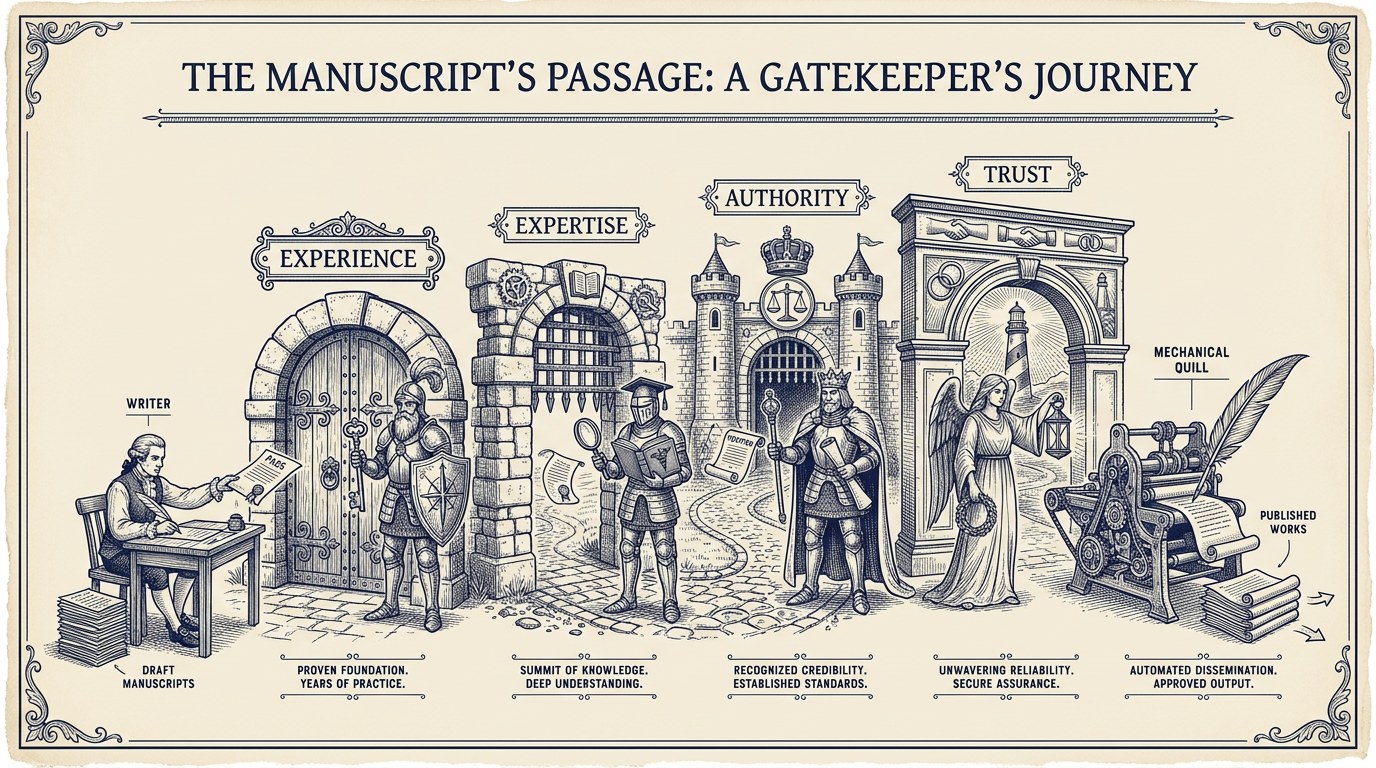
Google's own guidance on what makes content rank for high-intent queries reinforces this. Google's documentation on creating helpful, reliable, people-first content explicitly evaluates content against Experience, Expertise, Authoritativeness, and Trustworthiness signals. Operator content that demonstrates direct experience with specifics, expertise through tacit-knowledge framing, and trustworthiness through verified attribution clears that bar. Generic content does not.
Where AI-assisted drafting helps and where it kills voice
AI-assisted drafting has a defensible role in this phase but a narrow one. AI helps with first-pass outlining, transitional sentences, and grammar polish. AI does not write the operator angle, the SME-sourced examples, or the named failure patterns. Programs that flip that allocation produce content that reads like everything else on Page 1.
05Phase 4: Review cycles, separating SME review from editorial review
The single most common process failure we see is collapsing SME review and editorial review into one cycle with one reviewer. The result is drafts that take three rounds when they should take one.
SME review scope: facts and nuance only
SMEs check facts and operator nuance. Did the writer get the technical detail right. Did they characterize the failure mode correctly. Is the specific number accurate. SMEs are not editors. They will not catch passive voice. They will not flag broken internal links. They will not enforce voice consistency. Asking them to do editorial work produces frustrated SMEs and inconsistent drafts.
Editorial review scope: voice, structure, links
Editors check voice, structure, link discipline, schema readiness, and publishing format. Editors are not SMEs. They will not catch when the writer misrepresented a technical concept the editor does not understand at operator depth. Asking them to do SME work produces drafts that read well but contain factual errors operators catch in seconds.
The pattern that works: SME review first, scoped to facts and nuance, completed in one pass. Editorial review second, scoped to everything else, also one pass. Two reviewers, two scopes, two passes. Programs running this structure ship in 5 to 7 working days from brief approval to publish. Programs collapsing the reviews run 14 to 21 days and a meaningful share of rework.
06Phase 5: Publishing, the checklist that catches what post-publish monitoring catches too late
The publishing checklist is the last gate before the piece goes live. Under fifteen items, all binary pass-fail, no judgment calls. The checklist runs in 10 to 15 minutes and catches roughly 90 percent of the defects that would otherwise appear post-publish and require emergency fixes.
The four checklist categories
The items split into four categories. Metadata: title tag length, meta description, canonical URL, primary keyword presence in H1 and first paragraph. Structure: one H1 only, no skipped heading levels, all H2s have anchor IDs, FAQ H3s match FAQPage schema. Links: every internal link resolves to a live URL, every outbound citation opens in a new tab with proper rel attributes, no broken links anywhere. Schema: Article schema present per Schema.org's Article specification, BreadcrumbList schema present, FAQPage schema present and matching the rendered FAQ.
What only post-publish monitoring catches
The remaining 10 percent of defects only post-publish monitoring catches. Pages that render correctly on desktop but break on mobile. Schema that validates in isolation but conflicts with site-wide schema. Internal links that pass the checklist but get rewritten by a CMS routing rule. Programs that run only one of the two gates miss these and discover them through user complaints or Search Console errors days or weeks later.
07How the process changes by content type
The five-phase process applies across all B2B SaaS content types, but the weighting shifts. Cluster posts and sub-pillar pages run the full discipline at maximum depth. The brief is thorough, the SME interview is the longer 30-minute version, the drafting takes the full 2-3 day window, and the review cycles separate.
Comparison content and case studies
Comparison content has a lighter brief but a heavier SME interview. The strategic angle is usually clear (we are positioning against a named competitor) so the brief writes itself. The SME interview matters more because the differentiation language has to come from the operator, not from inferring it off the competitor's marketing site.
Case studies and customer stories invert the pattern. The brief is light, the SME interview is replaced by the customer interview, and the editorial review tightens to a single fact-check pass with the customer to confirm quotes. The buyer-stage targeting matters: Gartner's research on the B2B buying journey describes the consideration and decision stages as the points where case studies actually get read, which is the right context for production prioritization.
Awareness-stage content
Awareness-stage content (broad-topic explainers, glossary entries, definitional posts) can skip the SME interview in some cases. The risk is the content reads generic, but the trade-off is sometimes worth it for production volume. The judgment call is whether the topic has enough operator nuance to need an SME interview. Most B2B SaaS topics do. Glossary entries usually do not.
08Common process failures and the operational fixes
Four failure modes show up across most programs we audit before engagement. Each has a specific operational fix.
The brief-as-vibe-check failure
The brief-as-vibe-check failure is the most common. Briefs that are content ideas with bullet points instead of the six-element planning doc. The fix is the brief approval gate: a senior editor reads the brief against the six elements before drafting starts, and rejects briefs that do not clear the bar. One week of holding the line on this gate eliminates 40 percent of downstream rework.
The draft-then-research failure
The draft-then-research failure shows up when the writer starts drafting before sources are vetted. The fix is the source list as a brief element, with specific URLs vetted in the brief phase. Writers should cite from a pre-approved list, not search during drafting.
The SME-as-editor failure
The SME-as-editor failure is the review-collapse problem from Phase 4. The fix is documented review scope per reviewer, communicated in writing at engagement start.
The publish-and-forget failure
The publish-and-forget failure is the absence of post-publish monitoring. The fix is a 30-day post-publish check covering search performance, schema validity, internal link integrity, and traffic patterns. The cost is 15 minutes per piece per month. The benefit is catching the 10 percent of defects the publishing checklist misses, before they compound.
If you want this process running on your content production, that is what our content writing engagement is structured around, and the pricing for different program scales is on our pricing page.
09FAQ
Five questions covering what teams most often ask when adopting the five-phase content writing process.
How long does the full B2B SaaS content writing process take per piece?
For a standard cluster post (2,000 words), 5 to 7 working days from brief approval to publish. Brief: 1 day. SME interview and prep: 0.5 day. Drafting: 2 days. SME review: 1 day. Editorial review: 1 day. Publishing: 0.5 day. Programs collapsing review cycles run 14 to 21 days for the same output, so the discipline pays for itself in throughput alone.
Do we really need an SME interview for every piece?
For content above the awareness stage, yes. For glossary entries and basic definitional posts, often no. The judgment criterion is whether the topic has enough operator nuance that generic content would be detectable. Most B2B SaaS topics do. The cost of skipping the SME interview shows up as content that reads like ChatGPT output even when a human wrote it.
Can AI replace the writer in this process?
No, and the question itself signals a misunderstanding of where AI helps. AI assists with outlining, transitional prose, and polish. AI cannot run the SME interview, generate the operator angle, or write the named failure patterns. Programs that try to replace the writer with AI produce drafts that fail the helpful-content evaluation Google applies to all content regardless of authorship.
What is the difference between this process and what a generalist content agency runs?
Generalist agencies typically run a brief-and-draft model without the SME interview phase and without separated review cycles. The output ranks for low-competition keywords but fails on the high-intent commercial keywords that actually drive pipeline. The five-phase process exists because B2B SaaS content above the awareness stage requires operator depth that generalist workflows cannot produce.
How do we know if our current process is broken?
Three signals. First, content cycle time exceeds 10 working days from brief to publish on standard pieces. Second, drafts routinely require more than two rounds of revision. Third, content reads competent but does not rank or convert on high-intent keywords. Any two of those three signals mean the process is the bottleneck. Read our content writing approach for what the fix looks like in practice.
This is the five-phase production workflow under content writing.
The content writing sub-pillar covers the broader playbook, including the operator framework, the writing process, SME interviews, executive ghostwriting, and AI-assisted writing.