On this page
01Why content briefs are the highest-ROI activity in B2B SaaS content
Content briefs are operational documents that define the scope, intent, structure, and quality bar for a piece of content before production starts. For B2B SaaS programs, the brief is the document that integrates strategy, SEO, and writing into a single source of truth that the writer executes against.
What a content brief actually does
A brief converts strategic intent (we need a piece on X to capture Y query and convert Z persona) into operational specifics (target keyword, search intent, structure, proof points, internal links, CTAs). Without the brief, writers infer from incomplete information and produce inconsistent results. With a strong brief, writers execute the intent precisely. This post operates within the content strategy sub-pillar at the discipline level.
Why brief quality predicts content quality
PipelineRoad's analysis of thousands of B2B SaaS content pieces found that brief quality, not writer quality, is the single biggest predictor of first-draft quality. "A strong brief with a mediocre writer produces better content than a weak brief with an excellent writer." The 60 to 90 minutes spent on a brief is the highest-ROI activity in B2B SaaS content operations because every downstream cost (writing, editing, optimization, publishing, distribution) compounds against the brief quality.
02The 8 fields every B2B SaaS content brief must include
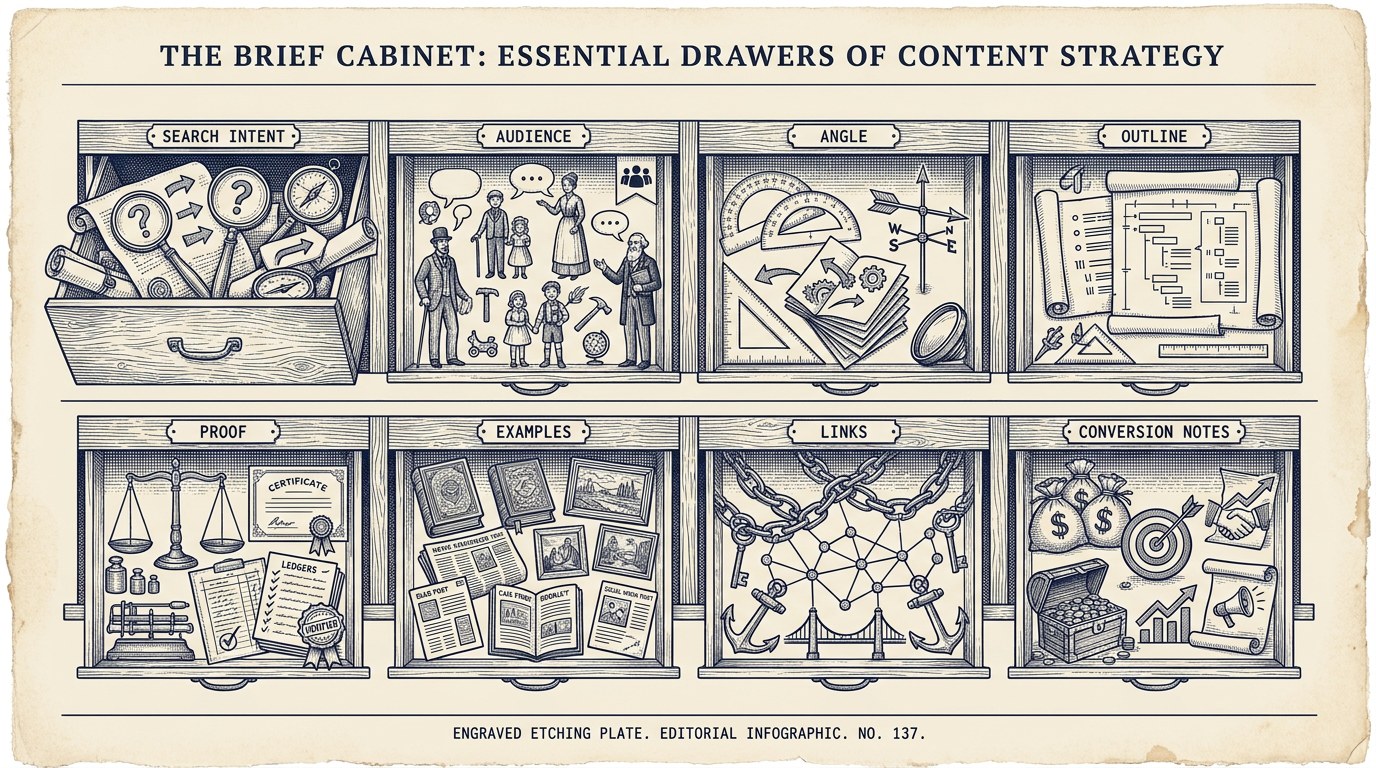
The 8-field framework covers what a brief must include to produce content that ranks, converts, and compounds. Each field has a specific operational purpose; skipping any produces predictable content failures.
The 8 fields
Field 1: target query and search intent
The primary keyword the piece targets plus the classified search intent (informational, commercial, transactional, navigational). Without this field, writers optimize for the wrong intent and produce content that ranks for nothing or converts at low rates. Daydream's 7-field template documents this as the first field for the same operational reason.
Field 2: buyer-journey stage and persona
Which stage of the three-stage B2B SaaS buyer journey the content serves (problem-aware, solution-aware, vendor-aware), and which ICP persona is the primary reader. Determines the tone, depth, and conversion path.
Field 3: outcome and KPI
The specific business outcome the content drives (signups, demo bookings, pipeline contribution, AI Search citation share) and the KPI used to measure it. Avoids vague goals like "brand awareness." Aligns writer execution to pipeline goals.
Field 4: thesis and core message
The single-sentence argument the piece makes. Without a thesis, content meanders and reads as generic. The thesis is what makes the content operator-grade and distinct from competitor content on the same query.
Field 5: structure and length
The H2/H3/H4 outline, total word count, and required sub-sections. Length should match the SERP winner pattern for the target query, not arbitrary brand standards. Structure should match how technical buyers scan the content.
Field 6: required proof points and sources
The specific data points, named examples, case studies, and authoritative sources the writer must include. This is what makes content cite-able by AI Search engines and trustworthy to technical buyers. Generic content fails this field; operator content passes it.
Field 7: internal linking spec
The specific internal links the writer must include and where: up-links to parent sub-pillar and pillar, lateral siblings, cross-cluster laterals, conversion links. This is what makes content topical-authority-building rather than isolated.
Field 8: CTAs and conversion path
The primary and secondary CTAs, the dark CTA placement, and the conversion endpoint. Determines whether the content produces pipeline or only traffic.
03The B2B SaaS-specific fields generic templates miss
Generic content brief templates miss three fields that matter most for B2B SaaS programs. Adding these fields differentiates operator-grade content from generic content.
Three B2B SaaS-specific fields most templates miss
The first is the technical-buyer proof requirement: specific data points, named operator examples (Stripe, Supabase, Notion, etc.), and citation-friendly statistics that technical buyers expect. Without this field, writers default to generic claims that technical buyers reject. The second is the pipeline-stage mapping: which of the three B2B SaaS buyer stages the content serves and what the next step is. Without this field, content sits in the funnel with no exit path. The third is the product positioning context: what the SaaS does, what category it competes in, and why it wins. Powered by Search's B2B SaaS content brief template covers a similar set of SaaS-specific fields with worked examples. Without this field, writers produce content that does not differentiate from competitor content. The framework integrates with the four-constraint B2B SaaS content marketing strategy framework at the discipline level. If you want to audit your current content briefs against the 8-field framework, book a 30-minute content brief audit with our team.
04Brief examples by content type
Different content types require different field emphasis. The same 8-field template works across types with different depth in different fields.
Brief example: cluster post
For a cluster post (e.g., "Single-page application SEO for B2B SaaS"), the brief emphasizes Field 1 (target query), Field 4 (thesis), Field 5 (structure), and Field 7 (internal linking spec). The thesis differentiates the post from competitor content; the linking spec connects the post to the sub-pillar and pillar. Typical brief length: 1,500 to 2,000 words.
Brief example: comparison page
For a comparison page (e.g., "[Product] vs [Competitor]"), the brief emphasizes Field 2 (vendor-aware persona), Field 6 (proof points and benchmark data), and Field 8 (conversion path to pricing or demo). The comparison must be balanced and substantive to earn trust; the proof points must be defensible. Typical brief length: 2,000 to 3,000 words because the comparison requires more structural detail.
Brief example: sub-pillar page
For a sub-pillar page (e.g., the technical SEO sub-pillar landing page), the brief emphasizes Field 4 (thesis as the sub-pillar's distinctive POV), Field 5 (structure as a comprehensive guide), and Field 7 (linking spec down to all cluster posts under the sub-pillar). Typical brief length: 2,500 to 4,000 words because the sub-pillar page is itself substantial content.
05The brief production workflow: who writes briefs and when
The workflow that produces strong briefs is consistent across high-performing B2B SaaS content programs. Two decisions matter most: ownership and timing.
Who owns brief creation
The content strategist or editorial lead owns brief creation, not the writer. Writers execute briefs; they do not write them. This separation matters because brief quality requires strategic context (audience, business goals, product positioning) that writers typically do not have full visibility into. Programs that ask writers to write their own briefs produce briefs that are technically complete but strategically thin.
When briefs get written in the production cycle
Briefs get written 1 to 2 weeks before content production starts, not at the moment a writer is assigned. This timing gives the strategist room to research the target query (SERP analysis, keyword expansion, AI Search citation analysis), gather proof points, define the thesis, and validate with the SME or founder if needed. Programs that write briefs the day they assign content produce briefs that miss research and proof point quality.
06Using briefs with freelancers, agencies, and AI workflows
Briefs work differently with different team models. The same 8-field template applies; the depth of each field changes based on the team configuration.
Briefs for freelance writers
Freelance writers do not have product context. Brief depth on Fields 3 (outcome), Field 4 (thesis), and Field 6 (proof points) must be substantial. Without depth in these fields, freelancers default to generic content that reads as if it could be about any SaaS company.
Briefs for agency partners
Agency writers optimize for the brief, not for the buyer. Brief depth on Field 2 (persona) and Field 4 (thesis) must be especially precise because agencies execute the brief literally. Vague briefs produce vague agency output.
Briefs for AI-assisted workflows
AI workflows (Claude, ChatGPT, Gemini, Perplexity) cannot infer context well. Brief depth on every field must be more structured and explicit. The thesis must be a single sentence the AI can extract. The proof points must be enumerated, not described. The CTA must be exact. AI-assisted content fails most often because the brief left too much room for the AI to fill creatively, which it does badly.
07Measuring brief quality and iterating the template
The brief template is an operational document, not a static asset. Programs that lock the template forever produce briefs disconnected from content reality 12 months later.
Brief quality scoring
Score each brief on a 1 to 5 scale across the 8 fields after the content publishes. Track which fields most affect output quality (typically Field 4 thesis, Field 6 proof points, and Field 7 linking spec). The scoring data shows where the template needs iteration.
Iterating the template against output quality
Update the template quarterly based on the brief quality scores. Add new fields when patterns emerge (in 2026, the most common addition is the AI Search citation requirement field). Drop fields that do not affect output quality. The integrated framework connects to the broader B2B SaaS content marketing pillar covering the five disciplines that surround content production.
08Common failures and the brief-as-checklist trap
Three failure patterns account for most underperforming B2B SaaS content brief programs. Each has a specific corrective discipline.
Three failure patterns
Failure 1: briefs as checklists, not operating docs
The most damaging failure is treating the brief template as fields to fill rather than as an operating document that shapes the content. Programs in this trap produce briefs that satisfy the template (every field filled) but produce thin content (no field has decision-quality depth). The fix is treating each field as a decision the brief-writer makes, not a slot to populate.
Failure 2: missing the B2B SaaS-specific fields
The reverse failure is using a generic content brief template (built for general marketing, B2C, or non-SaaS B2B) without adding the SaaS-specific fields. The result is content that reads as generic and fails to convert technical buyers. The fix is adding the technical-buyer proof requirement, pipeline-stage mapping, and product positioning context fields.
Failure 3: brief-writer / content-writer ownership confusion
The third failure is asking writers to write their own briefs because the strategist is overloaded. Briefs written by writers tend to be technically complete but strategically thin. The fix is preserving the brief-writer / content-writer separation, even if it means the strategist is the production bottleneck for now.
09FAQ
Seven questions covering the topics most commonly searched on content brief templates for B2B SaaS.
What is a content brief template?
A content brief template is a structured operational document that defines the scope, intent, structure, and quality bar for a piece of content before production starts. For B2B SaaS programs, the brief is the document that integrates strategy, SEO, and writing into a single source of truth that the writer executes against. The 8-field framework covers target query, buyer-journey stage, outcome and KPI, thesis, structure, proof points, internal linking, and CTAs.
Why do B2B SaaS programs need specific brief templates?
Generic content brief templates miss the fields that matter most for B2B SaaS specifically: technical-buyer proof requirements (specific data points, named operator examples), pipeline-stage mapping (which buyer stage the content serves), and product positioning context (what the SaaS does, what category it competes in, why it wins). B2B SaaS programs using generic templates produce content that reads as generic and fails to convert technical buyers.
What are the 8 fields every brief must include?
The 8 fields are: (1) target query and search intent, (2) buyer-journey stage and persona, (3) outcome and KPI, (4) thesis and core message, (5) structure and length, (6) required proof points and sources, (7) internal linking spec, and (8) CTAs and conversion path. Each field has a specific operational purpose. Skipping any of them produces predictable content failures.
Who should write content briefs?
The content strategist or editorial lead owns brief creation, not the writer. Writers execute briefs; they do not write them. This separation matters because brief quality requires strategic context (audience, business goals, product positioning) that writers typically do not have full visibility into. Programs that ask writers to write their own briefs produce briefs that are technically complete but strategically thin.
When in the production cycle should briefs be written?
Briefs should be written 1 to 2 weeks before content production starts, not at the moment a writer is assigned. This timing gives the strategist room to research the target query (SERP analysis, keyword expansion, AI Search citation analysis), gather proof points, define the thesis, and validate with the SME or founder if needed. Programs that write briefs the day they assign content produce briefs that miss research and proof point quality.
How do briefs differ for freelancers vs in-house writers vs AI workflows?
Freelance writers do not have product context, so brief depth on outcome, thesis, and proof points must be substantial. Agency partners optimize for the brief literally, so brief depth on persona and thesis must be especially precise. AI-assisted workflows cannot infer context well, so brief depth on every field must be more structured and explicit. The same 8-field template applies across all team models; the depth of each field changes based on the configuration.
What is the brief-as-checklist trap?
The brief-as-checklist trap is the most common failure pattern in B2B SaaS content brief programs. Programs treat the brief template as fields to fill rather than as an operating document that shapes the content. The result is briefs that satisfy the template (every field filled) but produce thin content (no field has decision-quality depth). The fix is treating each field as a decision the brief-writer makes, not a slot to populate, and reviewing brief quality before content production starts.
This sits inside the content strategy sub-pillar.
The content strategy sub-pillar covers the broader playbook including the four-constraint framework, content marketing plans, editorial calendars, and content distribution.