On this page
Most B2B SaaS content marketing budgets get cut in year two, not because the program failed, but because the CFO could not connect the line items to revenue. The team produced traffic, the deck showed rankings, and the budget request for year three landed in the same review as paid acquisition pulling 14 percent attributable pipeline. The traffic team lost the argument.
This page is the operator playbook for sizing a B2B SaaS content marketing budget that survives the next two budget reviews: the percentage benchmarks by ARR tier, the four-layer 60/25/10/5 allocation model, the proposal structure CFOs accept, and the failure modes that quietly kill defensible programs.
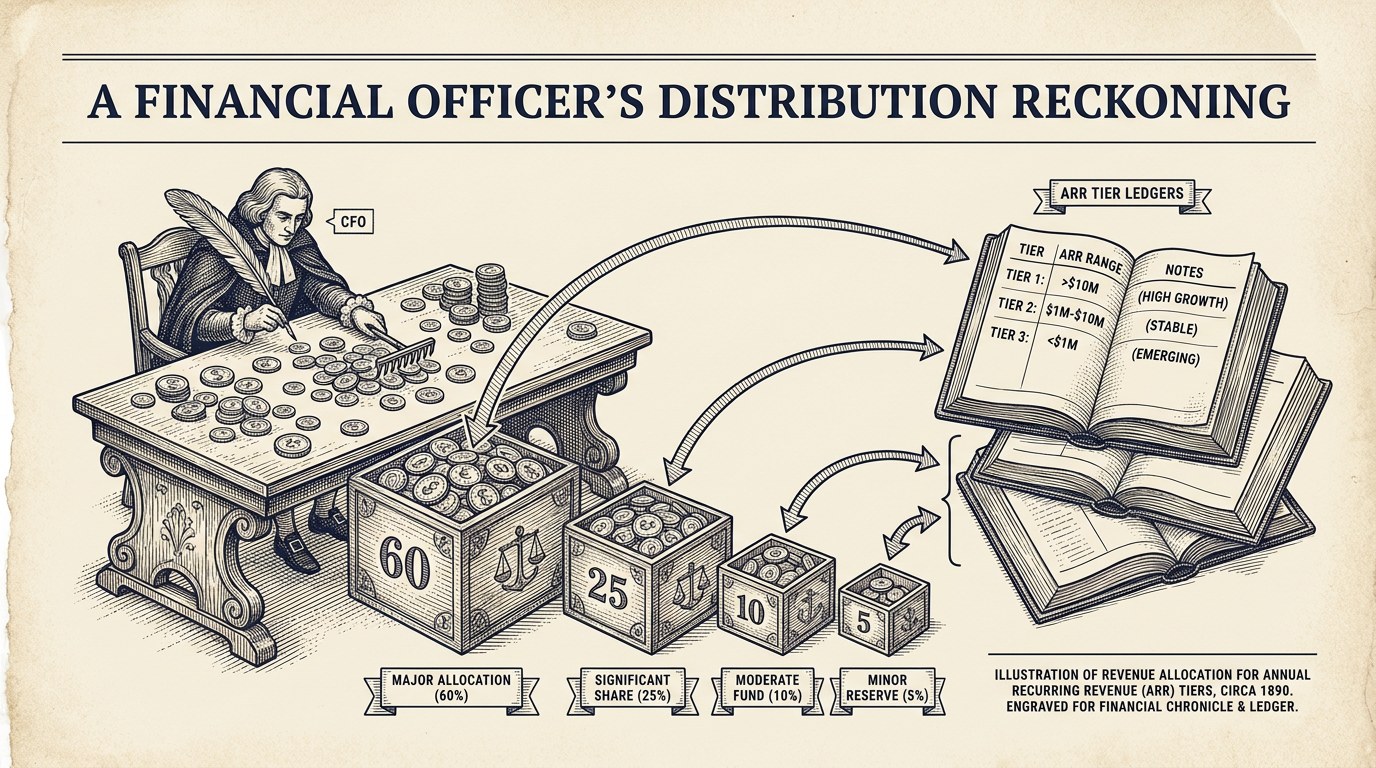
The short answer for B2B SaaS in 2026: allocate 25 to 35 percent of total marketing budget to content at the foundation stage, contracting to 12 to 18 percent above $200M ARR, and split that allocation 60 percent production, 25 percent distribution, 10 percent tools, and 5 percent measurement.
01Why content marketing budgets get cut first in B2B SaaS
Across the B2B SaaS engagements Technotize has run since 2024, the budget review pattern is consistent. Content marketing budgets get cut first in any year where pipeline targets miss, regardless of whether the content program was the underperformer. The reason is structural, not adversarial. Paid acquisition reports a clean cost-per-qualified-meeting number that any CFO can audit against revenue. Content marketing reports a longer attribution window, a softer pipeline-influence claim, and a set of leading indicators that no CFO learned to grade in finance school.
The implication is not that content marketing is the wrong channel. The Technotize content marketing ROI framework documents the categories of B2B SaaS where content is the dominant pipeline channel through year three onward. The implication is that the content marketing budget conversation requires a different proposal structure than the paid acquisition budget conversation. Programs that fail to learn this structure get their budget cut. Programs that learn it get the budget defended even in lean years.
The four categories where content marketing dominates
Content marketing produces the highest pipeline share in product-led growth motions, in vertical SaaS targeting buying committees with research-heavy purchases, in enterprise SaaS where the average sales cycle exceeds nine months, and in horizontal SaaS competing against incumbents on category-creation positioning. Programs in these categories should be budgeting content at the upper end of the ranges in Chapter 2. Programs outside these categories should size more conservatively.
02Sizing: percentage of marketing budget by ARR tier
The mistake most B2B SaaS marketing leaders make in budget proposals is anchoring to absolute dollars rather than to marketing-budget percentages. Absolute dollars vary too widely across companies. Percentages of total marketing spend benchmark cleanly against industry data. Content Marketing Institute's annual B2B research documents the percentage-allocation pattern across thousands of B2B programs and is the citation that survives any budget review.
Allocation by SaaS revenue tier (2026 benchmarks from our engagement data)
The percentage allocation we see across Technotize engagements correlates tightly with ARR tier. At early stage, content takes the larger share. At enterprise scale, content takes a smaller share but a much larger absolute dollar amount.
| ARR tier | Typical total marketing budget | Content allocation | Content dollars |
|---|---|---|---|
| $0 to $2M | $200K to $500K | 25 to 35% | $50K to $175K |
| $2M to $10M | $500K to $2M | 25 to 30% | $125K to $600K |
| $10M to $50M | $2M to $10M | 20 to 25% | $400K to $2.5M |
| $50M to $200M | $10M to $30M | 15 to 20% | $1.5M to $6M |
| $200M+ | $30M+ | 12 to 18% | $3.6M+ |
Why the percentage contracts as ARR grows
Two patterns explain the contraction. First, established programs have already built the asset library, so new production needs slow. Second, distribution and paid amplification become more efficient at scale because the brand standing earned by content makes outreach response rates rise and paid amplification CACs drop. Programs at $200M ARR with mature content libraries can produce equal or greater pipeline impact at a lower budget percentage because the foundation is already in place.
03The 60/25/10/5 allocation model
Within the content marketing budget, the allocation across four layers determines whether the spend produces compounding pipeline or static traffic. The 60/25/10/5 model is the split that survives the audit pattern we run on incoming engagements. It is also the split that under-resourced programs reverse, most often by cutting distribution to fund more production.
The four layers, explained
- Production (60%). The cost of producing the content itself: writers, editors, designers, researchers, SME interviews.
- Distribution (25%). The cost of getting the content seen: PR retainer, paid amplification, outreach personnel, influencer relationships.
- Tools and infrastructure (10%). The SaaS stack: CMS, SEO platforms, analytics, schema generators, AI assistants.
- Measurement (5%). Analytics ops: attribution modeling, dashboarding, quarterly business review preparation.
Why 60/25/10/5 and not 70/20/10
The Procter and Gamble 70/20/10 rule originated for consumer brand spend allocation across proven, emerging, and experimental channels. It was never designed for B2B SaaS content marketing budget allocation. Harvard Business School's coverage of digital marketing budget structures documents the way the 70/20/10 rule has been overextended into contexts where it no longer fits. The 60/25/10/5 model addresses B2B SaaS specifically: a higher production share than consumer programs need, a larger distribution share than most B2B SaaS programs actually allocate, a tools share that reflects the platform stack reality, and a measurement line item that is non-optional in any CFO-defensible structure.
04Production budget breakdown
Within the 60 percent production budget, four cost lines need explicit budget. Programs that fail to break out these lines underfund the largest one and discover the gap mid-year.
Writing and editorial
Writing is the largest production line for most programs. Siege Media's 2026 content marketing cost benchmarks document the current rate landscape: $750 to $2,000 per blog post for mid-market freelancers, $2,000 to $5,000 per piece for agency-led production with editorial review, $5,000 to $15,000 per piece for research-backed long-form. B2B SaaS programs in our engagements typically run a mix: 60 percent at the mid-tier rate, 30 percent at the long-form rate, 10 percent at the deep-research rate. Editorial review is a separate line at roughly 15 percent of total writing spend.
Design and visual production
Design covers original graphics, charts, illustrations, video production, and asset templating. Typical budget share within production is 15 to 20 percent. Programs under-budget this line when they treat design as a freelancer-on-call expense rather than a sustained capacity. Animalz' content pricing examples show how design costs vary by asset type, with interactive graphics and embedded data visualizations carrying the highest per-asset cost.
Research and SME access
Research budget includes survey instruments for original research, third-party data subscriptions, and SME interview costs. B2B SaaS programs producing one annual benchmark study and quarterly thought-leadership content typically allocate 10 to 15 percent of production budget to this line. The Technotize SME interview process covers how to extract maximum value from SME access without exceeding the budgeted hours per interview.
Operations and project management
Editorial calendar management, brief production, freelancer coordination, and quality assurance run roughly 8 to 12 percent of production budget. Underfunded programs treat this as overhead and absorb it into general marketing operations. The cost still gets paid, it just shows up in slower throughput.
05Distribution and amplification budget
The 25 percent distribution allocation breaks into four lines. Each line has a different ROI signature and a different time-to-impact window. Programs that consolidate the four into a single "PR retainer" line lose the ability to optimize.
Earned media and PR retainer
The largest distribution line is typically a PR retainer or fractional PR resource. For mid-market B2B SaaS programs, PR retainers range from $5,000 to $25,000 per month depending on tier, with the higher tier including dedicated outreach to Tier 1 publications. The Tier 1 publication pitching playbook covers what should be expected from a PR retainer at each price point.
Paid amplification on LinkedIn and selected newsletters
Paid amplification on LinkedIn and industry newsletter sponsorships runs 8 to 15 percent of distribution budget for most programs. The line scales with content velocity. Programs publishing twelve times per month run a higher amplification budget than programs publishing four times per month at the same total spend.
Influencer and creator partnerships
Industry influencer partnerships sit at 10 to 20 percent of distribution budget for programs that invest in this channel. Most B2B SaaS programs underinvest because the influencer economics in B2B SaaS look different than in consumer. Three to five credible industry voices in a vertical produce more pipeline influence than fifty general business creators.
Internal employee advocacy
The smallest distribution line is internal employee advocacy support: software costs, content packaging tools, and the half-FTE that runs the program. Roughly 5 to 8 percent of distribution budget. Programs underestimating this line discover that employee advocacy is the cheapest amplification channel per impression, but only when the operational support is funded.
06Tools and infrastructure budget
The 10 percent tools and infrastructure budget covers the SaaS stack content marketing runs on. The line is smaller than most marketing leaders assume because the per-seat costs scale poorly when teams treat tools as a luxury rather than a discipline. The default stack for a mid-market B2B SaaS content program at $2M to $10M ARR includes a content CMS (often the corporate website CMS plus an editorial layer), an SEO platform like Ahrefs or Semrush, an AI-assisted writing platform, an analytics stack (typically GA4 plus an attribution tool), and schema generation infrastructure. Total per-month software spend for this stack typically lands between $3,500 and $7,000.
The AI tooling line and where it should sit
The AI-assisted content production tools sit inside the tools budget, not the production budget. This separation matters for budget defensibility because AI tools have predictable per-seat costs and can be benchmarked against industry rates, while production budget needs to remain output-anchored. Programs that fold AI tooling into production budget lose the line-item clarity that makes CFO review productive. The AI content workflows playbook covers the workflow side, the budget treatment is separate.
07The CFO-defensible budget proposal
The proposal that survives the budget review has three required components. Proposals missing any of the three get cut first in lean budget years because the CFO has to assume the missing component will surface as a problem regardless.
Component 1: Pipeline-attributed revenue projection
The projection should show twelve-month pipeline attribution from content marketing using whatever attribution model the company uses for other channels. The number itself matters less than the consistency with how other channels are measured. The projection should include the data the CFO can audit against.
Component 2: Comparative cost per qualified meeting
The comparative table puts content marketing cost per qualified meeting next to the cost per qualified meeting from paid acquisition channels. For most B2B SaaS programs past the foundation stage, content marketing CPQM lands at 30 to 60 percent of paid acquisition CPQM, but the math only becomes defensible when the program has the prior twelve months of attribution data to support it.
Component 3: Honest downside scenario
The downside scenario describes what happens if content marketing pipeline contribution falls 30 percent below projection. Programs that omit this section signal to the CFO that the proposing team has not thought through the failure mode. Including the downside, with the operational changes that would be made in response, is what keeps the budget intact in the year following an actual miss.
Worked example: Workwize first-year content marketing budget
When Technotize started the Workwize engagement in June 2024, Workwize was a Dutch B2B SaaS at roughly $5M ARR. Their first-year content marketing budget allocated $180,000 across the four layers: $108,000 production (60 percent), $45,000 distribution (25 percent), $18,000 tools and infrastructure (10 percent), $9,000 measurement (5 percent). The proposal included an attributed-pipeline projection of $1.4M in influenced pipeline over twelve months, a CPQM comparison showing content at $340 versus paid at $890, and a downside scenario covering a 30 percent miss. The actual twelve-month pipeline attribution exceeded projection at $1.8M. The year-two budget grew to $240,000 with the same allocation split.
08Common failure modes and operational fixes
Four budget failure modes appear regularly in the engagements we audit. Each has a specific operational fix.
- Tools budget creep. Programs accumulate SaaS subscriptions across years until the tools line consumes 15 to 20 percent of total budget rather than the targeted 10 percent. Fix: an annual tools audit that flags any tool used by fewer than three team members or producing fewer than four named outputs per quarter.
- Distribution underfunding. The default reversal where distribution drops to 15 percent and production climbs to 75 percent produces a backlog of unread content. Fix: treat distribution as a non-negotiable line item with named owners and publications, and only allocate remaining budget to production after the distribution line is funded.
- Measurement treated as overhead. Measurement gets absorbed into marketing operations rather than funded as a content line. The CFO review then has no clean data to evaluate against. Fix: a named measurement line in the content marketing budget covering attribution platform costs, dashboard maintenance time, and QBR preparation.
- Year-one anchoring. Year-one budgets are set based on the prior team's spending and never recalibrate to the four-layer model. Fix: a fresh allocation review every twelve months that resizes against the current ARR tier and the program's actual stage.
If your team is rebuilding a content marketing budget against a tougher CFO review than last year, book a budget review call and we will audit the current allocation against the 60/25/10/5 model, benchmark against your ARR tier, and draft a defensible proposal.
09FAQ
What percentage of marketing budget should go to content marketing for B2B SaaS?
Foundation-stage B2B SaaS programs (under $2M ARR) should allocate 25 to 35 percent of total marketing budget to content marketing. The percentage contracts as ARR grows: 25 to 30 percent at $2M to $10M, 20 to 25 percent at $10M to $50M, 15 to 20 percent at $50M to $200M, and 12 to 18 percent above $200M. The percentage contracts because absolute spend grows faster than the fraction, not because content matters less at scale.
What is the 70/20/10 rule for marketing budget?
The 70/20/10 rule originated at Procter and Gamble for consumer brand spend allocation. Seventy percent of budget goes to proven channels, twenty percent to emerging channels, and ten percent to experimental channels. The rule was never designed for B2B SaaS content marketing budget allocation. For B2B SaaS content programs specifically, the 60/25/10/5 model (production, distribution, tools, measurement) fits the cost structure more accurately than the 70/20/10 rule.
What is the 3-3-3 rule in marketing?
The 3-3-3 rule is a content production guideline rather than a budget rule. It states that content should hold attention for three seconds, deliver value within three minutes, and produce action within three days. The rule is more useful for content design than budget allocation. For budget allocation in B2B SaaS, the 60/25/10/5 model in this article is the structural framework that fits.
How much should a B2B SaaS company spend on content marketing per year?
For a B2B SaaS company at $2M to $10M ARR with a typical marketing budget of $500K to $2M, content marketing spend should land between $125K and $600K annually. The lower end fits programs at the foundation stage or with strong product-led growth motions that do not depend heavily on content. The upper end fits programs in research-heavy verticals or category-creation positioning where content is the primary acquisition channel.
How do I defend my content marketing budget to a CFO?
A CFO-defensible content marketing budget proposal needs three components: a pipeline-attributed revenue projection using whatever attribution model the company uses for other channels, a comparative cost per qualified meeting against paid acquisition channels, and an honest downside scenario describing what happens if pipeline contribution falls 30 percent below projection. Proposals missing the downside scenario get cut first in lean years because the CFO assumes the missing component will surface as a problem regardless.
How much does content marketing cost in 2026?
Per-piece costs in 2026 run $750 to $2,000 for mid-market freelance blog posts, $2,000 to $5,000 for agency-produced pieces with editorial review, and $5,000 to $15,000 for research-backed long-form. Total annual program cost for B2B SaaS lands between $50K (foundation) and several million (enterprise), with the 60/25/10/5 allocation applied within whichever total fits the ARR tier.
Content marketing strategy for B2B SaaS
This budget framework sits inside our broader content strategy work. Browse the full sub-pillar to see the strategy, planning, and measurement playbooks that feed the budget conversation.
Read the Content Strategy sub-pillar →