
On this page
Most B2B SaaS content marketing ROI reports get rejected by CFOs. The report claims content drove $480K in pipeline. The CFO asks how the attribution math works. The answer is vague. The next budget cycle, content marketing gets a 30 percent haircut.
This is the operator framework for building ROI reporting that survives CFO scrutiny. Four metrics on a single scorecard. Multi-touch pipeline attribution with explicit math. The form-fill question that closes the self-reported attribution gap. The monthly report template that fits one page and answers the only question the CFO is asking: did this investment produce return.
01What content marketing ROI actually is
The discipline starts with a clear working definition of what content marketing ROI is and what separates it from the output metrics most programs report instead. The two layers serve different audiences and produce different decision frameworks. Programs that conflate them produce reports CFOs reject, which is the failure pattern chapter 02 covers in depth.
A working definition
Content marketing ROI is the measurable financial return on the content marketing investment, expressed as a ratio of attributed pipeline contribution divided by total program cost.
The formula is simple. Total pipeline attributed to content marketing in a 12-month rolling window, divided by total content marketing spend (team salaries, agency fees, tool licenses, distribution costs) in the same window. The output is a multiple. A ratio of 4.2x means the program produced $4.20 of pipeline for every $1.00 invested.
Where the math gets contested is the attribution layer. Which pipeline gets credited to content marketing? Last-touch only? First-touch? Multi-touch with equal weighting? Multi-touch with time-decay weighting? The model choice changes the ROI number significantly, and the gap matters because Gartner's research on the 13-touch B2B buying journey makes clear that single-touch models cannot describe the actual sequence of buyer interactions. Programs reporting 8x ROI on first-touch might report 3.5x ROI on time-decay multi-touch on the same underlying pipeline.
The honest answer is multi-touch with explicit weighting, covered in chapter 04. This sits inside our content measurement framework under the full content marketing reference, both of which cover the broader discipline the ROI calculation sits within.
What separates ROI from output metrics
Output metrics measure activity. Pieces published, words written, social shares, average session duration. Output metrics are easy to collect and meaningless to CFOs because they do not connect to revenue.
ROI metrics measure return. Pipeline attributed, closed-won attributed, cost per acquired customer, payback period.
The distinction matters because most B2B SaaS content marketing reports lead with output metrics dressed up as ROI. "We published 24 pieces and grew organic traffic 47 percent." The CFO reads that and asks what it produced in pipeline. The answer is usually unavailable because the reporting infrastructure measures the wrong layer.
The ROI framework starts with the layer the CFO is asking about and works backward to surface the supporting evidence, not forward from the activity metrics.
02Why most B2B SaaS ROI reports get rejected by CFOs
Three rejection patterns recur consistently across the B2B SaaS ROI reporting we have inherited from prior engagements. Each pattern undermines CFO trust in different ways, and the fix is not better presentation. The fix is structural changes to how the report is built. The sections below name the patterns explicitly and define what CFO-credible reporting looks like in contrast.
Three patterns CFOs reject
The CFO rejection patterns are consistent across the engagements we have inherited.
- Pattern 1: Vague attribution math. The report claims content marketing drove $480K in pipeline but cannot explain how the $480K was calculated. The marketing team's answer is "we use HubSpot's first-touch attribution." The CFO asks whether single-touch attribution captures the actual buying journey. The conversation collapses because the marketing team cannot defend the model.
- Pattern 2: Mixing influence metrics with attribution metrics. The report shows $1.2M in "content-influenced pipeline" without explaining what influence means. Did the buyer read one blog post? Did the buyer's company name appear on a list of accounts that visited the site? Influence is a vague concept that inflates ROI numbers without explanatory power. CFOs treat it as marketing creativity, not measurement.
- Pattern 3: Reporting more than four headline numbers. The report includes 12 metrics on the front page: traffic, leads, MQLs, SQLs, opportunities, pipeline, closed-won, cost per lead, cost per MQL, cost per opportunity, ROI multiple, ROI dollar amount. The CFO cannot identify which number to trust. The report gets categorized as "marketing storytelling" and budget defense decisions get made without it.
What credibility looks like
CFO-credible content marketing ROI reporting has four properties.
- Multi-touch attribution with explicit weighting, not single-touch. The report names which model is used (linear, time-decay, position-based) and what weights apply.
- Pipeline contribution leads. Traffic appears later as a supporting metric explaining how the pipeline got produced.
- It fits on one page. Four headline metrics in a scorecard format. Anything below the headline four is supporting detail.
- Self-reported attribution data is included, not just CRM attribution. The form-fill question "What helped you decide to evaluate us?" reveals the touchpoints CRM tracking misses entirely.
When these four properties are present, the report survives CFO scrutiny. When any one is absent, the report runs the rejection risk above.
03The four-metric scorecard CFOs actually trust
Four metrics earn their place on a CFO-credible content marketing ROI scorecard. Each captures a dimension the others miss. Adding more dilutes the scorecard back into operational noise; cutting any one loses an analytical layer the CFO depends on. The sections below define the four, explain why exactly four rather than eight or twelve, and walk through the single-page rendering pattern.
The four metrics
The four metrics that earn their place on a single-page scorecard for B2B SaaS content marketing ROI.
- Pipeline attributed (12-month rolling). Total dollar value of pipeline opportunities where content marketing has multi-touch attribution credit. Pulled from CRM, weighted per the attribution model defined in chapter 04.
- ROI multiple. Pipeline attributed divided by total program cost. The headline number. A 4.2x ROI multiple is strong for B2B SaaS at $5M to $20M ARR. 6x and above is exceptional. Below 2.5x signals the program needs intervention.
- Cost per acquired customer (CAC) attributable to content marketing. Content marketing spend divided by the count of closed-won customers with multi-touch content attribution. Compares directly against paid acquisition CAC. When content marketing CAC is 30 to 50 percent of paid CAC at scale, the program economics are sound.
- Payback period for content investment. Total content marketing spend divided by monthly recurring revenue from content-attributed customers. The number of months until program cost is recovered. B2B SaaS content marketing payback typically runs 8 to 14 months at $5M to $20M ARR, compressing toward 5 to 8 months as the program matures.
Why these four, not eight or twelve
The four are non-substitutable. Each captures a dimension the others miss. Pipeline attributed measures absolute return. ROI multiple measures efficiency. CAC measures program economics against paid alternatives. Payback period measures cash flow timing for CFO budgeting cycles.
Adding more metrics dilutes the scorecard. MQL counts, SQL counts, lead-to-opportunity ratios are operational metrics for marketing leadership to manage the program, not financial metrics for the CFO to defend the investment. The four-metric scorecard separates the two layers cleanly. The operational layer that feeds this scorecard, run weekly and monthly by marketing leadership, is covered in the operational metrics that feed the ROI scorecard.
How the scorecard reads on a single page
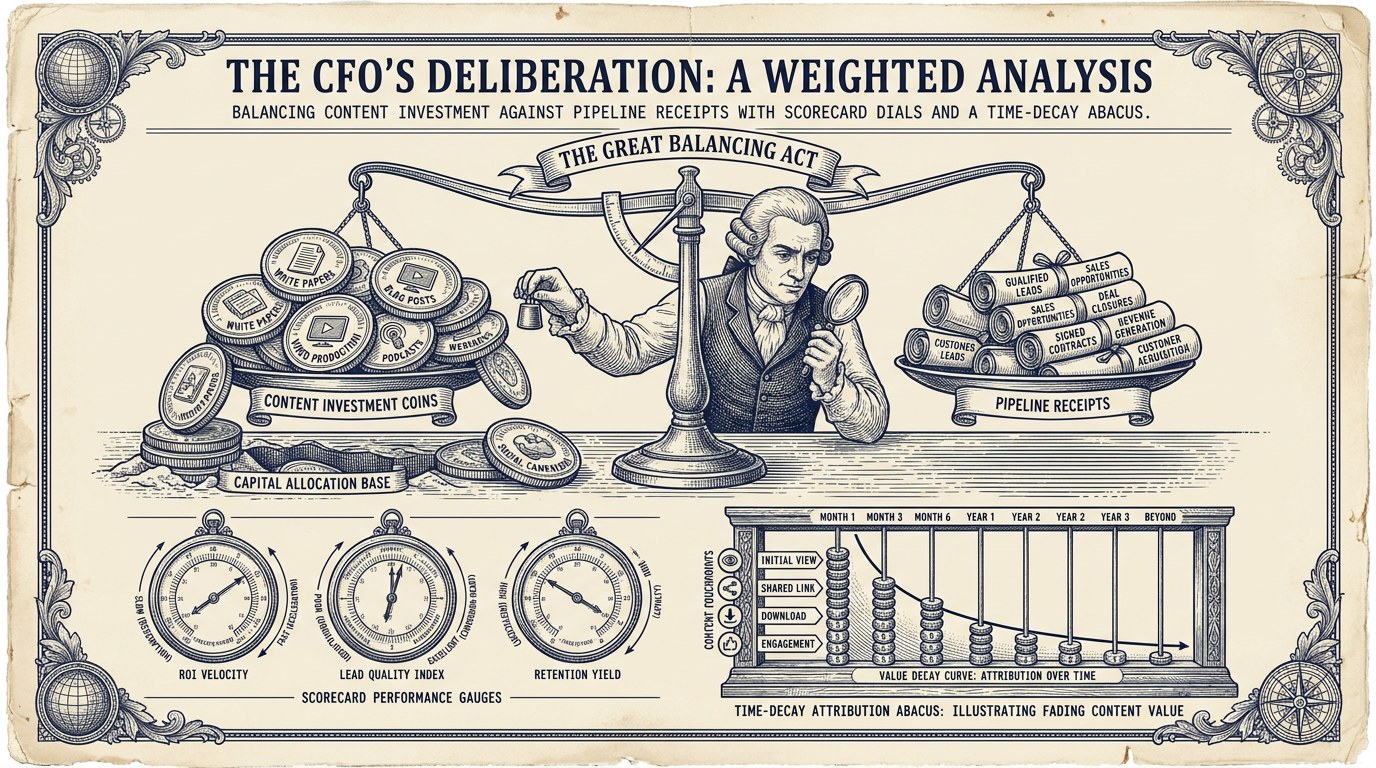
The scorecard renders as a four-quadrant grid on the first page of the monthly report. Each quadrant shows the current month, the prior month, and the year-over-year trend in a single visual.
The CFO scans the four numbers in 30 seconds and decides whether to read the supporting detail. Reports that bury the four metrics behind context get filed without action. Reports that surface them first earn the next budget cycle, and the benchmark thresholds we cite for each of the four metrics track closely with HubSpot's annual State of Marketing data on B2B program economics, which is what makes them legible across CFO conversations even outside our portfolio.
04Pipeline contribution attribution: the math
Pipeline attribution is where the ROI calculation gets contested. The choice of attribution model (first-touch, last-touch, or multi-touch) shifts the resulting ROI multiple significantly enough to change budget decisions. The sections below compare the three model families, recommend the right default for B2B SaaS, and walk through the calculation with a worked example so the math becomes legible to non-marketing stakeholders.
First-touch vs. last-touch vs. multi-touch
Three attribution models compete for default status in B2B SaaS content marketing.
- First-touch attribution credits the buyer's earliest interaction. Strong for measuring top-of-funnel content. Weak for B2B SaaS because the buyer's first content interaction often happens 6 to 18 months before they enter active evaluation.
- Last-touch attribution credits the buyer's final content interaction before booking a call. Strong for measuring bottom-of-funnel content. Weak because the final touch is often a comparison page or pricing review that the sales team would argue is sales enablement, not marketing-attributable.
- Multi-touch attribution credits multiple touchpoints across the buyer journey with weighted contribution. Strong for B2B SaaS because it matches the actual buyer journey of 6 to 18 touchpoints across 4 to 9 months. The weighting model choice (linear, time-decay, position-based) affects the math, but any multi-touch model captures more of the actual journey than either single-touch alternative.
The recommended model for B2B SaaS
Time-decay multi-touch with U-shape weighting. Each touchpoint gets credit, with higher weight given to the first touchpoint (40 percent), the touchpoint immediately before opportunity creation (40 percent), and the touchpoints in between (split among 20 percent).
The model captures the two highest-leverage moments in a B2B SaaS buyer journey: the moment of brand discovery and the moment of evaluation commitment. The 20 percent middle weight distributes across all intervening touchpoints, giving credit to the educational content that built trust without overweighting any single piece in the consideration phase. The weighting choice aligns with LinkedIn B2B Institute's research on long-term brand-building measurement, which has tracked how the discovery moment and the conversion moment carry the highest predictive value for revenue outcomes even though they look very different in CRM timestamps.
The calculation, with worked example
A buyer journey across 8 touchpoints culminating in a $96,000 ACV opportunity. The first touch is a comparison article. The fifth touch is a product-led pillar page. The eighth touch (immediately before opportunity creation) is the pricing page. The intervening touchpoints (2-4, 6-7) are educational blog content.
| Touchpoint | Weight | Attributed value |
|---|---|---|
| First touch (comparison article) | 40% | $38,400 |
| Touchpoints 2-4 (educational blog) | 6.67% each | $6,400 each |
| Touchpoint 5 (product-led pillar) | 6.67% | $6,400 |
| Touchpoints 6-7 (educational blog) | 6.67% each | $6,400 each |
| Last touch before opp (pricing page) | 40% | $38,400 |
The first touch (comparison article) and last touch (pricing page) each carry $38,400 in attributed pipeline credit. The intervening educational pieces carry $6,400 each. This is the math the CFO will defend because the model captures both the discovery and conversion moments without inflating any single piece's contribution.
Related operator reading: nearby in the same sub-pillar, our content audit operator playbook covers how to identify which pieces actually contribute to journeys like this. Across the program, the keyword research craft, in depth covers how to find the keywords that produce these high-value touchpoints in the first place.
05Self-reported attribution: closing the multi-touch gap
Multi-touch attribution captures more of the buyer journey than single-touch models, but it still misses 30 to 50 percent of actual content contribution because CRM tracking systematically excludes dark funnel touchpoints. Self-reported attribution closes the gap with one structured form-fill question. The sections below explain the gap, the question that closes it, and the implementation steps for HubSpot, Salesforce, and Marketo.
Why CRM data alone is insufficient
Even time-decay multi-touch attribution captures only the touchpoints that fire trackable events in the CRM. Anonymous research, dark social sharing, podcast mentions, peer recommendations, internal champion advocacy: none of these produce CRM events. The data layer simply does not see them.
Empirical pattern from our portfolio: CRM-only attribution captures 50 to 70 percent of actual buyer journey touchpoints. The missing 30 to 50 percent is the dark funnel, the touchpoints that influence the buying decision without leaving a trackable event. Programs reporting ROI purely from CRM data systematically under-credit content marketing's actual contribution by this same margin.
The form-fill question that closes the gap
A single open-text question on the demo request form or contact form closes most of the gap: "What helped you decide to evaluate us?" The buyer types their answer in their own words. Common answers:
- "Read your comparison article on X vs. Y."
- "Followed your founder on LinkedIn for the past year."
- "A colleague at my previous company recommended you."
- "Found you through your podcast appearance with [host]."
The self-reported answer reveals touchpoints CRM tracking would never surface. Aggregated across 50 to 200 inbound contacts per quarter, the pattern shows where the dark funnel concentrates. Programs that add this question typically discover 20 to 40 percent of buyers cite content that has zero CRM attribution credit.
Implementation in HubSpot, Salesforce, Marketo
Three steps to operationalize self-reported attribution.
- Step 1: Add the open-text field to the primary inbound forms (demo request, contact, pricing inquiry). Make it required for high-intent forms (demo, contact). Optional for low-intent forms (resource download).
- Step 2: Build the field as a custom property in the CRM with text indexing enabled. HubSpot uses "custom contact properties" with full-text search. Salesforce uses custom long-text fields with SOQL search. Marketo uses custom person fields.
- Step 3: Build the quarterly aggregation view. Pull all form responses for the trailing 90 days. Categorize answers into source buckets (blog article, podcast, social, peer referral, search). The resulting distribution becomes the self-reported attribution layer of the monthly ROI report.
06The monthly content marketing ROI report template
The monthly ROI report has three sections and fits on one page. Programs that try to add more lose the CFO attention budget that makes the report effective in the first place. The discipline is reductive, not additive. The sections below cover the three required sections, the editorial rule about removal versus addition, and the structural template that produces consistent month-over-month reports.
The three sections every monthly report contains
The template has three sections and fits on one page. Every report uses identical structure across months to enable trend tracking.
- Section 1: The four-metric scorecard. Pipeline attributed, ROI multiple, CAC, payback period. Current month, prior month, year-over-year. Renders as a four-quadrant grid in the top third of the page.
- Section 2: Pipeline narrative. Three to five sentences explaining the month's pipeline contribution. Which content pieces drove the largest attribution credit. Any anomalies (a single large opportunity that swung the numbers, a publication that produced unexpected pipeline, a campaign that under-delivered). Renders as a single short paragraph in the middle third.
- Section 3: Forward-looking. Three items: content investments shipping next month, anticipated pipeline impact, any risks or experiments worth flagging. Renders as a brief bulleted list in the bottom third.
What gets removed, not added
The discipline that makes the template work is the rule: anything that does not fit on one page gets removed. Traffic numbers, MQL counts, SQL counts, lead-to-opportunity ratios belong in the marketing operational dashboard, not the CFO ROI report.
The temptation is always to add more context for completeness. Resist it. The CFO's attention budget for marketing reports is one page, and the report earns standing by respecting that budget. CMI's annual B2B content marketing benchmark documents the same pattern at industry scale: programs that produce concise executive reporting hold budget through downturns at materially higher rates than programs that report at length.
Template structure
The actual one-page template has five fixed elements: header (month/year + report owner), scorecard (4-quadrant grid), pipeline narrative paragraph, forward-looking bullets (3), and footer (next report date + measurement methodology link).
Total content: roughly 250 to 350 words on one page. Same structure every month. Trend tracking happens by comparing prior-month reports side by side.
07Tool stack by ARR stage
The tool stack required to produce CFO-defensible ROI reporting evolves with program scale.
$5M to $20M ARR stack
Minimum viable infrastructure: HubSpot CRM (with multi-touch attribution enabled), GA4 (with conversions configured), a spreadsheet (Excel or Google Sheets) for the monthly ROI calculation. Total tool cost: under $500/month. Sufficient for programs producing 8 to 25 closed-won customers per quarter.
$20M to $100M ARR stack
Expanded infrastructure: HubSpot Marketing Hub Professional or Salesforce Marketing Cloud (with attribution reporting), a customer data platform or warehouse (Snowflake, BigQuery), a BI tool (Looker, Tableau, Mode), and a dedicated attribution platform (Bizible, Dreamdata, FullCircle). Total tool cost: $5,000 to $15,000/month. Required for programs producing 30 to 100 closed-won customers per quarter.
$100M+ ARR stack
Enterprise infrastructure: Salesforce or HubSpot Enterprise, a dedicated data warehouse with custom modeling, a BI platform with executive dashboards, dedicated attribution platform with multi-touch modeling, and a data engineering function maintaining the pipeline. Total tool cost: $20,000 to $80,000/month. Required for programs producing 150+ closed-won customers per quarter.
The stack progression matters because the ROI math infrastructure has to match the program scale. Programs running enterprise stacks at $10M ARR over-invest in measurement infrastructure. Programs running spreadsheet stacks at $80M ARR produce reports the CFO cannot trust at that scale.
08How ROI evolves across the program lifecycle
Content marketing ROI compounds across the program lifecycle in predictable stages. Year 1 establishes foundational measurement infrastructure. Year 2 adds attribution maturity. Year 3 and beyond opens predictive modeling. Programs that skip stages produce reports that overpromise on what current infrastructure can actually prove. The sections below define each stage and the work that bridges to the next.
Year 1: foundational measurement
Year 1 of a B2B SaaS content marketing program measures at the cluster level. Pipeline contribution attributed to entire topical clusters rather than individual pieces. Self-reported attribution data accumulates but does not yet produce statistically significant patterns.
The four-metric scorecard runs but the ROI multiple often comes in at 1.5x to 3x because production is ramping faster than results compound. Year 1 is the foundational year. The goal is producing defensible reporting infrastructure, not impressive numbers.
Year 2: attribution maturity
Year 2 brings the attribution data depth that makes multi-touch modeling reliable. Self-reported attribution patterns surface clearly across 200+ inbound contacts. The four-metric scorecard ROI multiple typically rises to 3x to 5x.
Cluster-level attribution refines into piece-level attribution for the highest-traffic content. The monthly report template runs consistently and CFO trust in the numbers builds.
Year 3+: predictive modeling
Year 3 and beyond opens the door to predictive modeling. The program has enough closed-won data attributed to specific content patterns that future pipeline can be modeled against planned content investments. ROI multiples typically reach 5x to 8x. Payback periods compress to 4 to 7 months. The content program is a defensible line item in annual budgeting cycles, defended with data rather than narrative.
Programs that skip stages produce reports that overpromise on what current infrastructure can actually prove. The path is sequential: foundation in year 1, maturity in year 2, predictive in year 3+. If you want to apply this to a specific program, book a call about your program and we will scope it together.
09FAQ
Seven questions covering the topics most commonly searched at the B2B SaaS content marketing ROI intersection, each with a self-contained answer designed for direct citation extraction by ChatGPT, Perplexity, and Google AI Overviews. The Q&A structure also feeds the FAQPage schema mainEntity declared in the SEO implementation section below, which is the highest-leverage schema for AI Search citation pickup.
What is content marketing ROI?
Content marketing ROI is the measurable financial return on the content marketing investment, expressed as a ratio of attributed pipeline contribution divided by total program cost. A 4.2x ROI multiple means the program produced $4.20 of pipeline for every $1.00 invested. The attribution model used (multi-touch, first-touch, last-touch) changes the calculation significantly; multi-touch with time-decay weighting is the recommended default for B2B SaaS.
How do you measure content marketing ROI for B2B SaaS?
Through four metrics on a single-page scorecard: pipeline attributed (12-month rolling), ROI multiple, CAC attributable to content marketing, and payback period for the content investment. Each metric is calculated from CRM data using time-decay multi-touch attribution, augmented with self-reported attribution from the inbound form question "What helped you decide to evaluate us?"
What's a good content marketing ROI for B2B SaaS?
At $5M to $20M ARR, a 4x ROI multiple is strong. 6x and above is exceptional. Below 2.5x signals the program needs intervention. The benchmarks scale with program maturity: year 1 typically produces 1.5x to 3x, year 2 produces 3x to 5x, year 3+ produces 5x to 8x.
What's the formula for content marketing ROI?
Pipeline attributed to content marketing in a 12-month rolling window, divided by total content marketing spend in the same window. The output is a multiple. The complexity lies in the attribution layer, not the division itself. Single-touch attribution produces inflated multiples; time-decay multi-touch attribution produces defensible multiples.
How long does it take for B2B SaaS content marketing to show ROI?
Year 1 produces foundational measurement and 1.5x to 3x ROI multiples as production ramps faster than results compound. Year 2 produces 3x to 5x as attribution matures. Year 3+ produces 5x to 8x with payback periods compressing to 4 to 7 months. CFOs evaluating year 1 numbers in isolation often conclude the program is failing; the trajectory across 24 to 36 months is what proves the investment.
Should I use first-touch, last-touch, or multi-touch attribution?
Multi-touch with time-decay weighting is the recommended default for B2B SaaS because buyer journeys span 6 to 18 touchpoints across 4 to 9 months. Single-touch models systematically misattribute by 40 to 70 percent. The U-shape weighting model (40 percent first touch, 40 percent last touch before opportunity, 20 percent distributed across middle touches) captures the highest-leverage moments without inflating any single piece's contribution.
What's the difference between content marketing ROI and content marketing metrics?
ROI metrics measure financial return (pipeline attributed, ROI multiple, CAC, payback period). Content marketing metrics include operational measurements like traffic, engagement, conversion rates, and lead counts. CFOs care about ROI metrics; marketing leadership uses operational metrics to manage the program. The two layers serve different audiences and belong in different reports.
Want this framework applied to your content marketing program?
30-minute call. We will review your current ROI reporting against the four-metric scorecard, identify which attribution model fits your buyer journey, and tell you honestly whether your measurement infrastructure is ready for CFO defense or needs foundational work first. The scorecard template is yours regardless of whether you engage us.
This is the ROI framework implementation guide under content measurement.
The strategic framework covering measurement infrastructure, attribution model selection, and CFO defense lives on the parent sub-pillar.
Read the measurement sub-pillar →