On this page
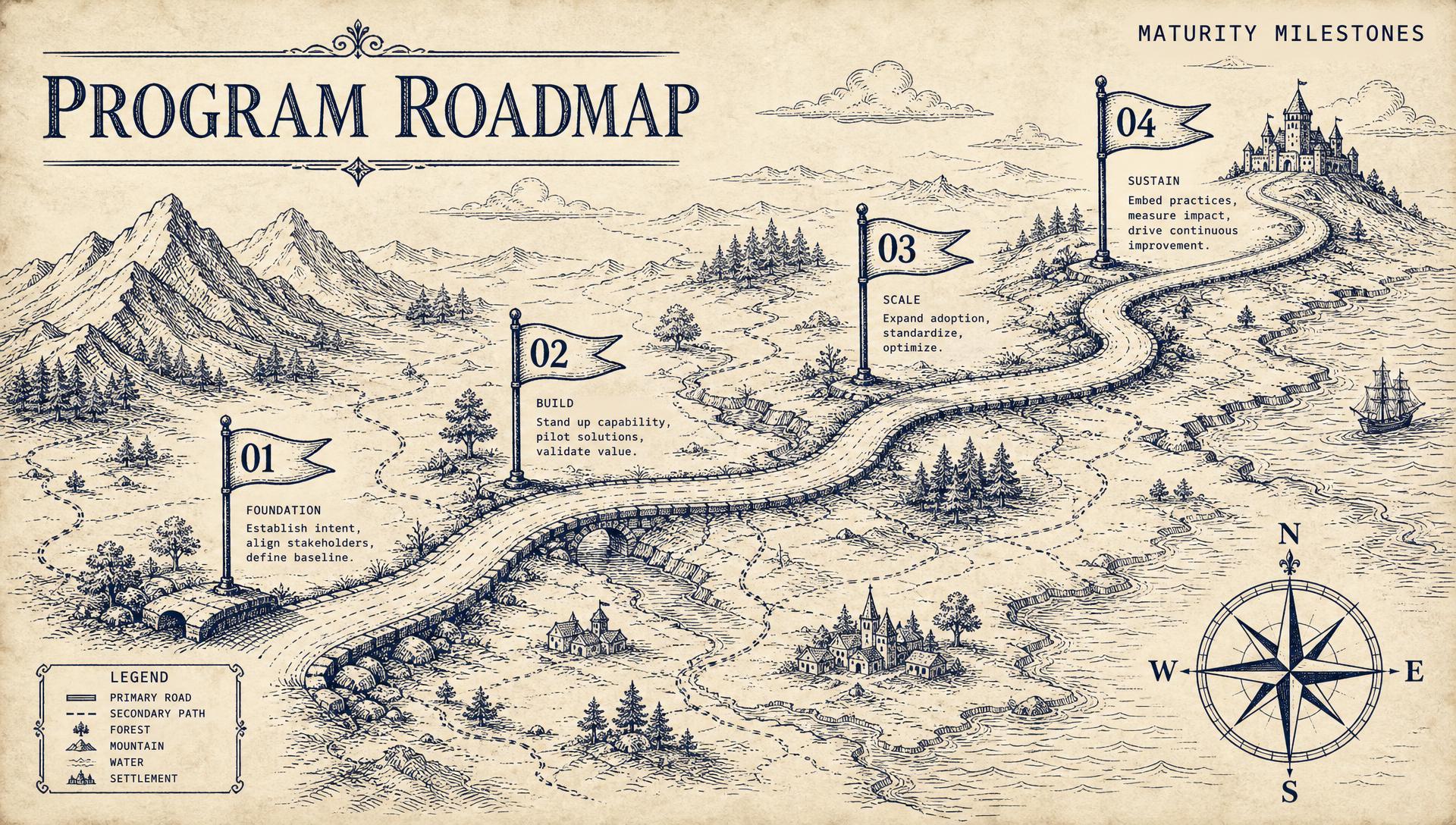
B2B SaaS SEO programs progress through predictable maturity stages from foundation through compounding authority. The progression is not linear: programs that skip foundation stages produce production cadences that do not compound; programs that linger in foundation stages without progressing to production produce strategy artifacts that never ship.
The roadmap below covers why B2B SaaS programs specifically need milestone-based maturity roadmaps, Stage 1 foundation work (months 1 to 6), Stage 2 production cadence (months 7 to 12), Stage 3 compounding authority (months 13 to 24), Stage 4 category leadership (months 25+), and the four common roadmap failures plus the course-correction interventions that get stalled programs progressing again.
01Why B2B SaaS SEO programs need milestone-based roadmaps
The dominant SEO roadmap content addresses how to learn the discipline (Coursera courses, learningseo.io, beginner tutorials). The audience for that content is individuals learning SEO. B2B SaaS programs need a different roadmap: how to mature an SEO operation from foundation through compounding authority, with the specific milestones, operational ownership, and leading indicators that B2B SaaS-specific programs require.
The B2B SaaS-specific calibration matters because the maturity timeline, content investment requirements, and team capacity needs differ structurally from generic SEO operations. B2B SaaS programs run 9 to 24 month foundation-to-compounding cycles versus the 3 to 6 month cycles that dominate consumer SEO content. The operational ownership splits across SEO, content, engineering, and sales teams in ways that consumer SEO does not require.
This sits inside the strategic SEO methodology hub for B2B SaaS programs and connects to the foundational B2B SaaS SEO pillar at the pillar level.
02Stage 1 (months 1 to 6): foundation
Stage 1 produces 4 critical artifacts that later stages depend on. Artifact 1: keyword research methodology applied. Sourcing, enrichment, qualification, clustering, prioritization completed against the five-source framework covered in the end-to-end B2B keyword research methodology playbook. Output: qualified keyword list with 12 to 18 cluster targets identified for Stage 2 production.
Artifact 2: sub-pillar architecture defined. The pillars and sub-pillars the program will own get defined explicitly with topical scope, internal linking architecture, and content production roadmap. Artifact 3: technical SEO health baseline. The 5-category technical SEO checklist (crawl, render, page experience, indexation, audit cadence) gets run against the current site with the highest-business-impact items prioritized and addressed before production scales.
Artifact 4: content production team and process operational. The writing capacity (1 to 3 internal writers typical at $5M to $50M ARR), SME interview cadence (3 to 6 SME interviews per quarter), review and approval workflow, and publish-to-Lovable handoff process all running consistently. Programs that skip Stage 1 and jump to production produce content cadences that do not compound because the foundation work was never built. The alignment of program stages to buyer-journey stages follows the structure Gartner's research on the B2B buying journey documents, where each evaluation stage requires different content artifacts and the SEO program roadmap should advance in step with that progression.
03Stage 2 (months 7 to 12): production cadence
Stage 2 focuses on shipping consistently at the cadence the foundation supports. Typical B2B SaaS programs at the $5M to $50M ARR range ship 12 to 18 cluster pieces per quarter. The cadence matters more than individual piece quality at this stage because consistency produces the compounding base that Stage 3 amplifies. Programs that prioritize individual-piece quality over cadence consistency at Stage 2 produce 6 to 8 pieces per quarter and miss the compounding inflection in Stage 3.
The Stage 2 operational discipline runs around 5 weekly rhythms. Rhythm 1: Monday keyword research review and priority queue update. Rhythm 2: weekly SME interviews booked and conducted (1 to 2 per week typical). Rhythm 3: daily writing throughput against the priority queue. Rhythm 4: weekly review-and-publish cycle. Rhythm 5: monthly link building outreach and digital PR work.
The leading indicators that surface when Stage 2 is producing the compounding base for Stage 3: rankings starting to emerge on early-published content (typically months 4 to 7 post-publish for competitive B2B SaaS keywords), MOFU and BOFU engagement metrics starting to register, internal champions in target accounts starting to share program content externally. The maturity benchmarks themselves track with the annual cross-industry data in HubSpot's State of Marketing report, where programs at each ARR tier exhibit recognizable patterns of channel investment, team composition, and measurement infrastructure.
04Stage 3 (months 13 to 24): compounding authority
Stage 3 emerges as Stage 2 content reaches ranking maturity. Typical ranking maturity timeline for competitive B2B SaaS keywords: 12 to 18 months post-publish. Earlier content from months 1 to 6 of Stage 2 reaches ranking maturity in months 13 to 18 of the program; content from months 7 to 12 of Stage 2 reaches ranking maturity in months 19 to 24 of the program.
Domain authority accumulates from sustained link building and digital PR work. Programs that ran consistent Stage 2 link building see DR gains of 15 to 35 points across Stage 2 and Stage 3 combined for B2B SaaS programs starting from DR 25 to 40 baselines. The DR accumulation produces the structural ranking advantage that Stage 4 category leadership rests on.
Pipeline contribution becomes measurable and compounding quarter over quarter. Stage 3 is typically when B2B SaaS programs first report SEO as the largest single source of inbound pipeline. The reporting connects back to the exec buy-in expectations set in Stage 1 (covered in the enterprise B2B SaaS SEO strategy operator framework). The long-horizon brand-building pattern at the category leadership stage draws on research published through LinkedIn's B2B Institute, which has documented why category leaders compound mental availability over multi-year horizons rather than capturing demand quarter-to-quarter.
05Stage 4 (months 25+): category leadership
Stage 4 runs at the asymptote where the program shapes category vocabulary and AI Search citation share. The transition into Stage 4 is marked by three observable signals. Signal 1: the program's content being cited by competitors in their own content. Signal 2: AI assistants (ChatGPT, Perplexity, Google AI Overviews) citing program content in their answers to category questions. Signal 3: industry publications citing the program as the operator reference for the category.
Stage 4 work shifts from production-volume focus to citation-share defense and category-vocabulary ownership. Programs that reach Stage 4 typically ship 8 to 14 cluster pieces per quarter (lower than Stage 2 and 3 cadence) but each piece carries substantial citation-share defensibility. Content depth, originality, and AI Search citation calibration matter more than production volume.
The AI Search citation share specifically connects to the content marketing measurement framework where citation tracking sits at Stage 5 measurement and to how AI Search engines retrieve and rank content which covers the citation extraction mechanics.
06Common roadmap failures and how to course-correct
Four failures recur. Failure 1: skipping Stage 1 foundation and jumping to Stage 2 production. The course-correction is returning to Stage 1 to complete the foundation artifacts even when production is already running. The cost of completing the foundation retrospectively is 2 to 3 months of program disruption; the cost of continuing without foundation is multi-year stalling at Stage 2 without compounding.
Failure 2: lingering at Stage 1 without progressing to Stage 2 production. Programs that produce 8 to 12 months of strategy artifacts without shipping content produce zero compounding. The course-correction is setting a Stage 2 launch date and shipping the first 4 to 6 cluster pieces even when the strategy artifacts are not fully complete. Failure 3: missing Stage 2 cadence consistency. Programs that ship 6 to 8 pieces per quarter instead of 12 to 18 miss the compounding inflection. The course-correction is auditing the production rhythms and identifying which of the 5 weekly rhythms is missing or under-running.
Failure 4: prematurely declaring Stage 3 or Stage 4. Programs that read ranking emergence on early content as Stage 3 compounding before Stage 2 cadence is consistent typically see ranking regression when Stage 2 production drops. The course-correction is using the leading indicators (DR accumulation, cross-piece traffic compounding, MOFU and BOFU engagement metrics) rather than individual-piece rankings to confirm Stage 3 progression. If you want a program maturity assessment against this roadmap, book a 30-minute conversation about your current program stage and progression path.
07FAQ
What are the stages of a B2B SaaS SEO program?
Four maturity stages. Stage 1 foundation (months 1 to 6): keyword research methodology applied, sub-pillar architecture defined, technical SEO health baseline established, content production team and process operational. Stage 2 production cadence (months 7 to 12): shipping 12 to 18 cluster pieces per quarter consistently. Stage 3 compounding authority (months 13 to 24): earlier content reaching ranking maturity, domain authority accumulating, pipeline contribution becoming measurable. Stage 4 category leadership (months 25+): program shapes category vocabulary and AI Search citation share.
How long does a B2B SaaS SEO program take to mature?
9 to 24 months from foundation to compounding authority. Stage 1 foundation runs months 1 to 6. Stage 2 production cadence runs months 7 to 12. Stage 3 compounding authority emerges months 13 to 24 as Stage 2 content reaches ranking maturity (typically 12 to 18 months post-publish for competitive B2B SaaS keywords). Stage 4 category leadership runs months 25+. Programs that skip stages or linger at one stage produce predictable failure patterns that delay the compounding inflection.
What's the difference between a learning-SEO roadmap and a B2B SaaS SEO program roadmap?
Learning-SEO roadmaps address how individuals learn the discipline. B2B SaaS SEO program roadmaps address how organizations mature an SEO operation. The audiences differ, the timelines differ, and the operational milestones differ. Learning roadmaps cover topics in sequence (technical SEO, on-page, off-page, content). Program roadmaps cover operational stages in sequence (foundation, production, compounding, leadership) with specific milestones, ownership, and leading indicators per stage.
What's the production cadence for Stage 2 of a B2B SaaS SEO program?
12 to 18 cluster pieces per quarter for typical B2B SaaS programs at the $5M to $50M ARR range. The cadence matters more than individual piece quality at Stage 2 because consistency produces the compounding base that Stage 3 amplifies. Programs that prioritize individual-piece quality over cadence consistency produce 6 to 8 pieces per quarter and miss the compounding inflection. Stage 2 runs on 5 weekly rhythms: keyword research review, SME interviews, writing throughput, review-and-publish, and link building outreach.
How do you know when a B2B SaaS SEO program has reached Stage 4 category leadership?
Three observable signals. Signal 1: the program's content being cited by competitors in their own content. Signal 2: AI assistants (ChatGPT, Perplexity, Google AI Overviews) citing program content in their answers to category questions. Signal 3: industry publications citing the program as the operator reference for the category. Programs that reach Stage 4 typically ship 8 to 14 cluster pieces per quarter (lower than Stage 2 and 3 cadence) but each piece carries substantial citation-share defensibility. The stage transition is marked by output observable in citation patterns rather than by internal-program metrics.
Continue with the B2B SaaS SEO strategy operator reference
The full strategy sub-pillar covers the operating model, exec buy-in framework, content allocation by funnel stage, and the maturity roadmap that sits behind every cluster post here.