
On this page
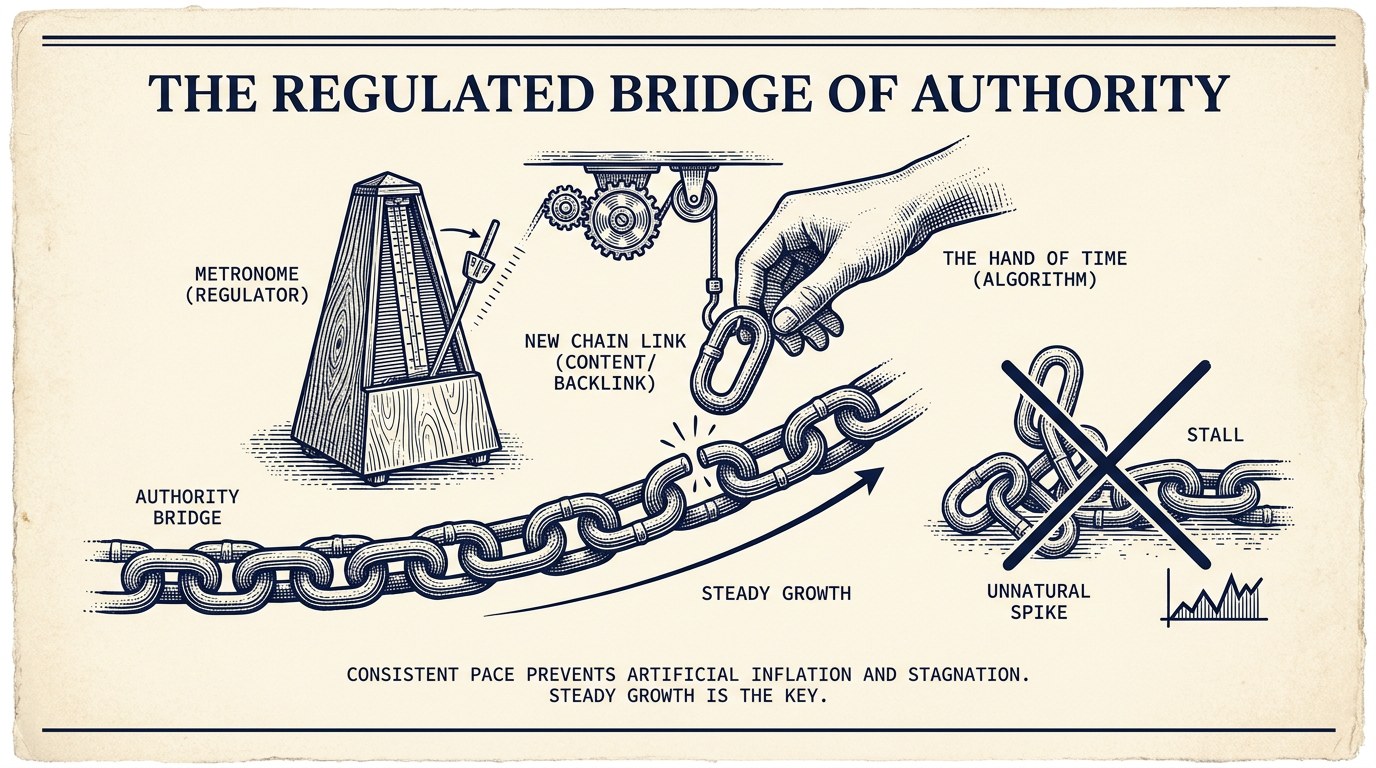
Link velocity is one of the most misunderstood concepts in B2B SaaS link building. Some practitioners treat it as a direct ranking factor (it isn't, per Google's own statements). Others dismiss it entirely (which misses the pattern-detection signal it actually feeds). The operational reality sits between the two: velocity isn't a ranking factor by itself, but velocity patterns that diverge sharply from natural growth get evaluated as evidence of engineered link building. The evaluation drives algorithmic devaluation and (rarely) manual penalties. This is the operator playbook for link velocity in B2B SaaS: what velocity actually is, the ranges that fit different program sizes and competitive contexts, the velocity-quality trade-off, the warning signs that surface before problems land, and the competitive benchmarking discipline that produces pacing targets matched to actual market signal.
01What link velocity actually is (and what Google actually evaluates)
Link velocity is the rate at which a site acquires new referring domains over a defined time period (typically measured in new referring domains per month). It is one chapter of our link insertion services for B2B SaaS and the foundation for understanding why velocity discipline matters even though velocity isn't a direct ranking factor.
The "made-up" framing and what it actually means
Google representatives have publicly called link velocity "made-up" as an isolated metric. As Search Engine Journal's analysis of link velocity as a ranking factor documents, the more accurate framing is that velocity itself is not a discrete ranking factor, but the pattern velocity reveals (whether links were earned through natural editorial citation or engineered through coordinated outreach) is what algorithmic systems evaluate. The semantic distinction matters: velocity is the symptom, the underlying pattern is the cause.
What the algorithmic systems actually evaluate
Per Google's link spam policies, the systems evaluate whether link patterns look like genuine editorial citation or engineered manipulation. Velocity contributes to this evaluation as one signal among several (alongside anchor distribution, referring domain quality patterns, and link placement context). A site with high velocity but otherwise natural patterns (diverse referring domains, varied anchor text, contextually relevant placement) doesn't typically trigger problems; a site with high velocity combined with anchor over-optimization and low-quality referring domains often does.
The B2B SaaS context
B2B SaaS programs face specific velocity considerations. The category typically supports moderate velocity (10 to 80 referring domains per month) because B2B SaaS content naturally accumulates editorial citation in the category's publications. Programs operating velocity far outside this range either under-invest in link building (very low velocity, falling behind competitors) or signal engineering (very high velocity, triggering algorithmic scrutiny).
The compounding effect with anchor mix
Velocity discipline compounds with the anchor mix strategy covered in the anchor text mix strategy playbook we ship. Programs running disciplined velocity and disciplined anchor mix produce link building outcomes that compound. Programs running high velocity without anchor discipline (or vice versa) often produce problems that the disciplined alternative would have prevented.
02Velocity ranges that fit different program sizes
Velocity ranges that look natural vary by program size and competitive context. Three program tiers cover the operational range.
Small program tier (Year 1 to 2 startups, low-competition niches)
Velocity range: 5 to 15 new referring domains per month. Pattern characteristics: gradual ramp from initial publication, mostly content-driven citation, supplemented by modest outreach. Programs in this tier shouldn't push beyond 15 to 20 referring domains per month without strong content-driven justification (viral content, news coverage, original research) because the higher velocity diverges from the natural pattern for site age and authority.
Mid-market tier (Year 2 to 5 programs, mid-competition niches)
Velocity range: 30 to 80 new referring domains per month. Pattern characteristics: combination of content-driven citation, structured outreach, and competitive link insertion. Programs in this tier have enough content portfolio and authority to support the velocity; pushing well below the range often means losing competitive position to rivals operating at the appropriate tier velocity.
Enterprise tier (Year 5+ programs, high-competition niches)
Velocity range: 100+ new referring domains per month. Pattern characteristics: substantial editorial earned citation, scaled outreach programs, brand-driven mention growth, and structured link building investment. Enterprise B2B SaaS programs in competitive categories often need this velocity tier to maintain competitive position; the velocity is justified by the substantial content portfolio and brand presence that produces editorial citation.
The age and authority calibration
Velocity should also calibrate to site age and authority. A 1-year-old site producing 50 new referring domains per month signals engineering regardless of which competition tier it sits in; a 10-year-old established brand producing the same velocity typically reflects natural growth. The age and authority calibration matters because algorithmic systems evaluate velocity against the site's accumulated history, not against generic benchmarks.
03The velocity-versus-quality trade-off
Velocity and quality exist in tension. The trade-off has three operational dimensions.
The acquisition capacity constraint
Programs have finite operator capacity for link acquisition. Capacity spent acquiring high-quality links (DR 50+ from relevant sites with editorial standards) produces lower link count per month than capacity spent acquiring lower-quality links. The trade-off is real; programs that pretend it doesn't exist typically end up producing lower-quality links at higher velocity.
The quality-first compound effect
Programs prioritizing quality at moderate velocity (DR 50+, topical relevance, editorial sites at 20 to 40 links per month) produce sustained ranking gains. Programs prioritizing volume at higher velocity (mixed quality, 80+ links per month) often produce short-term ranking gains followed by ranking instability as algorithmic systems evaluate and devalue the lower-quality portion of the link profile.
The sustainability dimension
Quality-first programs produce sustainable pacing because high-quality acquisition naturally has lower velocity ceilings. Programs targeting 30 high-quality links per month maintain that pace for years; programs targeting 80 lower-quality links per month often see the velocity collapse when the easy-to-acquire lower-quality sources get exhausted.
Quality measurement integration
Velocity reporting should integrate with link quality reporting from the niche edit ROI measurement playbook we ship. The integrated view shows both pacing and quality together, surfacing trade-off patterns that single-metric reporting hides.
04Warning signs of velocity-related algorithmic problems
Velocity-related algorithmic problems typically show warning signs before triggering rank suppression. Four warning sign categories matter.
Sudden velocity spikes
Warning sign: velocity doubling or tripling within 30 to 60 days. The spike signals coordinated link building when not paired with corresponding content events (viral piece, news coverage, major product launch). Mitigation: ramp velocity changes gradually; if a major content event is producing genuine velocity spike, document the cause for context.
Velocity-anchor pattern combination
Warning sign: high velocity combined with high exact-match anchor concentration. The combination signals coordinated targeting of specific commercial keywords. Mitigation: monitor velocity and anchor distribution together; high velocity with disciplined anchor mix (per the anchor text mix strategy playbook) typically doesn't trigger problems.
Referring domain quality drift during velocity ramps
Warning sign: as velocity ramps, average referring domain quality drops (DR, traffic, topical relevance). The drift signals that the velocity ramp is being achieved through lower-quality sources. Mitigation: maintain quality thresholds during velocity ramps; if quality can't be maintained, slow the ramp.
Competitive divergence
Warning sign: program velocity exceeding the velocity of top-ranking competitors by more than 2 to 3x sustained. The divergence signals operation outside the natural pattern for the competitive context. Mitigation: benchmark velocity against competitors quarterly per Chapter 05; persistent divergence is the actionable signal.
Recovery patterns
If velocity-related problems have already triggered (sudden ranking suppression with no clear content quality cause, organic traffic decline tied to specific link cohort acquisition periods), recovery typically requires substantial velocity reduction (50% or more for 6 to 12 months) combined with quality-focused acquisition. Pursuing aggressive link building during recovery typically extends rather than shortens the suppression period.
05Competitive velocity benchmarking discipline
Generic velocity ranges fail because what's natural varies by competitive context. Competitive benchmarking produces context-matched targets.
Competitor selection for benchmarking
Select the top 3 to 5 ranking competitors for the program's primary target keywords. The competitors should match the search intent of the target keyword set; ranking competitors for "b2b saas seo agency" produce the right benchmark for that keyword set, not ranking competitors for unrelated terms.
Velocity data extraction
Pull each competitor's velocity over the trailing 12 months: new referring domains per month, monthly trajectory pattern. Tools that produce this data: Ahrefs Site Explorer (referring domains over time view), Semrush (backlink analytics historical view). The data extraction should focus on referring domains (unique linking sites) rather than total backlinks (which include multiple links from same domain).
Velocity benchmark calculation
Calculate the average competitor velocity and the velocity range across competitors. The average produces the central tendency for the competitive context; the range produces the natural variance band. Programs operating within the range (or slightly above) match the natural pattern; programs operating well outside the range signal divergence.
Velocity benchmark refresh cadence
Refresh competitive velocity benchmarks quarterly. Competitor velocity evolves; new competitors enter the ranking SERPs; competitive intensity shifts. As Ahrefs' guidance on link velocity emphasizes, comparing against current competitive patterns matters more than against historical benchmarks because competitive context determines what's natural for the program's specific situation.
06Ramp patterns and seasonal calibration
Velocity ramps and seasonal patterns affect what looks natural. Three ramp patterns matter.
Initial program ramp
New link building programs should ramp velocity gradually rather than immediately operating at target velocity. Pattern: start at 30 to 50% of target velocity, ramp by 20 to 30% per month, reach target velocity at month 3 to 5. Programs that jump immediately to target velocity often produce velocity spike warning signs that gradual ramps avoid.
Content-event-driven spikes
Genuine content events (viral piece, news coverage, original research publication) produce legitimate velocity spikes that algorithmic systems generally tolerate. The pattern: a 2 to 4x velocity spike for 30 to 60 days following the event, then return to baseline. Programs experiencing content-event spikes should document the cause for context; the spike with corresponding content event reads differently than the spike without context.
Seasonal pattern recognition
Some B2B SaaS niches have seasonal velocity patterns: financial services see year-end planning content peaks, e-commerce sees Q4 holiday content peaks, B2B education sees academic-year calibration. Programs operating in seasonal niches should benchmark against competitor seasonal patterns rather than against flat annual averages.
Ramp-down patterns
Programs reducing link building investment (budget cuts, strategic pivots) should ramp velocity down gradually rather than stopping abruptly. Sudden velocity drops can signal abandonment patterns that algorithmic systems sometimes evaluate negatively. Pattern: reduce velocity by 20 to 30% per month rather than dropping immediately to minimum maintenance levels.
07Operational workflow and velocity tracking
Operational velocity tracking requires structured workflow. Three workflow components matter.
Monthly velocity tracking
Monthly cadence: pull new referring domain count for the trailing month, compare against prior 3-month trailing average, identify any spike or drop signals. Tools: Ahrefs Site Explorer (Referring Domains report with monthly trajectory), Search Console (Performance > Pages > Linking), Semrush Backlink Analytics. The tracking should distinguish referring domains (unique linking sites) from total backlinks.
Quarterly velocity-quality integration
Quarterly cadence: integrate velocity data with link quality data (DR distribution of new referring domains, topical relevance distribution, anchor distribution). The integration surfaces velocity-quality trade-off patterns the program may be making implicitly without recognizing.
Annual velocity strategy review
Annual cadence: full velocity review against competitive benchmarks, identification of velocity tier shifts (the program may have grown past its current tier), seasonal pattern audit, ramp pattern audit for the prior year's link building campaigns. The annual review feeds the next year's velocity strategy.
Velocity reporting integration with SEO scorecard
Velocity reporting should integrate with the SEO ROI scorecard framework for B2B SaaS we ship. The integration prevents velocity from being measured as an isolated metric and connects it to the broader program ROI story.
If you want this link velocity discipline running on your program, book a 30-minute velocity audit with our team. Compare engagement options for link building programs of different scales.
08Common failure modes and operational fixes
Four dominant failures.
The "velocity-as-direct-ranking-factor" failure: programs treating velocity as a direct ranking factor and either pushing maximum velocity for ranking gain or restricting velocity for safety. Fix: understand the actual relationship from Chapter 01; velocity matters as a pattern signal, not as a direct ranking factor.
The "no benchmarking" failure: programs operating velocity against generic rules without competitive benchmarking, producing velocity mismatched to competitive context. Fix: implement the competitive benchmarking workflow from Chapter 05.
The "velocity without quality discipline" failure: programs maximizing velocity without quality discipline, producing high-velocity link profiles dominated by lower-quality sources. Fix: implement the quality-first approach from Chapter 03; quality-prioritized programs at moderate velocity outperform volume-prioritized programs at higher velocity.
The "abrupt velocity changes" failure: programs jumping immediately to target velocity (during ramps) or dropping immediately to zero (during ramp-downs), producing velocity patterns that look engineered. Fix: implement the gradual ramp patterns from Chapter 06.
This is one chapter of the link insertion sub-pillar.
The full strategic framework covering link insertion, niche edits, anchor text mix, link velocity, and ROI measurement lives on the parent sub-pillar.
Read the link insertion sub-pillar →