
On this page
Most B2B SaaS content marketing dashboards track 15 to 30 metrics. Marketing leadership uses 6. The other 24 produce noise that obscures the decisions the program is supposed to support.
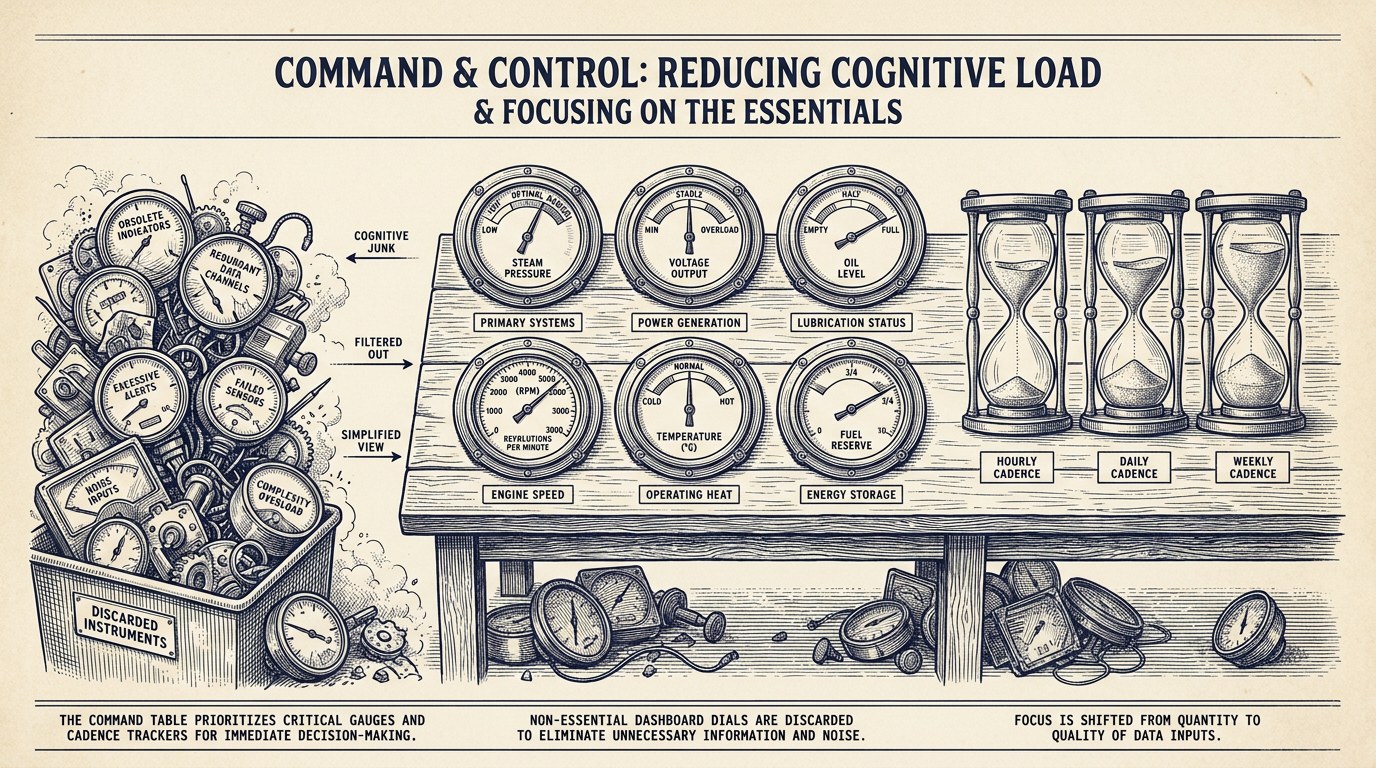
This is the operator framework for cutting the dashboard down to the metrics that drive weekly and monthly leadership action. Six metrics, three cadences, one operational dashboard that fits on a single screen. Production velocity as the leading indicator. Conversion rate against documented MQL definitions. Pipeline contribution at the cluster level. The pattern reduces dashboard complexity by 60 to 80 percent and improves the speed of program decisions measurably.
01What content marketing metrics actually measure
The first step is establishing what content marketing metrics are and the distinction between metrics and measurement as disciplines. Most B2B SaaS content programs have a metrics problem disguised as a measurement problem. The sections below define both, establish the layer separation, and set up the operational framework chapters 02 through 08 build on.
A working definition
Content marketing metrics are the operational measurements marketing leadership uses to manage a content program week to week and month to month. They measure activity (how much content shipped), reach (how many people encountered it), engagement (what they did with it), and conversion (whether they moved toward becoming customers). Content marketing metrics are distinct from content marketing ROI metrics: the former track program execution, the latter track financial return.
The distinction matters because the two metric layers serve different audiences. Marketing leadership uses operational metrics to manage the program, identify execution gaps, and reallocate resources. CFOs and finance leadership use ROI metrics to defend the program investment. Programs that conflate the two layers produce dashboards that overwhelm one audience and underserve the other. This sits inside our content measurement framework, the parent discipline that covers both the operational and financial measurement layers and how they connect.
Metrics versus measurement
Metrics are the specific numbers. Sessions, conversions, MQLs, pipeline attributed. Measurement is the discipline of selecting which metrics to track, defining how each metric is calculated, and setting the cadence for reporting. Most B2B SaaS content programs have a metrics problem disguised as a measurement problem. The dashboards have plenty of numbers. What they lack is the discipline of selection, definition, and cadence.
The framework in this post addresses all three. Section 03 covers selection (the six that earn their place). Sections 04, 05, and 06 cover definition (how each metric is calculated, what counts, what does not). Section 07 covers cadence (weekly versus monthly versus quarterly).
02Why most content marketing dashboards produce vanity noise
Three root causes account for most vanity noise in B2B SaaS content marketing dashboards. Each is structural rather than presentational, which means dashboard redesign alone cannot fix them. The fix is reducing the dashboard surface to the metrics that drive decisions. The sections below name the patterns and describe what changes operationally when the reduction happens.
Three patterns that produce vanity noise
The vanity-noise pattern across B2B SaaS content marketing dashboards is consistent. Three root causes account for most of it, and they show up together more often than not in the programs we inherit through the strategic content marketing playbook audit phase.
- Tracking everything the tools surface. GA4 surfaces 80+ metrics. HubSpot surfaces 100+. Semrush surfaces 50+. Teams build dashboards that include "the important ones from each tool" and end up with 25 to 40 metrics across the operational dashboard. Most of those metrics measure activity that does not connect to decisions. They get tracked because the tool tracks them, not because the marketing leadership team uses them.
- Confusing leading indicators with lagging indicators. Sessions are a lagging indicator of content quality and SEO investment from 4 to 12 months prior. Production velocity is a leading indicator of pipeline contribution 6 to 12 months forward. Dashboards mixing both at the same cadence treat them as equivalent. Marketing leadership reading those dashboards cannot tell which metrics they can move this quarter versus which metrics reflect work done last year.
- Site-wide averages instead of cohort comparisons. Bounce rate of 64 percent site-wide means nothing. Bounce rate of 78 percent on a specific cluster post compared against 52 percent on its parent sub-pillar means something specific (the cluster post likely has a thin-content problem). Programs reporting site-wide averages strip out the context that makes the metrics actionable.
What changes when you reduce
When the dashboard reduces from 25 metrics to 6, two things change. Marketing leadership starts using the dashboard for decisions instead of glancing at it for status. The reduced surface forces explicit definitions for each metric, which surfaces measurement gaps (the program's MQL definition is fuzzy, the production velocity is not tracked at all, the attribution model is unclear). Both changes compound. Decision velocity improves. The team stops debating metrics and starts debating actions.
The reduction is uncomfortable initially because metrics that get cut feel like lost visibility. The reframe: visibility on metrics nobody uses is not visibility, it is dashboard tax. The 6-metric framework recovers the dashboard tax and reinvests it in faster decision cycles, and the cuts get easier once teams notice that Google Analytics' own documentation on engagement metrics treats most of what they were tracking as supplementary signal rather than decision input.
03The six operational metrics that drive decisions
Six operational metrics earn their place in the weekly and monthly marketing leadership dashboard for B2B SaaS content programs. Each captures a dimension the others miss; the six are non-substitutable. The sections below define the six explicitly, explain why six rather than four or twelve, and show how the operational metrics layer feeds the financial ROI layer covered in our companion post on the content marketing ROI framework.
The six metrics
- Production velocity (weekly cadence). Pieces shipped per week, segmented by content type (pillar, sub-pillar, cluster post, comparison, integration page). Leading indicator of pipeline contribution 6 to 12 months forward.
- Cycle time from brief to publish (weekly cadence). Days from brief creation to live publish, averaged across pieces shipped that week. Identifies workflow bottlenecks early.
- Organic sessions to high-intent pages (monthly cadence). Sessions to pages tagged as high-intent (pricing, comparison, integration, product-led pillar). The traffic metric that correlates with pipeline. Site-wide sessions tracked separately as supporting context.
- Conversion rate to MQL (monthly cadence). Inbound contacts who reach MQL stage divided by content-attributed visitors. Tracked against a documented MQL definition, not a vague one.
- MQL-to-SQL conversion rate (monthly cadence). SQLs created divided by MQLs in the prior period. The metric that validates whether MQL counts represent actual qualified pipeline or inflated lead volume.
- Pipeline contribution at the cluster level (quarterly cadence). Pipeline attributed to topical clusters (not individual pieces). The metric that connects operational metrics to financial outcomes covered in the operator's ROI framework for B2B SaaS content marketing.
Why exactly six
The six are non-substitutable. Each captures a dimension the others miss. Production velocity and cycle time measure execution. Organic sessions to high-intent pages measure traffic quality. Conversion to MQL measures funnel entry. MQL-to-SQL measures lead quality. Cluster-level pipeline measures financial outcome.
Cut any one and the dashboard loses an analytical dimension. Adding more than six dilutes the dashboard back into vanity noise. Six is the tested ceiling for a single-screen operational dashboard that marketing leadership uses for actual decisions.
How they connect to ROI
The six operational metrics feed into the four ROI metrics covered in the CFO-defensible content marketing measurement framework (pipeline attributed, ROI multiple, CAC, payback period). Production velocity drives pipeline contribution. Conversion rate to MQL drives pipeline attributed. MQL-to-SQL conversion drives the ROI multiple. The two layers are integrated: operational metrics drive the program; ROI metrics defend the program. Both layers belong in a measurement infrastructure that supports CFO and marketing leadership decisions in parallel.
04Traffic and engagement: what to track, what to ignore
Traffic and engagement metrics are where most dashboards lose their signal. Traffic metrics earn dashboard space; most engagement metrics do not. The exception is cohort-specific engagement comparison with explicit baselines. The sections below cover the traffic metrics that matter, the engagement metrics that mostly produce noise, and the cohort-specific conditions where engagement metrics actually do matter operationally.
Traffic metrics that matter
Three traffic metrics earn their place in the operational dashboard for B2B SaaS content marketing.
- Organic sessions to high-intent pages. As defined in chapter 03. Tracked monthly. The traffic metric that correlates with pipeline.
- Ranking positions on commercial-intent keywords. Tracked in Ahrefs rank tracker or equivalent. Average position on a defined keyword set (typically 50 to 150 commercial-intent keywords aligned with revenue priorities). Tracked monthly. Identifies whether SEO investment is moving rankings on the keywords that matter for revenue. Deeper treatment lives in the tactical keyword research playbook that defines which commercial-intent keywords the rankings should target.
- Organic click-through rate from search. GSC data on organic CTR by query, tracked monthly at the page-cohort level (top 20 traffic pages, top 20 commercial intent pages). The metric definitions follow Google Search Console's performance reporting documentation directly, which matters because the page-cohort comparison only holds up when CTR is calculated the same way GSC defines it. Surfaces title-and-meta optimization opportunities.
Site-wide sessions, total pageviews, and total clicks belong in a supporting context section, not the headline operational dashboard. They are useful for trend tracking and audit work, not for decision-making.
Engagement metrics that mostly do not
Bounce rate, time on page, scroll depth, and session duration get tracked everywhere and used almost nowhere. They produce noise because they measure behavior on pages without distinguishing between high-intent and low-intent visitors. A pricing page with 78 percent bounce rate is healthy (visitors confirming pricing fits their budget). A blog post with 78 percent bounce rate is concerning. Site-wide engagement metrics blur these patterns into useless averages.
The fix is removing them from the operational dashboard entirely. They belong in audit-specific analysis (covered in our content audit operator playbook) where cohort comparisons make them actionable.
When engagement metrics actually do matter
Engagement metrics earn their place in the dashboard when compared cohort-specifically. Bounce rate on a specific cluster post versus its parent sub-pillar. Time on page on this month's published pieces versus the trailing 6-month average. Scroll depth on pages that drive MQLs versus pages that do not.
These cohort-specific comparisons surface actionable patterns. The site-wide averages do not. The discipline is reporting engagement metrics only when they are scoped to a specific cohort comparison with an explicit baseline, and the baseline ranges that hold up across B2B SaaS programs are documented in HubSpot's marketing benchmark database, which is what gives the cohort comparison its outside reference point.
05Conversion and lead-quality: where MQL definitions matter
Conversion and lead-quality metrics are where program credibility most often breaks down. The metrics are meaningless without rigorous MQL definitions, and programs running loose or undocumented definitions produce inflated counts that frustrate sales and erode marketing credibility with leadership. The sections below cover the headline conversion metrics, the MQL definition problem and its fix, and the lead-quality check metrics that prevent inflation.
Conversion rate metrics
Conversion rate to MQL is the headline conversion metric in the operational dashboard. The calculation: inbound contacts who reach MQL stage in a period, divided by content-attributed visitors in the same period. Tracked monthly, with the prior 3-month rolling average shown for trend context.
The number is meaningful only if the MQL definition is documented and applied consistently. Without that, the metric becomes whatever the marketing team needs it to be in any given month. The discipline is documenting the MQL definition explicitly in writing, applying it through automated qualification rules in the CRM rather than manual lead grading, and refreshing the definition annually with sales leadership input.
The MQL definition problem
The pattern across B2B SaaS programs we have inherited: MQL definitions are vague, applied inconsistently, and updated implicitly when MQL counts get embarrassing. "Visited the pricing page" might be the MQL definition in January, "completed a 30-day free trial" by July, "requested a demo" by November. Each redefinition moves the goalposts and produces non-comparable monthly numbers.
The fix is a documented MQL definition with explicit qualification criteria. Sample documented definition: "An MQL is an inbound contact who (a) provided a business email, (b) works at a company in the ICP profile (B2B SaaS, $5M+ ARR, US/EU geography), (c) has demonstrated buying intent via at least one of: demo request, free trial activation, pricing page visit + return visit within 7 days, or 3+ page sessions across high-intent content. MQLs are evaluated weekly and routed to sales within 24 hours of qualification."
That level of specificity makes the metric comparable across months and defensible in cross-functional conversations with sales.
Lead-quality scoring against pipeline
MQL counts inflate without MQL-to-SQL conversion as a check metric. Programs reporting "MQLs grew 40 percent year-over-year" without showing the MQL-to-SQL conversion rate are reporting lead volume, not lead quality.
The check: MQL-to-SQL conversion rate, tracked monthly, with a trailing 6-month rolling average. Healthy ratios for B2B SaaS are typically 15 to 35 percent (varies by segment and definition tightness). A declining MQL-to-SQL ratio with rising MQL counts signals the MQL definition is loosening, which produces inflated metrics and frustrated sales teams.
06Production metrics: velocity, cycle time, and the queue
Production metrics are the strongest forward indicators of pipeline contribution in the operational dashboard. They sit upstream of every traffic and conversion metric the program reports later. The sections below cover production velocity (the headline forward indicator), cycle time (the workflow bottleneck diagnostic), and queue depth (the supplementary metric that contextualizes velocity week over week).
Production velocity
Production velocity is the strongest forward indicator of pipeline contribution in the operational dashboard. The calculation: pieces shipped per week, averaged over the trailing 4 weeks. Segmented by content type (pillar pages, sub-pillar pages, cluster posts, comparison pages, integration pages, case studies). Workflow design behind the velocity number is covered in depth on the production sub-pillar where velocity, cycle time, and workflow design get covered together.
Healthy B2B SaaS content programs ship 2 to 4 pieces per week sustainably. Programs shipping less than 1 piece per week consistently underperform in pipeline contribution within 12 months. Programs shipping 5+ pieces per week often sacrifice quality unless production infrastructure scales with the velocity.
The reason velocity predicts pipeline so strongly: content compounds. Each piece adds incremental search surface, incremental authority signals, and incremental attribution data. Programs with consistent velocity compound across 18 to 36 months in ways that programs with sporadic velocity do not. The dashboard tracks velocity as the leading indicator because it is the single metric most under the team's control.
Cycle time from brief to publish
Cycle time measures days from brief creation to live publish, averaged across pieces shipped in the week. Healthy cycle times for B2B SaaS content are typically 14 to 28 days for cluster posts, 21 to 45 days for sub-pillar updates, 28 to 60 days for pillar work.
Cycle times exceeding these ranges signal workflow bottlenecks. SME interview scheduling, multiple revision cycles, design dependencies, legal review backlogs. The dashboard surfaces cycle time week to week so bottlenecks get identified before they suppress velocity for the quarter.
The diagnostic value of cycle time compounds when it is segmented by stage of the production workflow. Brief-to-draft cycle time, draft-to-edit cycle time, edit-to-publish cycle time. Each segment can be tracked separately to identify which workflow stage produces the bottleneck.
Queue depth as forward indicator
Queue depth measures the number of pieces actively in production at any given time. Healthy queue depth for B2B SaaS programs is roughly 2x the weekly velocity (a program shipping 3 pieces per week should have roughly 6 pieces in active production).
Queue depth below 1x velocity signals the program is reactive (producing content one piece at a time, no buffer). Queue depth above 4x velocity signals workflow congestion (too many pieces stuck mid-production). The dashboard tracks queue depth as the supplementary production metric that contextualizes velocity. The connection between production discipline and pipeline outcomes shows up clearly in CMI's research on content marketing measurement, which has tracked the gap between programs with operational measurement infrastructure and programs without it across multiple annual reports.
07The weekly content marketing operational dashboard
The weekly operational dashboard fits on a single screen and concentrates on metrics that move week to week. Metrics that compound over months or quarters belong in the monthly and quarterly reports instead. The discipline of cadence-specific dashboards prevents the noise that arises when programs report everything at the same frequency. The sections below cover the weekly dashboard structure, the cadence-based removal rules, and the leadership audience that consumes it.
What the weekly dashboard contains
The weekly dashboard fits on a single screen. The structure has five elements.
- Header. Week of, dashboard owner, last refresh timestamp.
- Production scorecard (top third). Production velocity (this week, trailing 4-week average), cycle time (this week, trailing 4-week average), queue depth (current count, target).
- Traffic and ranking summary (middle third). Organic sessions to high-intent pages (this week, prior week, year-over-year), average ranking position on commercial keywords (current, trend), top 3 newly-ranking pages from the past 30 days.
- Conversion summary (bottom third). MQLs created this week, MQL-to-SQL conversion rate (trailing 30 days), top 3 content-attributed pipeline opportunities by ACV.
- Footer. This week's production summary (1-2 sentences), next week's planned shipments (3-5 bullets), any blockers needing leadership attention.
What gets removed weekly versus monthly
The weekly dashboard removes the metrics that do not move week to week. Pipeline contribution data lags by 30 to 90 days and produces noise at weekly cadence. Cluster-level pipeline tracking belongs in the monthly or quarterly report instead. Site-wide engagement averages produce no actionable weekly signal and get removed.
The monthly report adds what the weekly dashboard removes: traffic trend analysis, conversion rate trends, MQL-to-SQL ratio trends, attribution model outputs, cluster-level pipeline attribution. The quarterly report adds what the monthly removes: ROI multiple, CAC trends, payback period, year-over-year comparisons across multiple cohorts.
Three cadences. Three distinct dashboards. Each scoped to the metrics that produce signal at that cadence. For programs treating AI Search as a third measurement layer alongside organic search and pipeline, the AI Search measurement framework for B2B SaaS content covers prompt-based testing, dedicated rank trackers, and AI referral analysis.
Who reads it
The weekly dashboard is read by marketing leadership (CMO, VP Marketing, Director of Content). It is reviewed in the weekly marketing leadership meeting. Action items emerge from the review (a stuck piece gets unblocked, a slow-converting page gets flagged for refresh, a hiring decision gets accelerated based on queue depth).
The monthly report is read by marketing leadership plus finance partners. The quarterly ROI report goes to the executive team and the CFO. Each layer has its audience and decision cadence; mixing layers produces dashboards that serve no audience well.
08How metrics evolve by ARR stage
Content marketing metrics evolve as the program scales. Programs at different ARR stages need different metric sets because the underlying measurement infrastructure capacity differs. Running an enterprise-stage dashboard at $10M ARR produces fake precision. Running a startup-stage dashboard at $80M ARR produces uncertainty the CFO cannot defend. The sections below cover the right metric set at each scale.
$5M to $20M ARR set
The six-metric operational dashboard is the foundation. Production velocity, cycle time, organic sessions to high-intent pages, conversion to MQL, MQL-to-SQL conversion, cluster-level pipeline. Tracked at weekly, monthly, and quarterly cadences respectively. Tool stack: GA4 + HubSpot + spreadsheet. Roughly $300 to $600 per month in tooling.
The discipline at this stage is foundational. Documenting MQL definitions, building consistent reporting cadences, training the team on the six-metric framework. Programs that build measurement discipline here produce defensible reports for the next stage.
$20M to $100M ARR set
Adds 3 to 4 attribution metrics to the operational dashboard. Multi-touch attribution model outputs, self-reported attribution layer from the form-fill question, source attribution at the cluster level (organic vs. paid vs. social vs. referral). The expanded dashboard reaches 9 to 10 metrics and requires tooling investment in attribution platforms (Bizible, Dreamdata, or equivalent).
At this stage the operational dashboard and the ROI report diverge meaningfully. Marketing leadership reads the operational dashboard for program management. The CFO reads the ROI report for budget defense. Both pull from the same data warehouse but surface different metrics for their respective audiences.
$100M+ ARR set
Adds predictive modeling outputs. Forecasted pipeline from content investments in the next 90 days. Forecasted ranking trajectories on commercial-intent keywords. Customer acquisition cost projections by content cluster. The expanded dashboard supports executive-level marketing investment decisions that span 12 to 18 month horizons.
Tool stack at this stage runs $20,000 to $80,000 per month in marketing measurement infrastructure. The investment is justified by the program scale: companies producing 150+ closed-won customers per quarter through content marketing need measurement infrastructure that matches.
Skipping stages produces dashboards that exceed what the measurement infrastructure can actually support. A $15M ARR program running enterprise dashboards produces fake precision. A $80M ARR program running spreadsheet dashboards produces uncertainty the CFO cannot defend. The right pattern is sequential evolution: foundation, expansion, prediction. If you want to apply this framework to your specific stage, book a call about your program and we will scope the right measurement infrastructure together.
09FAQ
Seven questions covering the topics most commonly searched at the B2B SaaS content marketing metrics intersection, each with a self-contained answer designed for direct citation extraction by ChatGPT, Perplexity, and Google AI Overviews. The Q&A structure also feeds the FAQPage schema mainEntity declared in the SEO implementation section below, which is the highest-leverage schema for AI Search citation pickup.
What content marketing metrics should B2B SaaS companies track?
Six operational metrics drive the weekly and monthly decisions: production velocity (pieces shipped per week), cycle time (days from brief to publish), organic sessions to high-intent pages, conversion rate to MQL, MQL-to-SQL conversion rate, and pipeline contribution at the cluster level. Three cadences (weekly, monthly, quarterly) determine which metric appears in which dashboard. Programs tracking 15+ metrics across the same dashboard produce noise instead of signal.
What is the difference between content marketing metrics and content marketing KPIs?
Content marketing metrics are the specific measurements (sessions, conversions, MQLs). KPIs are the small subset of metrics tied to program goals and executive decision-making. Most B2B SaaS programs use the terms interchangeably; the six-metric framework treats all six as KPIs because each connects to a specific operational or financial decision.
How many content marketing metrics should we track?
Six in the operational dashboard. Marketing leadership uses 6 metrics for weekly and monthly decisions. The other 15 to 30 metrics most programs track produce vanity noise that obscures decisions. The discipline is reducing the dashboard, not expanding it. Cohort-specific engagement metrics (bounce rate on specific page groups, time on page against baseline) belong in audit-specific analysis, not the operational dashboard.
What are good content marketing KPI benchmarks for B2B SaaS?
Production velocity: 2 to 4 pieces per week sustainable. Cycle time: 14 to 28 days for cluster posts. MQL-to-SQL conversion: 15 to 35 percent. Pipeline contribution: tracked at the cluster level rather than individual pieces. ROI multiple at $5M to $20M ARR: 1.5x to 3x in year 1, rising to 3x to 5x in year 2 and 5x to 8x in year 3+.
Is bounce rate a useful content marketing metric?
Site-wide bounce rate is mostly noise. Cohort-specific bounce rate (a specific cluster post compared against its parent sub-pillar, this month's published pieces compared against trailing 6-month average) is actionable. The discipline is using engagement metrics only in cohort-specific comparisons with explicit baselines. Site-wide averages produce no actionable signal.
How often should we report content marketing metrics?
Three cadences. Weekly for production metrics (velocity, cycle time, queue depth). Monthly for traffic and conversion metrics (organic sessions, conversion rate to MQL, MQL-to-SQL ratio). Quarterly for pipeline and ROI metrics (cluster-level pipeline, ROI multiple, CAC, payback period). Programs reporting all metrics at the same cadence produce noise that hides signal.
Should we track different metrics for different content types?
Production metrics segment by content type (pillar pages versus cluster posts versus comparison pages). The six core operational metrics apply across all content types. The discipline is consistency at the dashboard layer with segmentation in the underlying data. Reports that show different metrics for different content types produce inconsistent decision frameworks.
This is the operational metrics implementation guide under content measurement.
The strategic framework covering measurement infrastructure, the financial ROI layer, and CFO defense lives on the parent sub-pillar.