
On this page
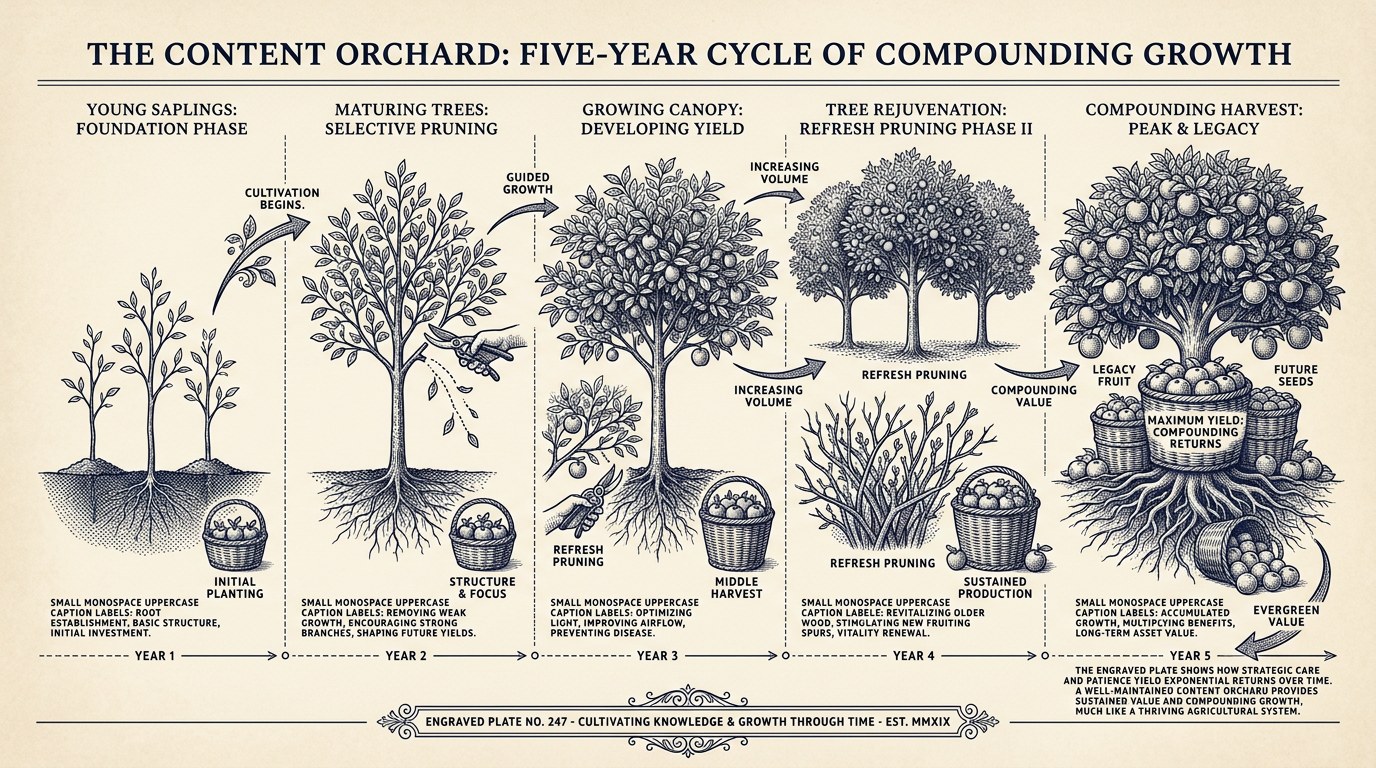
B2B SaaS content compounds over 24 to 60 months. The first 12 months capture only 20 to 40% of a strong piece's total lifetime value. Programs measuring content on first-year metrics systematically under-value content's contribution and fail to defend the long-term content investment in budget reviews. This is the operator playbook for content lifecycle value in B2B SaaS: the five lifecycle stages each piece moves through, the measurement framework for each stage, the maintenance discipline that extends content lifecycle from 24 to 60 months, the content lifetime value (CLV) calculation framework, and the CFO framing that positions content as a long-term revenue asset rather than a short-term marketing cost.
01Why content compounds differently in B2B SaaS than other industries
Content in B2B SaaS produces compounding value patterns that differ structurally from B2C content, e-commerce content, or short-cycle B2B content. This chapter sits within our content measurement services for B2B SaaS and the foundation for understanding why content lifecycle measurement is operationally different in B2B SaaS.
The journey length effect
B2B SaaS buyer journeys span 18 to 36 months. A piece of content created in January typically continues attracting buyers throughout 2027 and beyond because the journey timeline is long enough that new buyers continuously enter the journey at the awareness stage where the piece serves. B2C content with weeks-long buyer journeys doesn't show this compounding pattern; the content reaches the audience available at publication and tapers off rapidly.
The keyword stability effect
B2B SaaS category keywords are stable over years. "What is [B2B SaaS category]" queries change slowly; the category itself evolves but the core query persists. Content ranking well for stable category keywords continues producing organic traffic for years. B2C and e-commerce content competes against rapidly changing search algorithms, seasonal cycles, and shifting consumer preferences.
The decision-cycle compounding effect
B2B SaaS buyers reference content multiple times during decision cycles. A buyer who reads a piece in their first month of awareness may return to the same piece in their evaluation phase, share it with stakeholders during the procurement review, and reference it post-purchase during implementation. The same piece serves multiple journey moments for the same buyer.
The dark social compounding effect
B2B SaaS content shared through dark social channels (forwarded emails, Slack messages, LinkedIn DMs) compounds in ways that don't appear in standard analytics. A piece becomes the "go-to reference" within specific communities and gets shared across the community over years. This dark social compounding produces value that single-period attribution misses entirely.
02The five content lifecycle stages with distinct value patterns
Content moves through five lifecycle stages in B2B SaaS, each with distinct value patterns and operational attention requirements.
Stage 1: Launch (months 0 to 3)
The initial 90 days post-publication. Value comes from active distribution (LinkedIn, email, Twitter, syndication), early organic indexing, and initial direct engagement. Distribution-amplification effort produces the majority of traffic during this stage. Typical value capture: 5 to 15% of lifetime value.
Stage 2: Early compounding (months 3 to 12)
Months 3 to 12 see search engines fully index and rank the content, organic traffic stabilizes, and initial backlinks accumulate. Distribution effort tapers; organic discovery becomes the dominant traffic source. AI Search citations begin appearing for relevant queries. Typical value capture: 15 to 25% of lifetime value.
Stage 3: Mature compounding (months 12 to 36)
Months 12 to 36 produce the highest absolute traffic and conversion levels for most strong B2B SaaS content. Search rankings stabilize, backlink profile matures, citation patterns establish, and the content becomes the reference piece for its topic within the program's content portfolio. Typical value capture: 40 to 50% of lifetime value. This is the stage where content earns the majority of its lifetime ROI.
Stage 4: Maturity (months 36 to 48)
Months 36 to 48 see continued strong performance but begin showing competitive pressure, search algorithm shifts, or category evolution that requires response. Without maintenance, decline begins during this stage; with maintenance, the content continues compounding into stage 5. Typical value capture: 15 to 20% of lifetime value, conditional on maintenance.
Stage 5: Decline-or-refresh (months 48+)
Beyond month 48, the content either declines (without intervention) or extends into a second lifecycle (with substantial refresh). Decline patterns: gradual organic traffic decay, ranking position erosion, backlink decay as referring pages get updated. Refresh decisions: full content rewrites for currently-evergreen topics, or strategic retirement for topics that have evolved. The when-to-refresh-vs-retire content framework covers complementary decision criteria.
03Measuring stage 1 to 3 (months 0 to 12)
Months 0 to 12 measurement focuses on velocity and trajectory signals that predict the compounding patterns of stages 3 to 5.
Launch phase measurement (stage 1)
Key signals at month 1 to 3: total visits from active distribution, engagement signals (time on page, scroll depth), early organic indexation timing, and initial search position appearances. Strong launch metrics don't guarantee strong lifetime value but weak launch metrics often indicate underlying content quality issues. The content scoring playbook covers the 30-day measurement framework in detail.
Early compounding measurement (stage 2)
Months 3 to 12 measurement focuses on search visibility maturation and organic traffic trajectory. Key signals: monthly organic traffic growth rate, ranking position stabilization for target keywords, backlink acquisition rate, and AI Search citation appearance. The trajectory at month 6 typically predicts the mature compounding pattern reliably.
The 12-month projection
At 12 months, compile a comparative view: actual traffic and engagement against initial 30-day projections, against similar pieces from prior cohorts, and against the program's overall content portfolio performance. The 12-month projection produces the input for the maintenance decision (Chapter 5) and the lifetime value estimate (Chapter 6).
04Measuring stage 4 to 5 (months 12 to 60)
Months 12 to 60 measurement focuses on compounding sustainability, competitive pressure response, and the decision points that determine whether content extends or declines.
Mature compounding measurement (stage 3)
Months 12 to 36 measurement focuses on the absolute performance peaks: peak monthly organic traffic, peak monthly conversion attribution, peak ranking positions, peak backlink count. These peaks become the benchmarks for evaluating stage 4 and 5 performance. The pattern: stage 3 peak performance multiplied by approximately 4 to 8 estimates the total months at near-peak performance (the mature compounding window).
Maturity measurement (stage 4)
Months 36 to 48 measurement focuses on performance retention. Key signals: traffic retention rate against stage 3 peak, ranking position retention, conversion attribution retention. Pieces holding 70%+ of peak performance at month 48 are candidates for extension into stage 5 via refresh; pieces declining below 50% may not justify refresh investment.
Decline-or-refresh measurement (stage 5)
Beyond month 48, measurement focuses on the refresh-versus-retire decision. Key signals: the cost of refresh investment (estimating the rewrite effort), the projected post-refresh performance trajectory (will refresh extend the lifecycle materially), and the alternative use of the production capacity (could producing a new piece on the same topic outperform refreshing the existing piece). The decision economics drive the program's portfolio refresh strategy.
05The maintenance discipline that extends content lifecycle
Maintenance investment is the single largest determinant of total content lifetime value. Three maintenance practices matter.
Quarterly refresh cycle
Quarterly cadence: review the content portfolio for pieces in stage 3 or 4, identify pieces showing competitive pressure or content drift, schedule targeted refreshes. Typical refresh scope: update stale statistics, refresh competitive comparisons, add new examples or data, optimize for shifted search intent. The quarterly cadence prevents the chronic "we'll refresh that piece next quarter" pattern that delays refresh until decline is irreversible. The content audit framework playbook covers complementary audit cadence.
Topic cluster maintenance
Maintenance at the topic-cluster level: review the pieces within each topic cluster (pillar plus cluster posts) quarterly, identify gaps or weak links between pieces, add new pieces to fill cluster gaps, update internal links across the cluster. Cluster-level maintenance compounds individual piece maintenance because the pieces support each other through internal linking and topical authority.
Annual content portfolio review
Annual cadence: full portfolio review covering performance trajectory for every piece, lifecycle stage identification, refresh-versus-retire decisions for stage 5 candidates, and production capacity reallocation based on the portfolio analysis. The annual review prevents the portfolio from accumulating long-tail underperformers that consume incremental maintenance without producing returns.
06Content lifetime value (CLV) calculation framework
Content lifetime value (CLV) is the right primary long-term metric for content programs. Four calculation components matter.
Total pipeline contribution
CLV starts with total pipeline contribution attributable to the content across its lifetime. Pull attribution data (using the content attribution modeling framework) across stages 1 to 5. The total provides the gross value the piece produced for the program.
Cost basis
Cost basis includes production cost (writing, editing, design, distribution at launch), maintenance cost over the lifetime (quarterly refresh effort, ongoing optimization), and infrastructure cost allocation (CMS, analytics, attribution tooling). Subtracting cost basis from pipeline contribution produces the net contribution.
Time-value discounting
For long-cycle content (3 to 5+ year lifecycle), apply standard time-value discounting to compare future value against present cost. The discounting prevents over-valuation of late-stage value compared to early-stage cost. Use the program's internal discount rate (typically 8 to 12% for B2B SaaS) for consistency with broader financial reporting.
Per-piece CLV reporting
Per-piece CLV reports surface which pieces produce disproportionate program value. The top 10 to 20% of pieces typically produce 60 to 80% of total program CLV. The reporting drives portfolio decisions: which pieces deserve refresh investment, which production patterns produce highest-CLV content, which topic areas justify expanded production. The SEO ROI scorecard framework covers complementary scorecard structure for CLV reporting.
07Content-as-revenue-asset CFO framing
CFO framing determines whether content lifecycle measurement defends budget. Four framing components matter.
Asset depreciation analogy
Position content as a depreciating capital asset that produces revenue for years. The framing connects to financial concepts CFOs understand from their broader experience: an asset produces revenue over its useful life, declines in productive value over time, requires maintenance investment to extend useful life, and gets evaluated on lifetime ROI rather than single-period cost. The framing change shifts the conversation from "should we keep spending on content?" to "what's the lifetime ROI of our content portfolio?"
Multi-year ROI rather than annual ROI
Single-year ROI calculations on B2B SaaS content systematically under-state value (per Chapter 1). Multi-year ROI calculations using the CLV framework from Chapter 6 produce the accurate value picture. The content marketing budget framework for B2B SaaS covers complementary budget-framing that aligns with this CLV approach.
Portfolio mix reporting
Portfolio reporting shows the mix of content lifecycle stages currently active in the program. Programs with healthy portfolios have content distributed across stages 1 to 5 (active production, mature compounding, ongoing refresh). Programs with poor portfolios concentrate in stages 1 to 2 only (always producing new, never compounding) or stage 5 (lots of legacy content without active production). The mix surfaces the program's structural health.
Comparison against alternative channels
The content lifetime value framing enables comparison against alternative marketing channels. Paid acquisition typically produces immediate ROI but no compounding; content produces lower immediate ROI but high compounding ROI over years. The comparison framing helps CFOs understand the strategic role content plays in the marketing mix rather than treating it as a pure cost item.
If you want this content lifecycle value framework running on your program, book a 30-minute lifecycle audit with our team. Compare engagement options for content measurement programs of different scales.
08Common failure modes and operational fixes
Four dominant failures.
The "first-year ROI only" failure: programs measuring content on first-year metrics and concluding content under-performs versus channels with immediate returns. Fix: implement CLV measurement per Chapter 6; first-year metrics capture only 20 to 40% of B2B SaaS content's actual lifetime value.
The "no maintenance discipline" failure: programs publishing content and never refreshing, allowing pieces to decline from peak performance after 18 to 24 months. Fix: ship the quarterly refresh cycle from Chapter 5; maintenance investment of 5 to 15% of production cost produces 2 to 3x lifetime value.
The "no CFO framing" failure: programs measuring content lifecycle internally but presenting marketing-language reports to executives. Fix: adopt the asset depreciation framing from Chapter 7; CFOs respond to asset-based framing far more than they respond to marketing-channel framing.
The "kill-everything-at-decline" failure: programs retiring content as soon as decline begins rather than evaluating refresh economics. Fix: apply the refresh-versus-retire decision framework from Chapter 4; many declining pieces benefit from refresh investment that extends lifecycle into stage 5.
This is one chapter of the content measurement sub-pillar.
The full strategic framework covering content measurement, attribution modeling, content scoring, and lifecycle value lives on the parent sub-pillar.
Read the content measurement sub-pillar →