On this page
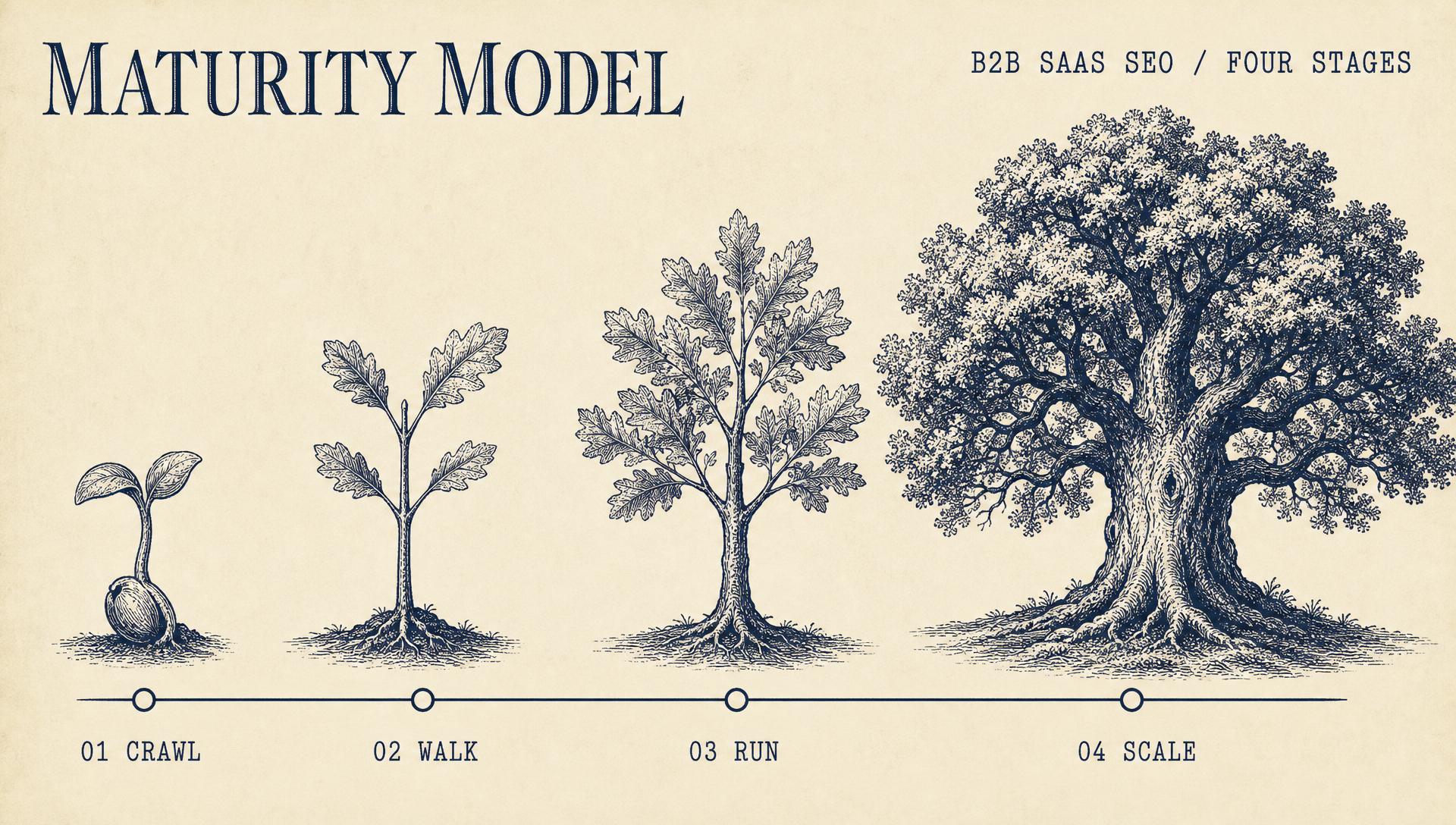
The B2B SaaS SEO maturity model has four stages: Foundation (below $5M ARR), Acceleration ($5M to $20M), Compounding ($20M to $50M), and Authority (above $50M). Each stage has a distinct playbook. Running the wrong stage's playbook is the most common structural cause of program failure across every program we have audited.
01Why a maturity model
Most B2B SaaS SEO content treats SEO as if there is one playbook that scales from $1M ARR to $500M ARR. There is not. The playbook that wins for a $3M ARR company is structurally wrong for a $40M ARR company, and vice versa. The 4-stage maturity model below maps the right playbook to the right stage. Running the wrong stage's playbook is the most common structural cause of program failure across every program we have audited.
What the model is for
The model is a diagnostic and a planner. As a diagnostic, it tells a marketing leader whether their current program matches their actual stage. As a planner, it tells them what the next stage will need and how to start preparing for it. The 5-question diagnostic in chapter 08 maps a specific company to a specific stage.
Why ARR is the anchor metric
ARR is the strongest single predictor of which stage a company is in. Not DR, not employee count, not funding round. ARR captures the size of the customer base, the maturity of the product, and the company's capacity to absorb the cost of the right-sized program. DR follows ARR more often than ARR follows DR.
02Foundation (below $5M ARR)
The starting stage. Most B2B SaaS companies enter Foundation as soon as they have something to sell and stay in it through Series A.
Foundation characteristics
ARR below $5M. DR usually below 25. Brand search demand low or non-existent. Marketing team is 1 to 5 people. Product is recently post-PMF or still finding it. Sales cycle is being figured out. Buyer personas are roughly defined but not validated. The company cannot yet absorb a $25K per month SEO retainer or a senior in-house SEO hire.
Foundation budget range
$3K to $7K per month total SEO investment. Roughly $40K to $85K annual. At this stage, the SEO program is foundational investment, not primary acquisition. Paid is doing the heavy lifting on pipeline.
Foundation tactics that work
Build the master pillar page and 3 to 5 cluster topics maximum. Ship 6 to 10 pieces of operator-grade content per cluster. Get technical hygiene right: schema markup, Core Web Vitals, internal linking, indexation. Earn the first 5 to 10 editorial backlinks. Set up pipeline attribution from day one. Do not try to cover 15 topics. Do not run velocity-trap content production.
Foundation failure mode
Spreading too thin. The Foundation-stage company hires an agency and asks for "everything," and the agency obliges. 30 pieces a quarter across 12 topics, none with topical authority, none ranking. 18 months later the company has 100 published pieces and no pipeline. This is the most common Foundation failure pattern.
Foundation success metric
By month 18 of a Foundation program: DR moved into the high 20s or 30s, 3 to 5 cluster topics with content ranked in positions 10 to 30, first defensible pipeline contribution from organic (5 to 10 percent of inbound).
03Acceleration ($5M to $20M ARR)
The compounding stage begins. This is where SEO investment starts paying back the original capital.
Acceleration characteristics
ARR $5M to $20M. DR usually 25 to 50. Brand search demand exists and is growing. Marketing team is 5 to 15 people, usually with a head of growth or VP marketing. Product has PMF. Sales motion is defined. Buyer personas are validated. The company can absorb a $10K to $20K per month SEO investment.
Acceleration budget range
$7K to $20K per month total SEO investment. Roughly $85K to $240K annual. SEO is becoming a primary acquisition channel alongside paid.
Acceleration tactics that work
Shift content from generic SaaS audience to specific personas in the active buying committee. Expand from 3 to 5 cluster topics to 6 to 10. Run a serious link campaign (digital PR, expert contribution, original research). Start refreshing the Foundation-stage content to deepen topical authority on the cores. Build product-led pillars for vertical use cases.
Acceleration failure mode
Continuing the Foundation playbook. Acceleration companies that keep running Foundation tactics produce 3 to 5 cluster topics worth of content for 18 more months. The opportunity cost is the persona-targeted content and links that would compound. This failure shows up as plateauing traffic and pipeline.
Acceleration success metric
By month 18 of Acceleration: DR moved into the high 40s or low 50s, 6 to 10 cluster topics with content in top 10 on commercial-intent keywords, pipeline contribution from organic at 15 to 25 percent of inbound, demo requests measurably driven by organic.
04Compounding ($20M to $50M ARR)
The asset is built. The next 1.5x of pipeline comes from authority signals, not content volume.
Compounding characteristics
ARR $20M to $50M. DR usually 50 to 65. Brand search demand is significant. Marketing team is 15 to 40 people, usually with multiple specialist functions. Product is mature in core market, possibly expanding into adjacent categories. Sales motion is repeatable. The company can absorb $20K to $40K per month SEO investment.
Compounding budget range
$15K to $40K per month. Roughly $180K to $480K annual. SEO is now the dominant acquisition channel or near-dominant.
Compounding tactics that work
Run a sustained link-building campaign that targets DR 60+ publications. Refresh the top-performing existing content with newer data and additional depth. Build comparison and migration content for competitor takeout. Build vertical-specific landing pages for industries the company is expanding into. Start producing original research that earns links organically.
Compounding failure mode
Confusing "more content" with "more authority." Compounding-stage programs that keep adding new pieces without investing in links and content refresh produce a sprawling content library with no incremental authority gains. The pipeline plateaus. The team blames the strategy. The strategy is fine; the investment mix is wrong.
Compounding success metric
By month 18 of Compounding: DR into the low 60s, top 3 rankings on core commercial-intent keywords, pipeline contribution from organic at 30 to 50 percent of inbound, cost per pipeline dollar from organic below cost from paid at scale.
05Authority (above $50M ARR)
The category-leading stage. SEO is now a moat, not just a channel.
Authority characteristics
ARR above $50M. DR usually 65+. The company owns its core category in organic search. Brand search dwarfs non-brand search. Marketing team is 40+ people with deep specialist functions. Product is the category leader or close to it. The company can absorb $40K to $80K+ per month SEO investment, but the marginal return on incremental SEO spend is declining.
Authority budget range
$30K to $80K+ per month. Roughly $360K to $960K+ annual. SEO is the dominant acquisition channel and the program is operating as a moat.
Authority tactics that work
Category creation in adjacent verticals. Competitive defense (own competitor brand terms organically through comparison content). Geographic expansion content for new markets. Sustained original research at industry-leading depth. Brand-level link building (sponsored research, conference presence, executive thought leadership that earns links organically). Optimize for AI Search and emerging surface channels.
Authority failure mode
Complacency. The Authority program that ranks #1 for every term in the core category gets comfortable. Investment in defending the category slows. Competitive challengers move in over 12 to 24 months. The company loses ground without realizing it until the rankings shift. Prevention is sustained investment in defense and adjacent expansion.
Authority success metric
By month 18 of Authority: DR 70+, top 3 rankings retained on all core commercial-intent keywords, pipeline contribution from organic at 50 to 70 percent of inbound, year-over-year growth from organic in the 30 to 50 percent range despite the larger base.
06Transitioning between stages
Stages do not jump. The transition between any two adjacent stages takes 6 to 12 months.
Transition signals
The signal that a stage transition is approaching: the current playbook is producing diminishing returns. DR has plateaued. Content production is steady but new pieces aren't ranking as well as older pieces. Pipeline contribution growth is flattening even though the team is doing the same things. These signals mean the company has outgrown the current stage's playbook.
Executing the transition
Layer in the next stage's tactics gradually while continuing the current stage's tactics. Do not stop the working tactics abruptly. The Acceleration company moving toward Compounding starts running a sustained link campaign 6 months before fully shifting investment toward links. By the time the link campaign is in full swing, the budget has shifted with it.
Common transition mistakes
Skipping a stage is the most common mistake. A Foundation-stage company tries to run Acceleration tactics because the company "feels" ready, before the foundation work is done. The result is structural debt: the Acceleration tactics produce nothing because there is no topical authority for them to compound against, and the foundation never gets built. Companies that skip stages lose 12 to 18 months.
07The diagnostic, how to identify your stage
Five questions. Answer honestly.
The 5 questions
- What is your current ARR (not target ARR, current)?
- What is your domain rating (DR) right now in Ahrefs?
- Do you have a defined ICP and validated buyer personas?
- Is SEO currently producing defensible pipeline contribution (more than 5 percent of inbound)?
- Has your team done topical authority work, pillar pages, cluster architecture, internal linking, already?
Mapping answers to a stage
ARR under $5M plus no defined personas plus no topical authority work yet: Foundation. ARR $5M to $20M plus defined personas plus some topical authority work but pipeline contribution under 15 percent: Acceleration. ARR $20M to $50M plus topical authority on core topics plus pipeline contribution over 25 percent: Compounding. ARR over $50M plus category-leading rankings plus pipeline contribution over 40 percent: Authority. Mixed signals (high ARR, low DR) usually indicate a company that has run weak SEO for years and is structurally Foundation despite the ARR.
08Common stage-skipping mistakes
Beyond the "skipping stages" general failure, three specific patterns we see repeatedly.
The Acceleration leapfrog
A Foundation company hires an Acceleration-tier agency and starts publishing 8 pieces a month across 12 topics. 18 months in, the company has spent $250K on content that does not rank. The agency is fired. The diagnosis is wrong; the issue was running Acceleration tactics at Foundation scale, not the agency.
The Authority pretense
A Compounding-stage company starts running Authority tactics (category creation, sponsored research) before the Compounding-stage authority is fully built. The Authority tactics earn some attention but produce minimal pipeline because the core authority isn't deep enough yet to convert the attention into demand.
The Foundation freeze
An Acceleration-stage company keeps running the Foundation playbook because "it was working." Foundation tactics ran their course and now the program is plateauing. The team interprets the plateau as a market problem, not a stage-mismatch problem. The pipeline opportunity from Acceleration tactics is left on the table.
09Workwize stage progression as a reference
The cleanest cross-stage progression we have shipped. Foundation to Acceleration to Compounding across 22 months.
Workwize starting stage
At engagement start, Workwize was around $8M ARR, DR 27, with some Foundation-stage work already done by an in-house team. They were structurally Acceleration on the company side but Foundation on the SEO program side. The mismatch was costing them roughly 30 percent of pipeline efficiency.
Workwize phase progression
Months 1 to 6: completed Foundation work, master pillar, 3 core clusters, technical remediation. Months 6 to 14: Acceleration tactics, persona-targeted content, link campaign, vertical use case pillars. Months 14 to 22: Compounding tactics, content refresh on top performers, expanded link campaign to DR 60+ publications, original research that earned links organically. (Full case study walks through each phase month by month.)
Workwize end state
DR 71 at month 22. Monthly pipeline contribution from organic at approximately $1.16M, up from approximately $360K at engagement start. MQLs from organic at 111 per month, up from 28. The company crossed from Acceleration into Compounding during the engagement. The progression was visible and measurable at every stage transition.
10FAQ
These FAQs address common concerns about the B2B SaaS SEO Maturity Model. They clarify how to interpret stage characteristics against your company's unique circumstances and offer guidance on optimizing your progression through the model.
What if our ARR and DR do not match the stage characteristics?
Most common pattern: high ARR with low DR. This usually means the company has run weak SEO for years and is structurally Foundation on the SEO side despite the ARR. The right move is to start at Foundation tactics regardless of ARR, because the topical authority does not exist yet. Skipping the foundation work because the ARR suggests Acceleration loses 12 to 18 months.
Can a company jump a stage?
No. Stages are about structural readiness, not desire. Companies that try to skip stages lose 12 to 18 months on average. The honest move is to do the stage you are in, well, and let the work pull you into the next stage.
How long does each stage take to complete?
Foundation: 12 to 18 months to fully build out. Acceleration: 12 to 18 months. Compounding: typically 18 to 24 months. Authority: ongoing, the stage does not complete, it sustains. Total time from new program to Authority stage is typically 5 to 7 years of consistent investment.
What if our budget does not match our stage?
If budget is below the stage range, do the high-priority parts of the stage's playbook at the budget you have. Foundation work at $3K per month is possible, just slower. If budget is above the stage range, do not skip ahead to the next stage's tactics. Reinvest the extra budget into doing the current stage's work more deeply. Spending Acceleration money at Foundation stage usually goes into velocity-trap content.
Can a company be in different stages on different topic clusters?
Yes. A category leader on core terms (Authority) may be Foundation-stage on a new adjacent vertical they are entering. The cluster-level stage assessment matters as much as the company-level one. The right tactics per cluster follow the cluster's stage, not the company's overall stage.
What is the fastest a company can move from Foundation to Compounding?
Roughly 30 months minimum. Foundation typically takes 12 to 18 months. Acceleration takes another 12 to 18. Compounding work then layers on. Anyone promising faster has either skipped a stage or is misrepresenting the work.
Part of the
B2B SaaS SEO strategy playbook →
The pillar covering ARR-stage maturity, cluster architecture, attribution design, and the structural decisions that determine whether an SEO program compounds or stalls.
Where this fits in the broader playbook
This piece sits inside the strategy sub-pillar covering audience-first SEO, which is one chapter of our complete B2B SaaS SEO operator framework. For deeper framing on the same discipline, see our B2B SaaS SEO strategy framework.
Closely related reading from the same sub-pillar
- how long B2B SaaS SEO actually takes , what month-by-month SEO progress actually looks like.
- our outsource-vs-build-in-house framework , the in-house vs agency decision framework by ARR.
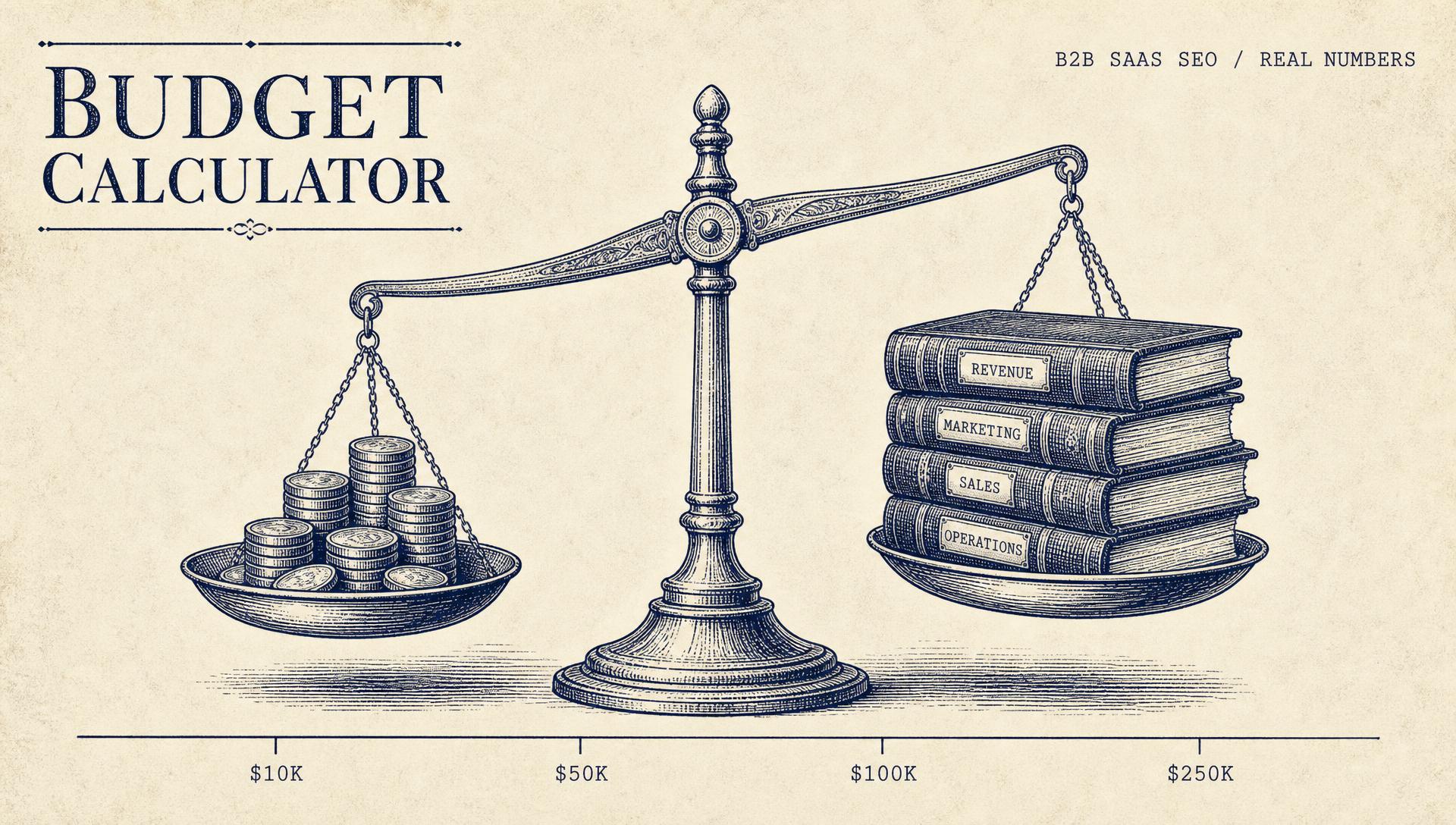
- the SaaS SEO budget calculator , how to size SEO budget by maturity stage.
From other corners of the program
- the content strategy discipline , the cross-cluster discipline that compounds this work.
- the full B2B SaaS content marketing methodology , the upstream pillar this connects to.
When you're ready to put this into a program, book a 30-min call or see the program pricing. Average response time: under 4 business hours.