On this page
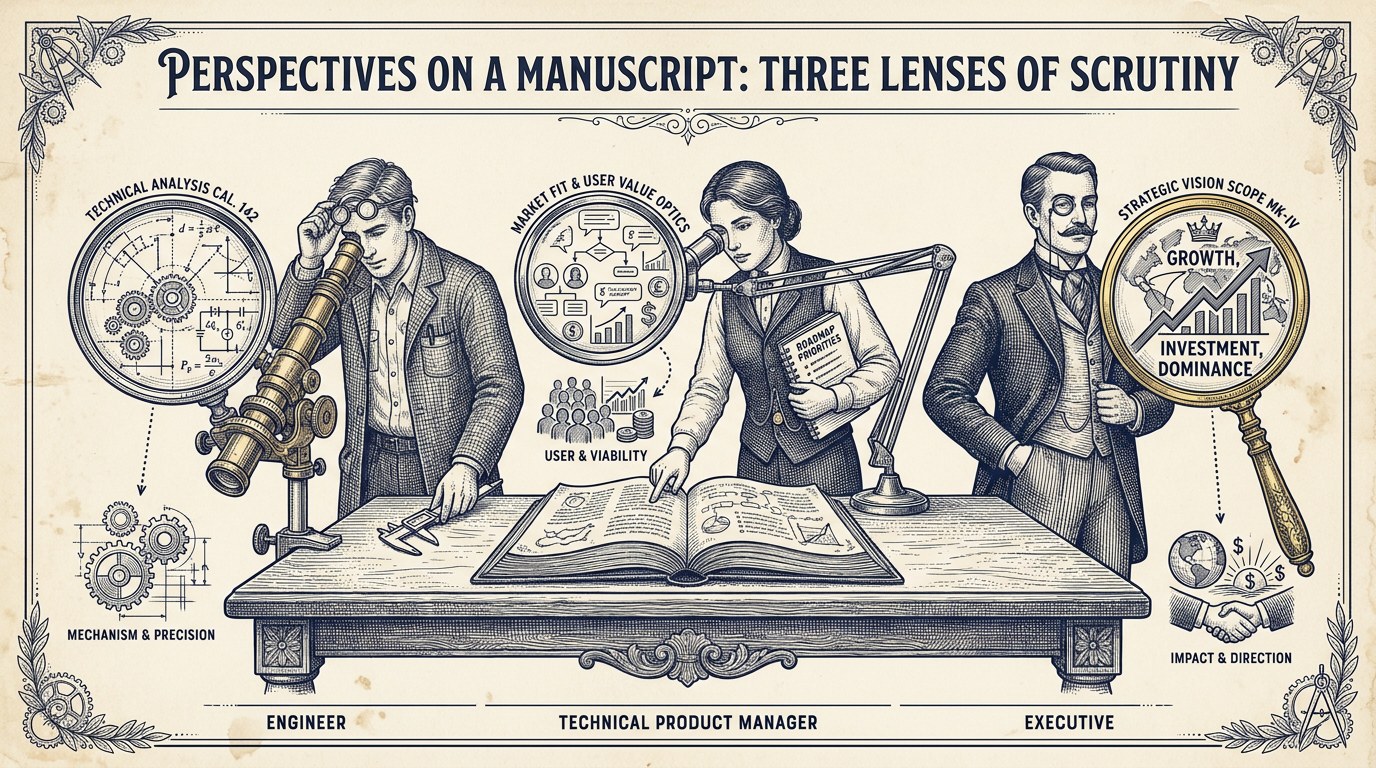
Technical buyers are the audience B2B SaaS content needs to convert, and they are not monolithic. Engineers read for technical accuracy and code-level specificity. Technical product managers read for architectural fit and integration depth. Technical executives read for strategic implications and operating-model impact.
Programs that produce one voice for all three under-perform across the board because the proof points engineers care about are different from what technical PMs care about and different from what technical executives care about. This post covers the three-track voice framework, the voice patterns and proof points each track responds to, the format and channel choices that match each track, and the measurement structure that ties track-specific writing to pipeline outcomes.
01Who B2B SaaS technical buyers actually are
Technical buyers are the audience B2B SaaS content needs to convert, but the term collapses three distinct subtypes that have different reading patterns and different rejection triggers. Programs treating technical buyers as a single audience produce content that serves none of them well.
The three technical-buyer subtypes
The buying committee for B2B SaaS purchases typically includes three technical roles: engineers (who evaluate implementation feasibility), technical product managers (who evaluate architectural and product fit), and technical executives (CTOs, VP Eng, technical-leaning founders, who evaluate strategic and operational impact). Stack Overflow's 2024 Developer Survey documents that 84 percent of developers use technical documentation as their primary learning channel, with 90 percent specifically reading API and SDK package docs. The reading-pattern signal informs the engineer-track voice. This post operates within the content writing sub-pillar at the discipline level.
Why the subtypes matter for voice
The proof points engineers care about (specific APIs, named libraries, code examples) are different from what technical PMs care about (system architecture, integration patterns) and different from what technical executives care about (TCO, risk, organizational readiness). A single voice cannot satisfy all three. The three-track framework integrates with the four-element content writing operator framework by operationalizing Element 2 (technical-buyer voice) for each subtype.
02The three-track voice framework
The framework maps three voice tracks to the three technical-buyer subtypes. Each track has its own voice patterns, proof-point thresholds, and rejection triggers.
The three tracks
The tracks below are listed in order of technical depth. Track 1 sits deepest in the technical stack; Track 3 sits closest to business strategy. Programs should pick the primary track per piece before drafting; secondary tracks get served through specific sections or up-links.
Track 1: engineers
Voice signature: code-level specificity, named libraries and APIs, concrete implementation details, willingness to acknowledge tradeoffs and limitations. Proof-point threshold: every substantive claim needs technical backing the reader could verify themselves. Rejection triggers: marketing-speak, vague benefits framing, missing code or API references where readers would expect them. Reading channel: documentation, engineering blogs, GitHub READMEs.
Track 2: technical product managers
Voice signature: system-level framing, integration patterns, dependency mapping, scenarios across multi-product environments. Proof-point threshold: named architectures, integration case studies, specific stack examples from comparable companies. Rejection triggers: surface-level feature lists without architectural context, claims that ignore integration complexity, generic "scalable" or "flexible" framings. Reading channel: long-form blog posts, architecture deep-dives, conference talks.
Track 3: technical executives
Voice signature: business-impact framing tied to technical specifics, TCO discussions, operating-model implications, named industry patterns. Proof-point threshold: financial data, organizational examples, peer-company patterns, named industry research. Rejection triggers: pure marketing framing without technical depth, technical-only framing without business implications, generic ROI claims without methodology. Reading channel: executive-level long-form, LinkedIn, podcasts, research reports.
03Track 1: writing for engineers
Writing for engineers requires technical accuracy as the primary signal. Voice patterns that work in other tracks (business-impact framing, persona-based emotional appeals) actively erode trust with engineering readers.
Voice patterns that work for engineers
Three voice patterns recur in operator-grade engineer-track content. First, specific code or API references in place of abstract descriptions ("the POST /v1/payment_intents endpoint" not "the payments API"). Second, named libraries with version specifics where versions matter ("React 18.2 with Suspense boundaries" not "modern React"). Third, willingness to acknowledge edge cases and tradeoffs that less rigorous content papers over. GitLab's Handbook documents the operator voice pattern for technical companies; the same patterns apply to engineer-facing content from B2B SaaS programs.
Proof-point integration for engineers
Each engineer-track claim should carry one of four proof types within 1 to 2 sentences: a code snippet, a named library or API reference, a benchmark number with methodology, or a verifiable third-party citation. Programs that batch proofs into a "technical details" sidebar break the integration. The pattern is in-line proof: claim, then immediate technical backing, then implication for the reader.
04Track 2: writing for technical product managers
Writing for technical product managers requires system-level framing that addresses how the product fits into multi-product architectures. Engineer-track content under-serves PMs by missing the integration context; executive-track content under-serves PMs by missing the technical depth.
Voice patterns that work for technical PMs
Three voice patterns recur in operator-grade PM-track content. First, system-level framing with named components ("the event bus between the auth service and the billing service" not "the integration"). Second, integration scenarios with multi-product examples ("when Salesforce, Snowflake, and Segment are all in the stack"). Third, dependency mapping that acknowledges what breaks when which component changes.
Proof-point integration for technical PMs
PM-track claims carry three proof types: named architecture diagrams or descriptions, integration case studies from comparable B2B SaaS companies, and specific stack examples that show how the product fits. Programs producing PM content without named comparable-company examples under-perform because PMs read for "has someone like us solved this" signals. If you want to audit your current technical-buyer content against the three-track framework, book a 30-minute technical-buyer audit with our team.
05Track 3: writing for technical executives
Writing for technical executives requires connecting technical specifics to business and operating-model implications. Pure technical writing under-serves the executive who needs to make a buy-or-build, hire-or-vendor decision; pure business writing under-serves the executive who has technical depth and rejects content that papers over technical reality.
Voice patterns that work for technical executives
Three voice patterns recur in operator-grade executive-track content. First, business-impact framing anchored in technical specifics ("the cost of self-hosting Postgres at 50TB scale: $X in infrastructure, $Y in dedicated headcount, $Z in opportunity cost"). Second, named industry patterns and peer-company examples ("Stripe's pattern of building payment infrastructure in-house versus Notion's pattern of using Plaid"). Third, operating-model implications that explicitly cover the people and process changes a technology decision drives. Gartner's B2B buying journey research documents that 13 content interactions on average occur in B2B buying journeys; executive-track content sits at the higher-stakes end of those interactions.
Proof-point integration for technical executives
Executive-track claims carry four proof types: financial data with methodology, organizational examples from peer companies, named industry research, and operator anecdotes from comparable programs. Programs producing executive content that relies only on industry research (without operator-anecdote specificity) under-perform because technical executives have access to the same industry research and want the operator signal that distinguishes one program's analysis from another's.
06Format and channel patterns by track
Each track responds to different formats and lives on different channels. Programs that produce one piece per topic and push it across all channels under-perform programs that match format to track.
Track-specific formats
Engineer track favors documentation, tutorials with working code, engineering blog posts, GitHub READMEs, and conference talks at technical events. Typical length: 1,500 to 3,000 words for blog posts, longer for technical deep-dives. Technical PM track favors architecture deep-dives, integration guides, and comparison posts that operate at the system level. Typical length: 2,000 to 4,000 words. Executive track favors LinkedIn long-form, podcast guest appearances, research reports, and executive briefings. Typical length: 1,200 to 2,500 words for written; 30 to 60 minutes for spoken.
Track-specific channels
Engineers spend reading time on documentation sites, GitHub, technical newsletters, Stack Overflow, and engineering-focused Slack and Discord communities. Technical PMs spend reading time on long-form content sites, conference talk replays, and product-focused communities. Technical executives spend reading time on LinkedIn, podcasts, research-aggregator sites, and peer-network communities. Distribution effort should match the channel-by-track pattern; pushing engineer content to LinkedIn produces minimal engagement, and pushing executive content to GitHub produces zero engagement.
07Measuring track-specific writing effectiveness
Track-specific measurement separates programs improving on track-fit from programs producing neutralized content. The KPIs that matter operate at the track level and the program level.
Track-specific KPIs
For each track, three KPIs catch most writing-quality issues. Track 1 (engineers): time-on-page over 4 minutes, code-snippet engagement (copy-paste analytics), and inbound traffic from technical communities. Track 2 (technical PMs): time-on-page over 6 minutes, downloads of architecture diagrams or integration guides, scroll-depth to architecture sections. Track 3 (technical executives): LinkedIn engagement rate, executive-account demo requests within 30 days of content publication, sales-call references to specific content pieces.
Program-level patterns
At the program level, the track-balance measurement matters. Healthy track-balance: roughly 40 percent engineer-track, 35 percent PM-track, 25 percent executive-track (varies by ICP). Programs skewed heavily to one track produce excellent results for one subtype and weak results for the others. The integration with the three-tier board SEO scorecard covers program-level reporting on technical-buyer content health.
08Common failures and the one-size-fits-all trap
Three failure patterns account for most underperforming B2B SaaS technical content. Each has a specific corrective discipline.
Three failure patterns
The patterns below appear in roughly 70 percent of B2B SaaS technical-content audits we run. Each shares a root cause (treating technical buyers as a single audience) and a corrective approach.
Failure 1: one-size-fits-all neutralization
The most common failure is producing neutralized content that tries to serve all three tracks at once. The content lands flat with all three audiences because no track gets the specific signal it reads for. The fix is committing to a primary track per piece, with the three-track framework applied as an editorial decision before drafting begins.
Failure 2: engineer-only skew
The reverse failure is producing only engineer-track content because engineering teams typically draft technical content. The program builds engineering brand authority but fails to convert technical PMs and technical executives. The fix is balancing production across the three tracks with explicit editorial-calendar allocation per quarter.
Failure 3: missing the proof-point threshold per track
The third failure is producing track-appropriate voice but missing the proof-point threshold for that track. Engineer-track content with weak code references, PM-track content without named architectures, or executive-track content without financial data all fail at the proof-point step. The fix is brief-level enforcement of the track-specific proof-point requirements before writing starts.
09FAQ
Seven questions covering the topics most commonly searched on writing for technical buyers in B2B SaaS.
Who are the three technical buyer subtypes for B2B SaaS?
The three technical buyer subtypes are: engineers (who evaluate implementation feasibility, read for technical accuracy and code-level specificity), technical product managers (who evaluate architectural and product fit, read for integration patterns and system-level framing), and technical executives including CTOs, VP Eng, and technical-leaning founders (who evaluate strategic and operational impact, read for TCO, risk, and operating-model implications).
What is the three-track voice framework?
The three-track voice framework maps three voice tracks to the three technical-buyer subtypes. Track 1 (engineers): code-level specificity, named libraries and APIs, concrete implementation details. Track 2 (technical PMs): system-level framing, integration patterns, dependency mapping. Track 3 (technical executives): business-impact framing anchored in technical specifics, TCO discussions, operating-model implications.
How do you write content that engineers will read?
Three voice patterns work for engineers. Use specific code or API references in place of abstract descriptions. Name libraries with version specifics where versions matter. Acknowledge edge cases and tradeoffs rather than papering over them. Proof points should sit within 1 to 2 sentences of each claim, drawing from code snippets, named library or API references, benchmark numbers with methodology, or verifiable third-party citations.
What proof points do technical product managers care about?
Technical PMs respond to three proof types: named architecture diagrams or descriptions, integration case studies from comparable B2B SaaS companies, and specific stack examples that show how the product fits. PMs read for "has someone like us solved this" signals, which makes named comparable-company examples the highest-value proof type.
What does executive-track content look like?
Executive-track content connects technical specifics to business and operating-model implications. Voice patterns: business-impact framing anchored in technical specifics, named industry patterns and peer-company examples, operating-model implications that cover the people and process changes a technology decision drives. Proof points: financial data with methodology, organizational examples from peer companies, named industry research, and operator anecdotes from comparable programs.
How should content production balance across the three tracks?
Healthy track-balance varies by ICP but typically lands around 40 percent engineer-track, 35 percent PM-track, 25 percent executive-track. Programs skewed heavily to one track produce excellent results for one subtype and weak results for the others. The fix is explicit editorial-calendar allocation per quarter, with primary-track commitment per piece set as part of the brief design before drafting begins.
What is the one-size-fits-all trap?
The one-size-fits-all trap is the most common failure pattern in B2B SaaS technical content. Programs produce neutralized content that tries to serve all three tracks at once. The content lands flat with all three audiences because no track gets the specific signal it reads for. The fix is committing to a primary track per piece, with secondary tracks served through specific sections or up-links to track-specific siblings.
This is the three-track voice framework under content writing.
The content writing sub-pillar covers the broader playbook, including the four-element operator framework, technical-buyer voice, the writing process, executive ghostwriting, and AI-assisted writing.