On this page
Most B2B SaaS SEO budget conversations end the same way: the agency pitches a vague range, finance asks what it actually buys, and the proposal goes back for another round of revisions. The number was never tied to specific deliverables, a specific stage of company growth, or a specific timeline to pipeline.
This is the budget framework we use at Technotize, with realistic ranges by ARR stage, allocation breakdowns, the agency vs in-house vs hybrid math, the hidden costs nobody mentions, and an interactive calculator that turns three inputs into a number you can defend in a finance review.
01Why SEO budget conversations break down for B2B SaaS
The conversation breaks down at the same moment, every time.
The CMO has decided SEO is the next channel investment. The agency proposes a number. Finance asks the CFO question: "what specifically are we getting for this and when do we recoup it?" The agency answer is some version of "it depends on your goals." Finance sends the proposal back. The CMO loses six weeks rebuilding the case with a less specific deliverable list because the original number had no specific deliverables attached.
This is not bad luck. It is structural. Most SaaS SEO agencies build their pricing without an ARR-stage framework. They quote ranges that cover a 5x spread because they do not have a model that connects budget to outcomes by company size. So the only honest answer they can give is "$5,000 to $25,000 per month, depends on your goals."
The CFO cannot approve a 5x spread. The CFO can approve a specific number tied to specific deliverables tied to a specific timeline.
There are three things that break the budget conversation in B2B SaaS specifically:
The "it depends" hedge
Generic and unfalsifiable. It depends on what? Nobody specifies. The hedge protects the agency from commitment but it sabotages the budget approval process.
Ranges without ARR context
"$5K to $25K per month" assumes the same SEO program produces the same value at $2M ARR and $50M ARR. It does not. The realistic budget at $2M ARR is below $7K per month because the company cannot absorb more SEO output without breaking other parts of the business. The realistic budget at $50M ARR is above $25K per month because the competitive surface is wider and the maintenance burden of an existing program scales.
No deliverable specificity
"Comprehensive SEO services" is not a deliverable. "4 to 6 pieces of cluster content per month, 1 technical audit per quarter, 2 to 4 link building campaigns per quarter, monthly reporting on pipeline contribution" is a deliverable list. Specificity is what gets approved.
The budget framework below commits to specific numbers tied to specific ARR stages tied to specific deliverables. That is the only kind of budget that survives finance review.
02The framework: budget by ARR stage
Four stages. Four budget brackets. Each bracket assumes a hybrid in-house plus agency model, which is the cost-efficient default for most B2B SaaS companies and the model documented in our B2B SaaS SEO strategy playbook.
Foundation stage ($1M to $5M ARR): $3,000 to $7,000 per month
Most B2B SaaS companies start SEO in this stage. The site usually has DR under 25, organic traffic under 1,000 monthly sessions, and limited content infrastructure. The budget at this stage funds roughly 2 to 4 pieces of cluster content per month, basic technical maintenance, light link building, and the tooling required to track everything.
The constraint at Foundation: you cannot compete with DR 70+ enterprise sites on head terms yet, so the budget optimizes for low-competition long-tail commercial intent (comparison content, migration content, integration pages). Programs that try to spend Acceleration-stage budgets at Foundation produce content faster than the company can absorb, which breaks the production system. Programs that spend below Foundation tier ($1,500 per month and below) produce so little content that the cluster architecture takes 24+ months to compound.
Acceleration stage ($5M to $20M ARR): $7,000 to $15,000 per month
The cluster strategy starts working. The site reaches DR 30 to 50, organic traffic crosses 5,000 to 15,000 monthly sessions, and content production scales to 4 to 6 pieces per month. The budget at this stage funds the full hybrid model: an in-house content lead, a contracted writing team, dedicated technical SEO work, programmatic content infrastructure, and active link building.
The Acceleration budget is the inflection point. Programs that hit this stage with the right structure produce meaningful pipeline by month 14 to 18. Programs that get the structure wrong (most commonly: too much budget allocated to content velocity without the editorial discipline to maintain quality) hit the same DR ceiling for 12 months.
Compounding stage ($20M to $50M ARR): $15,000 to $30,000 per month
Programmatic content scales. Comparison and migration content proliferates. International SEO becomes meaningful for many B2B SaaS categories. The site reaches DR 50 to 70 and the cluster architecture has accumulated topical authority that compounds across new content. Production scales to 6 to 10 pieces per month plus programmatic page directories with hundreds of variants.
The Compounding budget funds: a dedicated SEO function (in-house lead plus 2 to 4 contracted writers), a senior technical SEO contributor, dedicated digital PR, programmatic infrastructure engineering, and increasingly sophisticated measurement and attribution.
Authority stage ($50M+ ARR): $30,000 to $80,000+ per month
The defensive moat. Brand search dominates. The site has DR 70+ and the cluster architecture is the category reference. Most of the budget at this stage goes to defending the position: refresh cycles, AI Search visibility, link defense, technical maintenance at scale, international expansion.
Authority-stage budgets are not about producing more content. They are about keeping the existing content the highest-ranking content as the SERP shifts and competitors invest. A B2B SaaS company at $100M ARR spending $30K per month on SEO is under-investing for the category position. The same company at $20M ARR would be massively over-investing.
The math behind these brackets: each bracket assumes content production at a quality level that produces ranking and converting content (real briefs, real SMEs, real editorial review), link investment proportional to the competitive surface at that stage, and technical maintenance that prevents the work from compounding into authority loss over time. The numbers assume hybrid model. Pure agency runs at the higher end of each range. Pure in-house runs at 1.5x to 2x of each range due to FTE costs we cover in chapter 5.
03The budget calculator
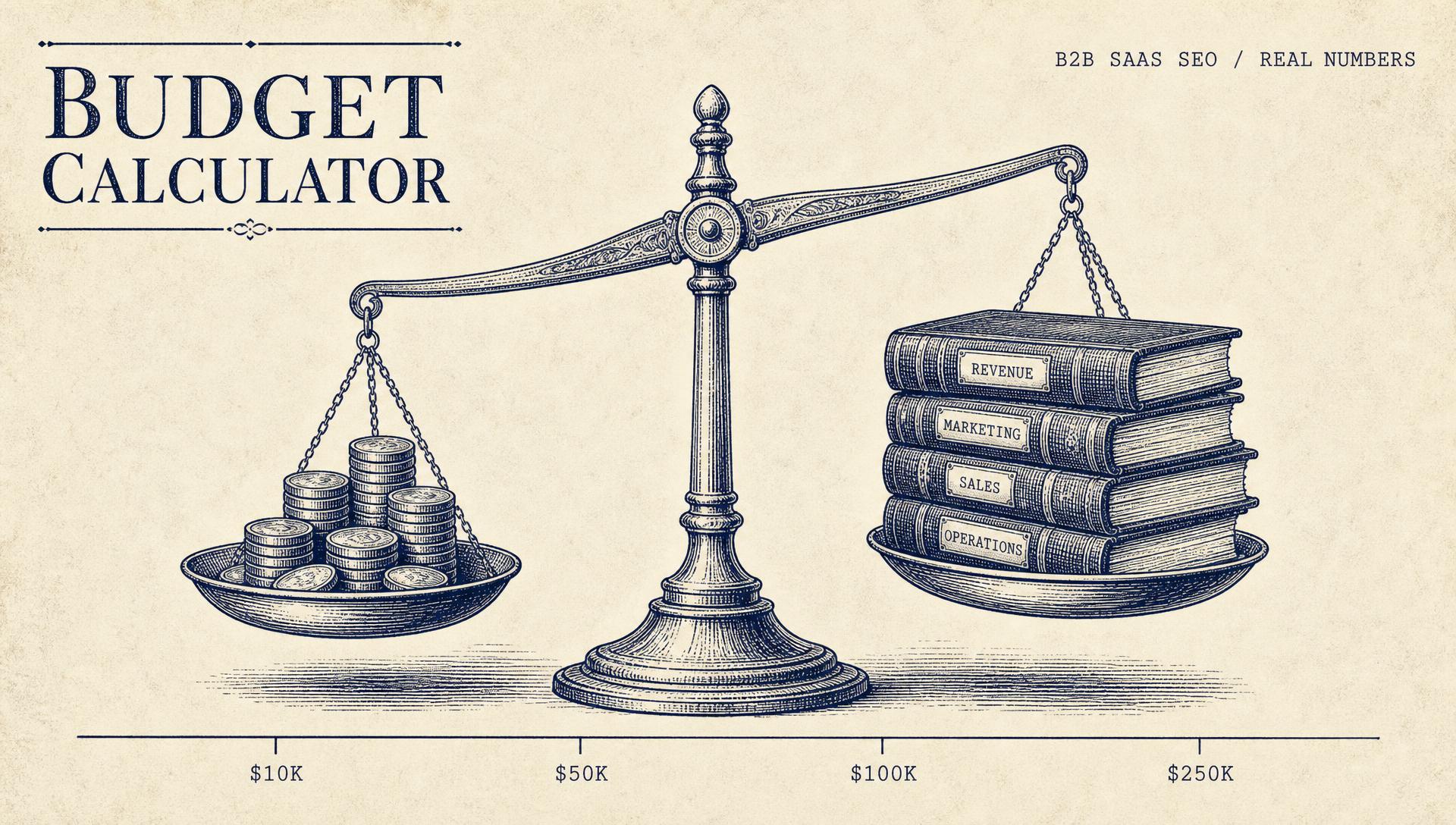
The calculator takes three inputs (ARR stage, current DR, primary goal) and produces a specific budget recommendation, allocation breakdown, and timeline to predictable pipeline. The output is the number you can take into a finance review.
What the calculator does not do: replace the strategic decision of whether SEO is the right channel for your company at this moment. We cover that question in the strategy playbook. The budget calculator assumes you have already decided to invest in SEO and need to commit to the right number.
04Allocation: where the budget actually goes
Total budget is the question agencies talk about. Allocation is the question that determines whether the budget produces pipeline.
The default allocation we use for most B2B SaaS programs:
Content production: 45 to 55 percent
Writers (in-house and contracted), editorial review, SME interviews, design and visual asset production, content management. The single largest line item because content is the leverage point that produces rankings. Programs that under-allocate here (below 40 percent) produce content scarcity that collapses the cluster architecture.
Links and digital PR: 20 to 30 percent
Outreach, content syndication, podcast appearances, industry research and reports, guest posting in relevant publications, broken link reclamation. Programs that under-allocate here (below 15 percent) produce content that ranks slower than it should because the authority signal is weak.
Technical SEO and audits: 10 to 15 percent
Quarterly audits, technical fixes, schema deployment, Core Web Vitals work, migration support, JavaScript rendering verification, sitemap and robots.txt maintenance. Programs that under-allocate here see content production hit a ceiling that no amount of content can break through.
Tool stack: 5 to 10 percent
Ahrefs or SEMrush ($300 to $1,000 per month), Screaming Frog ($200 per year), Surfer SEO or Frase ($200 per month), GSC and GA4 (free), HubSpot or attribution tooling, AI tools, content management. Most programs underestimate this category by 3 to 5x because they forget the recurring cost of the full tool stack.
The allocation shifts by stage. Three patterns:
Foundation stage runs heavier on content (60 percent) because technical surface area is small and link investment has lower marginal return at low DR. Tool stack stays at 10 percent because the basic stack is the same regardless of company size. Links drop to 15 percent because there is less to amplify.
Acceleration stage runs the standard allocation (50/25/15/10) because all four categories produce comparable marginal returns at this stage. This is the stage where allocation discipline matters most.
Compounding stage shifts toward links (30 percent) because the existing cluster needs reinforcement to compete with newer competitors. Technical stays at 15 percent. Content drops to 45 percent because content velocity has saturated the cluster's absorption capacity.
Authority stage shifts toward technical (20 percent) because the site complexity demands it and toward tools (15 percent) because the measurement requirements scale. Content drops to 40 percent because most spend goes to refresh and defense rather than new production.
The three most common allocation mistakes we see:
- Over-allocating to content. Programs at 70+ percent content allocation produce volume that nobody links to. Without the link allocation to amplify the content, the rankings ceiling at DR 35 to 45 holds for years.
- Under-allocating to technical. Programs at under 8 percent technical allocation accumulate technical debt that erases content gains. Crawl budget waste, broken internal linking, schema gaps, and Core Web Vitals failures compound.
- Treating tools as overhead. Programs that try to run on $200 per month of tools miss data, misallocate effort, and cannot prove pipeline contribution. The tool stack is the measurement substrate. Underfund it and the program cannot defend itself in finance review.
05Agency vs in-house vs hybrid: the cost math
The total cost of an SEO program is rarely the agency invoice. The realistic cost includes the agency invoice plus the in-house team time plus the tool stack plus the management overhead. The model you choose determines how that cost distributes.
Pure in-house cost (annual, B2B SaaS at Series B)
- Senior content writer or content lead: $80,000 to $130,000 base, plus 25 to 30 percent fully-loaded cost (benefits, equipment, software, management overhead). Effective annual cost: $100,000 to $170,000.
- Senior SEO specialist: $90,000 to $140,000 base, fully-loaded effective: $115,000 to $180,000.
- Technical SEO contractor or part-time hire: $20,000 to $60,000 per year for ongoing audit and fix work.
- Tool stack: $1,500 to $3,000 per month, $18,000 to $36,000 per year.
- Management overhead (CMO time, designer time): 15 to 20 percent of total, roughly $40,000 to $90,000 effective.
Total in-house cost: $293,000 to $536,000 per year for a basic team that produces 4 to 6 pieces per month.
That is the same output a $7,000 to $15,000 per month agency produces. Annual agency cost: $84,000 to $180,000. The pure in-house model costs roughly 3x the pure agency model for equivalent output at most B2B SaaS company sizes.
Why companies still go in-house. Brand voice control, faster iteration on edits, deeper product knowledge integration, longer-term institutional knowledge, the ability to retain key writers as the company scales. These benefits are real and legitimate. They just cost meaningfully more, which is the trade.
Hybrid model (annual, the most common Technotize engagement structure)
- One in-house content lead: $80,000 to $120,000 fully-loaded effective: $100,000 to $155,000.
- Agency execution: $5,000 to $15,000 per month, $60,000 to $180,000 per year.
- Reduced tool stack (agency provides most): $500 to $1,500 per month, $6,000 to $18,000 per year.
- Reduced management overhead: 10 to 15 percent of total, roughly $20,000 to $50,000 effective.
Total hybrid cost: $186,000 to $403,000 per year for output equivalent to or better than the pure in-house team.
The hybrid model produces more content (the agency adds capacity) at a lower total cost than pure in-house. The in-house lead handles brand voice, product knowledge integration, and final editorial decisions. The agency handles production capacity, tooling, technical SEO depth, link building, and the operational discipline that small in-house teams struggle to maintain.
Breakeven analysis. Below $20M ARR, hybrid wins on cost basis. Between $20M and $50M ARR, hybrid still wins on cost but pure in-house becomes more competitive on speed and integration. Above $50M ARR, pure in-house starts winning on total cost and integration depth. Below $5M ARR, pure agency wins because hiring an in-house content lead requires a steady-state pipeline that Foundation-stage companies do not yet have.
For deeper analysis of when each model fits, see our strategy playbook chapter on in-house vs agency vs hybrid.
06The hidden costs nobody mentions
The line items that are not in the agency proposal but show up in the actual spend.
Tool stack at scale
The basic tool budget ($500 to $1,500 per month) covers Ahrefs or SEMrush plus Screaming Frog. The realistic tool budget for an Acceleration or Compounding stage company is $2,000 to $8,000 per month. Add: Surfer SEO or Frase or Clearscope for content optimization ($200 to $400 per month). Add: Otter or Fathom or Fireflies for SME interview transcription ($200 per month for team plans). Add: a content management platform like Trello or Notion or Airtable ($100 to $500 per month). Add: GSC and GA4 (free) plus HubSpot or attribution tooling ($800 to $3,200 per month for the marketing tier most B2B SaaS companies actually need). Add: AI tools (Claude, ChatGPT Team, etc.) for $200 to $800 per month. Most teams underestimate this category by 3 to 5x in the first year.
Internal time
CMO time on content review and approval: 4 to 8 hours per week. Product team time on SME interviews and accuracy reviews: 2 to 4 hours per week. Founder or executive time on bylined thought leadership: 1 to 3 hours per week. Across these categories, roughly 8 to 15 hours per week of internal time, which at typical B2B SaaS salary levels equates to $30,000 to $80,000 per year of opportunity cost. Not a cash expense, but real.
Content review and approval cycles
Each piece of content typically goes through 3 to 5 reviewers (writer, editor, SME, marketing reviewer, optionally legal). Total review time per piece: 8 to 15 hours across reviewers. At an average loaded cost of $80 per hour, that is $640 to $1,200 of internal time per published piece, often invisible in the agency budget but very real.
Migration and platform costs
B2B SaaS sites get rebuilt every 18 to 36 months on average. WordPress to Webflow, Webflow to Framer, Framer to Lovable, custom Next.js builds. Each migration is a high-risk technical SEO event that costs $20,000 to $80,000 in engineering plus consulting plus opportunity cost from temporary ranking instability. Programs that do not budget for migrations are surprised when they happen, every time. (Detailed migration playbook in B2B SaaS website migrations without ranking loss.)
Legal review for regulated categories
Healthcare SaaS, financial SaaS, legal tech, security tools, and HR tech often need legal or compliance review before publishing content with claims. This adds 15 to 25 percent to content production cost and 1 to 3 weeks to the publishing timeline per piece. Programs in regulated categories that do not budget for this are continually behind schedule.
The sum of these hidden costs typically adds 40 to 80 percent to the apparent agency or in-house cost. The smart move is to budget for them upfront. The dumb move is to discover them in month 4 when the program has already underestimated total spend by half.
07What you get at each budget tier
Specific deliverables at specific monthly spend. No hedging.
$3,000 to $7,000 per month (Foundation tier)
- 2 to 4 pieces of cluster content per month at 2,000 to 3,000 words each
- One quarterly technical SEO audit
- Light link building (1 to 2 successful placements per quarter via outreach)
- Basic schema deployment and maintenance
- Monthly reporting on rankings, traffic, and pipeline contribution
- Tool stack provisioning (Ahrefs or SEMrush, Screaming Frog, basic content tools)
Realistic outcome over 12 months. Site reaches DR 25 to 35 from a starting point of DR 8 to 18. Organic traffic 1,000 to 4,000 monthly sessions. 5 to 15 monthly MQLs from organic by month 12 to 14. Defensible pipeline contribution by month 14 to 18.
$7,000 to $15,000 per month (Acceleration tier)
- 4 to 6 pieces of cluster content per month
- Programmatic content infrastructure (integration pages, location pages, comparison pages at scale)
- Real link building (3 to 6 successful placements per quarter, including digital PR and HARO-equivalent work)
- Quarterly technical audits plus rolling technical fixes
- Schema deployment, refresh cycles, internal linking discipline
- Monthly reporting on pipeline contribution per cluster, per content type
- Refresh and audit work on existing content (kicks in at month 9 to 12)
Realistic outcome over 12 months. Site reaches DR 35 to 55. Organic traffic 5,000 to 15,000 monthly sessions. 30 to 80 monthly MQLs from organic by month 12 to 14. Pipeline contribution becomes a primary marketing channel.
$15,000 to $30,000 per month (Compounding tier)
- 6 to 10 pieces of cluster content per month plus programmatic page directories
- Multi-cluster simultaneous builds (typically 2 to 4 active clusters)
- Sustained link building (8 to 15 successful placements per quarter, including original research-driven PR)
- Dedicated technical SEO maintenance with response time under 48 hours
- International SEO expansion (hreflang, localized content) where applicable
- AI Search visibility work (llms.txt, structured data optimization, content formatting for AI extraction)
- Comprehensive measurement and attribution
- Refresh and retire cycles every 6 months
Realistic outcome over 12 months. Site reaches DR 55 to 70. Organic traffic 15,000 to 50,000 monthly sessions. 80 to 200 monthly MQLs from organic. Pipeline contribution between 30 and 50 percent of total inbound demand.
$30,000+ per month (Authority tier)
- 10+ pieces per month plus full programmatic infrastructure
- Multi-cluster builds (4 to 8 active clusters)
- Industry-defining original research (1 to 2 per year)
- Brand defense via continuous SERP monitoring and response
- AI Search dedicated work
- Multiple regions and languages
- Dedicated technical SEO with response time under 12 hours
- Quarterly executive reviews with measurement against business objectives
Realistic outcome over 12 months. Site stays at or above DR 70. Organic traffic 50,000+ monthly sessions. 200+ monthly MQLs. SEO is the largest single inbound channel.
The agencies promising more deliverables at each tier are lying or planning to under-deliver. The agencies promising less are either inefficient or hiding margin. These ranges are what realistic, well-run programs produce.
08What Technotize charges and why
Three tiers, each mapped to the framework above.
Starter: $5,000 per month
Foundation stage companies. Includes 3 to 4 pieces of cluster content per month, quarterly technical audits, basic link building, monthly reporting. Suitable for B2B SaaS companies between $1M and $5M ARR with founders or marketing leads who can dedicate 2 to 4 hours per week to SME interviews and editorial review.
Growth: $10,000 per month
Acceleration stage companies. Includes 5 to 6 pieces per month, programmatic content infrastructure, sustained link building, monthly technical audits, comprehensive reporting on pipeline attribution. Suitable for B2B SaaS companies between $5M and $20M ARR with an in-house content lead or marketing director who can own brand voice and final editorial decisions.
Enterprise: $25,000+ per month
Compounding and Authority stage companies. Custom-scoped to specific cluster targets, multi-region content production, dedicated technical SEO retainer, original research production, AI Search visibility work. Suitable for B2B SaaS companies above $20M ARR with established marketing functions and clear pipeline attribution requirements.
What is included across all tiers: senior operator strategy, real SME-driven content (no AI-only output), real editorial review, dedicated account leadership, monthly reporting tied to pipeline, quarterly strategic reviews, and the content strategy playbook execution discipline.
What is not included: paid media (we do not run PPC), website redesign or rebuild work (we partner with specialist firms), customer success or sales work, generic content marketing for non-pipeline goals.
Where we are not the right fit: B2B SaaS companies below $1M ARR (the program economics do not work), companies in categories with under 30-day buying cycles (SEO is not the right channel), companies that need pipeline contribution within 6 months (the channel takes 12 to 18 months to produce defensible ROI), founders who want a generic "marketing agency" rather than a specialist SEO partner. We turn down roughly one in three prospect calls for these reasons. Honest mismatches save everyone time.
09FAQ
The following frequently asked questions address common concerns about B2B SaaS SEO budgets. We cover budget sufficiency at various ARR levels, international SEO pricing, and realistic ROI timelines.
Is $5,000 per month enough for a B2B SaaS company at $3M ARR?
At $3M ARR, $5,000 per month sits at the upper end of the realistic Foundation budget. It funds 3 to 4 pieces of cluster content per month, basic technical maintenance, and light link building. The constraint is not budget at this stage. The constraint is the company's ability to absorb content output without breaking SME interview cadence. Most $3M ARR companies do well at $4,000 to $6,000 per month.
How does pricing change for international or multi-language SEO?
Add 30 to 60 percent on top of the base budget per additional language for content translation, localization review, and link building in the target market. A program at $10,000 per month for English would scale to roughly $13,000 to $16,000 per month for English plus German, depending on the German content depth required.
What is the realistic ROI timeline at each budget tier?
Foundation: 12 to 18 months to defensible pipeline contribution. Acceleration: 9 to 14 months. Compounding: 6 to 10 months for incremental work because the cluster architecture is already producing. Authority: continuous, with refresh cycles producing ROI within 30 to 60 days of refresh.
Should we negotiate the agency budget down to save money?
Negotiating budget without negotiating scope is the most common mistake. Either reduce the deliverable count (3 pieces per month instead of 4, for example) at a proportionally lower price, or commit to the full budget for the full deliverable list. Discounted rates with full deliverables produce burnt-out agency teams and quality drift within 3 to 6 months.
What if our company does not have an in-house counterpart yet?
The hybrid model assumes one in-house lead. Without it, programs default to pure agency, which adds 20 to 30 percent to the effective cost (because the agency has to do internal coordination work that the in-house lead would otherwise handle). The right move at most stages is to hire the in-house lead first, then engage the agency.
Do these budgets include paid distribution or PR?
No. The budgets above are purely organic SEO and content. Paid distribution (boosted LinkedIn posts, sponsored newsletter placements, paid syndication) is a separate line item that typically adds $2,000 to $10,000 per month for B2B SaaS at Acceleration stage and above.
This article is one piece of the strategy cluster. The full B2B SaaS SEO strategy playbook covers the four-stage maturity model, in-house versus agency decisions, realistic timelines, and what predicts program success.
Read the full strategy playbook →Where this fits in the broader playbook
This piece sits inside the strategy sub-pillar covering audience-first SEO, which is one chapter of the strategic framework for SaaS-specific SEO. For deeper framing on the same discipline, see our B2B SaaS SEO strategy framework.
Closely related reading from the same sub-pillar
- the maturity model that scopes spend , the maturity stages each budget tier maps to.
- the in-house vs outsourced decision , the team-structure call that changes budget composition.
- the SEO/PPC budget split , how to split this budget between organic and paid.
From other corners of the program
- how we build assets that earn links , the cross-cluster discipline that compounds this work.
- the comprehensive link building reference , the upstream pillar this connects to.
When you're ready to put this into a program, set up a working session or review program pricing tiers. Average response time: under 4 business hours.