On this page
Single-page applications (SPAs) deliver smooth, app-like experiences by loading content dynamically with JavaScript. For B2B SaaS products built on React, Vue, Angular, or Svelte, this is the default architecture. The trade-off is search visibility. Google's crawlers handle JavaScript, but the process is slow and prone to gaps. AI Search engines (ChatGPT, Perplexity, Gemini) often skip JavaScript execution entirely.
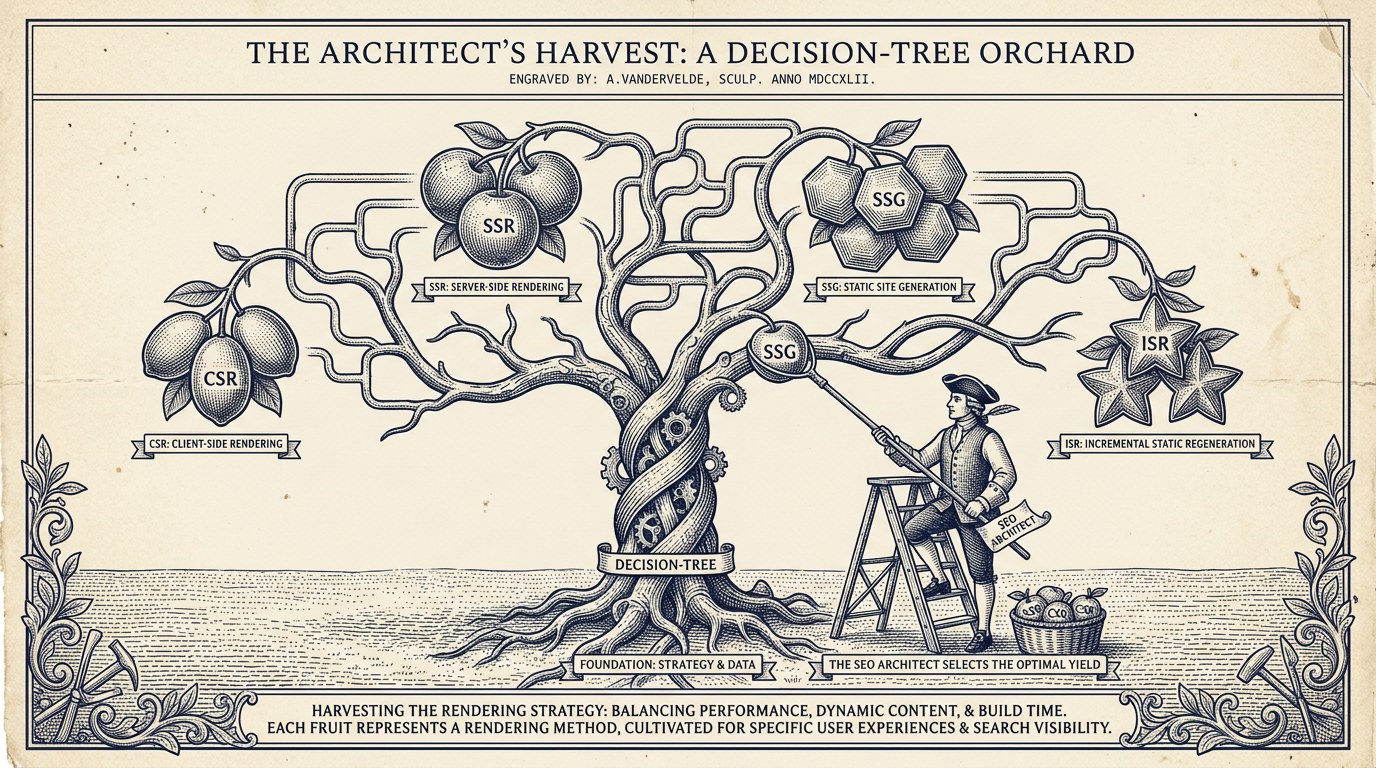
The result: B2B SaaS programs that built their marketing site on the same SPA framework as their product app often discover that their content is not being indexed, or is indexed without the on-page details that determine ranking. This post covers the four rendering strategies (CSR, SSR, SSG, ISR), the decision tree for choosing between them, and the B2B SaaS-specific patterns we see most often. The output is a decision framework a CMO can take to engineering to align rendering strategy with SEO outcomes.
01What single-page application SEO actually is for B2B SaaS
Single-page application SEO is the practice of making JavaScript-rendered web applications discoverable and rankable in search engines. The challenge is that traditional SEO assumes HTML content is present when crawlers arrive. SPAs render content dynamically with JavaScript, which means crawlers must execute code to see what users see.
What SPA SEO actually means
A single-page application is a web app that loads one HTML shell and uses JavaScript to update the content as users navigate. React, Vue, Angular, and Svelte are the dominant SPA frameworks. The architecture produces smooth user experiences but creates indexing problems because Google's JavaScript indexing is slower, less reliable, and more resource-intensive than HTML indexing.
For B2B SaaS programs, the question is not whether SPAs are bad for SEO, but which rendering strategy produces SEO outcomes that match pipeline goals. This post operates within the B2B SaaS technical SEO sub-pillar at the discipline level.
Why B2B SaaS products are particularly affected
B2B SaaS programs ship marketing sites and product apps. The product app legitimately benefits from SPA architecture (smooth interactions, app-like experiences). The marketing site rarely does. When B2B SaaS engineering teams default to a single framework for both, they often choose what works for the product, then discover the marketing site cannot rank. The cost is invisible until 6 to 12 months after launch when the SEO program fails to produce pipeline.
02The four rendering strategies: CSR, SSR, SSG, ISR
Four rendering strategies dominate B2B SaaS in 2026. Each produces a different SEO outcome and fits a different use case. Programs that match the strategy to the content surface produce SEO outcomes that compound. Programs that pick a default and apply it everywhere produce mixed results.
The four rendering strategies in 2026
CSR (Client-Side Rendering)
The browser receives an empty HTML shell and renders content with JavaScript. This is the default React, Vue, and Angular behavior without additional configuration. CSR fits authenticated product apps where SEO does not matter. CSR fails for marketing sites because crawlers must execute JavaScript to see content, which delays or prevents indexing.
SSR (Server-Side Rendering)
The server renders the page for every request and sends complete HTML to the browser. Google's Web.dev guide on rendering documents that SSR produces the strongest SEO outcomes because crawlers receive fully-rendered HTML at request time. SSR fits sites with frequently-changing content (dashboards, news, e-commerce with dynamic inventory). The trade-off is higher server cost and slower Time to First Byte for cold requests.
SSG (Static Site Generation)
The build process renders every page once and outputs static HTML files. The CMS or content source updates trigger a rebuild. SSG fits B2B SaaS marketing sites where the content changes weekly or monthly, not per-request. Next.js, Astro, Nuxt, and Gatsby are the dominant SSG frameworks. SSG produces the fastest page loads (HTML served from CDN) and the cleanest SEO outcomes because crawlers receive complete HTML instantly.
ISR (Incremental Static Regeneration)
A hybrid that generates pages statically, then updates them in the background as new data comes in. ISR fits B2B SaaS sites with mostly-static content but occasional dynamic sections (blog posts that surface real-time stats, comparison pages that pull current pricing). Next.js pioneered ISR; most modern SSG frameworks now support it.
03How Google indexes JavaScript in 2026
Google's JavaScript indexing has improved substantially since 2018 but still operates differently from HTML indexing. Understanding the two-wave model determines whether a B2B SaaS program's content gets indexed quickly or sits in queue for weeks.
Google's two-wave indexing model
Wave 1 crawls the initial HTML response. If content is present in HTML, Google indexes it immediately. Wave 2 returns later to execute JavaScript and capture the rendered content. The delay between waves typically runs 24 hours to several weeks depending on crawl budget and page priority. For B2B SaaS marketing sites on CSR-only architecture, this delay is the difference between content that ranks quickly and content that never reaches its potential.
When JavaScript rendering fails to surface content
JavaScript indexing fails in three common cases. First, JavaScript errors that prevent the page from rendering for the crawler (the page works in browsers but throws errors in Googlebot's rendering environment). Second, content loaded after user interaction (clicks, scrolls, hovers) that crawlers do not trigger. Third, content blocked by robots.txt or noindex tags applied to the JavaScript bundle. Google's JavaScript SEO documentation covers debugging via the URL Inspection tool in Search Console.
04The AI Search and agentic crawler dimension
AI Search engines and agentic crawlers handle SPAs differently than Google. The differences matter for B2B SaaS programs targeting AI Search citation share, which is a growing share of B2B buyer discovery in 2026.
Why AI crawlers handle JavaScript differently
AI crawlers (used by ChatGPT's training pipeline, Perplexity's retrieval system, Gemini's grounding) prioritize speed and breadth over depth. Many do not execute JavaScript at all. The Nuxt SEO team documents this clearly: in 2026, SPAs must serve content as HTML at the initial request because AI crawlers often skip JavaScript execution entirely. CSR-only marketing sites are effectively invisible to AI Search.
What this means for B2B SaaS SPA programs
Any page intended to rank in Google or be cited by AI Search engines must serve content in the initial HTML response. SSR, SSG, or ISR all meet this requirement. CSR does not. Programs that ignored this in 2023 and 2024 are now discovering that their content surfaces in Google (after Wave 2 indexing) but never appears in AI Search citations because the AI crawlers never see it. The fix is migrating the rendering strategy or implementing prerendering, both of which compound in cost the longer they wait. If you want to walk through which of your content surfaces are CSR-only and which need migration, book a 30-minute SPA SEO audit with our team.
05URL structure, meta tags, and per-route SEO
Beyond rendering, three on-page elements determine whether SPA routes can rank: URLs, meta tags, and structured data. Each must be unique per route. SPAs that share these across routes rank for nothing.
Per-route URL patterns
Each meaningful page must have a unique URL with a meaningful path. Fragment-based routing (/#/about) is no longer recommended; History API routing (/about) is the standard. The path should be descriptive (/integrations/salesforce not /page?id=8675309). The URL is the primary signal Google uses to associate a route with a topic.
Dynamic meta tag management
In an SPA, the title tag and meta description must be updated dynamically for each route. React Helmet, Vue Meta, and Next.js Head handle this. Without dynamic meta management, every route shares the meta tags from the initial HTML, which means SERP snippets look identical and Google has no per-route signal to differentiate routes. Per-route schema.org markup (Article, Product, FAQ, BreadcrumbList) reinforces the signal.
06Core Web Vitals on SPA architectures
Core Web Vitals (LCP, INP, CLS) affect SPA ranking the same way they affect any site, but SPAs have specific patterns that affect performance. The hydration cost is the most common culprit.
The hydration cost
Hydration is the process where the SPA framework attaches JavaScript event handlers to the rendered HTML after page load. Even on SSR or SSG pages, hydration runs in the browser and can block interactivity for 500ms to several seconds on lower-end devices. Google's Web.dev guidance on INP optimization shows hydration as one of the most common INP failures on React-based sites.
Measuring SPA Core Web Vitals
Use real-user monitoring (CrUX, Web Vitals report in Search Console, Cloudflare RUM) rather than synthetic tests for SPAs. Synthetic tests run on cold cache and overstate the problem. Real-user data captures the variation across devices, networks, and cache states that determine actual ranking signals. Programs that optimize against synthetic data often spend effort on issues that real users do not experience.
07B2B SaaS-specific SPA patterns and decisions
The rendering-strategy decision is shaped by the B2B SaaS architecture pattern. Three patterns dominate the portfolio. Each maps to a different rendering strategy choice.
Three B2B SaaS SPA patterns we see most often
Pattern 1: Marketing site SPA, product app SPA
The team built both the marketing site and the product app on React with CSR. SEO failed on the marketing site. Fix: migrate the marketing site to SSG (Next.js or Astro) while leaving the product app as CSR. The marketing site rebuilds when content changes; the product app continues to serve logged-in users via CSR. This is the most common high-performing pattern for B2B SaaS at DR 30 to 60. The fix typically requires 4 to 8 weeks of engineering work and recovers within 2 to 4 months of indexing.
Pattern 2: Hybrid marketing site, isolated product SPA
Marketing site is server-rendered (WordPress, Webflow, Sanity-headless), product app is React SPA on app.domain.com. This is the cleanest architecture. SEO works for the marketing site by default; the product app does not affect SEO. Most issues in this pattern come from marketing pages that drift into the product app subdomain by accident.
Pattern 3: Fully separated marketing and product
Marketing site on one framework, product on another, no shared code. Each can be optimized for its purpose. This is the most flexible but requires the engineering team to maintain two stacks. The pattern works for B2B SaaS programs with 30+ engineers. Smaller teams typically benefit more from Pattern 2.
The pattern integrates with the API documentation SEO framework for developer-focused B2B SaaS on the docs surface.
08Common failures and the wait-and-see trap
Three failure patterns account for most underperforming B2B SaaS SPA SEO programs. Each has a specific corrective discipline.
Three failure patterns
Failure 1: the wait-and-see trap
The most damaging failure is launching a CSR marketing site and assuming Google will figure it out. Six months later, indexing is partial, rankings are flat, AI Search citations are zero. Recovery requires migration to SSR/SSG or significant prerendering work. The cost of preventing this at launch (1 to 2 weeks of architecture discussion) is 5 to 10 percent of the cost of fixing it after.
Failure 2: choosing rendering strategy without auditing surfaces
The team picks SSR or SSG based on framework preference rather than content surface analysis. The result is SSR on routes that change weekly (wasted server cost) or SSG on routes with real-time data (stale content). The fix is auditing each content surface (marketing pages, blog, docs, integration pages, comparison pages) and matching the rendering strategy to the update cadence.
Failure 3: ignoring the AI crawler dimension
The team optimizes for Google's JavaScript rendering and ignores AI crawlers entirely. Google indexes the content via Wave 2, but AI Search engines never see it because they skip JavaScript. The program's pipeline from AI Search citation stays at zero while competitors with SSR/SSG-based architectures earn citation share. The fix is treating the AI crawler dimension as a first-class requirement, not an afterthought.
09FAQ
Is a single-page application bad for SEO?
Not inherently. The issue is the default Client-Side Rendering (CSR) configuration of most SPA frameworks. CSR-only sites surface to Google's crawlers as empty HTML shells, which delays or prevents indexing. SPAs configured with Server-Side Rendering (SSR), Static Site Generation (SSG), or Incremental Static Regeneration (ISR) produce HTML that crawlers can read directly and rank normally. For B2B SaaS marketing sites, SSG (via Next.js, Astro, or Nuxt) is the most common high-performing configuration.
What are the four rendering strategies for SPAs?
The four strategies are: CSR (Client-Side Rendering) where the browser renders content with JavaScript; SSR (Server-Side Rendering) where the server renders HTML for each request; SSG (Static Site Generation) where the build process pre-renders every page as static HTML; and ISR (Incremental Static Regeneration) which combines SSG with background updates as data changes. CSR fits authenticated product apps where SEO does not matter. SSR, SSG, and ISR all produce SEO-friendly HTML and fit different update cadences.
How does Google index JavaScript in 2026?
Google uses a two-wave indexing model. Wave 1 crawls the initial HTML response and indexes content present in HTML immediately. Wave 2 returns later to execute JavaScript and capture rendered content. The delay between waves typically runs 24 hours to several weeks depending on crawl budget and page priority. For CSR-only marketing sites, the Wave 2 delay is the difference between content that ranks quickly and content that never reaches its potential. SSR, SSG, and ISR eliminate the delay by serving rendered HTML in Wave 1.
Do AI Search engines like ChatGPT index JavaScript content?
Often no. AI crawlers used by ChatGPT, Perplexity, Gemini, and agentic crawlers prioritize speed and breadth over depth. Many do not execute JavaScript at all. Any page intended to be cited by AI Search engines must serve content in the initial HTML response, which means SSR, SSG, or ISR. CSR-only marketing sites are effectively invisible to AI Search in 2026, which is a growing source of B2B SaaS buyer discovery.
Should my B2B SaaS marketing site use the same framework as the product app?
Usually no. The most common high-performing B2B SaaS pattern separates the two: SSG marketing site (Next.js, Astro, or Nuxt) connected to a CSR product app on a subdomain or path. The marketing site serves SEO and AI Search citation; the product app serves logged-in users where SEO does not matter. This separation eliminates roughly 80 percent of B2B SaaS SPA SEO problems and gives both surfaces the architecture that fits their purpose.
What about React Helmet, Vue Meta, and Next.js Head?
These libraries handle dynamic meta tag management in SPAs. Each route can update the title tag, meta description, canonical URL, and Open Graph tags independently. Without these libraries, every SPA route shares the meta tags from the initial HTML, which means SERP snippets look identical across routes and Google has no per-route signal to differentiate them. Per-route meta management is non-negotiable for any SPA that needs to rank.
How long does SPA SEO recovery take after migration?
Recovery typically runs 2 to 4 months after migration from CSR to SSR/SSG/ISR. Google must re-crawl the affected routes, process the new HTML responses, and consolidate the ranking signals. Indexing usually completes within 30 to 60 days. Ranking impact appears 60 to 120 days post-migration. Programs that migrate without rebuilding internal linking simultaneously often see slower recovery because the ranking signals stay split between old and new architecture.
Part of the technical SEO playbook
This is the single-page application rendering decision tree under technical SEO.
The technical SEO sub-pillar covers the broader operator framework for B2B SaaS technical SEO including indexing, crawl budget, schema, and rendering.
Read the technical SEO sub-pillar →