On this page
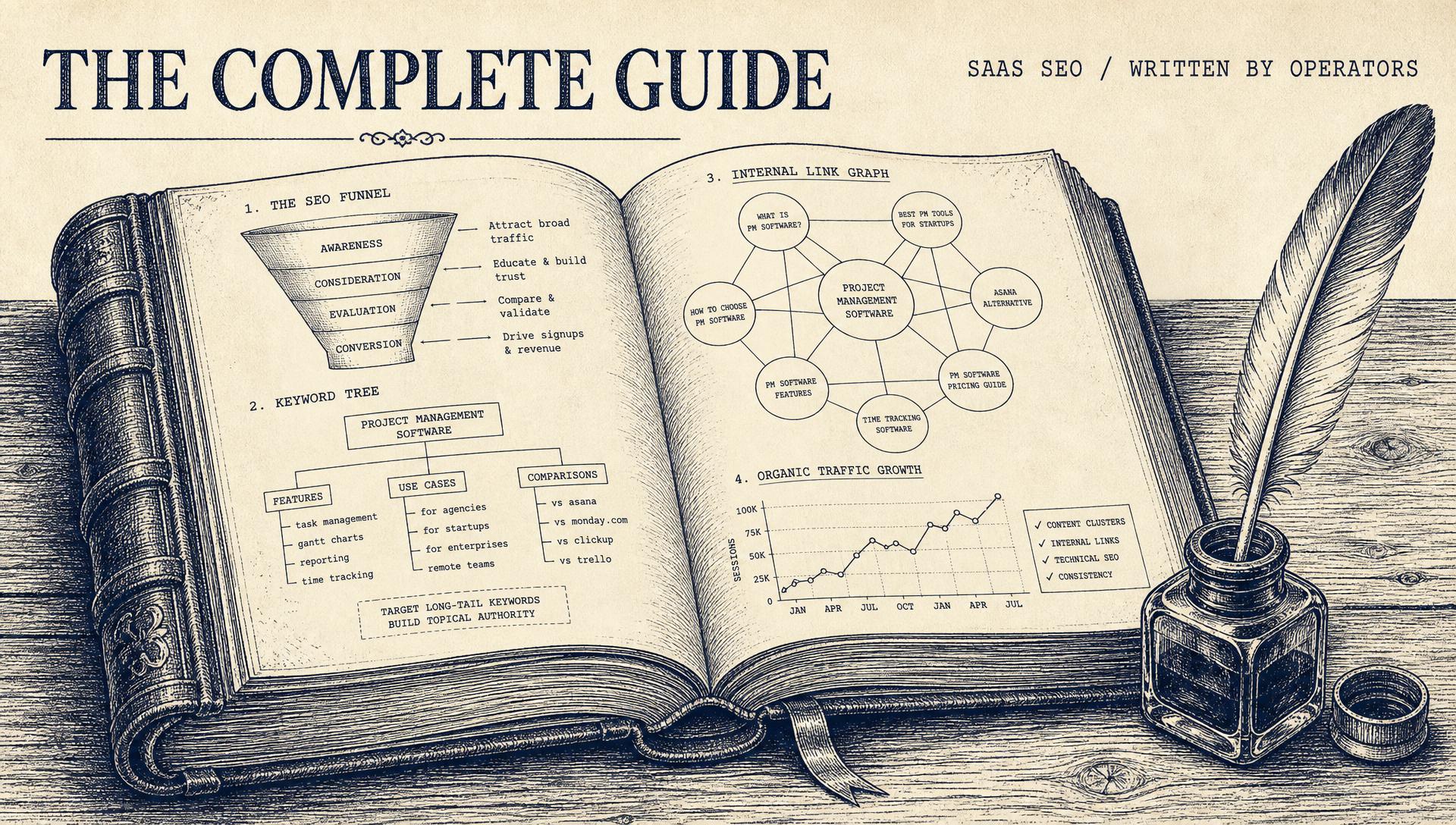
Most B2B SaaS keyword research stops at volume. The program picks the highest-volume terms in the category, builds content for them, and waits. Six months later, the rankings exist but the pipeline does not. The problem is that high-volume keywords usually have high competition and unclear intent, and the traffic they produce rarely matches the program's actual buyers.
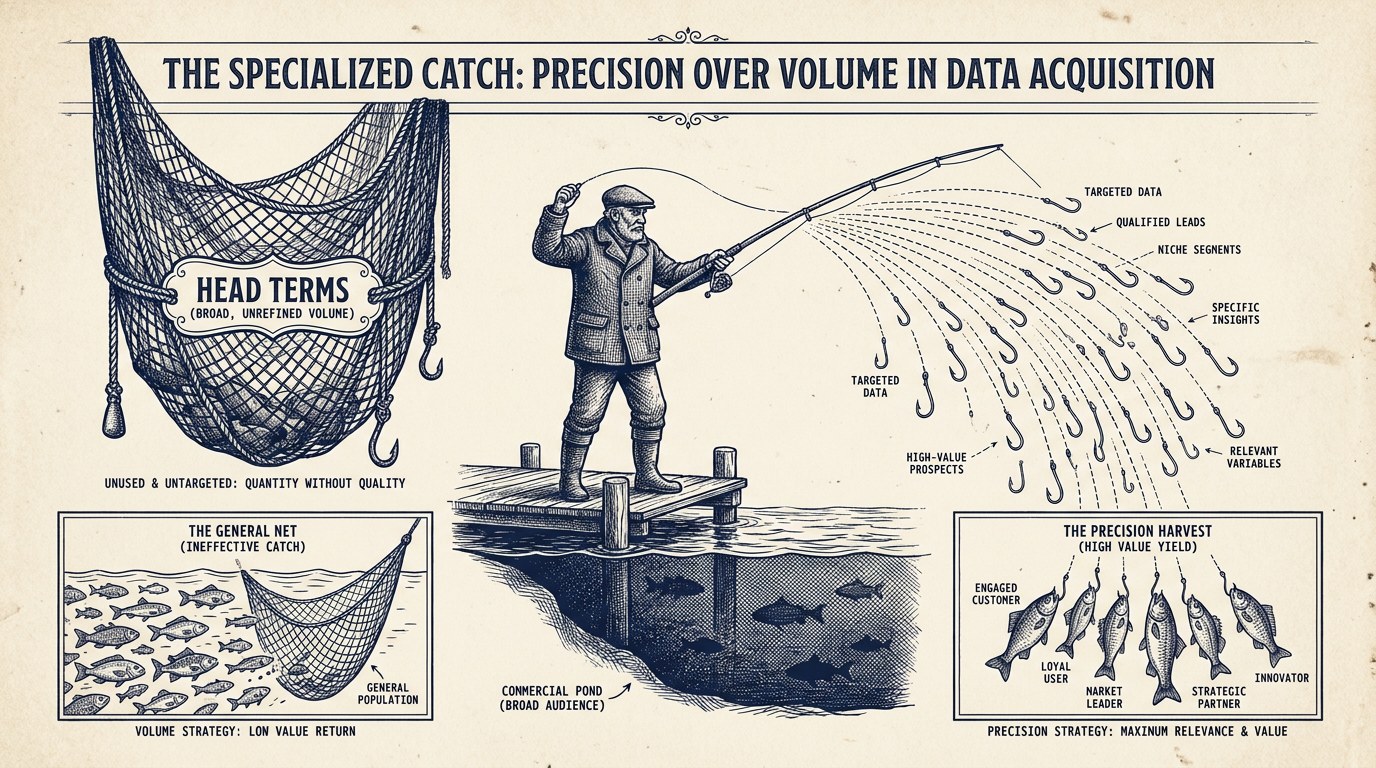
Long-tail and low-competition keywords work the opposite way. Smaller volume, sharper intent, faster ranking trajectory, and conversion rates that often exceed head-term traffic by 5 to 15 times for B2B SaaS programs. This post covers the four categories of long-tail keywords that consistently produce pipeline, the SERP qualification framework that separates winnable terms from time-wasters, and the sources keyword tools miss.
01What low-competition keywords are and why they matter for B2B SaaS
Low-competition keywords are search terms where the existing top-ranking content is weak enough that a well-produced post on a moderately authoritative site can rank within 90 to 180 days. For B2B SaaS programs operating between DR 30 and DR 70, low-competition keywords are not just an optimization tactic. They are the primary path to organic pipeline because the head terms in most B2B SaaS categories are dominated by HubSpot, Salesforce, G2, and Wikipedia.
What low-competition keywords actually are
A keyword qualifies as low-competition under three conditions. First, Keyword Difficulty (KD) under 30 in Ahrefs or Semrush. Second, top-ranking content with DR below 60 on at least two of the top 5 results. Third, SERP intent that is mixed or unclear, signaling that no dominant authority owns the term. Hitting all three is the strongest indicator. Hitting two of three is usually enough for a B2B SaaS program with strong content to compete.
This post operates within the keyword research sub-pillar covering discovery methodology for B2B SaaS programs at the discipline level. The foundational methodology lives in the keyword research operator framework for B2B SaaS programs which this post extends with the long-tail and low-competition specifics.
Why B2B SaaS sites win disproportionately on low-competition terms
B2B SaaS audiences are smaller and more specific than consumer audiences. A keyword that registers 100 monthly searches in Ahrefs may have an actual audience of 300 to 500 monthly searchers because the tool undersamples niche B2B terms. The discrepancy works in favor of B2B SaaS programs that pursue these keywords seriously. Powered by Search documents this pattern in their B2B SaaS keyword research methodology: ranking for terms with 500 monthly searches often produces more pipeline than ranking for terms with 5,000 monthly searches because the buyer intent on smaller-volume terms is sharper.
The competitive dynamics reinforce the opportunity. Sites that rank top 10 for high-volume keywords (HubSpot, Salesforce, G2) typically ignore long-tail terms because the volume does not justify their content production cost. That gap is the opening for smaller B2B SaaS programs to claim the long-tail systematically.
02Long-tail vs short-tail: the volume-intent trade-off
The classic head-term-versus-long-tail framing comes from Chris Anderson's 2006 book on the long tail of distribution. Applied to B2B SaaS keyword research, the principle is straightforward: head terms have volume and competition, long-tail terms have specificity and conversion. The question for any program is which side of the trade-off matches its current stage and authority.
The volume-intent inversion
High-volume keywords tend to attract searchers in early research mode. "What is project management" produces awareness traffic. Low-volume keywords tend to attract searchers in late evaluation mode. "Asana vs Monday for engineering teams of 50" produces evaluation traffic. The conversion rate inversion is dramatic: long-tail evaluation traffic typically converts to trial or demo at 4 to 12 percent. Head-term awareness traffic typically converts at 0.2 to 0.8 percent. The math favors long-tail for any B2B SaaS program optimizing for pipeline rather than volume.
Why high-volume keywords mislead B2B SaaS programs
High-volume keywords mislead because the audience composition is wrong. A 10,000-volume keyword like "marketing automation software" pulls traffic from students researching for assignments, journalists writing roundups, and prospects in the awareness stage with no near-term buying intent. The same keyword pulls B2B SaaS buyers, but they represent 5 to 15 percent of the total traffic. A 500-volume keyword like "marketing automation for B2B SaaS with under 50 employees" pulls almost exclusively B2B SaaS buyers with active evaluation intent. The 500-volume keyword produces fewer sessions but better sessions. Ahrefs' research on long-tail keywords documents that the long tail accounts for the majority of search demand even though no individual long-tail term shows high volume.
03The four B2B SaaS long-tail categories that produce pipeline
Across the B2B SaaS engagements we have run, four long-tail categories consistently produce most of the organic pipeline. Programs that cover all four categories rank for hundreds of terms with cumulative buyer intent. Programs that cover only one or two miss the majority of the available pipeline.
The four categories share a structural property: they are unambiguously commercial. Searchers using these terms are not researching abstractly. They are evaluating tools or actively comparing options. Each category warrants dedicated content production, and each maps to a different stage of the B2B SaaS buyer journey.
Category 1: Integration keywords
Integration keywords follow the pattern [your tool] + [their tool] integration. Examples: "Salesforce HubSpot integration," "Slack Asana integration," "Zapier Notion integration." The searcher is already using one tool and is evaluating whether your tool plays well with their existing stack. This is purchase-adjacent intent at scale.
A B2B SaaS product with 50 named integrations can produce 50 to 150 integration pages, each targeting 2 to 5 keywords. The total addressable volume across these pages typically exceeds the head terms by a wide margin.
Category 2: Comparison and alternative keywords
Comparison keywords follow patterns like [competitor] vs [competitor], [competitor] alternatives, or best [category] for [persona]. These pages are read by buyers in active evaluation. Conversion rates on well-built comparison content typically run 6 to 12 percent for B2B SaaS, which is 10 to 30 times higher than top-of-funnel blog content. The catch is that comparison pages must be honest. Programs that produce one-sided comparisons lose credibility quickly. Programs that produce balanced comparisons earn buyer trust and demo bookings.
Category 3: Use-case-by-persona keywords
Use-case-by-persona keywords combine a product category with a buyer persona or industry. Examples: "CRM for solo founders," "project management software for marketing agencies," "accounting software for SaaS startups." These terms have low volume individually but compound when a program produces 30 to 80 of them across its key personas. The conversion advantage is high because the searcher has self-qualified by including the persona in the query.
Category 4: Problem-aware long-tail
Problem-aware long-tail keywords are searchers expressing a specific pain point that your product solves. Examples: "how to track time across multiple client projects without timesheets," "how to keep customer feedback from Slack and email in one place." These terms often show zero volume in tools because the phrasing is too specific to register. They convert exceptionally well when the content rings true to the experience. Customer support tickets and sales call recordings are the best sources for discovering these terms. If you want help mapping these four categories to your specific product, book a 30-minute keyword opportunity audit with our team.
04Zero-search-volume keywords: the misunderstood opportunity
Zero-search-volume keywords are the most underweighted opportunity in B2B SaaS keyword research because most programs read the volume metric literally. Tools that report 0 monthly searches do not always mean zero actual searches. A page that ranks for one zero-volume term often picks up dozens of close variants, and the tool counts each of them on its own.
What zero-search-volume actually means
Keyword tools build search volume estimates by sampling clickstream data and search engine data. The sampling works well at scale (terms with 1,000+ monthly searches) and gets noisier at low volume. When Ahrefs checked its own zero- and low-volume rankings against Search Console, most keywords got about the searches the tool predicted. The pages that beat the estimate did it by ranking for many long-tail variants of a bigger topic. So the opportunity is rarely one hidden term. It is the cluster of buyer phrasings around it, which the tools report one at a time.
When zero-volume keywords are worth the effort
Zero-volume keywords are worth pursuing when three conditions are met. First, the term reflects genuine buyer language captured from sales calls, support tickets, or customer interviews. Second, the SERP exists (Google returns results when you search the term) and is weak. Third, the term maps to a real product capability you can describe with depth. Hitting all three suggests the term has actual but undersampled volume and that ranking will produce qualified traffic. Programs that ship 20 to 50 zero-volume posts per year typically discover that 30 to 50 percent of them earn meaningful traffic after 12 to 18 months.
05The SERP qualification framework: go or skip
Before producing content for any keyword, run the SERP qualification framework. Five signals tell you whether a B2B SaaS site under DR 60 has a realistic chance of ranking. Programs that qualify every target keyword against the framework ship faster, waste less production capacity, and rank more often.
Signal 1: Top result DR under 50
If the top 1 or 2 results have DR under 50, the keyword is winnable for a program at DR 30 to 60. Domain authority is the strongest single predictor of ranking, and SERPs without high-DR dominance are open. Programs that hit this signal typically rank within 60 to 120 days with quality content.
Signal 2: SERP shows mixed intent
If the top 10 contains a mix of forums, listicles, product pages, and tutorials, the SERP is unsettled. Google has not decided what intent the term serves. Programs that produce content matching the dominant buyer intent often rank quickly because they resolve the SERP ambiguity. Mixed-intent SERPs are the most common ranking opportunity in B2B SaaS.
Signal 3: Forum or Q&A content in top 10
Reddit, Quora, or Stack Exchange content in the top 5 signals that Google could not find authoritative editorial content for the term. The audience is searching, but the content that exists is community-generated. A well-produced editorial piece from a B2B SaaS site usually outranks forum content within 90 to 180 days because Google prefers authoritative editorial content when it exists.
Signal 4: Outdated top-ranking content
If the top-ranking content is older than 2 years and has not been substantially updated, the SERP is vulnerable. Backlinko's CTR research documents that freshness signals matter to Google in roughly 30 to 40 percent of queries. Outdated top-ranking content is an open invitation for fresh content with the same depth.
Signal 5: No B2B SaaS-specific result in top 10
If the top 10 contains only generic content (no B2B SaaS-specific operator perspective), the SaaS-qualified angle is open. Many low-competition terms qualify under this signal because the term is generic enough that nobody has produced the B2B-SaaS-specific version. This is the most common winnable pattern for operator-grade B2B SaaS content.
06Building the keyword list: sources tools miss
The most valuable B2B SaaS keywords never appear in Ahrefs or Semrush because the audience is too small for clickstream tools to track. Building a complete keyword list requires combining tool data with operator sources that capture buyer language directly.
Sources keyword tools miss
The four operator sources that consistently surface high-value B2B SaaS keywords are sales call transcripts (Gong, Chorus, Fathom), customer support tickets and chat logs, third-party review sites (G2, Capterra, TrustRadius), and community channels (Reddit, Slack groups, LinkedIn). The Powered by Search team frames this as the audit step that most B2B SaaS programs skip: "We sometimes find that ranking for search terms with a monthly search volume of 500 can be more profitable than terms with a monthly volume of 5,000" specifically because the lower-volume terms came from these operator sources.
Operator sources for B2B SaaS keyword discovery
Sales call transcripts produce phrases buyers use to describe their problem before knowing your category exists. Customer support tickets surface problems your existing customers articulate in their own language. G2 and Capterra reviews on competitor products reveal the gaps buyers experience with alternatives. Reddit threads in the target persona's community show how buyers research before involving sales. Combine 50 to 200 source items across these channels and you discover 30 to 100 high-intent terms per category that competitors are not targeting.
07Mapping keywords to content and conversion
Discovering the keywords is half the work. Mapping each keyword to the right content type and conversion path is the other half. Programs that ship content without a mapping discipline produce posts that rank but do not convert.
Mapping keywords to buyer journey stage
Each keyword maps to one of three stages: problem-aware (the buyer knows they have a problem, not the category), solution-aware (the buyer knows the category, not the specific tools), or product-aware (the buyer is evaluating named tools). Problem-aware keywords map to educational long-form content with soft CTAs. Solution-aware keywords map to category comparison pages with product mentions. Product-aware keywords map to comparison pages, alternative pages, and integration pages with direct trial or demo CTAs.
Content type by keyword category
Integration keywords map to dedicated integration pages with technical depth (200 to 500 words) and primary trial CTAs. Comparison keywords map to balanced 2,500 to 4,000 word comparison content with both products treated fairly. Use-case-by-persona keywords map to landing pages with persona-specific case studies and social proof. Problem-aware long-tail maps to blog content with sub-CTAs to relevant product pages. The pattern integrates with the broader B2B SaaS SEO measurement framework that operates on the same quarterly cadence for tracking which keyword categories produce the highest pipeline yield.
08Common failures and the volume-first trap
Three failure patterns account for most underperforming B2B SaaS keyword strategies. Each one has a specific corrective discipline. The chapter also addresses the volume-first trap, which is the single most damaging pattern in B2B SaaS keyword research.
Failure 1: chasing volume over intent
The most damaging failure is sorting keyword lists by volume and targeting the top 50. The output is content that competes head-to-head with HubSpot, Salesforce, and the major category players. The competitive math does not work. The fix is sorting by KD ascending, qualifying every target by SERP signals, and producing the long-tail systematically.
Failure 2: writing for keywords instead of buyers
The second failure is writing content optimized for the keyword rather than the buyer behind the keyword. The result is content that ranks but reads like SEO filler, with low engagement, low conversion, and increasingly poor ranking trajectories as Google's quality signals catch up. The fix is starting every post with the buyer's question in their own language, then optimizing the answer for ranking.
Failure 3: ignoring SERP qualification
The third failure is shipping content for keywords without running the SERP qualification framework. The result is content that targets keywords where the SERP is locked (high-DR dominance, no openings) and the content never ranks despite good production. The fix is the five-signal SERP qualification as a release gate before any keyword enters the content production queue.
09FAQ
What are low-competition keywords in SEO?
Low-competition keywords are search terms where the existing top-ranking content is weak enough that a well-produced post on a moderately authoritative site can rank within 90 to 180 days. The qualifying conditions are Keyword Difficulty (KD) under 30, top-ranking content with Domain Rating (DR) below 60 on at least two of the top 5 results, and SERP intent that is mixed or unclear.
What is the difference between long-tail and short-tail keywords?
Short-tail keywords are 1 to 2 word phrases with high volume and high competition. Long-tail keywords are 3 or more word phrases with lower volume and lower competition. The trade-off is volume versus specificity. Short-tail produces awareness traffic with low conversion. Long-tail produces evaluation traffic with conversion rates 5 to 15 times higher for B2B SaaS programs.
Are zero-search-volume keywords worth targeting?
Yes, when three conditions are met. The term reflects genuine buyer language captured from sales calls, support tickets, or customer interviews. The SERP exists and is weak. The term maps to a real product capability with depth. Keyword tools systematically undersample volume for terms with audiences under 1,000 monthly searchers worldwide, which means zero-volume terms often have 30 to 100 actual monthly searches.
What are the four B2B SaaS long-tail keyword categories?
The four categories that consistently produce pipeline are: integration keywords, comparison and alternative keywords, use-case-by-persona keywords, and problem-aware long-tail. Programs that cover all four categories generate 60 to 80 percent of organic pipeline from these terms.
How do I qualify whether a keyword is worth targeting?
Run the five-signal SERP qualification framework before producing content. Signal 1: top result DR under 50. Signal 2: SERP shows mixed intent. Signal 3: forum or Q&A content in top 10. Signal 4: outdated top-ranking content. Signal 5: no B2B SaaS-specific result in top 10. Targets that hit 2 or more signals are typically winnable in 90 to 180 days for B2B SaaS programs at DR 30 to 60.
Where do I find B2B SaaS keywords that keyword tools miss?
Four operator sources consistently surface high-value B2B SaaS keywords: sales call transcripts from Gong, Chorus, or Fathom, customer support tickets and chat logs, third-party review sites like G2 and Capterra (especially competitor reviews), and community channels including Reddit, Slack groups, and LinkedIn. Combining 50 to 200 source items across these channels discovers 30 to 100 high-intent terms per category.
Why do volume-first keyword strategies fail for B2B SaaS?
Volume-first strategies fail because high-volume keywords have audience compositions that do not match B2B SaaS buyer profiles. A 10,000-volume keyword like "marketing automation software" pulls traffic from students, journalists, and prospects in early awareness with no near-term buying intent. B2B SaaS buyers represent only 5 to 15 percent of that traffic. A 500-volume keyword targeting a specific persona pulls almost exclusively B2B SaaS buyers with active evaluation intent.
Part of the keyword research playbook
This is the long-tail keyword operator playbook under keyword research.
The foundational keyword research methodology, the four-source framework, and how each connects to the broader B2B SaaS SEO program lives on the parent sub-pillar.