On this page
Log file analysis surfaces what every other technical SEO tool cannot: how search engine and AI crawler bots actually behave on your site, which URLs they hit, which they ignore, which return errors, and how their behavior changes as you ship technical fixes. Crawl emulators like Screaming Frog and Sitebulb tell you what Google could crawl. Log files tell you what Google did crawl, in what order, and at what frequency.
The signal difference matters for B2B SaaS programs because SaaS architectures produce crawl waste patterns that emulators rarely catch. Staging environments leak into production indexes. Multi-tenant subdomain structures distribute crawl unevenly. Parameter explosion from filters and faceted navigation eats crawl budget on pages no buyer searches for. And as of 2025 and 2026, AI crawlers (GPTBot, ClaudeBot, PerplexityBot, Google-Extended) introduced a new measurement category that logs are the only reliable source for.
This is the operator playbook for B2B SaaS log analysis. The signals that matter. The tools that surface them. The workflow that turns raw log files into 90-day technical SEO decisions.
01What log file analysis is and what it shows that crawl emulators cannot
Log file analysis is the systematic process of examining server access logs to understand how search engine bots, AI crawlers, and other automated visitors actually behave on a site. The discipline matters because logs record ground truth: every request the server received, with timestamp, user agent, requesting IP, URL, status code, and response size. Every other technical SEO tool produces inferences from a different vantage point. The sections below establish the working definition for B2B SaaS programs, name the specific signal categories logs surface that crawl emulators cannot, and explain why the discipline became more valuable in 2025 and 2026 than it was in 2022.
A working definition for B2B SaaS programs
Log file analysis for B2B SaaS SEO is the systematic discipline of extracting server access logs from production hosting infrastructure, parsing the logs into structured fields, segmenting the traffic by bot identity and URL template, and interpreting the resulting patterns to identify crawl waste, indexing coverage gaps, and AI crawler behavior. The output drives technical SEO decisions about which pages to deprioritize through robots.txt, which to redirect, which to noindex, which to surface more prominently through internal linking, and which to monitor for AI crawler coverage gaps that affect AI Search citation infrastructure.
The discipline is differentiated from crawl emulator analysis (Screaming Frog, Sitebulb, JetOctopus crawl mode) because emulators produce what a bot could crawl if given the chance, while logs produce what bots actually did crawl over a defined time window. The two are complementary. Crawl emulators surface site structure and on-page signals. Logs surface bot behavior against that structure. Programs running only one of the two miss critical signal categories. The implementation operates within the broader technical SEO sub-pillar for B2B SaaS programs at the discipline level and connects to the complete B2B SaaS SEO playbook at the pillar level.
What logs surface that Screaming Frog and Sitebulb cannot
Crawl emulators simulate how a bot would crawl a site by starting from a seed URL or sitemap and following internal links. They produce inventory of crawlable pages, status codes for those pages, on-page signals, internal linking maps, and detected technical issues. They cannot show actual crawl frequency, which URLs Googlebot ignored despite being crawlable, how often pages are recrawled, the time-of-day distribution of bot activity, or how AI crawler behavior differs from Googlebot behavior. These signal categories matter for B2B SaaS programs because they directly inform crawl budget allocation decisions and AI Search measurement infrastructure.
Logs surface seven specific signal categories that crawl emulators cannot. First, actual crawl frequency by URL pattern: how many times Googlebot hit each template over 30 days. Second, status code distribution by template, which often differs from what emulators report because production conditions (rate limiting, geo-routing, A/B test variants, feature flags) produce different responses to bots than to emulator IPs. Third, bot identity verification through reverse DNS, which only logs can support. Fourth, time-of-day bot activity patterns that reveal whether crawl budget concentrates in periods that overlap with deployment windows. Fifth, AI crawler segmentation by user agent. Sixth, crawl waste indicators specific to dynamically generated URLs that emulators rarely surface. Seventh, the temporal relationship between content publication and first bot discovery, which informs internal linking and sitemap submission strategy.
Why log analysis became more valuable in 2025 and 2026
Two changes elevated log analysis from a technical SEO niche discipline to core measurement infrastructure between 2024 and 2026. The first was the rise of AI crawlers as a distinct traffic category. GPTBot launched in August 2023. ClaudeBot launched in late 2023. PerplexityBot followed. Google-Extended (the AI-specific crawler) launched in October 2023. OAI-SearchBot (OpenAI's search-specific crawler) launched in late 2024. By 2025 and 2026, AI crawlers collectively account for 4 to 18 percent of bot traffic on B2B SaaS sites, with significant variation by content category. Logs are the only data source that segments this traffic reliably. GA4 and Search Console cannot. The second change was the increased complexity of B2B SaaS architectures (multi-tenant subdomain structures, microfrontend deployments, edge rendering, AI-assisted feature explosions) that produce more dynamic URLs and more potential crawl waste than the architectures common in 2018 through 2022.
02The signals that matter for B2B SaaS sites specifically
Log file analysis produces dozens of potential signals. Most of them are noise for B2B SaaS programs. The signals that drive technical SEO decisions cluster into four categories: crawl frequency by URL pattern, status code distribution by template, bot identity verification, and crawl waste indicators specific to SaaS architectures. The sections below cover each category with the specific signals to extract, the patterns that indicate problems, and the decision rules for acting on findings.
Crawl frequency by URL pattern
Crawl frequency by URL pattern is the foundational signal. Group every log line by URL template (using URL pattern matching: /blog/*, /customers/*, /integrations/*, /pricing, etc.) and count Googlebot hits per pattern over the analysis window. The output is a frequency table showing which templates Google prioritizes and which it deprioritizes. Healthy B2B SaaS programs concentrate Googlebot activity on commercial-intent templates (/pricing, /customers/*, /integrations/*, /solutions/*) at 30 to 60 percent of total crawl, with the blog at 20 to 40 percent and remaining templates at 10 to 30 percent combined.
Patterns that indicate problems: Googlebot spends over 50 percent of crawl budget on the blog with under 15 percent on commercial-intent pages (common in early-stage programs that lean on content marketing without commercial-intent SEO infrastructure). Googlebot spends significant crawl on URLs that should not be crawled (faceted navigation parameters, internal search results, session-tagged URLs). Googlebot has near-zero activity on entire templates (a sign of orphaned content or robots.txt misconfiguration). Each pattern has a specific corrective action covered in Chapter 07.
Status code distribution by template
Status code distribution by template surfaces what crawl emulators miss because production responds to bots differently than emulators. Group every log line by URL template and HTTP status code. Compute the distribution: what percentage of crawls per template returned 200, 301, 302, 304, 403, 404, 410, 500, 503. Healthy templates show over 92 percent 200s and 304s combined, under 5 percent redirects, and under 3 percent error codes.
Patterns that indicate problems: a template with over 10 percent 404s often signals internal linking pointing to deleted pages, or stale sitemaps, or scraper-induced false URLs entering the index. A template with over 15 percent 503s signals rate limiting or server resource constraints affecting bot access during peak periods. A template with over 8 percent 301s often signals an incomplete migration where old URLs still get crawled. The distribution patterns drive prioritized fix lists for the technical SEO team.
Bot identity verification and spoofing detection
User-agent strings are not sufficient for bot identity verification. Scrapers routinely impersonate Googlebot, AhrefsBot, and AI crawlers to evade rate limiting or to gather competitive intelligence. Programs that trust user-agent strings without verification overcount legitimate bot activity by 15 to 35 percent. The correction requires reverse DNS lookup against the requesting IP and forward-DNS confirmation. Google publishes the verification procedure: reverse DNS should resolve to a googlebot.com or google.com hostname, and forward DNS from that hostname should resolve back to the same IP. The same pattern applies to AI crawlers (openai.com, anthropic.com, perplexity.ai).
Operationally, bot verification runs as a batch process during log parsing. For B2B SaaS programs at scale, the verification step typically removes 12 to 25 percent of log lines that claim to be Googlebot but fail DNS verification. The remaining verified Googlebot lines form the basis for all subsequent analysis. Programs that skip verification produce reports that overstate crawl coverage and miss the spoofing activity itself, which sometimes indicates scraper attempts that the security team needs to address.
Crawl waste indicators specific to SaaS architectures
Crawl waste indicators for B2B SaaS architectures are distinct from the patterns commonly documented for e-commerce or news sites. The four most common patterns are: staging or preview environment URLs leaking into production indexes (signal: Googlebot hits on staging.example.com, preview.example.com, or feature-branch.example.com subdomains); multi-tenant subdomain crawl imbalance (signal: Googlebot crawls customer-specific subdomains that should be noindexed); parameter explosion from filters and faceted navigation (signal: many crawled URLs share a base path but differ only in query parameters); and soft 404s from API endpoints rendered as pages (signal: API URLs returning 200 status with empty or near-empty content bodies). Each pattern wastes crawl budget that should land on priority commercial content. Chapter 04 covers each pattern in depth with the corrective actions.
03The B2B SaaS log analysis workflow: extract, parse, segment, interpret
The log analysis workflow is a four-step sequence: extract, parse, segment, interpret. Each step has specific operational mechanics, common failure modes, and decision rules. The workflow runs on a 90-day cycle (covered in Chapter 07) and feeds the broader technical SEO improvement program. The sections below cover each step with the practical implementation specifics.
Extract: log access and the formats you will encounter
Log extraction is the operational bottleneck for most B2B SaaS programs. Marketing teams rarely have direct access to production logs; engineering does. The first step is establishing a recurring extract from production hosting infrastructure (Cloudflare, AWS CloudFront, Fastly, Vercel, Netlify, or origin server logs from AWS, GCP, or Azure). The extract should cover 28 to 30 days minimum to capture weekly patterns and 60 to 90 days when investigating slower-moving signals.
Common log formats encountered: Combined Log Format (CLF) from Apache and Nginx; W3C Extended Log Format from IIS; Cloudflare's HTTP request logs in JSON; AWS Application Load Balancer logs; Vercel and Netlify build logs (less useful for crawl analysis since they capture function invocations rather than request logs). The format determines the parser configuration. Tools like Screaming Frog Log Analyser auto-detect common formats. Custom pipelines require explicit format specifications. For programs using a CDN, request logs from the CDN are the right source because they capture origin and edge traffic; for programs without a CDN, origin server logs work.
Parse: the fields that matter and the ones to ignore
Log parsing extracts structured fields from raw log lines. The fields that matter for SEO analysis: timestamp, requesting IP, user agent, HTTP method, URL path (including query parameters), HTTP status code, response size, and referrer. The fields to ignore for SEO purposes: client SSL details, ALB target group identifiers, internal request IDs, and cache identifiers. Programs that try to parse everything produce slower pipelines without analytical benefit.
Parsing typically uses regex patterns matched to the log format, or structured log parsers in tools like Logstash, Fluentd, or custom Python with pandas. For B2B SaaS programs running at scale, parsing volume often hits 100,000 to 5,000,000 log lines per day. The parsing pipeline must be efficient at scale; programs that try to load full logs into spreadsheet tools fail within the first week of analysis. The output of parsing is a structured dataset (typically a Parquet file or BigQuery table) ready for the segmentation step.
Segment: separating Googlebot, Bingbot, AI crawlers, and noise
Segmentation separates the parsed log dataset into bot identity buckets. The buckets that matter for B2B SaaS programs: verified Googlebot (the dominant SEO traffic source), verified Bingbot (smaller but non-trivial), verified AI crawlers (GPTBot, ClaudeBot, PerplexityBot, Google-Extended, OAI-SearchBot, Bytespider for ByteDance, Amazonbot, CCBot for Common Crawl), verified SEO tool bots (AhrefsBot, SemrushBot, MJ12bot, DataForSeoBot), and unverified traffic (claimed bot user agents that failed DNS verification, plus human and unidentified traffic).
Each bucket runs through analysis separately. Googlebot patterns inform traditional SEO decisions. AI crawler patterns inform AI Search infrastructure decisions. SEO tool bot patterns identify scraping activity worth understanding from a competitive intelligence standpoint. Unverified traffic patterns sometimes surface security issues (botnet activity, credential stuffing attempts) that the security team handles. The segmentation step typically reduces the analyzed dataset from 100 percent of log lines to 35 to 60 percent (the verified bot subset).
Interpret: turning patterns into 90-day technical SEO decisions
Interpretation is where signal becomes decision. The segmented dataset feeds a structured interpretation framework with three layers. First, the priority commercial templates: do they receive proportional crawl share? Second, the crawl waste patterns: which templates absorb crawl that should land elsewhere? Third, the AI crawler coverage: do AI crawlers reach the priority content that supports AI Search citation infrastructure? Each layer produces a specific decision: prioritize, redirect, deprioritize via robots.txt, noindex, restructure internal linking, or escalate to engineering for architectural fixes.
The interpretation framework feeds the 90-day technical SEO improvement cycle covered in Chapter 07. Programs that stop at interpretation without committing to the improvement cycle waste 60 to 80 percent of the analysis investment. The discipline pairs cleanly with the broader B2B SaaS SEO measurement framework that operates on the same quarterly cadence for compounding metrics.
04Crawl waste patterns unique to B2B SaaS architectures
B2B SaaS sites produce four crawl waste patterns at higher rates than e-commerce, news, or content sites. Each pattern wastes crawl budget that should land on commercial-intent content. Each is invisible to crawl emulators but obvious in 30 days of production logs. The sections below cover each pattern with the diagnostic signal, the architectural cause, and the corrective action.
Staging, preview, and feature-flag environment leakage
The most common B2B SaaS crawl waste pattern is staging or preview environment URLs leaking into production indexes. The signal in logs: Googlebot hits on subdomains like staging.example.com, preview.example.com, dev.example.com, or feature-branch subdomains like feat-new-pricing.example.com. The architectural cause is typically Vercel, Netlify, or similar platform-as-a-service deployments that auto-create preview URLs for every branch, combined with marketing or engineering teams sharing preview URLs externally, which produces backlinks that Google then crawls.
The corrective action is two-layered. First, configure the staging and preview environments to return X-Robots-Tag: noindex headers at the platform level so any future external links cannot result in indexation. Second, audit the existing index for staging URLs that leaked and submit them for removal in Search Console. The pattern compounds across customer-facing teams (marketing, customer success, design) who share preview links during reviews; the systemic fix at the platform level is more reliable than relying on team discipline.
Multi-tenant subdomain crawl distribution
Multi-tenant B2B SaaS programs that host customer-specific subdomains (e.g., customer-acme.app.example.com, customer-globex.app.example.com) often see Googlebot crawl those subdomains when internal linking, share-from-product features, or customer marketing creates backlinks. The signal: Googlebot crawls subdomains that resolve to authenticated application surfaces rather than marketing content. The architectural cause is the inherent SaaS pattern of giving customers dedicated subdomains for their app instances combined with insufficient bot blocking at the platform level.
The corrective action is to block crawler access to authenticated subdomains via robots.txt at the subdomain level, X-Robots-Tag headers, or a CDN rule that returns 403 to verified bots on those subdomains. The fix requires engineering coordination because the implementation often touches the customer app architecture rather than the marketing site. Programs that skip this fix waste 5 to 20 percent of Googlebot crawl budget on URLs that have zero SEO value.
Parameter explosion from filters and faceted navigation
B2B SaaS sites that include filtered content lists (blog category and tag combinations, integrations directories with category filters, customer logos filtered by industry) often produce parameter explosion: each filter combination creates a distinct URL, and the combinations multiply. A blog with five categories and ten tags can produce up to 50 unique URLs from filter combinations alone. The signal in logs: many crawled URLs share a base path but differ only in query parameters, often producing thousands of low-value URLs that Googlebot crawls to discover they offer no unique content.
The corrective action depends on whether the filter URLs serve a purpose. If they are genuinely useful for users but redundant from an indexing perspective, the fix is canonical tags pointing each filter URL to the base unfiltered page. If they are not useful for users at all, the fix is robots.txt disallow rules combined with nofollow on internal links. The corrective pattern is documented in the broader Google guidance on faceted navigation. For B2B SaaS programs, the operational signal is to query the log dataset for URLs containing query parameters and cross-reference with internal linking to identify the underlying source of the parameter explosion.
Soft 404s from API endpoints rendered as pages
The fourth B2B SaaS crawl waste pattern is API endpoints rendered as user-facing pages, returning HTTP 200 status codes but containing empty or near-empty content bodies. The signal in logs: URLs in paths like /api/v1/*, /internal/*, or specific application route patterns receiving Googlebot crawls and returning 200 responses with response sizes under 5 KB. The architectural cause is typically a Next.js or React-Router-style application that serves the same shell HTML for all routes, returning 200 for routes that the application then renders as 404 client-side. Google sees the 200 status and indexes the URL despite the empty content.
The corrective action is configuring the application to return HTTP 410 (Gone) or 404 status codes for invalid API routes rather than the 200-with-empty-shell pattern. The fix typically requires engineering implementation because it touches the routing layer of the application. For programs that cannot ship the fix immediately, a CDN rule at Cloudflare or Fastly intercepting API path patterns and returning 410 to verified Googlebot can serve as a temporary mitigation. If you want to walk through which of these four patterns is hitting your B2B SaaS architecture specifically, book a 30-minute technical SEO review with our team and we will trace each pattern against your production logs.
05AI crawler behavior: GPTBot, ClaudeBot, PerplexityBot, Google-Extended
AI crawler tracking became a distinct technical SEO measurement category between 2023 and 2026. The crawlers operate differently from traditional search bots, target different content patterns, and serve as the input infrastructure for AI Search citation. The sections below name the relevant bots, explain how to verify their identity, and detail how to measure their coverage of priority content.
The bot identity landscape in 2026
The AI crawler landscape in 2026 includes seven primary bots that B2B SaaS programs need to track. GPTBot (OpenAI's training crawler, user agent string contains GPTBot/1.0) crawls broadly for ChatGPT model training. OAI-SearchBot (OpenAI's search-specific crawler launched in late 2024) crawls for ChatGPT Search responses. ChatGPT-User (the on-demand crawler triggered by user queries in ChatGPT) crawls specific URLs in response to user requests. ClaudeBot (Anthropic's training crawler) crawls for Claude model training. PerplexityBot (Perplexity's training and retrieval crawler) crawls for Perplexity Search responses. Google-Extended (Google's AI-specific crawler launched in October 2023) crawls for Google's AI products including Gemini training and AI Overviews. Bytespider (ByteDance's crawler that powers Doubao and related products) crawls broadly across Western and Chinese content.
Smaller AI crawlers worth tracking include Amazonbot (powers Amazon's AI features), Applebot-Extended (Apple's AI-specific crawler launched in 2024), Diffbot (commercial structured data crawler that feeds several AI systems), and CCBot (Common Crawl, the open data source that feeds many open-source AI training pipelines). Each bot has a distinct user agent string and a published IP range or DNS pattern for verification.
Verifying legitimate AI crawlers versus impersonators
User-agent verification is insufficient for AI crawlers, same as for Googlebot. Scrapers routinely impersonate AI crawlers either to evade rate limiting or to scrape content under cover of legitimate crawler activity. The verification procedure follows the same pattern as Google: reverse DNS lookup confirming the requesting IP resolves to the bot operator's domain (openai.com for GPTBot and OAI-SearchBot, anthropic.com for ClaudeBot, perplexity.ai for PerplexityBot, applebot.apple.com for Applebot-Extended).
OpenAI publishes its IP ranges and DNS verification procedure publicly. Anthropic publishes ClaudeBot IPs. Perplexity publishes a list of crawler IPs for verification. Google-Extended traffic verifies through the same procedure as standard Googlebot (reverse DNS resolves to google.com, googlebot.com, or googleusercontent.com). Programs that skip verification overcount AI crawler coverage by 12 to 30 percent and miss the impersonator activity itself, which sometimes signals competitive scraping.
Measuring AI crawler coverage of your priority content
AI crawler coverage of priority content is the measurement category that matters most for B2B SaaS programs. The question: do AI crawlers reach the pages that need to feed AI Search citation, or do they miss those pages? The methodology: identify priority URLs (the 20 to 50 commercial-intent pages that drive AI Search citation goals), then segment AI crawler traffic in logs by those URLs, then compute per-URL crawl frequency by AI crawler over the analysis window.
Patterns that indicate problems: GPTBot has not crawled the comparison pages in 30 days (signal: indexing gap that affects ChatGPT response generation about your brand versus competitors). ClaudeBot has crawled the homepage but not the customer logos page (signal: incomplete brand context in Claude's training corpus). PerplexityBot is hitting blog content but not the pricing page (signal: AI Search will surface your blog mentions but not the commercial pages where buyers convert). Each gap has a specific corrective action: improve internal linking to the missing pages, add the URLs to the sitemap, ensure no crawler-blocking robots.txt rules apply, and consider explicit URL submissions through the platforms that support them. The pattern integrates with the operational 47-item AEO checklist that executes the citation strategy and the broader AI Search measurement infrastructure documented in the AI Search mechanism reference for B2B SaaS programs.
06Tool selection: Screaming Frog versus Botify versus OnCrawl versus custom pipelines
Tool selection for log file analysis depends on program scale, integration requirements, and existing observability infrastructure rather than feature preferences in isolation. The sections below cover the three main tool categories with the operational specifics, the best-fit programs, and the price reality. The recommendation framework is volume-based: programs select tools based on daily log line volume and the engineering capacity available to support custom pipelines.
Screaming Frog Log File Analyser
Screaming Frog Log File Analyser at $239 per year per license is the right tool for B2B SaaS programs with under 100,000 daily log lines. The tool handles up to one million log lines per project on standard hardware and integrates cleanly with Screaming Frog SEO Spider for crawl-versus-actual comparison. The strengths are price, ease of setup (drag-and-drop log file analysis), and the verified-bot filtering built into the tool. The limitations are scale (programs above 500,000 daily lines hit performance walls) and the lack of automation for recurring analysis cycles.
Best-fit programs: B2B SaaS at under $20M ARR running on Vercel, Netlify, or single-origin hosting infrastructure where log access is straightforward. Programs that want quarterly log analysis without a dedicated observability engineering investment. Programs where the marketing or SEO team will run the analysis themselves rather than receiving reports from engineering. The tool's ceiling becomes a real constraint at 200,000 daily log lines or higher, at which point the upgrade path is to enterprise tools or custom pipelines.
Botify and OnCrawl
Botify and OnCrawl are enterprise log analysis platforms at $2,000 to $10,000 per month depending on log volume and feature configuration. Both integrate log analysis with broader technical SEO platforms (crawl emulation, monitoring, reporting). The strengths are scale (handling millions of daily log lines), automation (recurring analysis without manual extracts), and integration with the rest of the technical SEO platform.
Best-fit programs: B2B SaaS at over $50M ARR with high content volume and complex architecture (multi-tenant subdomains, microservices, international editions). Programs that need automated log analysis tied to commit-level deployment tracking. Programs where the technical SEO function reports into a marketing engineering team rather than the marketing team directly. The investment is justifiable for programs with under 200,000 daily log lines only when the broader technical SEO platform features (not just log analysis) drive the buying decision.
Custom pipelines: Splunk, ELK, BigQuery
Custom log analysis pipelines built on Splunk, the Elastic Stack (Elasticsearch, Logstash, Kibana), or BigQuery serve programs that already operate observability infrastructure for product engineering. The strengths are infinite scale, full control over parsing and segmentation logic, and integration with the product analytics infrastructure the engineering team already uses. The limitations are setup cost (engineering investment in pipeline construction) and operational cost (ongoing maintenance of parsing rules as log formats evolve).
Best-fit programs: B2B SaaS at over $100M ARR where engineering already maintains a logging infrastructure that includes web traffic logs. Programs where the technical SEO team can collaborate with engineering on parsing rules and dashboards. Programs where the value of having log analysis embedded in the broader observability platform (correlating SEO bot behavior with deployment events, infrastructure incidents, and product analytics) exceeds the cost of building and maintaining the custom pipeline. For most B2B SaaS programs, the right answer is one of the first two categories rather than custom pipelines, because the engineering investment rarely produces enough marginal value over Screaming Frog or Botify to justify the cost.
07Acting on findings: the 90-day technical SEO improvement cycle
Log file analysis produces signal. The 90-day cycle turns signal into decision and decision into shipped fixes that re-monitor over the subsequent 60 days. Programs that stop at the analysis report waste 60 to 80 percent of the investment. The sections below cover the triage framework, the operational cycle, and how log findings close the loop with the broader technical SEO program.
Triage: the four-bucket prioritization framework
The four-bucket prioritization framework sorts log findings by impact and effort. Bucket 1 (high impact, low effort): findings that fix in under 4 hours of engineering work and produce a measurable improvement in crawl distribution. Typical examples: robots.txt rule additions, sitemap updates, canonical tag additions on faceted navigation URLs. Bucket 2 (high impact, high effort): findings that require multi-week engineering work but produce significant improvement. Typical examples: rendering pipeline fixes for soft 404s, customer subdomain crawler blocking, deployment platform configuration for preview environment noindex.
Bucket 3 (medium impact, low effort): findings worth fixing but not in the next sprint. Typical examples: minor redirect chain cleanup, small internal linking adjustments. Bucket 4 (low impact, any effort): findings to deprioritize. Typical examples: long-tail 404s from old marketing campaigns, low-volume parameter combinations that already canonicalize correctly. The framework prevents the trap of treating every log finding as equally important, which produces fix lists that engineering does not ship.
The 30/60/90 cycle: fixes, redirects, and re-monitoring
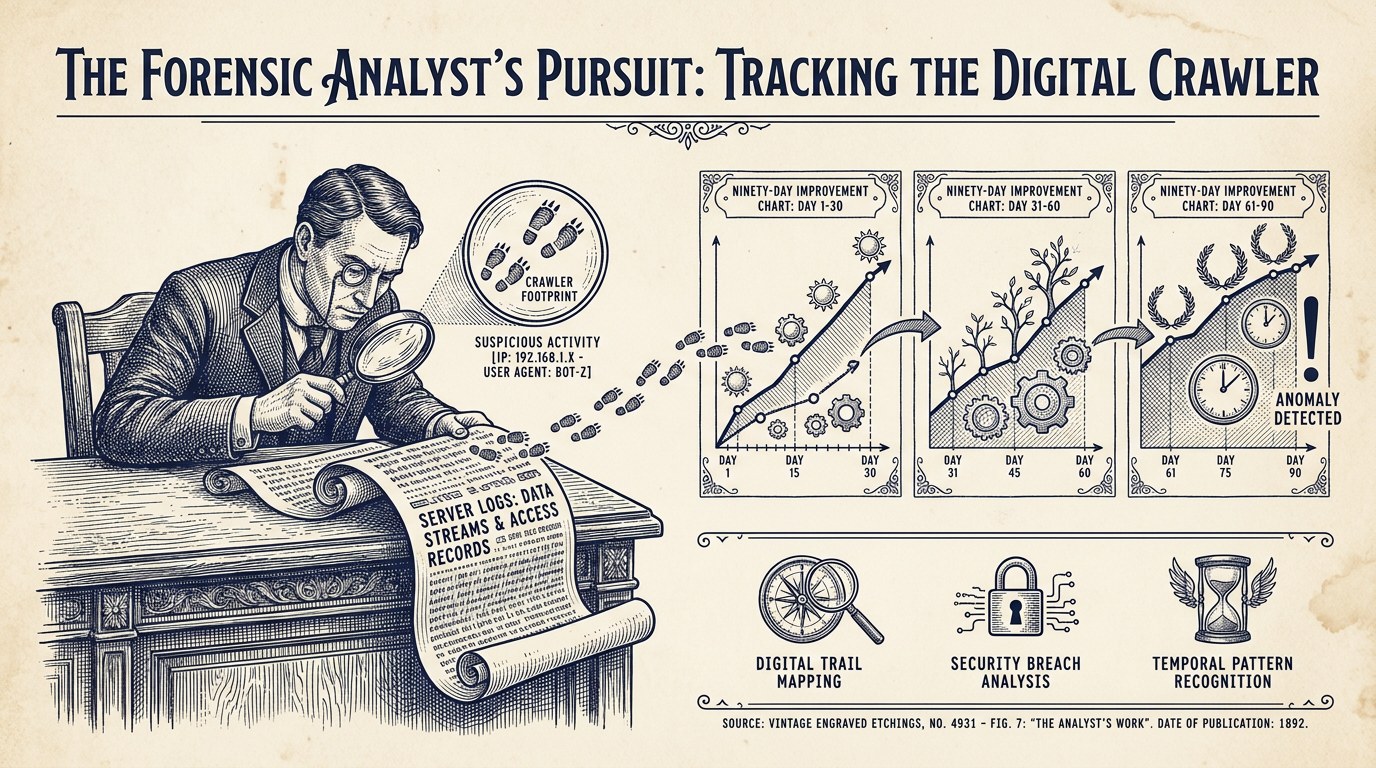
The operational cycle runs 30/60/90. Days 1 to 30: extract and analyze 28 to 30 days of production logs, complete the triage, and ship the Bucket 1 fixes. Days 31 to 60: ship Bucket 2 fixes that are achievable in the sprint cycle, and re-extract a fresh 28-day log window to begin measuring whether the Bucket 1 fixes took effect. Days 61 to 90: complete the Bucket 2 fixes, ship Bucket 3 fixes as bandwidth allows, and conduct the 60-day post-fix log analysis to validate that Bucket 1 fixes produced the expected crawl pattern changes.
The cycle then repeats. The 90-day cadence aligns with the quarterly reporting cycle most B2B SaaS programs run and matches the broader content marketing measurement framework for B2B SaaS programs that operates on the same compounding-metrics rhythm. Programs that run log analysis at higher frequency than 90 days produce noise; programs that run lower frequency than 90 days miss the compounding signal.
Closing the loop with the broader technical SEO program
Log file analysis findings rarely operate in isolation. The fixes that emerge from log analysis (crawl waste cleanup, redirect updates, robots.txt changes, sitemap updates) close loops in the broader B2B SaaS technical SEO program. Crawl waste cleanup pairs with crawl budget optimization. Redirect updates pair with the broader migration and IA work. Sitemap updates pair with content production and refresh cadence. AI crawler coverage findings pair with the AEO program and the AI Search measurement infrastructure.
The closing-the-loop discipline is what separates log analysis from a technical SEO checkbox exercise. Programs that run log analysis as a standalone discipline produce reports that do not connect to broader program goals. Programs that integrate log findings into the quarterly technical SEO review and the AEO measurement scorecard produce compounding improvement over 6 to 18 months.
08Common failures and the false-positive trap
Three failure modes account for most underperforming B2B SaaS log analysis programs. The first is recent and tied to the AI crawler measurement gap. The second is structural and produces fix lists that engineering cannot or will not ship. The third is the false-positive trap, where log findings look serious but are actually expected behavior. Each failure has a corresponding fix that is operationally simple but disciplinarily difficult.
Failure 1: trusting user-agent strings without reverse DNS verification
The most common failure pattern in 2025 and 2026 is trusting user-agent strings without reverse DNS verification. Programs that run log analysis report Googlebot and AI crawler activity that includes 15 to 35 percent impersonator traffic. The downstream reports overstate bot coverage, misattribute crawl waste patterns, and produce false confidence about AI crawler reach. The fix is operationally simple (add reverse DNS verification to the parsing pipeline) but requires engineering or technical SEO discipline to implement correctly the first time and to maintain as bot operators update their IP ranges and DNS patterns.
Failure 2: treating staging crawl leakage as a one-time fix
The second-most-common failure is treating staging environment crawl leakage as a one-time fix rather than an ongoing operational discipline. Programs identify the leakage pattern in the first log analysis cycle, ship the fix (typically a robots.txt update or X-Robots-Tag header), and assume the pattern is resolved. Over the following 6 to 12 months, new preview environments are spun up for new branches, customer success teams share preview links in support tickets, and the pattern resurfaces. The fix is treating staging crawl prevention as a platform-level configuration that applies automatically to every new preview environment, plus quarterly verification through log analysis that no new leakage has appeared.
Failure 3: missing the AI crawler measurement layer
The third failure is more recent (post-2024) and quieter than the first two. Programs run log analysis successfully against traditional SEO metrics (Googlebot coverage, status code distribution, crawl waste cleanup) but never segment AI crawler traffic separately. The AI crawler activity generates AI Search citation infrastructure value that is invisible to the program because the segmentation step does not include the AI crawler buckets. Programs at $10M+ ARR running AI Search measurement programs (Profound, Quattr, AthenaHQ, Otterly) need the AI crawler log layer to diagnose why specific queries do not cite the brand. The fix is adding AI crawler segmentation to the log analysis pipeline, with reverse DNS verification per bot type, and integrating the AI crawler findings into the quarterly technical SEO and AEO measurement scorecards.
09FAQ
Seven questions covering the topics most commonly searched on log file analysis for B2B SaaS programs, each with a self-contained answer designed for direct citation extraction by ChatGPT, Perplexity, and Google AI Overviews.
What is log file analysis for B2B SaaS SEO?
Log file analysis for B2B SaaS SEO is the systematic discipline of extracting server access logs from production hosting infrastructure, parsing the logs into structured fields, segmenting traffic by bot identity and URL template, and interpreting patterns to identify crawl waste, indexing coverage gaps, and AI crawler behavior. The output drives technical SEO decisions about which pages to deprioritize, redirect, noindex, or surface more prominently. The discipline differs from crawl emulation (Screaming Frog, Sitebulb) because logs record actual bot behavior over time rather than simulated crawls of site structure.
How is log file analysis different from a regular SEO crawl?
A regular SEO crawl (Screaming Frog Spider, Sitebulb, JetOctopus) starts from a seed URL or sitemap and simulates how a bot would crawl the site by following internal links. It produces inventory of crawlable pages, status codes, and on-page signals. Log file analysis extracts actual server logs and analyzes what bots really did over a 30-day or longer window. The crawl tells you what could be crawled; the log tells you what was crawled. Both are useful, and they answer different questions. Programs running only crawls miss 40 to 70 percent of the crawl waste their architecture produces in production.
Do I need log file analysis if my site is under 1,000 pages?
For B2B SaaS sites under 1,000 pages with no multi-tenant subdomains, no staging environment leakage, and standard CMS-based architecture, log file analysis produces marginal additional signal over crawl emulator analysis. The threshold where log analysis becomes high-value: B2B SaaS sites over 5,000 pages, sites with customer-facing subdomains, sites running on platforms that auto-create preview URLs (Vercel, Netlify), or sites that need to measure AI crawler coverage. Below those thresholds, the analysis is worth running quarterly but does not require a dedicated tool investment.
Which AI crawlers should I track in log files for B2B SaaS SEO?
Track seven primary AI crawlers in B2B SaaS log analysis: GPTBot (OpenAI's training crawler), OAI-SearchBot (OpenAI's search crawler launched late 2024), ChatGPT-User (on-demand crawler triggered by user queries in ChatGPT), ClaudeBot (Anthropic's training crawler), PerplexityBot (Perplexity's training and retrieval crawler), Google-Extended (Google's AI-specific crawler), and Bytespider (ByteDance's crawler). Smaller bots worth tracking when budget allows: Amazonbot, Applebot-Extended, Diffbot, and CCBot (Common Crawl). Each has a distinct user agent string and a verifiable DNS pattern.
How often should B2B SaaS programs run log file analysis?
The optimal cadence for B2B SaaS log file analysis is quarterly with a 28 to 30 day analysis window per cycle. The 90-day rhythm matches the operational cycle of identifying findings, triaging by impact and effort, shipping fixes, and re-monitoring to validate the fixes took effect. Programs running log analysis at higher frequency (monthly or weekly) produce noise that does not align with the compounding cadence of technical SEO improvements. Programs running at lower frequency (semi-annually) miss patterns that compound between cycles and accumulate crawl waste at scale.
What tools do you recommend for log file analysis?
Tool recommendation depends on B2B SaaS program scale. For programs under 100,000 daily log lines and under $20M ARR: Screaming Frog Log File Analyser at $239 per year. For programs over 500,000 daily log lines or over $50M ARR with complex architecture: Botify or OnCrawl at $2,000 to $10,000 per month. For programs over $100M ARR that already operate observability infrastructure for product engineering: custom pipelines built on Splunk, the Elastic Stack, or BigQuery. The selection criterion is log volume and existing engineering capacity rather than feature preferences in isolation.
Can log file analysis improve AI Search citation share?
Yes, indirectly. Log file analysis surfaces gaps in AI crawler coverage of priority content. When GPTBot, ClaudeBot, or PerplexityBot has not crawled the comparison pages, pricing page, or customer logos page in 30 days, the corresponding AI Search responses cannot cite that content reliably. Fixing the coverage gaps (through improved internal linking, sitemap submission, robots.txt cleanup) is a foundational input to AI Search citation improvement. The relationship is necessary but not sufficient: crawler coverage enables citation pickup but does not guarantee it; other factors include content quality, schema markup, brand mention frequency, and external authority signals.
Part of the technical SEO playbook
This is the log file analysis operator playbook under technical SEO.
The strategic framework covering technical SEO as a discipline, the categories of work, and how each connects to the broader B2B SaaS SEO program lives on the parent sub-pillar.